
In recent years the work of Gustavo Zalamea (1951) has over and over again returned to the same elements: again returned to the same elements: the construction of images based on the appropriation of plastic, literary, and political icons; collage as a discursive and plastic strategy; and reflection on contemporaneity through the exploration of the meaning of monuments and public spaces. This exhibition at the Museum of Modern Art in Bogota during the months of September and October presented a series of large format polyptychs almost all from 1998 and 1999, along with a few works from earlier years. In this group, Zalamea proposed a series of canvases that once again used the image of the main square of Bogota and the surrounding buildings as the axis of his construction of pictorial space and the basis for his personal exploration of political and artistic phenomena.
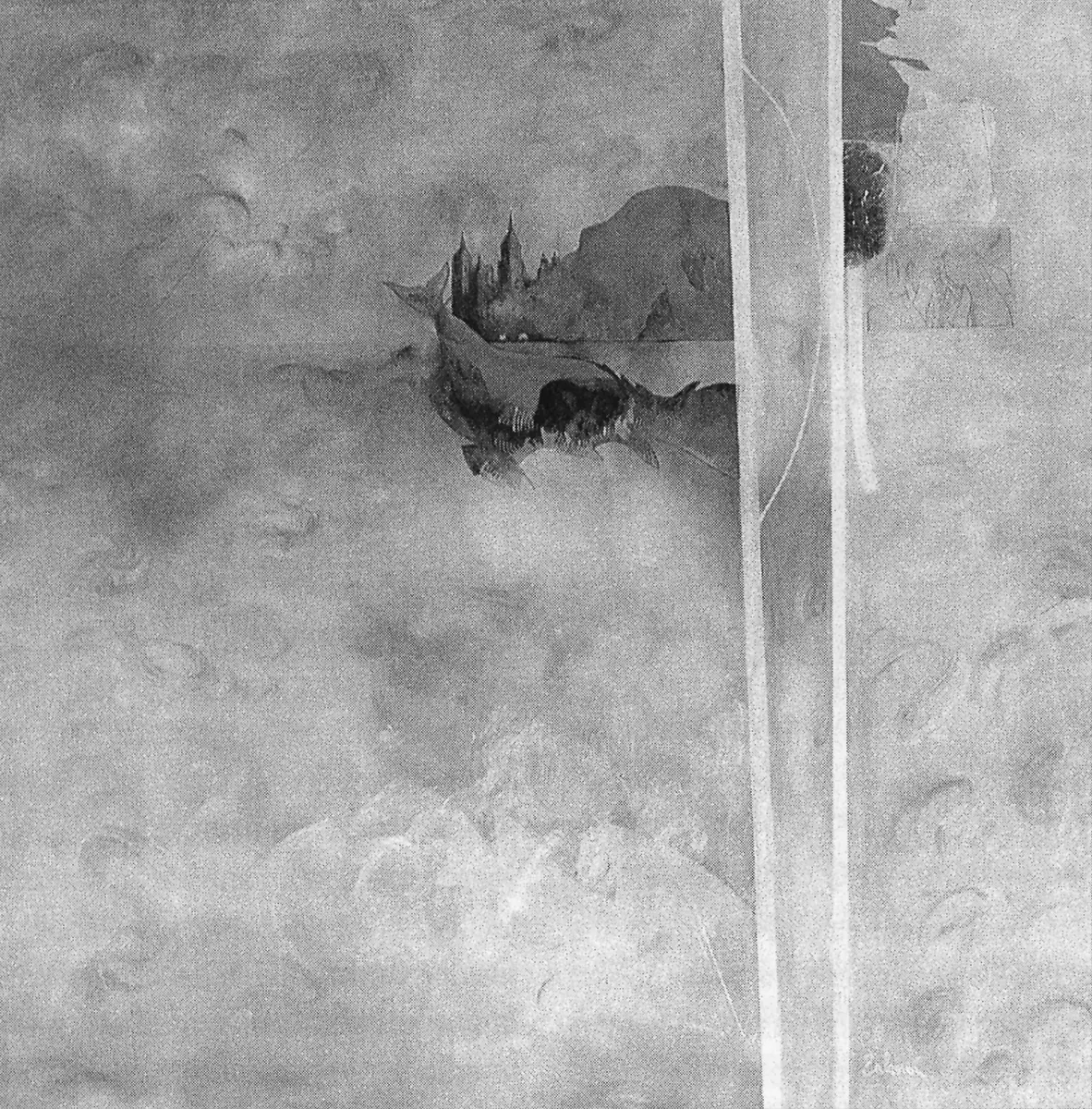
Zalamea appropriated the icon of the National Capitol, Gericault's The Raft of the Medusa, and Moby Dick, from Melville’s novel to structure—along with the flooding of the Bolivar Square and a series of nudes explicitly inspired by Matisse—a pictorial series that seemed to oscillate between the epic and the lyrical. On the one hand, there was the narrative structure to each of the fragments making up his works. The political and historical connotations that the shipwreck of the National Capitol evokes in the mind of the spectator, along with the adventure of The Raft and the whale which so obsessed Captain Ahab, form a visual pole in which the clash between the figures and the powerful force of nature provides the main plastic object. There are in each of these fragments’ grandiose events in which no less grandiose figures participate. At the opposite extreme, we find a series of female bodies which impose their presence through a rapid, synthetic kind of drawing and color which in most cases is the expressive gesture of a subjectivity obsessed with purely pictorial elements. The immobile body, detached from space, imposing itself autonomously in the picture, encompasses, in each of Zalamea's obsessive polyptychs, what he himself has called "the aesthetic frame", "the ever subjective and personal search for beauty. “To these ideas, we must add the unfinished appearance that seemed to characterize all the works on view. Each painting looked as if it had been abandoned halfway through, just when it was beginning to form itself before the gaze of its creator. This "sketchy" character calls attention to the creative process, the process that precedes the formation of the image. In this sense, the canvas which the spectator sees does nothing other than emphasize a sort of suspension of the image in a moment in which it has not yet come together into a complete whole; a moment in which the pleasure of creation has not yet reached the point of satisfaction. "Work in process" is another of the themes on which Zalamea reflects.
All the works which the artist presented to the Bogota public were structured around the idea of collage, in which fragments of various textual origins co-habit within a space the semantic "unity" of which springs in principle from the intentions of the artist. Although Zalamea has not literally cut out
each of his fragments but has depicted them, the arbitrary coming together of these elements within the pictorial space is fundamentally determined by a conceptual relationship, the meaning of which results from Zalamea's concerns. "With the sea", he says, "the square is invaded with concepts of infinity and excess associated with the idea of origins, something that is archaic, impenetrable, and uncontrollable. Literature is also present (Melville and Conrad), as are politics (Congress, the Titanic), painting (The Raft of the Medusa), poetry (the shipwreck), and myth (cyclical narrative)."
In this way, collage becomes a discursive strategy that allows the artist to reflect on the meaning of monuments and public spaces, without lapsing into any systematic and methodologically coherent analysis which are the domains of other cultural spheres, such as the social sciences. Zalamea's work, which takes up the surrealist and even Dadaist tradition (already present in Bogota Project, from 1994), refuses to observe the discipline of a more reasonable kind of thinking. It instead openly opts for visual metaphors and the proposal of unusual kinds of relationships concerning the public sphere and the collective meaning of spaces which, like the Bolivar Square, synthesize and bring together all the threads of identity in a society absolutely besieged by violence. The excess of the encounter between the icons in his pictures is in fact not only an ironic gaze at politics and the contemporary history of Colombia but a close scrutiny of the meaning collectively given to these kinds of spaces symbolically seen as the center of a country and its nationality.
WILLIAM LÓPEZ