
When you live in a country whose war leaves more fatalities than many other contemporary military conflicts, it seems logical that this complex reality is presented in the work of numerous Colombian artists. The ways they approach the theme are diverse: some center their investigation on the political, on memory, on eroticism, or on daily violence, opting to structure their work on this reality in an explicit fashion, while others use more allegorical resources. Violence is thus encountered with an experiential plurality that allows an approach from different levels of meaning, diversifying the focuses and interweaving the sphere of the personal and the collective.
With her paintings and drawings, Johanna Calle (Bogota, 1965) enters the group of artists who approach Colombia's complex society in a sharp and subtle way. The '90s began for the artist with a manifest interest in exploring surfaces, using for this aim a wide range of materials and supports, like plastics and canvases that she partially stuck onto the stretcher, painting them on both sides with different pigments in order to see the effect of front and back, as well as the behavior of the material. They are surfaces that work like an opening and a filter at the same time, where there are no references to concrete situations, but only to objects that stem from partial memories as if trying to reconstruct them from the dream sphere. The insects and other dissected bugs that can be discerned reinforce the ambivalence of the use of the materials. But what these paintings announce is the progressive importance that drawing will acquire in her work and her interest in undefined situations that are about to happen, and whose final result we can only intuit. The experiment with the materials and with the suspense of the images continues to be investigated during her stay in London.1
Upon her return to Bogota, the theme becomes a game of reflection. Setting out from existing objects, the notion of play is tackled from diverse perspectives: this can be seen as a learning resource—for example, the doll—but also as a definition of roles. Small dolls are manipulated, disarmed, rearmed, but the pieces do not fit, they are fragments that are worked on the canvas from that perspective. The images are the result of objects previously operated on by the artist, in a process preceding the creation of the work. We thus notice a doll that has been opened, cut, and put back together in an order that is not the one we are accustomed to seeing. In this way, the inoffensive toy becomes a new, threatening, and aggressive reality that symbolically represents what is lived in the dailiness of the environment. The rules of the game are not always clear, and she frequently changes them as she goes along. She uses this subversion of rules in the manipulation and re-elaboration of the objects, in the creation of real or invented mechanisms, and it also appears in the use of the materials. Breaking the traditional order (first, charcoal for drawing, then, oil for painting), Calle inverts convention and draws with charcoal on oil; it becomes more and more important that the lines of the drawing have a relevant role. In works like Delatores (Accusers, 1996), the toys are placed in everyday situations, but without losing ambiguity. If the open, manipulated doll becomes threatening, no less threatening is the image above it, taken from a harmless cookbook of traditional cuisine where instructions are given on how to stuff a chicken. In seeking different possibilities for one single image, the apparently harmless becomes frightening.
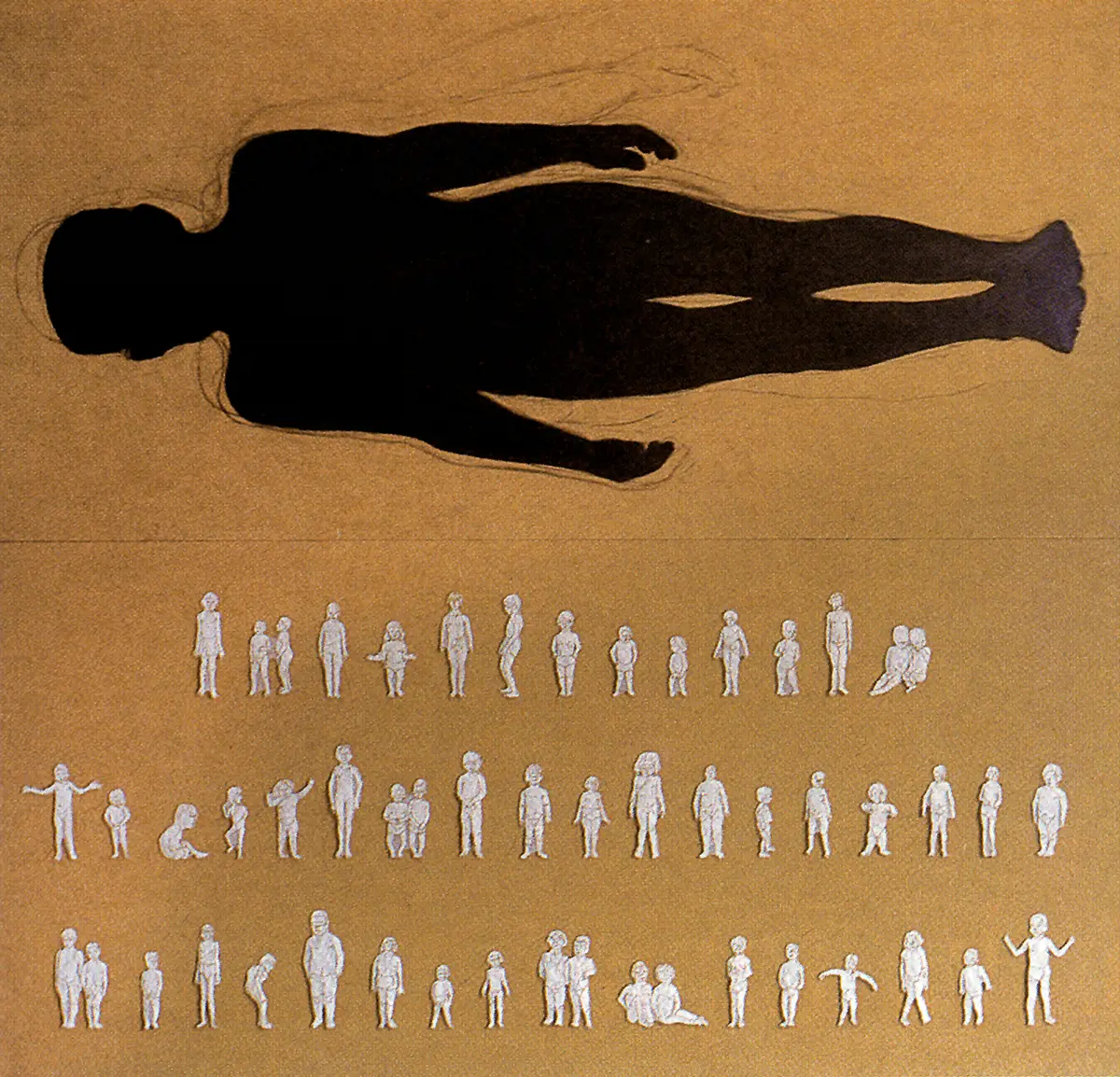
Her inquiry into play led her directly to the figure of the child, for similar to what happens in games, the rules for children are also unclear. She began working with children with congenital malformations, appropriating images from books and magazines. She did not record problems that were too evident, but rather those that can be intuited beneath an appearance of normality. Genetic rules, like those of play, are not always predictable. Única instancia (Sole example, 1996),2 is a work that is representative of that search and of the new investigative experiences that the artist assumed using other technical resources. She patiently began to sew with thread on waxed paper the cutout figures, resolutely doing her utmost to create works that stem from real facts: first the genetic deformations, and then referring directly to the national reality.
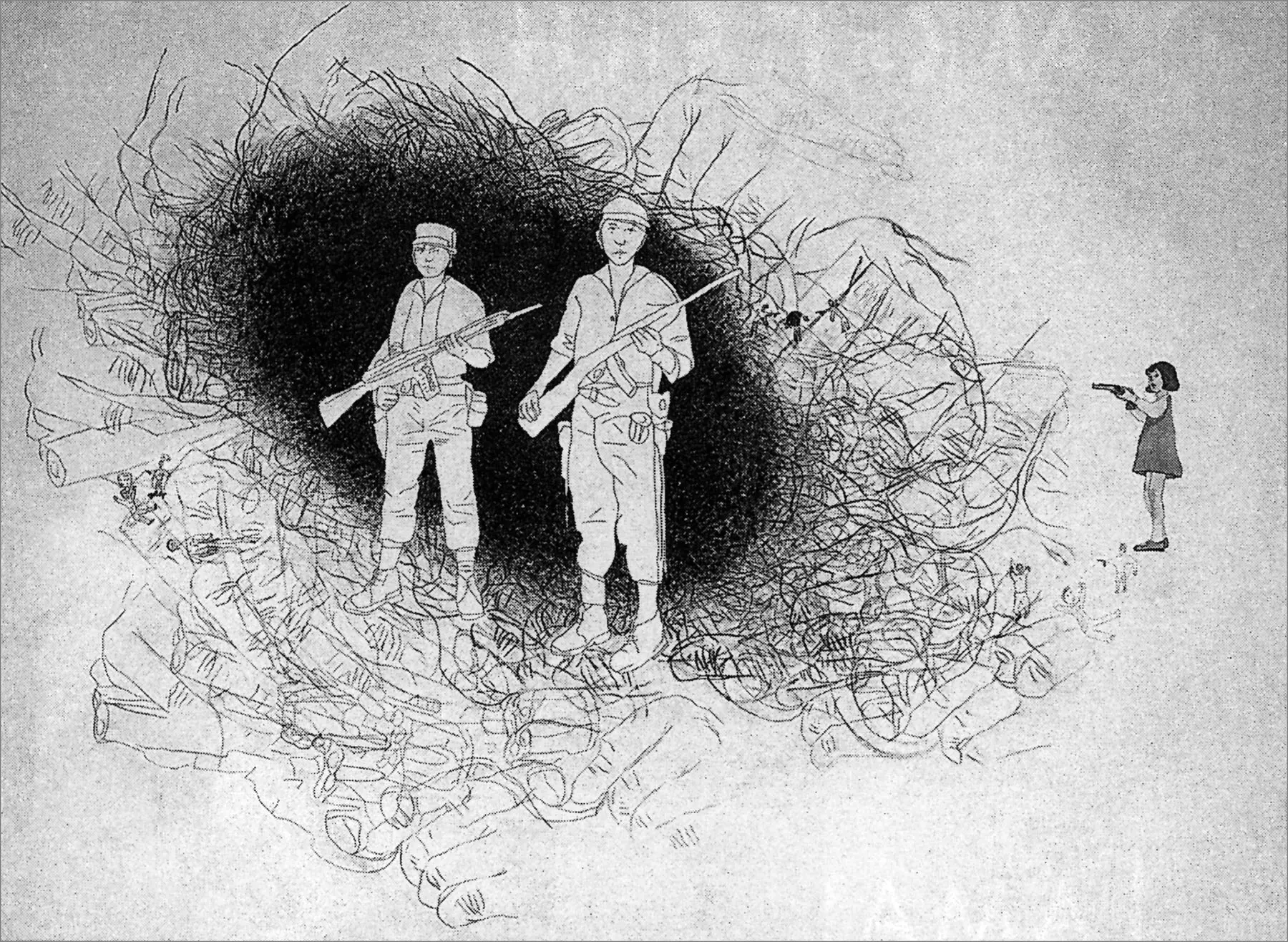
In Territorios indelebles (Indelible territories, 1997) she continues to embroider on paper or canvas, involving painting and drawing as well. There she works on an event that appeared in the press, the assassination of a civil servant and two girls leaning over the coffin, looking with simple curiosity at a fact that has become commonplace for them. The children become defenseless victims of a conflict that involves them, and it would seem that the familiarity with violence ends up anesthetizing the possibility of being moved. In Juegos de infancia (Childhood Games, 1998), she turns to the images of children recruited by the guerrillas, placing them in a situation in which playing is no longer a drill. In this line of exploration, she worked on Las chicas de acero (The girls of steel, 1998). Following a report that appeared in the newspaper once again gives occasion to propose a peculiar form of alluding to events, at the same time as she explores the possibilities of drawing.
As Calle explains: "At the beginning of 1998, the National Army's 14th Brigade from Puerto Berrío initiated the civic program of the Girls of Steel. This name was adapted from a national television series, 'The Men of honor' in which professional actors re-create the adventures of soldiers. In 1997, the serial was followed by the publication of the comic strip 'The Men of Steel' in the Sunday supplement of the newspaper El Tiempo. Unlike the characters of the TV adventures or the comics, the girls were not actresses or fictional characters. The young women selected, hailing from Segovia, a mining town in the northwest of Antioquia, had to work in health and recreation. The 15 that were chosen (among them l0 were minors) had to wear a military uniform, in spite of never having undergone military training or being professionally tied to the military organization. The ELN accused them of espionage and covert operations and kidnapped them for 20 days.3 Based on these facts and the photographs that appeared in the press, Calle created a" work that bears the portrait of each of the 15 girls. The way she made the drawing emphasizes the vulnerability of these young women exposed before two enemy fronts. The portraits were created by perforating the wooden surface and using a medium that refers to the drawing, but goes beyond the conventional forms in order to experiment. These orifices are like wounds on the surface; they define the features of each of them by alluding through this resource to the absence and indecision of the girls. The work goes beyond this concrete event and becomes a reflection of the vulnerability to which many other people are subjected."
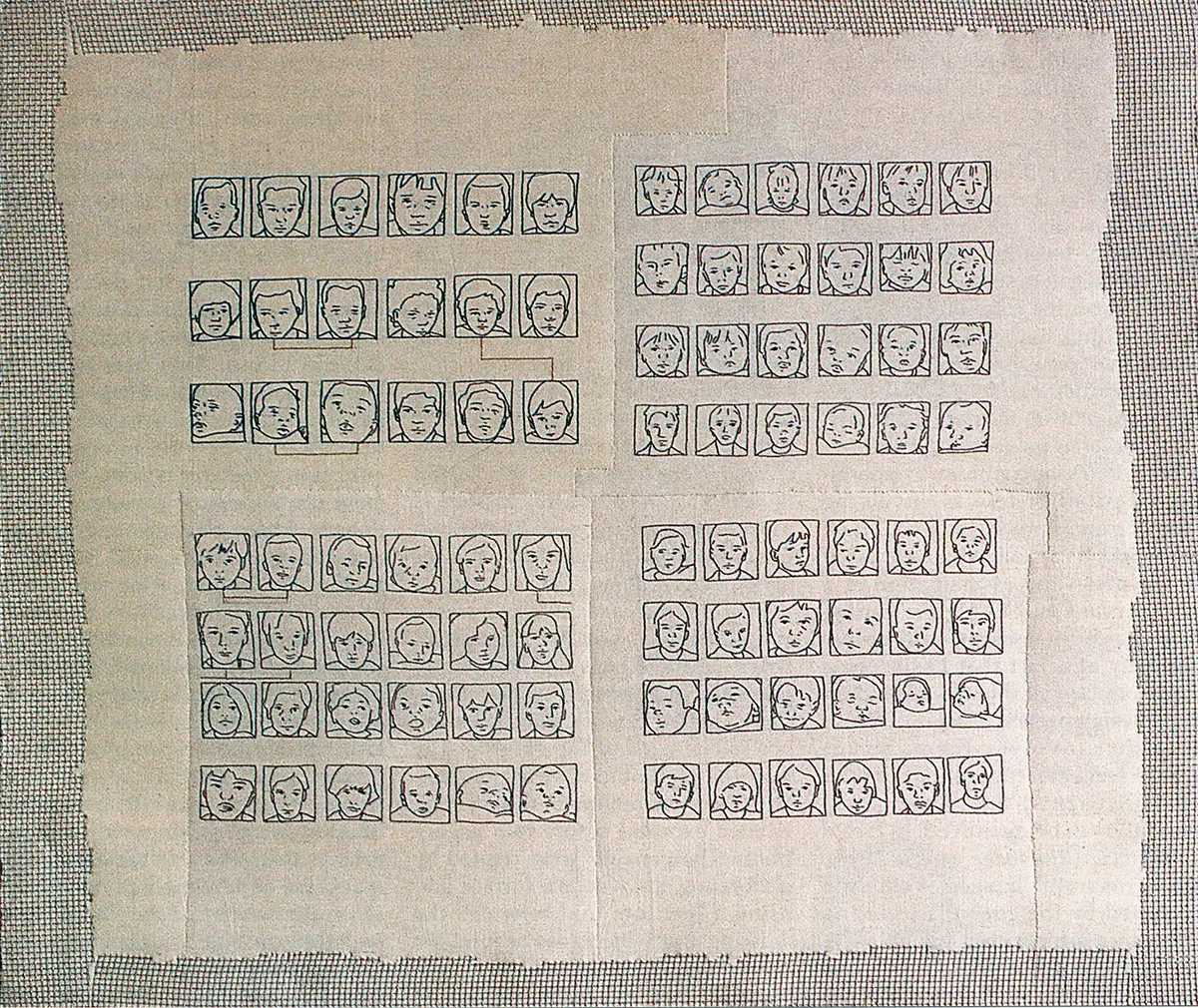
Her two most recent pieces, Nombre propio (Own name, 1997-1999) and Historias simultáneas (Simultaneous histories, 1999), continue to inquire into the ambiguities of adult/child relations. The first project began when, throughout 1997, she followed the list of abandoned children that, under the title "The children are looking for their home," was published in the daily newspapers El Tiempo and El Espectador. Each of the lists included between 18 and 24 photographs of children under the care of Bienestar Familiar (Family well-being), an organization that, among other things, takes charge of protecting minors. In order that adoption procedures may begin, a judge must declare the children "abandoned." Those children are generally not orphans, and the publication eventually seeks to locate the parents or some relative who can take responsibility. The procedure winds up being routine and the possibilities of returning to the family circle are remote. The images that Johanna Calle draws follow the features of the published photographs with great fidelity. And the resource is once again the use of embroidery, a painstaking and wasteful process that distances itself from the quick line of the drawing, opting instead for an alternative that she plans to construct little by little, with small stitches. Calle "states that she sought an uninterrupted line, and the line of thread does not only operate on the surface, but it also perforates again and again, leaving an indelible trace. The act of embroidering the portrait of each one of the abandoned children allows me to make a detailed examination of their facial features, which even leads me, in some cases, to memorize not only their characteristics but also their names. This implies that, for me, they cease to be a statistic and become concrete cases."4 So concrete, that the artist dedicated two years almost exclusively to this work.
It turns out that the handling of time is vital in the life of these children who spend a long time waiting to be adopted. As time goes by and they begin to grow, they have fewer possibilities of finding adoptive parents. "That wait is a time that seems infinite but has the pressing goal of 18 years when the adolescent becomes an adult and will once again be left to fend for himself or herself."5
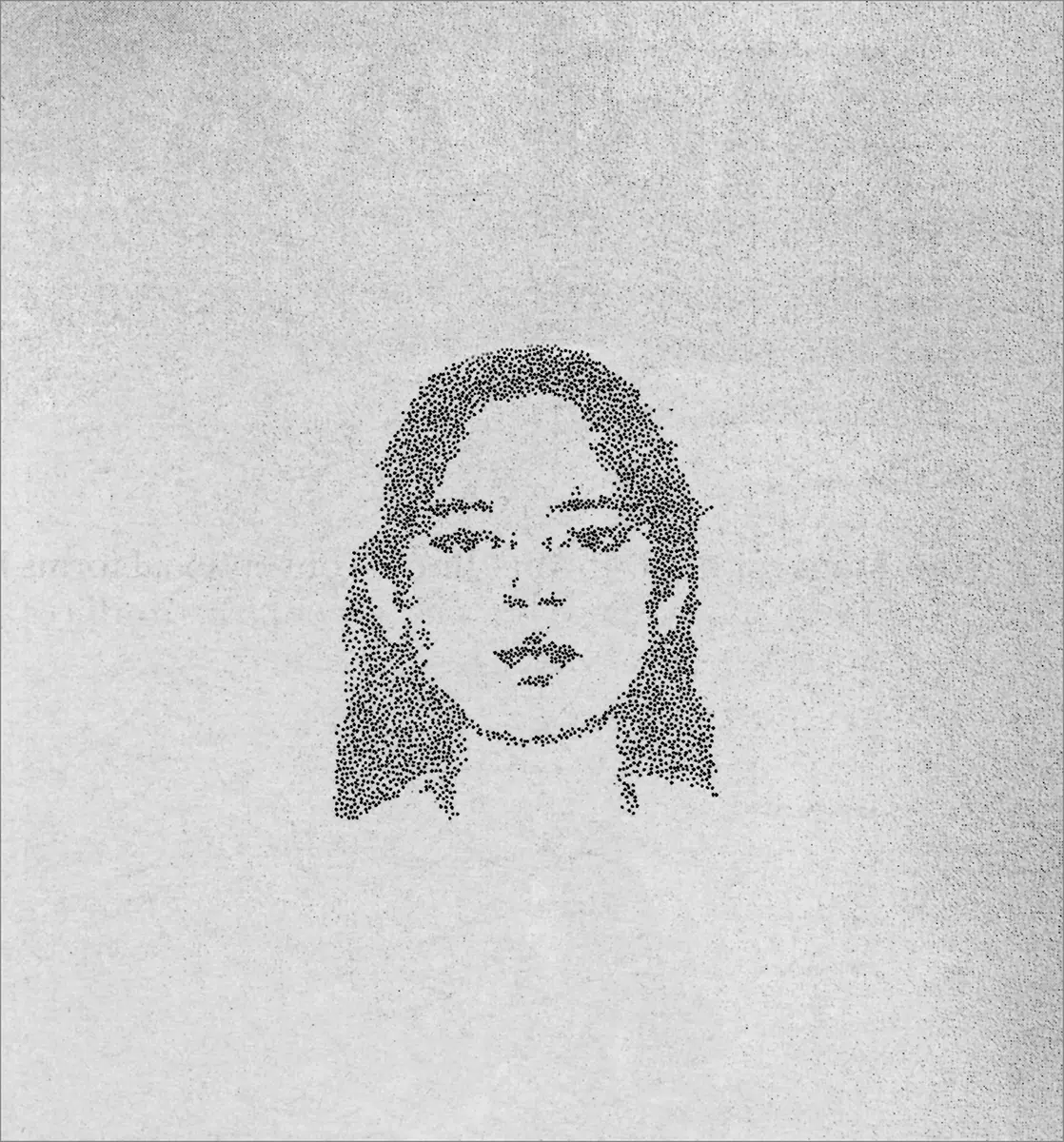
Calle works on a crude canvas, integrated into a support of felt and wire, mixing the materials in such a way that what stands out is a technical austerity that is moving, without any need for stridency. The thin thread that subtly skirts the surface makes us reflect on the confinement to which these children are subjected, and to the fragility that hinders them from crossing the weak barrier interposed by the thin wire. But in addition, the quality of the thread drawing demonstrates that we are not standing before a serial image, lost in the anonymity of a sequence of children's faces. Each case is particular and carries behind it a personal dramatic history. They are not hypothetical situations, but rather real, and the volume of the cases brings us face-to-face with the true importance of the problem.
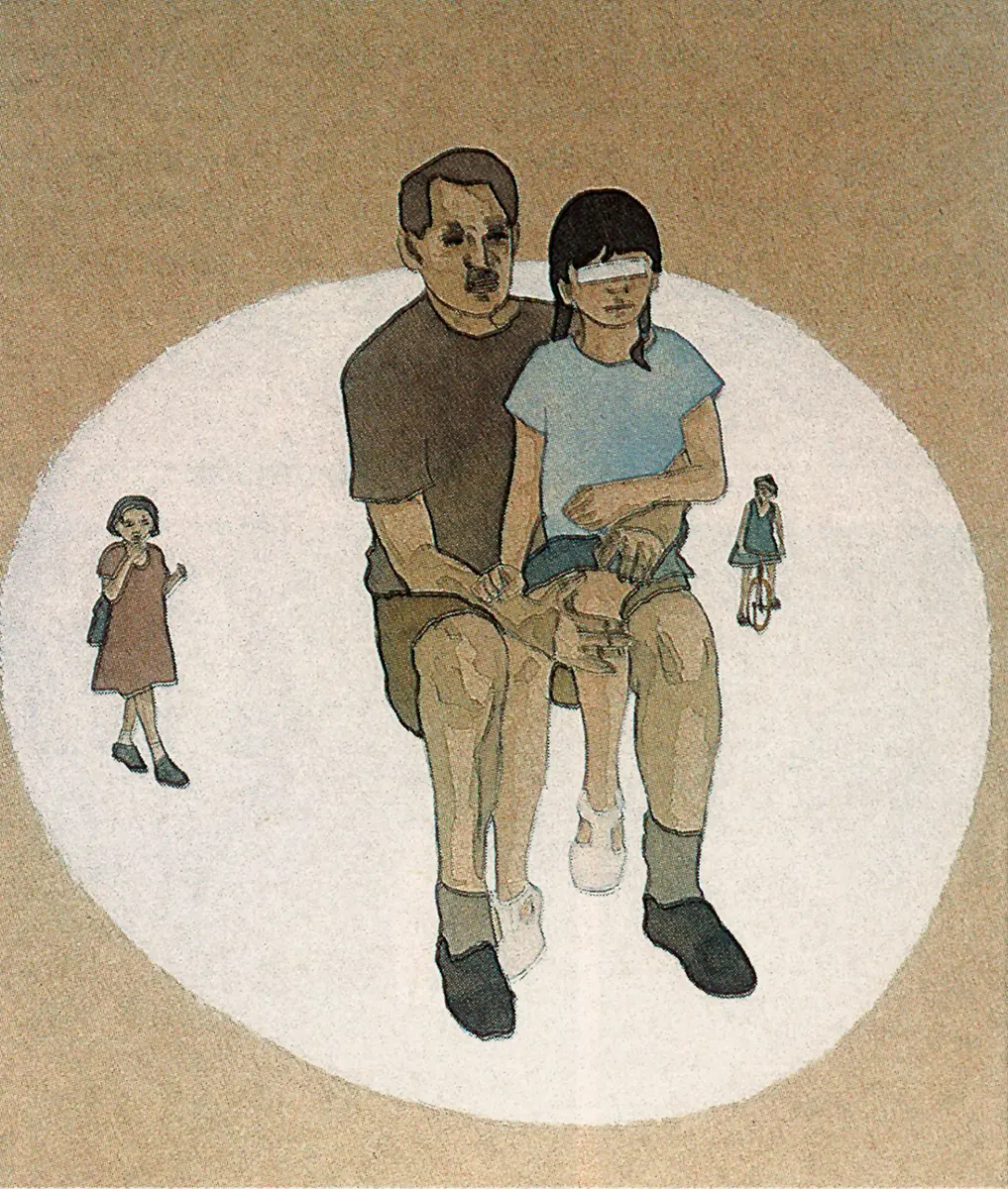
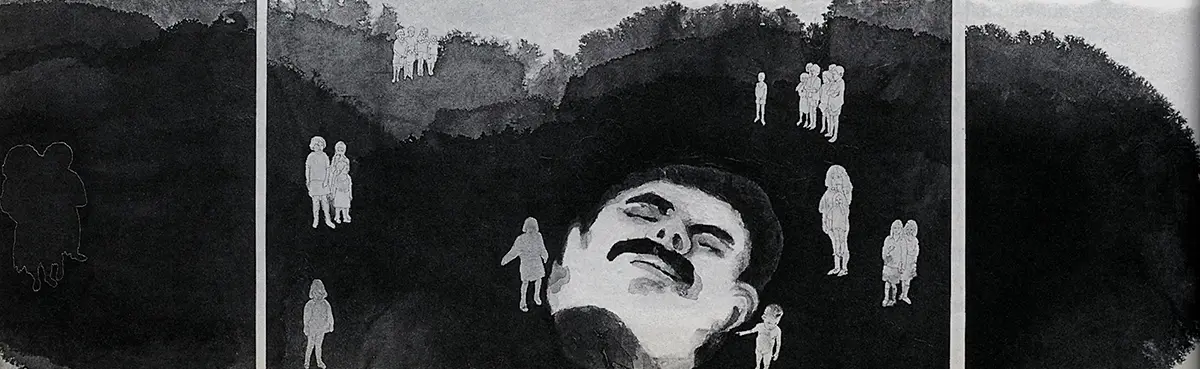
In Historias simultáneas, she continues to work on images provided by newspapers, and she also collects testimonies. Different moments of urban and rural childhood are identified throughout the 26 pieces that begin with reality, but which, when altered, give us another representation of the adult/ child relationship. The ambiguity in the suggested play once again gains space, and the apparently normal and commonplace situations allow us to see complex and disturbing images that refer to problems as concrete as abuse, mistreatment, or abandonment.
Calle declares that "danger lurks in the situations that I set forth. A family portrait, for example, becomes a concealed denunciation."6 The work seeks to outline a panorama based on particular cases, showing in those fragmented histories the reality in force.
And it is that Johanna Calle has the ability to use play and ambiguity in order to create images that allegorically bring us face-to-face with the complex social situation that the country is living.
NOTES
2. A work that received mention at the VI Salón de
Arte Joven, 1996.
3. Author's interview with the artist (Bogota, November
1999).
4. ibid.
5. ibid.
6. ibid.
* All photos in this article were taken by Juan Fernando Herrán.