
The Uruguayan artist José Gurvich (1927-1974) left an important legacy made up of works created in his "Torres-Garcian" phase and other pieces realized during his most idiosyncratic phase, which began in the mid-sixties and lasted until his death. The twenty-fifth anniversary of his death in 1999 inspired a series of activities and exhibitions in Montevideo and Buenos Aires and initiated a calendar of international shows for 2000. Watercolors, témperas, oils, ceramics, sculptures, reliefs, and murals document his production that was tragically interrupted when he was only 47 years old.1
Gurvich, born Zusmanas Gurvicius into a Jewish home with few resources in Lithuania, immigrated to Uruguay in 1932. Having settled with his family in the southern neighborhood (Barrio Sur) of the capital, Montevideo, one of the places where immigrants of Jewish origin concentrated, he lived his childhood and adolescence in humble conditions. In 1942, he began to study painting at the National School of Fine Arts under the direction of the Uruguayan painter José Cúneo. After 1944 he became acquainted with the master Joaquín Torres-García (1874-1949), definitively incorporating himself into his Studio (Taller Torres-García) in 1945. Since then, and until the official closing of Taller Torres-García (Torres-García's Workshop [1963]), Gurvich would participate in all of Torres-García's activities, which included publications, local and international shows, the creation of murals, and teaching. He was one of the master's favorite students and a great exponent of the Southern School. In his "Torres-García" period, Gurvich created art by following the language formed by Joaquín Torres-García, who united universalism, Americanism, and constructivism, though always imposing his own stamp upon them. During the fifties, manifold experiences began to orient Gurvich toward a more personal expressivity, which would start to evolve in the sixties.
Among the experiences that led him toward the transformations, we could cite his trips to Europe and his three stays in Israel (from 1954 to 1969), and especially his three lengthy sojourns on the Kibbutz Ramoth Menasche, where he worked as a shepherd and painted. Based on his discovery of other iconographic sources during his trips to Europe and his stays in Israel, and upon his return to Jewish sources—to which would be added his interest in rural life, esoteric readings, his love for the essence of the organic, his attraction to the spiral of life and the vital flow—Gurvich delved into his inner imagination and devoted himself with lyrical curiosity to the hidden rules of his spirit in order to raid forms of communication proper. The change is already clear in his works from 1965, is accentuated in 1966, and continues until his death. Gurvich unfolded a world in which great importance was given to the assimilation of a "Torres-Garcian" inheritance, the progressive search for his Jewish identity, his admiration for the art of Bosch, Chagall, Brueghel, Miró, Klee, El Greco, Goya, Tàpies, Vasarely, Cúneo, Solari (as well as for other masters of Uruguayan art and art history), and the development of his personal artistic potential.
The Montevidean period between 1966 and 1969 is particularly noteworthy. This is when Gurvich developed his most idiosyncratic language. In his creative world, the imaginative force, the absurd, freedom, and fantasy all increased.
A metamorphosed reality and a fluctuating world are shaped with lyricism in the works created since the mid-sixties. Gurvich began to create a pictorial world in which a dynamic composition, a configuration of a world in perpetual becoming, the evasion of the habitual coordinates of time and space, and the osmosis between the real and the fantastic all prevailed. He temporalized space, he overcame gravity, and he granted immanent mobility to fluctuating beings that are inscribed in the vital flow that seems to overflow from his canvases. In various pieces, Gurvich searched for the essence of the organic in oval shapes that spin in a centripetal vortex, he generated interesting optical effects, he created compositions based on the juxtaposition of scenes and characters, and he generated astral fantasies. Vertigos, whirlpools, vortices, oneiric veins, centripetal dynamism, a world of forms in perpetual motion, intense chromatism, or severe monochrome, reveal in those series the best of the painter.
Gurvich had a telluric worldview connected to his childhood in Yestmev, the Lithuanian village where he was born and from where his family hails. It is also the semi-rural framework of his house studio on Polonia Street in Cerro. In turn, the rural world is an ineludible reference linked to his experiences as a shepherd on the Kibbutz Ramot Menasche during his stays in Israel. But there is also something more global and symbolic, an exaltation of the organic, of nature, and of life. This is why, time and again, he used images like the egg, which in addition to appearing in the works of Bosch and Brueghel, has a long tradition as a universal emblem of immortality and the origin of life. He thus turned to the spiral, either as a sign or as a global composite form. A fundamental theme of symbolic art of the ages, the spiral alludes to cosmic dynamism and the creative and changing forces of nature. There is also a song to Universal and Cosmic Man, to the couple, to the family, and to love. Hence the references to Adam and Eve, the essential couple.
However, Gurvich did not lose contact with constructive universalism, and he maintained connections between the organic, the spiritual, and the intellectual, the idea that beauty is not an autonomous value, the mystical vision of the painter, the conception of art as non-imitative creation, and the relevance of harmony. Nor did he fully distance himself from his symbolism, and this is why we see the appearance and reappearance in his iconography developed since the mid-sixties of spirals, stairways, clocks, the primordial couple, the cosmic, dynamic forces, and astral constellations.
An imaginative and porous personality
Unlike many "Torres-Garcians" more closely attached to the universal- ist-constructive orthodoxy, Gurvich opened himself up to change. Indeed, he had a particularly porous personality, and he absorbed novels at the same time as he emphatically sought out other sources of renovation, a fact attested to by his writings, the evocation of his closest students and colleagues, and the memory of his relatives and friends.2
Since 1957, we have documents written by the painter that make up a series of notebooks, although his notes and reflections in no way attempt to achieve a doctrinaire definition or establish precepts for any single school (in this sense he is clearly different from his master, Torres-García). They are essentially useful for testing the receptive character of the transformations, and they serve to transmit their sensibility and feelings.
We discover in them the fact that the imagination played an ever-greater role in the artist, inviting him into vertigo and experimentation. Gurvich confesses that he experienced moments in which he felt dragged, he wished to go through the doors, and he felt that his imagination was exploding and that, throbbing within him, lay wild abandon. At those moments he says that he felt that he could see the absurd and verify the strange. He underscores that he did not wish to give too much importance to reason and logic. He explains that he was seeking a way to link geometry and imagination in order that they may sing a new song, that they may give real life to the illusory that seemed to slip through his fingers. He also refers to the need to guess unknown mysteries and to express the incomprehensible that is only seen by the soul,3 and he also shows his enchantment with cosmic reality4.
The interior was a key theme for Gurvich, who proposed a tour through himself in search of inner pulses. La sutil vibration del alma (The subtle vibration of the soul) summoned it. "Intuition" is a recurring word in his prose. Gurvich believed that the concept limits, while intuition draws man nearer to the infinite. For him, intuition imagines, it is unlimited. Inasmuch as the concept reasons, it is equivalent to delimitation. That reason should not limit a leitmotif. Gurvich wrote that if there is free intelligence, there must be a free space where reason does not restrict other searches. All his prose reveals his appreciation of emotion. Dream, song, fantasy, and lyricism are themes that he puts before all others.
But in the lack of control, he did not lose the exhaustive exercise of his imaginative freedom or his fantasy. On the contrary, we perceive in his manifestations a permanent force not to suppress harmony. The imaginary song and the plastic construction coexist. In many different ways, his works and his writings make mention of the intricate links that he wished to establish between imagination, free creative play, discipline, fantasy, immediacy, intuition, irrationality, rationality, order, and rules. To experiment continuously was one of his goals, but without forgetting what was already won in the awareness and obtaining of plastic values.
Gurvich was not a theoretician, and his style of renovating himself was based on his imaginative personality, his innate lyricism, and his ability to fly, all of which were increased by his travels and experiences abroad.
Consolidation of a unique language: To define his own voice. The appreciation of Jewish identity.
The multiple, "Diasporic," Uruguayan-Jewish identity is essential in the development of these creative phases. His experiences in Israel were fundamental. An essential element to keep in mind is the kibbutz, which was the key place for his experiences in Israel. To live, work, and create on the kibbutz was a seductive alternative in order to remain Jewish in a secular way in a rural, communal, and socialist context, and it implied a new way of rethinking identity, which is what surely attracted Gurvich, a progressive man with intense social concerns.
It is obvious to the viewer of his work that his experiences on the communal farm left an indelible trace, perhaps because of the intensity with which the artist lived during these periods and what they presupposed in regard to themes of identity. Gurvich internally lived the revolutionary experience of the kibbutz when he still maintained his most original characteristics. He dedicated himself intensely to his work as a shepherd, he was moved by the bucolic reality, he was excited by the collective work spirit, and the lived experiences of that still glorious and pioneering era of the kibbutz touched him. The verve of the Israeli and kibbutz experience is reflected in his writings, as well as in his paintings, drawings, and diverse works on paper.
Some very subjective baggage came to the surface of the kibbutz. Memories came together of the old village where he was born and lived as a child (a Lithuanian shtetl, a village of Jews from Eastern Europe), with recollections of the semi-rural framework of his house-studio on Polonia Street in Cerro, and his experiences as a shepherd. In Israel and on the kibbutz, José Gurvich began to clutch anew his ties with the Jewish tradition that he had seen and experienced in his home, as a child and an adolescent, and which had been faithfully kept by his mother. A flashback was produced, a return and a recovery of the world of recollections. Judaism was skin-deep and only needed a stimulus to flourish with greater force. From the point of view of identity, Gurvich's life was constructed as a palimpsest: elements that seemed erased and had been covered up in the process of assimilation into Uruguay flourished as layers, little by little, after his first trip to Israel, and they developed on later visits.
Another factor to keep in mind in the search for identity is his connection with the subject of the Holocaust. Gurvich lived with survivors of the Holocaust (quite visible in Uruguay, in Israel, and in the New York community of those years), and he knew of the losses involved, both from live accounts and by family stories. He also knew that the Nazis murdered the family from Lithuania and that both his paternal line (Gurvicius) and his maternal line (Galperaite) had been decimated.
The kibbutz is an essential referent
After the '60s, the kibbutz experiences and legacies rose with unusual force and originality in Gurvich's creations. Those essential experiences were captured in a rather imaginative way in the consolidation process of his most original language. His pictures and drawings are filled with angels, old men with long beards, ritual meal tables, sheep, Hebrew candelabras, stairways that lead to heaven, great hypertrophied figures that fly weightless over small beings, objects, and animals amassed in nature, and the human tide. Figures that levitate, Sabbath veils; the mythical and mystical time of festivities and Biblical legends, and the real-time of the kibbutz are joined in diverse pieces. It is a heterogeneous show in which a permanent dialectic between macrocosm and microcosm gravitates.
The floating figures demonstrate Gurvich's ability to work pictorially from fantasy, challenging, for example, the laws of gravity, which is an iconographic element that ties his work to that of Marc Chagall. The mobility and rupture with respect to traditional temporal and spatial coordinates may be linked, as in the case of Chagall, to the artist's Diasporic experiences, moves, displacements, and uprootings. Flying may be linked to the traditional nomadic condition of the Jew, experienced by Gurvich himself on numerous occasions. He was an exile in his early childhood and he lived the complexity of the exiles. In spite of fleeing a Lithuanian shtetl, and the fact that that escape spells relief in the face of eventual persecution, there is still nostalgia, a trauma for the loss of an original home, and the pain of abandoning a daily childhood reality. Flying may be a way of trying to forget, of evading certain aspects of those lived experiences, like marginality, insecurity, anxiety, and anguish. Flying may be a synonym for escaping upward, to ward off a fluid space that offers other possibilities. On the other hand, it seems arbitrary to make people fly, to have them move through space. But it is not. It reflects the inner vision anchored in memory and lived experience. It is not a random decision. The apparently absurd and incoherent is no such thing from the perspective of spiritual and artistic logic. The dream landscape is integrated into that of memory and imagination without allowing Gurvich to lose contact with daily life. He knew how to combine the personal everyday experience and the most basic things with the sacred and symbolic. And this is how he transmitted his inner poetic force. Psychic reality settled in his work, always tied to his intimate sympathy toward the human being and the manifestations of common life.
Beyond the specific subject matter, the kibbutz is a permanent iconographic reference, whether the artist is in Cerro or in New York, and even when the issue tackled is another. The kibbutz iconography returns again and again, it fits in and ties together with others. Everything is interconnected in a syncretism that accompanied him until the end of his days.
Festivals and other Jewish subjects in the frame of the kibbutz
Since 1964, Gurvich painted an entire cycle of traditional Jewish festivals, works created in Israel, Montevideo, and New York. In addition to canvases and panels, he worked on a series of témperas dedicated to this subject matter. All of them were framed within the context of the kibbutz.
Particularly touching were the traditional festivities created in an organic community, which allows all national festivals like Sucot, Pesaj, Purim, Shavuot, Hanukkah, and Shabat, to be celebrated together in a non-traditional fashion. The festivals on the kibbutz are integrated naturally; they follow the vital and rural cycle. For anyone who has ever lived in the most genuine, heroic periods of the jalutzian (pioneer) life of the kibbutz, it is difficult to remain immune to the commotion produced by these collective festivals in a communal way within an original rural framework and in Israeli soil. This is a lived experience that, for a galutic Jew (i.e., of the Diaspora) with the baggage of migrations, abandonments, and losses, leaves an indelible trace. The repetition of the cycle of the festivities gives new energy to life, and it generates a structure that speaks of productive cycles and enjoyable life, concepts dear to the artist, beyond the religious and the ritual.
Gurvich believed in life, circular time, immortality, the eternal, and in survival. He made the love of life an essential theme and he imposed a Jewish secular pictorial reality without deaths or catastrophes. His vision looked toward the present and the future with hope, it accentuated the renovation of the vital cycle, a leitmotif in his work. And this is why he was delighted by what survives, by the eternal reality of nature, by the sun that comes out every day, by the humble tasks of the field, by the most trivial objects that accompany the human being in his daily course, and by the festivals.
He decided to paint these types of themes and not catastrophes, the Holocaust, the ghettos, or the persecutions. This posture is a declaration in itself, an affirmation, a response to historical events. There is even something more global and symbolic: a true exaltation of the organic, of nature, and of life, which goes beyond concrete experiences. He upheld in his writings that everything has a right to live.5 His is a song to life.
However, Gurvich occasionally refers to the death instinct, suffering, and to martyrdom, through the Christ figure in one of his works (La creación en collage [Creation in collage], Composición del kibutz [Composition of the kibbutz, 1966], the diverse versions of Qué pesado es ser judío [What a pain it is to be a Jew], Carta al Hombre [Letter to Man]). He also drew a huge geometric Christ on the cross,6 he made another out of ceramic, and he verbalized the appearance of that figure in his iconography, maintaining that it was a symbol of suffering and martyrdom and that in all cultures there was always someone crucified, that is, a scapegoat.7 He emphasized suffering by also creating a Christ lying face down. In that sense, he takes a theme already tackled by Marc Chagall with his Calvary of 1912, when he represented Jesus covered with the traditional blanket (talit) used in the synagogues. In reality, Chagall was also not the first to represent Christ as a Jew, using him as a symbol of universal suffering. Mark Antokolsky (Christ before the judges, 1874), Maurycy Gottlieb (Christ before Pilate, 1877, and Christ in the temple, 1879), Max Liebermann (Christ in the temple, 1879), and Samuel Hirszenberg had all done the same thing before him. That relation to Christ as a brother in suffering and as a symbol of martyrdom also appears in modern Jewish literature, like Uri Zvi Greenberg's work.8
Creation
In various compositions, Gurvich uniquely recreated Genesis. The theme of origin, dear to Torres-García, is taken to a cosmic terrain and to the eternal return, as occurred with other artists of the Studio, like Julio Alpuy. Both in Gurvich and in Julio Alpuy, another of Joaquín Torres-García's favorite students, we notice a permanent homage to Genesis, to the Bereshit (the original name of the Hebrew text, which means "in the beginning"), and to the stages to which the first verses of the Old Testament refer.
But there is more than just the legacy of Torres-García. In Israel, Biblical texts, which in the life of the traditional Jew of the Diaspora were part of his religious life, come to form part of his secular life and daily reality as a source of wisdom, like songs inspired by names of people, places, and popular sayings.
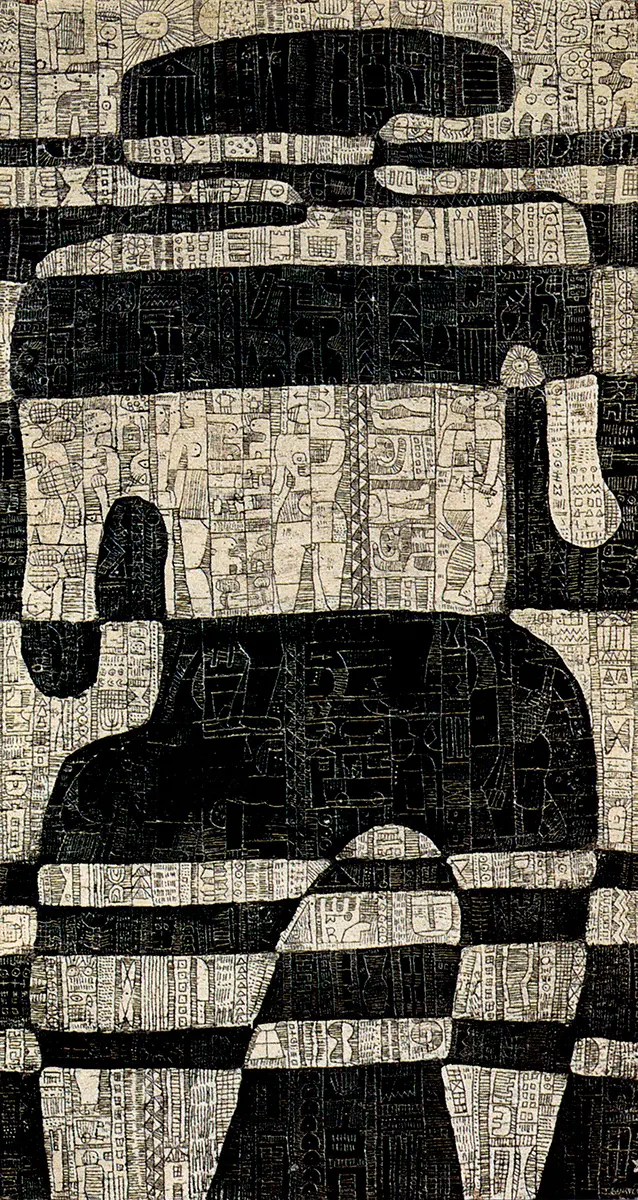
In Composición constructiva (Constructive composition, 1964-1965), created on the kibbutz, Gurvich composes an objet trouvé, a board that he found, and he engraves it with a punch, thus making, with incisions and then with paint, original representations of Genesis and other biblical themes, developed on the body of a cosmic man. He thus unites two motifs that were quite dear to him. The composition is created as if in registers that could be read. In the upper section is the creation of the world, the four elements, the moon and the sun, the stars, the first man and the first woman, the birds and the fishes, the serpent, the Tree of Good and Evil, the expulsion from Paradise, the Tables of the Law, and Jewish symbols like the Star of David and the menorah. In the middle of the cosmic man's body, he configures scenes of the seven capital sins, a theme that would return later in other more figurative and denotative compositions (7 pecados capitales [7 capital sins, 1967] and La gula [Gluttony, 1968]).
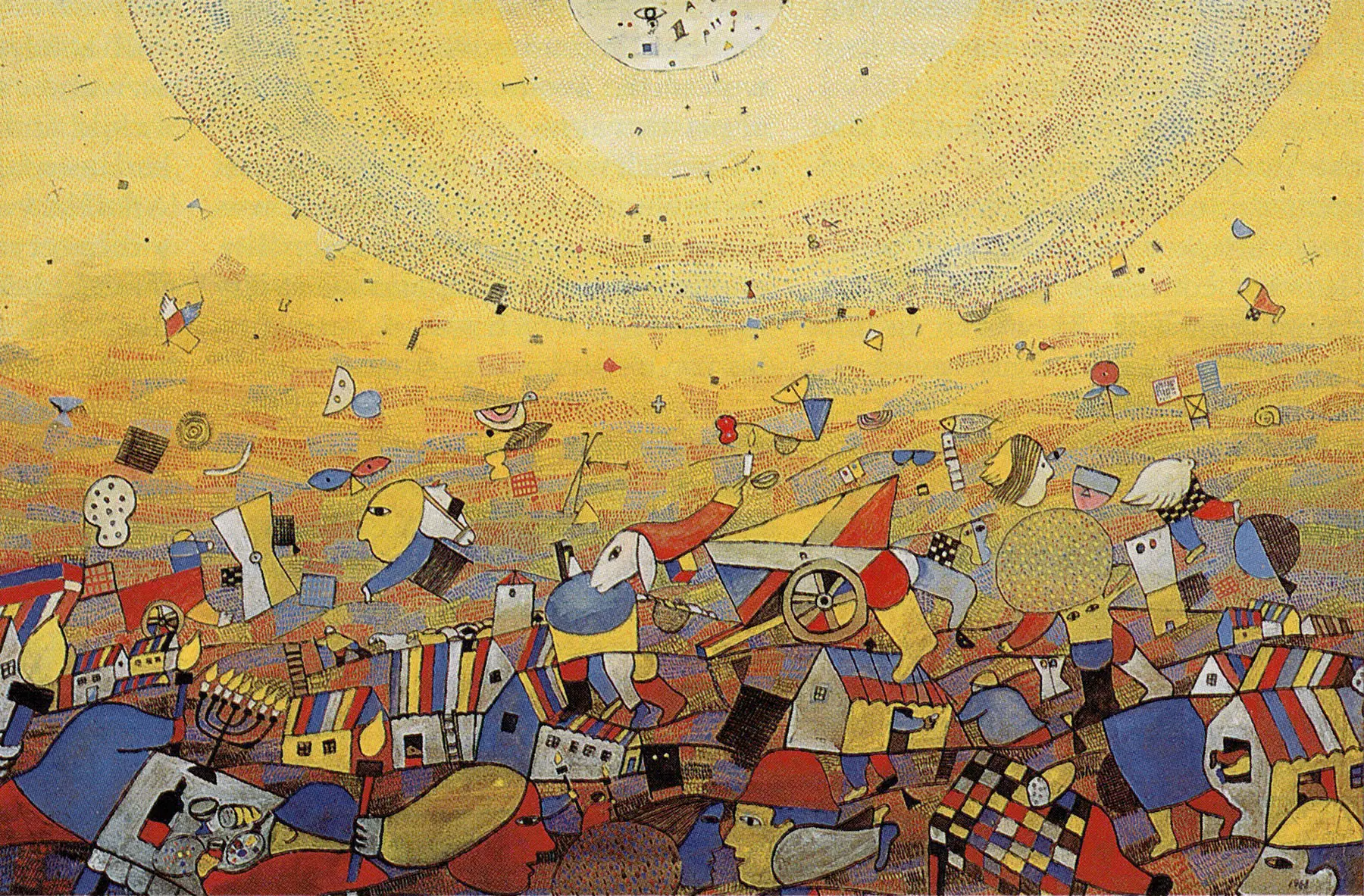
La Creación en colores puros (The Creation in pure colors, 1968) connotes a serene vision of an already ordered world, where things and beings are beginning to find their spot. An enormous "star-sun-heaven," of an even semicircularly, hangs from an Earth on which we can make out houses, candelabras, tables, female and male characters, animals, utensils, anthropo/zoomorphic beings, and microorganisms. It is a painting that speaks to vitality, continuity, and cyclical return in the middle of a scene in which we discover the love of the earth and of agricultural labor.
There is no tradition or Biblical text that can divorce Gurvich from daily reality. For Gurvich, to tackle Genesis is an opportunity to look both at the terrestrial and the celestial: he celebrates the transcendent from the perspective of the daily. Gurvich did not establish conventional ties between the animate and the inanimate worlds. Things and characters that seem fantastic are, at the same time, those of his daily world. The artist transcends toward a world of imagination and symbolism in a simultaneity of times and lived experiences, operating with mechanisms linked to memory. He puts everything on the same plane without forgetting about the big or the small. In his writings, he speaks precisely of giving life millimeter by millimeter. He simultaneously works the part and the whole.
The couple and the universal man
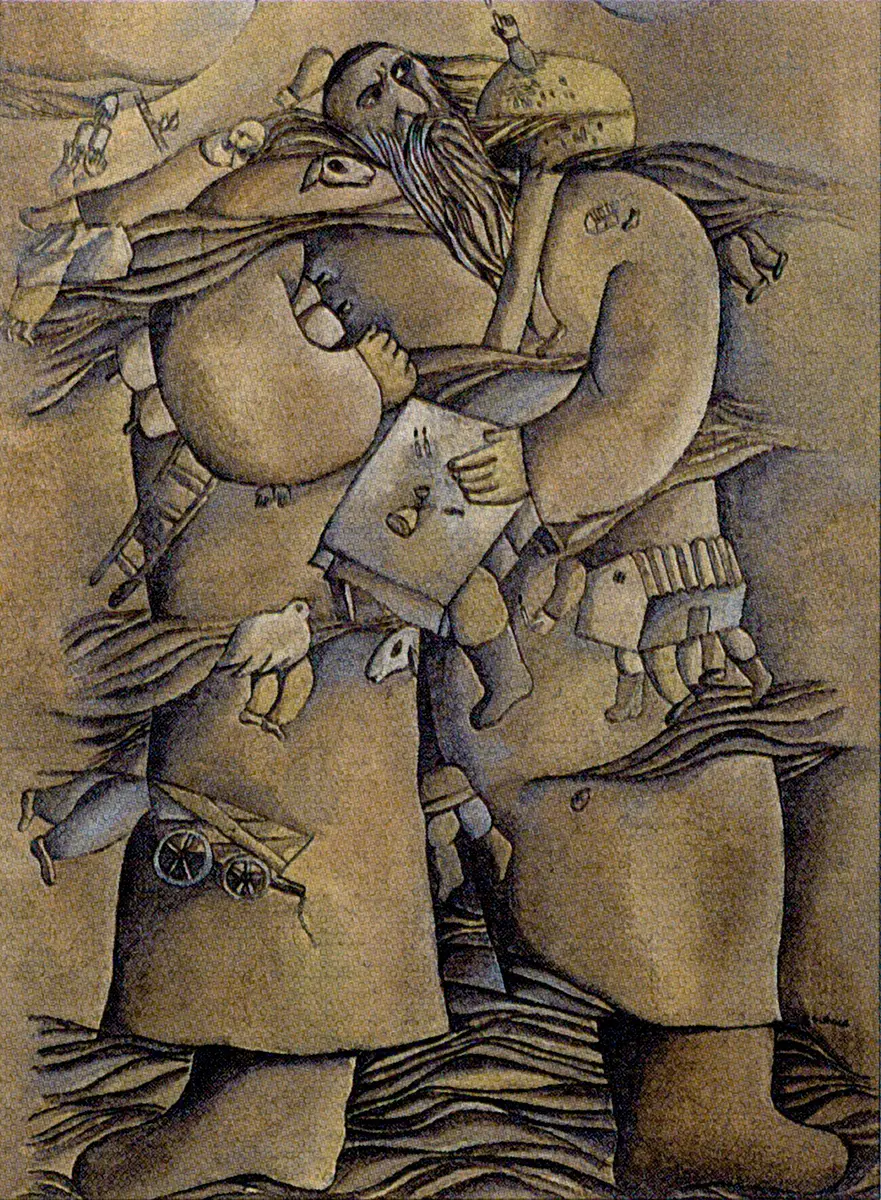
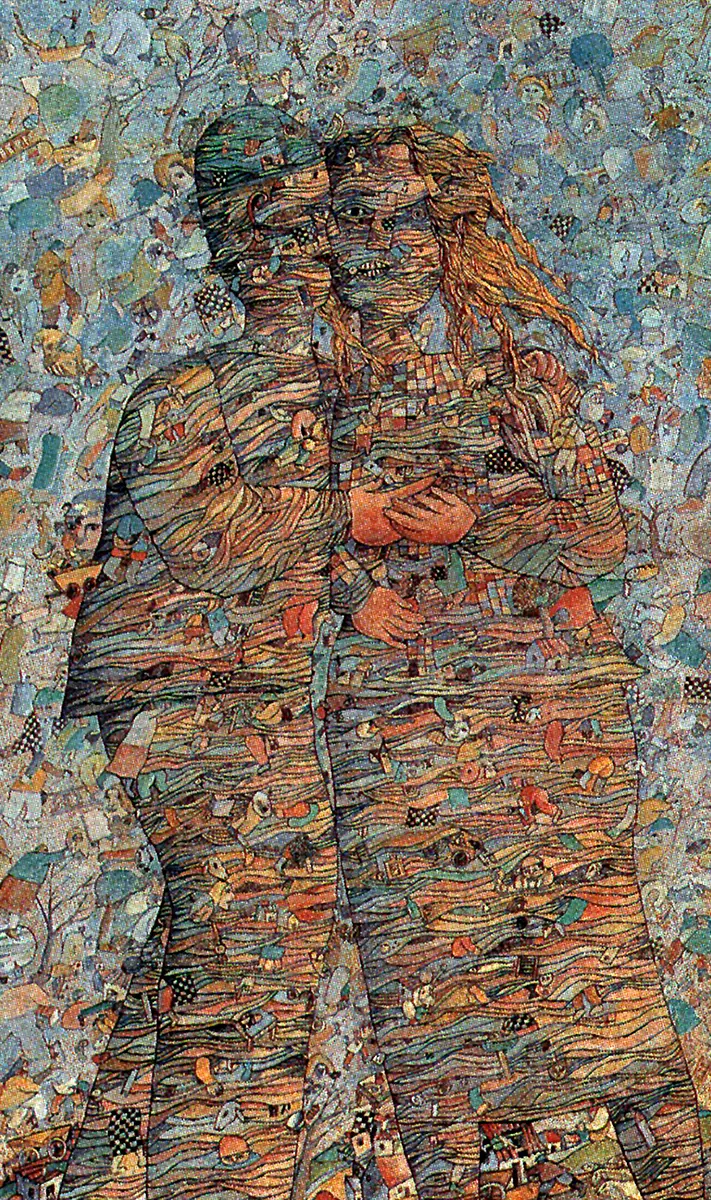
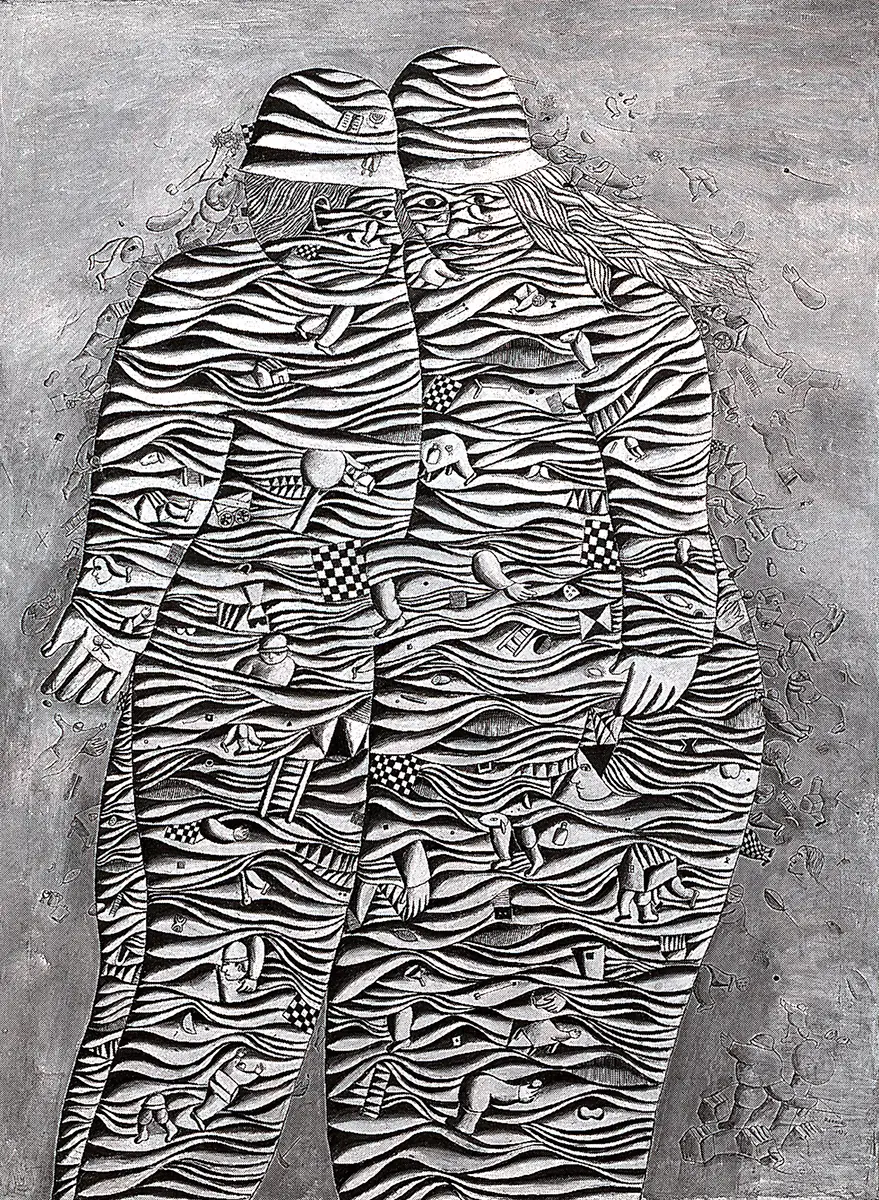
Gurvich stressed humanism, love, and the value of the couple. For him, love and sex were ways of affirming life. In his writings, Gurvich expressed the importance of loving as an essential condition of man and as an indispensable condition of life.9 It is a very important theme in his work and he confronts it in diverse ways. The reference, in other works, is more Biblical. Adam and Eve form another common theme in Gurvich, and in this preference, in addition to a primordial couple of Torres-García's constructive universalism, his Jewish inheritance and his Israeli experience may also have had some influence. Biblically- rooted love, the song to the love of the couple in the Song of Songs (Shir a Shirim), is not merely an erudite or religious reference; one did not need to be familiar with Biblical texts in order to know its basic lines, especially in Israel of that period. That text was then a motif of numerous folk dances and songs frequently sung on the kibbutz and throughout Israel. Worshipped on a daily basis were the love of the couple, the bodily, the sexual, the sensual, the aspiration toward fusion (what Julia Kristeva calls "fusional aspiration")10, ecstasy (leaving oneself), and the consecrated couple, pillar of Jewish society. On the kibbutz, the Song of Songs becomes particularly relevant due to its bucolic character, especially valued in the rural framework. In Cosmic couple, Gurvich presents the female body and the male body squeezed together in an embrace. They are a symbiotic man and woman who are united and blended thanks to eternal love. They are surrounded and pierced by hundreds of very small figures. And in spite of the fact that the figures are defined by a fine outline, no precise limits between the context and the characters are established. It is a free composition based on undulating rays that allow space to be penetrated. They are a couple inhabited by symbols and figures that re-create an agitated reality. It is an active world in which an uncontainable reality throbs, a tumultuous, noisy, active current that hurries in a context integrally populated by minute figures that contrast with the great couple. The human being belongs to that small world in which the universe or macrocosm is reflected, the human body is a universe in miniature, an idea that stretches from the Greeks to the Jewish Cabala and takes root in Western thought. There is a metaphysical relation between man and the rest of nature, and it is therefore difficult to separate them. However, it is the hypertrophied couple that imposes itself upon that fragmented and vertiginous reality.
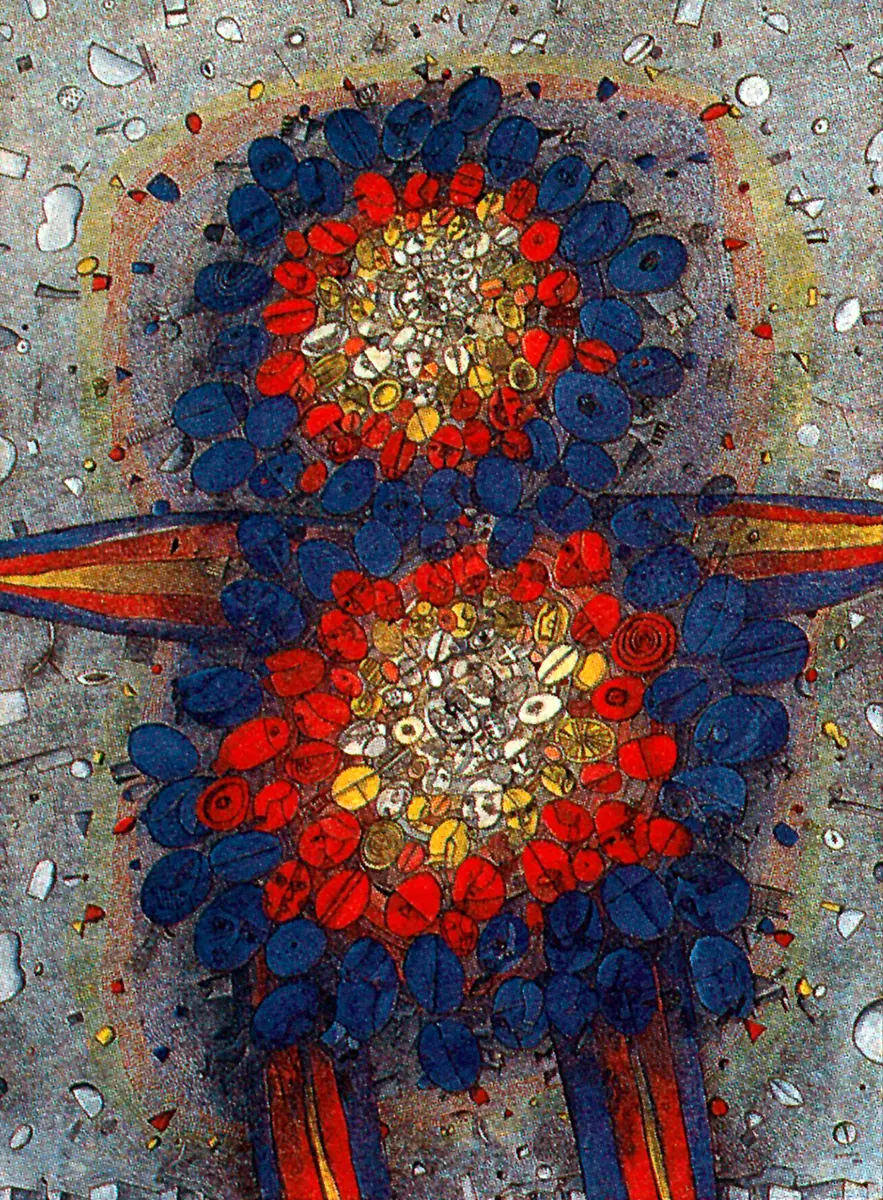
Underscoring the importance of the cosmic man is also an essential chapter in the artist's production, already appearing in his "Torres-Gardan" period, and which would be developed later with greater emphasis on fantastic compositions. In the series Hombres Astrales (Astral men), a largely symbolic figure dominates the composition, within which Gurvich unfolds a world of dynamic and living shapes that describe an eternal and essential human being. That human being survives the contingencies, and within him throb with great intensity the essence of the organic and the vital flowing. It's worth recalling that Adam has ties to the earth since, according to religion and etymology, God creates him out of the very earth (adamd, in Hebrew). Shapes begin to make up the being of the entire universe, and there is a permanent dialog between microcosm and macrocosm through minute symbols and small representations of daily life. The central figure houses a universe in a perpetual state of becoming. In that universe, the essence of the organic prevails and a spatial fantasy is generated.
Spatial and fantastic themes
In the mid-sixties, Gurvich created a rather extensive series on the fantastic, spatial, and cosmological. Stars, strange spacecraft, bodies that float in the extraterrestrial sphere, shapes that spin in the stratosphere, and astral beings make up those compositions. Symbols and images circulate in a space located beyond Earth, gigantic men that impose their authority on large cities; geometric elements, organic figures, and vital silhouettes are raised above houses, cities, and highways.
While creating this series, Gurvich gave growing importance to fantasy. But what detonated it was spatial exploration, which impressed him from the first moment.11 From the very beginning, Gurvich was attentive12 to the most relevant facts that were transmitted on television and about which he read, taking interest in the achievements of spacecraft able to reach the Universe beyond the Earth's atmosphere, in rockets, new vehicles, and satellites that pierced his retina and his mind since the Soviet Union launched Sputnik / on October 4, 1957 (which appears in a newspaper in one of his cafe scenes from that year). These facts, a natural curiosity toward unexplainable elements, and a growing attraction toward the fantastic also led him to science fiction. Gurvich was a reader of H.G. Wells, Isaac Asimov, Aldous Huxley, and Ray Bradbury.13 In some of the texts of those authors he found references to interstellar and interplanetary travels, and to imaginary explorations searching for intelligent life in other worlds.
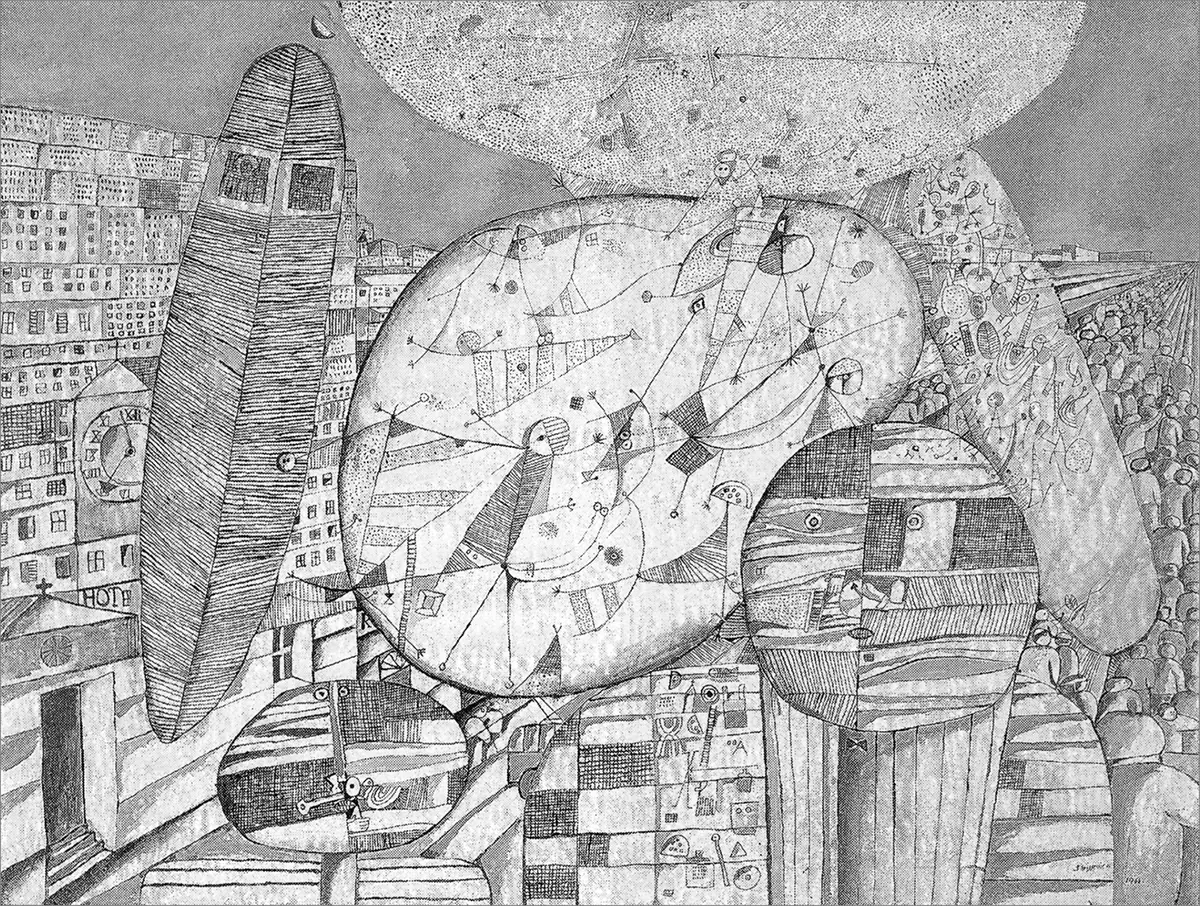
In Los Astronautas (The astronauts, 1968), there is a simultaneity of times and spaces. At the same time, Gurvich sets forth the stable reality of a metropolis, of nature, and of the human being, which contrasts with the enormous spaceship and territories yet to be discovered. A spacecraft rises from the buildings, and throughout the composition, there is an interconnection between nature, metropolis, humanism, and a strange and enigmatic zone, yet unformed, which contains an arcane world to be deciphered in the future.
It's worth pointing out that the vision transmitted by Gurvich is optimistic. He is not afraid of an unknown future or of unknown realities, and his vision of things extraterrestrial lacks ominous and terrible elements. He always privileges the natural world, the world created by man, and above all, he privileges the human being, which never loses the lead role.
New York urban landscape
Gurvich paid homage to urban landscapes throughout his creative life. But it is after the mid-sixties that homage acquires quite unique features that especially culminate in his vision of New York. This is when he paints explosions of movement and the impact of the megalopolis' acceleration.
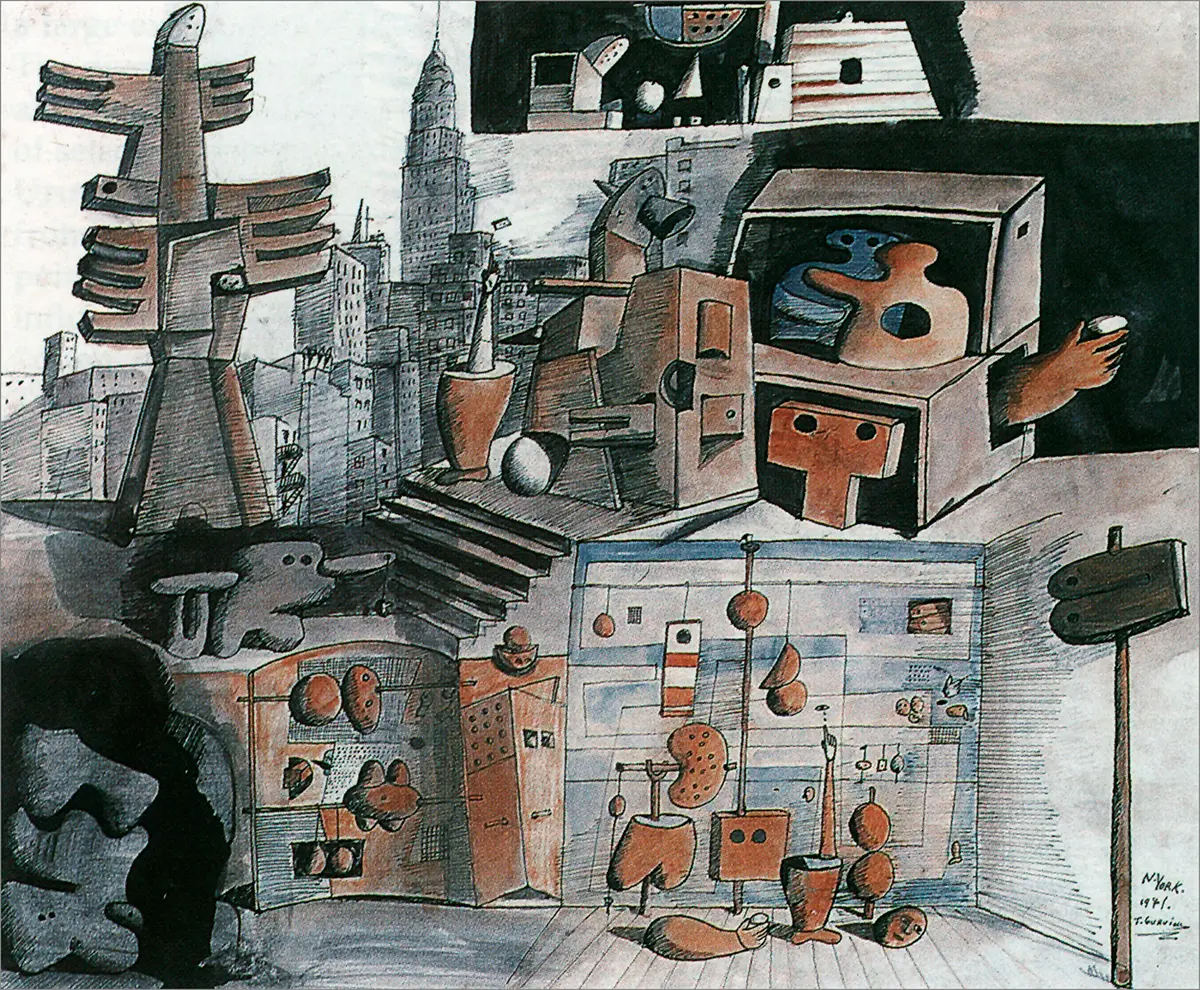
In 1970, Gurvich moved to New York (where he remained until his death), just like so many other painters from the Torres-García Studio. In his New York period, he records a gaze that accentuates the dynamism of the urban reality. Gurvich captured New York in full swing and recorded the heterogeneous landscape of the great metropolis. He recorded the alienation of mass man, juxtaposing scenes and characters that express the city's chaotic dimensions. Nevertheless, the characters that run and fly impose their authority on the reality of the buildings, and they somehow overcome dehumanization. A heterogeneous and mixed-up reality in perpetual turmoil is observed in some visions of the city. In other cases, a more ethereal configuration is predominant and what stands out are the enormous skies with flying creatures. Signs, traffic, tin cans, skyscrapers, taximeters, cars, and a running crowd prevail in other proposals on this theme.
During his stay in New York, and until his death, he developed his sculptural impulse with particular emphasis. In the big city, he designed numerous projects for monuments that he was creating on the scale of a metropolis. It is very difficult to evaluate the future development of those proposals since, due to his premature death, he left those projects unspecified. But it is evident, upon their analysis, that a potential sculpture dwelled within Gurvich.
That impulse, in any case, is not born ex tiihilo. Gurvich always felt attracted by three-dimensional objects and manual work. But the great change occurred in 1967, in Cerro, when he began to work with the spirit of a sculptor. Some of Gurvich's most noteworthy creations were his ceramics from the end of the '60s. Those experiences impelled him to think about the ability to transfer the forms on a large scale, an idea that was already present in the late '60s.
In addition to his antecedents in the treatment of ceramic and the influence of the big city, we must also keep in mind, in studying his approach to the sculptural concept, his contacts, and affinities with Gonzalo Fonseca, Julio Alpuy, and Marcelo Bonevardi, who were then working with three-dimensional forms in New York.
Enormous cavities that recall female sexual organs refer, in other projects, to a theme that dates back to prehistory. There would seem to be echoes of vulvae and uteri, a homage to the procreative ability of woman and to that entryway into the great mystery. There are also phallic references. It is curious to see the erotic theme shown with such intensity as in Proyecto para monumento o Cerámica erótica (Project for a monument or erotic ceramic, 1971), not at all frequent in Gurvich's work or in that of his colleagues at the Torres-García Studio (although Julio Alpuy also calls upon the theme). The frankness with which Alpuy introduces eroticism could have been contemplated by Gurvich, who then created projects with obvious sexual connotations. Perhaps it should be linked to his song to the couple, to a life-giving sensuality, to the man-woman union as an element of creation and continuity of life, essential themes in his work. Those penises and vulvae in symbolic coitus have the celebratory energy of union, love, sexuality, and especially genesis, fertility, of life. As always, Gurvich expressed himself symbolically, distanced from descriptive functions, and searching for shared meanings. The celebration of the vital is set in opposition to the rectangular and linear rigidity of metropolitan architecture, and it is the human that triumphs over the inert, as we see in his projects of assorted monuments.
Legacies
With a palette of luminous, diaphanous, and expansive colors, with undulating compositions, dynamic graphics, oval forms, and curved rhythms, and with numerous pictorial and drawing resources, to which may be added a unique handling of ceramics, José Gurvich specified numerous works that enrich the Uruguayan, Latin American, and international artistic heritage. Fantasy, pictorial sensibility, ability with color, the craftsman's great care, lyricism, spirituality, creative intuition, composite intelligence, versatility, organic conception of the unity of the painting, and talent for integrating a vast repertoire: all these bears witness to his accentuated creative spirit.
Gurvich's creation corresponds quite well with Uruguayan culture, a culture with deep European roots. The Uruguayan essence consists, to a large degree, of the peculiar and permanent way of integrating things European. Because it is characteristic of Uruguayan culture to be syncretic, to adopt languages from Europe or the West and to recycle them or adapt them to the local needs and to feel, to a large extent, part of the Old World. The diverse international expressions are integrated according to an outline of selective retention and discarding. "Uruguay, a Europeanized country from a historical and demographic point of view, is permeable to foreign influences, and it is the epitome of an 'open area,'" to use one of Marta Traba's terms. The critic Fernando García Esteban, upon establishing some of the identifying patterns of Uruguayan art, affirmed that the fact that a relation with Europe exists and is intimate does not imply a flaw to be hidden or from which we need to free ourselves.14 This is why Gurvich is a very characteristic exponent of Uruguay and of a culture generated, to a large degree, by European immigrants from diverse origins.
Universal, Uruguyan, Jewish, and Gurvich left a fluid and syncretic legacy based on the reinvention of multiple traditions generated in a play of receptivity open to dissimilar sources. He left a personal vision of constructive universalism, a Jewish legacy to "Torres-Garcian" art, and to the history of Uruguayan art. He participated in the visual discourse of the social construction of Jewish Diaspora identity/identities and at the same time the social construction of the complex Uruguayan identity/identities. The anxiety over identity is one of the key themes of the modern and contemporary Jewish condition, as is its problematic nature. The same thing may be said, to a certain degree, with Uruguayan identity. The Uruguayans have been shaken by crucial themes, especially in recent decades, and know of their own violence, persecutions, exiles, diasporas, and reencounters.
NOTES
1. See Alicia Haber, “Identidades compartidas’ and "La voz entranable" in the catalog José Gurvich: El mundo intimo del artists (Montevideo: Fundacion Buquebus of Montevideo and the Centro Cultural Borges of Buenos Aires, 1999) 9-10,12-48. See Alicia Haber, José Gurvich: Un canto a la vida (Mosca, 2000). See the José Gurvich show at the MUVA Virtual Museum of the Arts, El País, texts by Alicia Haber (Spanish and English).
2. Interviews conducted by the author on several occasions with Julia Añorga and the painters Guillermo Fernández, Ernesto Vila, and Adolfo Nigra.
3. Artist’s text, no date, in the Gurvich family’s file.
4. Artist’s text, no date, in the Gurvich family’s file.
5. Gurvich’s writings. Family collection; no date, no pagination.
6. The work was exhibited in the Centro Cultural Borges in Buenos Aires, September-October 1999.
7. The author interviewed Julia Anorga, the artist’s wife, in June 1999.
8. Avram Kampf, Jewish Experience in the Art of the Twentieth Century (S. Hadley, Mass.: Bergin & Garvey, 1984).
9. Artist's text, no date, in the Gurvich family's file.
10. Julia Kristeva, Tales of love, trans. Leon S. Roudiez (New York: Columbia UP, 1987)
11. Author's interview with Julia Añorga, June 1999.
12. Author's interview with Julia Añorga, June 1999.
13. Author's interview with Julia Añorga, June 1999.
14. Fernando García Esteban, Panorama de la pintura uruguaya conlemporánea (Montevideo: Alfa, 1965) 41.
ALICIA HABER
Alicia Haber is an Uruguayan historian, teacher, and art critic. She is an art consultant and chief curator at the Department of Culture of the Montevideo Municipal Government, director of the Virtual Museum of Arts El País (MUVA), and art critic for the daily El País. She has published numerous books and catalogs.