
Laura Anderson Barbata's installations and mixed media pieces explore the histories and constructs that map one's identity. By combining religious symbols, and both contemporary and well-worn objects with a lyrical touch of nature, the Mexico City-born artist conjures up statements of cultural self-reflection. The One Who Rests Among Tender Roots (all works are from 1999 unless otherwise noted), stands as an evocative testament to the melange of societal influences examined by Anderson Barbata. Upon a black metal table with spindly legs on wheels, sits a chipped black stepping stool dotted by underlayers of red and cream pigment. A shelf jutting from the stool's middle rungs bears a wooden box filled with tender, lush green wheat sprouts. Overlooking the wheat above, a headless Christ figure stands with his hand raised in blessing. The top of the stool supports a larger box of verdant wheat grasses, behind which are stacked religious texts in the Nahuatl dialect, upon which rests the diminutive frame of a house, made of rose branches. Another house frame, inverted this time, made of matchsticks, is suspended from a wooden extension of the table. The result is an enchanting amalgam of elements that reflect complicated histories: its indigenous roots, Catholic doctrine, the domestic embrace, and the prevailing presence of nature.
In a more politically charged context, Anderson Barbata's Your Land-Our Lords addresses state-dictated concepts of identity. This is the most powerful piece in the show. Towering against the wall, the mid-section of an old wooden canoe is employed as ground, symbolizing a kind of U.S./ Mexico border. Placed on one of the boat's footrests are a pair of army boots attached to the top of the disintegrating sandal soles worn by the indigenous in Mexico. In effect, the U.S. border guards, implied by the boots, step upon the entering immigrant population. Along the top edge of the canoe, jagged pieces of glass jut out menacingly from gray cement, clearly meant to hinder passage. Similar means deter the scaling of walls surrounding property in Mexico. A torn strip of white cloth hangs from a nearby nail as a symbolic act of surrender, or as a remnant ripped from an immigrant's shirt. Finally, at eye level is an exhibition catalog with photographs of Mexican families for us to peruse. But, as with Anderson's other figures in the exhibition, all of the people portrayed are headless. She cuts out ovals where their heads should sit, depersonalizing the individuals so that they become the anonymous statistics employed by the state to categorize them.
Overall, this exhibition resonates because each piece differs but informs the next, leading the viewer to build upon the previous impression. In Thought, Word, Deed (And O-Mission), three tall stacks of books of similar height, support the references Anderson Barbata deems central to our histories. Each colorful, tower of volumes contains an array of Bibles and New Testaments in various languages. Balanced upon one tower of books is a handmade toy ladder covered in gold leaf, pointing upward, as if rising to the heavens. The second stack supports a carved wooden head and shoulder-less figure in a dress. It is a presence effectively silenced. The remaining tower bears a large house frame made of thorny rose branches. The domestic, the emotional, and the spiritual rise from the biblical foundations, each as stable and certain as the uneven stacks that could collapse with gentle pressure.
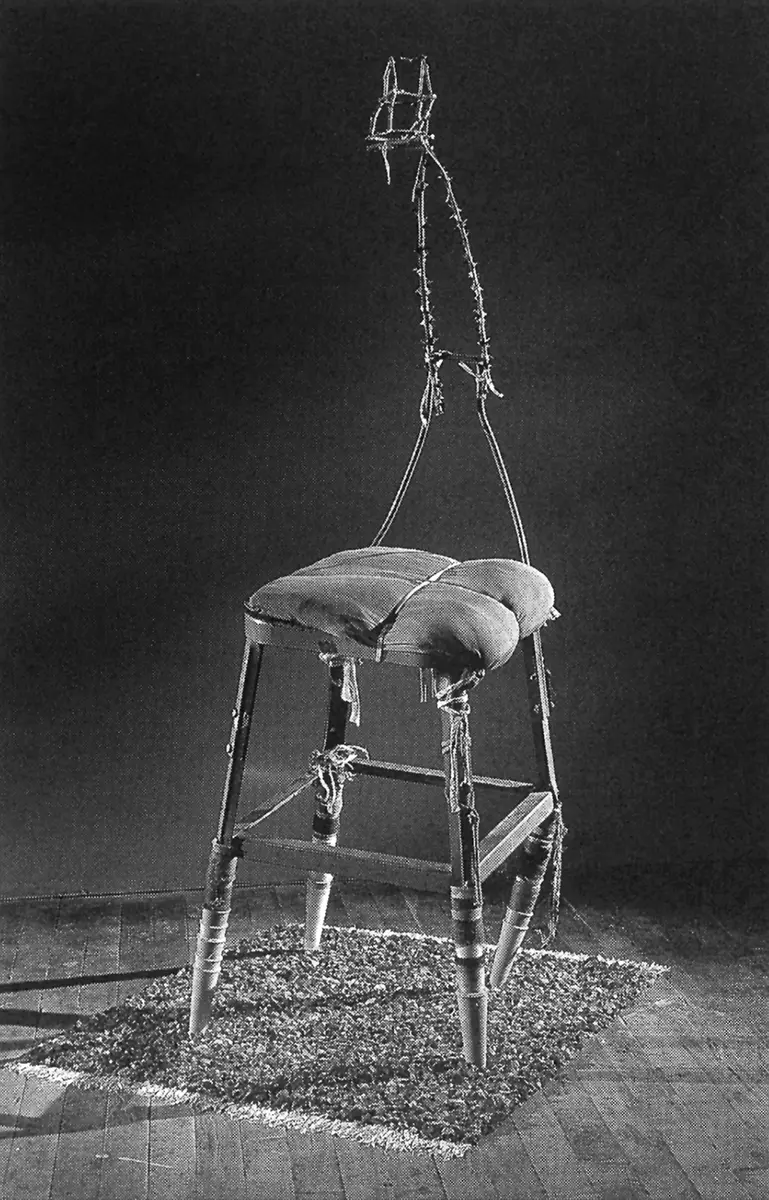
Finally, The Ancient is Substituted By is a piece that resonates hauntingly, melding identities into a kind of ritual throne. Set upon a radiant bed of red flower petals framed at either end with yellow petals suggesting carpet fringe, rests a seat fashioned from a chipped gray metal stool. Stacked golden plastic thread cones, some still bearing magenta, sapphire, or lavender thread, serve as their fragile legs. A faded plum-toned cushion is tied to the seat with shoestring and two gangly wires create an arch, supporting two thorny stems that join above Anderson's trademark house frame as a crown. It is an ephemeral, contemporary throne, pieced together from the remnants of modern life and made magical with its crowned house of thorns and regal red carpet of petals. At the onset of the new millennium, Anderson Barbata effectively synthesizes humankind's evolution to the sum of one's history, leaving us to reflect on what we have become.
MARY SCHNEIDER ENRIQUEZ