
In her early works that were intensely dedicated to the Duchess of Alba—traditional etchings that were excellent, though limited by that very tradition— Liliana Porter had made the effort to overcome technical limitations and to concentrate on the image itself. An impeccable technique, an almost excessive sense of visual elegance, a good eye for the "enchantment" in her ambiguity of "charm" and magic —all this gave her work enormous appeal.
That appeal granted her well-deserved success both among the lay public and the critics. Today, in retrospect, it nevertheless seems to have hidden a series of complex indecisions. For many years, her faithfulness to graphic work led her to explore her imagery in a field that began to close in on her. Her dive into an assault upon the canvas was basically based on serigraphy. The play between reality and image as an instrument to achieve the magical was based on photomechanical reproduction, often assisted by the pencil or paintbrush. When a well-applied style of craftsmanship entered the picture, the satisfaction of completing a skill as well as the rigor of the image could be seen.
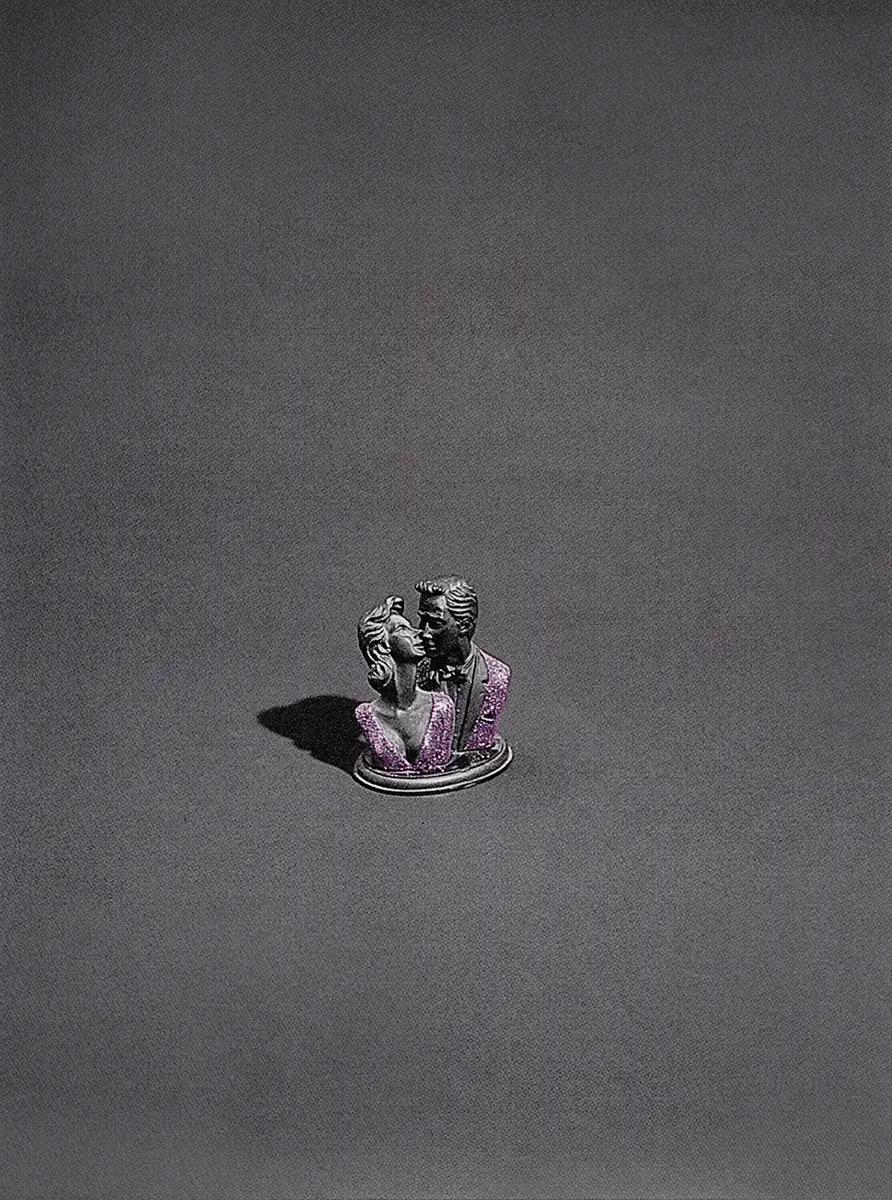
In 1995, Porter decided to confront reality more directly, either by using the objects themselves or through photography as a means to document them. This step helped to distill her approach. What until then had been presented as a journey along the borders of illustration now became the proposal itself. What could have been included as visual accompaniment in a book by Borges or Lewis Carroll—her favorite literary models—now began to turn into her own book.
Porter had already made incursions into photography in the mid-seventies. But the works belonged to an investigation into the object's relation to its representation. The trompe l'oeil, the deceit with respect to the precise point at which the image ends and reality begins, created the mystery of uncertainty. The artist's hand merged with the drawing, supporting represented images and getting into the impossible space between the line and the wall that was drawn upon. Correctly inserted into the post-conceptual code of the period of these pieces, they nonetheless did not totally express the will of the artist. She played with two incompatible spatial qualities in which the work only pointed toward one possibility of coherence. But this coherence was overcome by the identities of the spaces. The combination of the space of the photographed object with the space of the drawing on the wall, and the combination of the drawing and the object within the photographed space, ultimately referred more to a dialog of formal repertoires than to the magic of the reality/unreality dialog. It is something that becomes clear once again in this show.
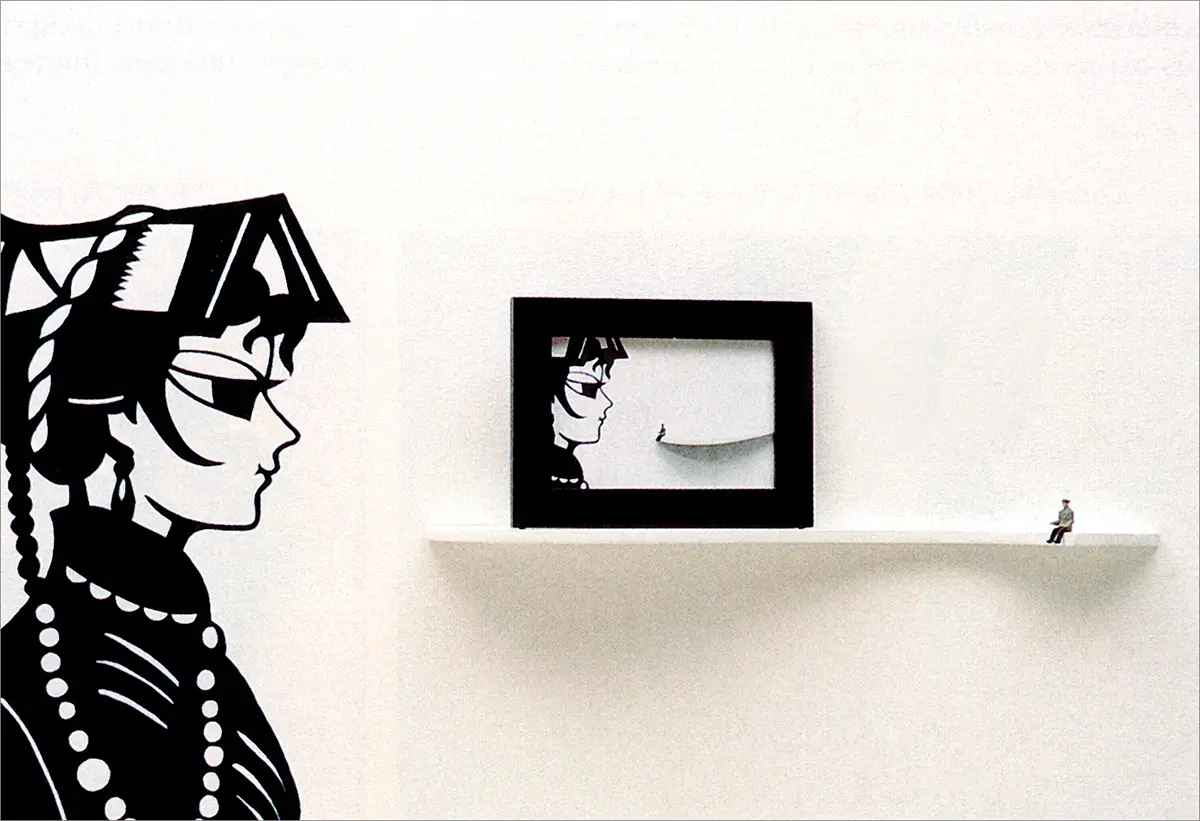
The homogenization of space was initially achieved through the use of photo-serigraphy over a uniform field, either canvas or wall. There the object related more directly to its image, a more direct dialog could be established without the interference of spurious supports like photographic paper, and minimizing as much as possible the loss of information caused by the photomechanical media. The space stretched three-dimensionally thanks to the objects that escaped the prison of the support. And the elements of painting and drawing that also appeared in the work were nothing more than other characters within her narrative.
During a relatively long period, Porter apparently refined the technical aspects of her presentation and the scale of elements in her repertoire. With the help of the present work, however, it could be thought that what was refined was the quality of the dialog of her objects. It was literally a question of establishing what things one object had to say to another and/or to the viewer. What's more, it was a question of elucidating what object deserved to be cited in these dialogs or, better yet, what object deserves to appear on stage to act its own part. It is here where the idea of an engraving, painting, or installation began to lose its meaning because the work became a theater, in the best sense of the word.
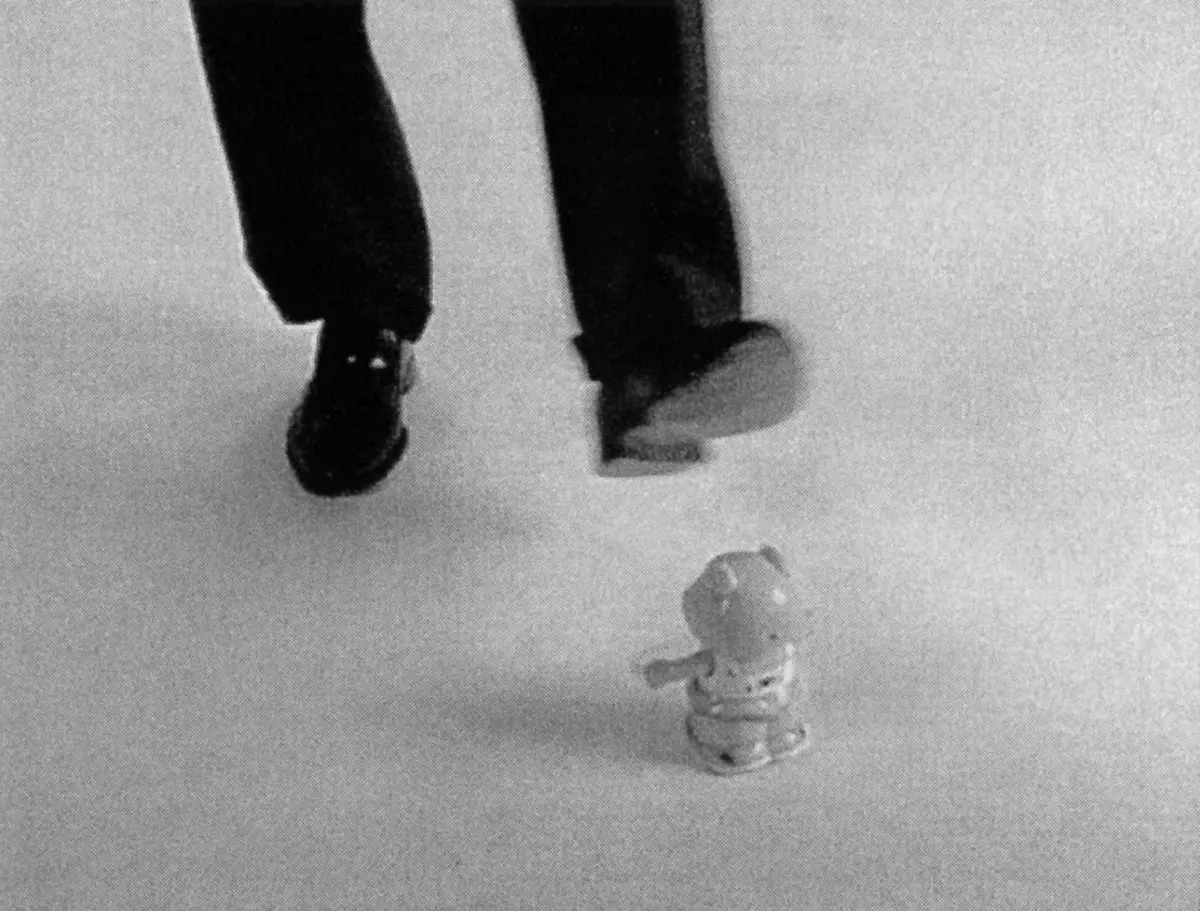
The assumption of photography as a presumed "documentary" medium for presenting its characters is therefore a key step toward the purification of her work. The large, photographic space (generally in color) is a stage on which the characters can maintain themselves without the interference of artisanal noises. The public approaches the event without having to dwell on an evaluation of the technical finish. Given the fact that for a long time, the quality of the finish had been one of the sturdy supports of Porter's works, this step was quite significant. It represents the maturity of the image, the acceptance of its power of selection of appropriate characters, and the importance of their voice. In this radical step, Porter did not discard her games with the trompe l'oeil. It is only that they were no longer the vehicle of her work. They were now the stage props that helped in the expression.
It is thus worth discussing who the characters are and what their expression is. Kulechov, one of the fathers of Soviet cinema and Sergei Eisenstein's teacher, used a photograph of the intentionally inexpressive face of the actor Mosyukin next to various images. The same face seemed hungry next to a bowl of soup, tender next to the image of a child, sad with an agonizing woman. Kulechov wanted to demonstrate to his students, during his early 20s, that the actor is nothing more than a mannequin that can be manipulated through montage.1 In a crude manner, this is the mechanism employed by Porter.
There is, however, one important distinction. For Kulechov, it really doesn't matter who the actor is, what his expression is, or what his accompanying image is.
The intention is to demonstrate that there is a process of qualification produced when one image turns into the context of the other. It is a process similar to that used by Magritte in his paintings. But already in Magritte, and even more so in the work of Porter, it does matter who the characters are, as does the manipulation of what is being said. Porter's art does not work with just any object. Her selection is careful and reflects not only the world delineated by Borges, Alice in Wonderland, and by Magritte, but also by her very personal blend of astonishment, childishness, and humorous distancing.
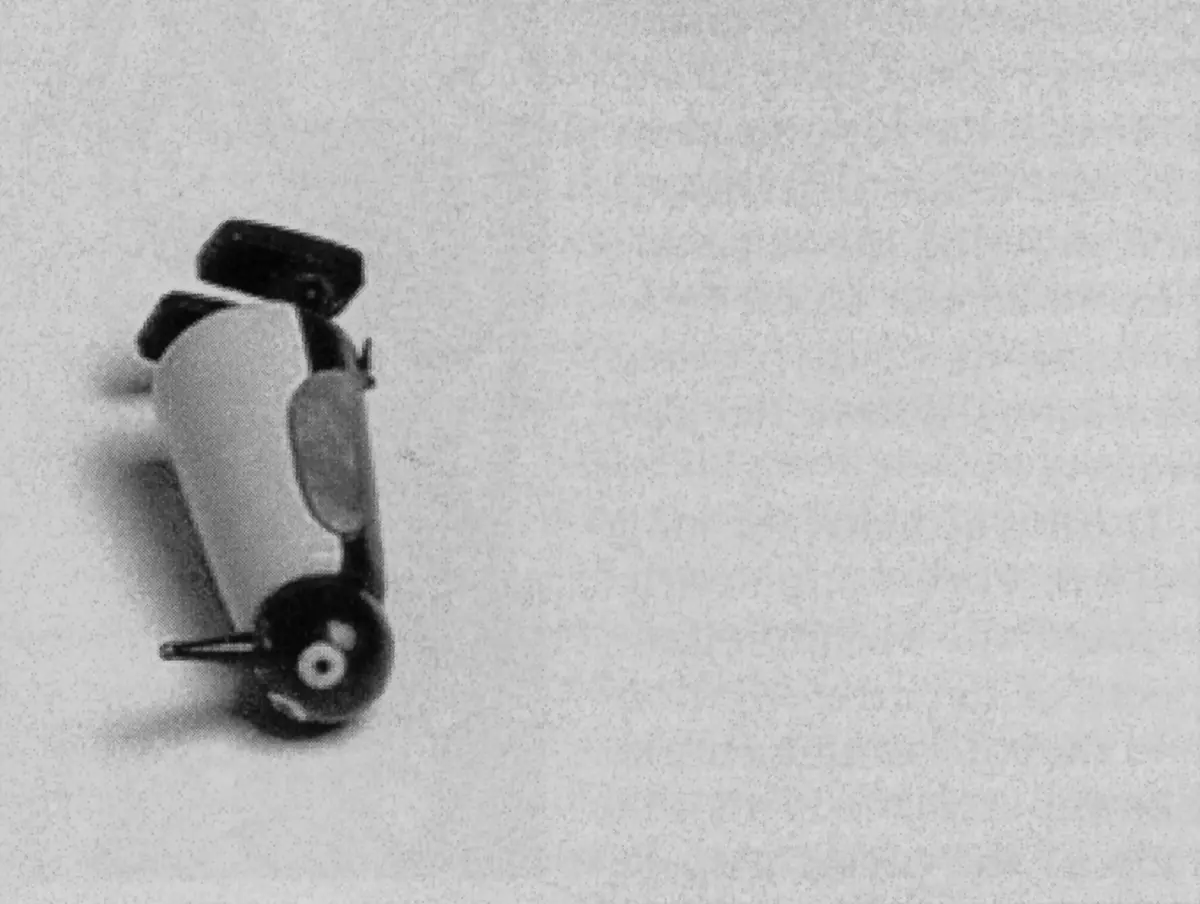
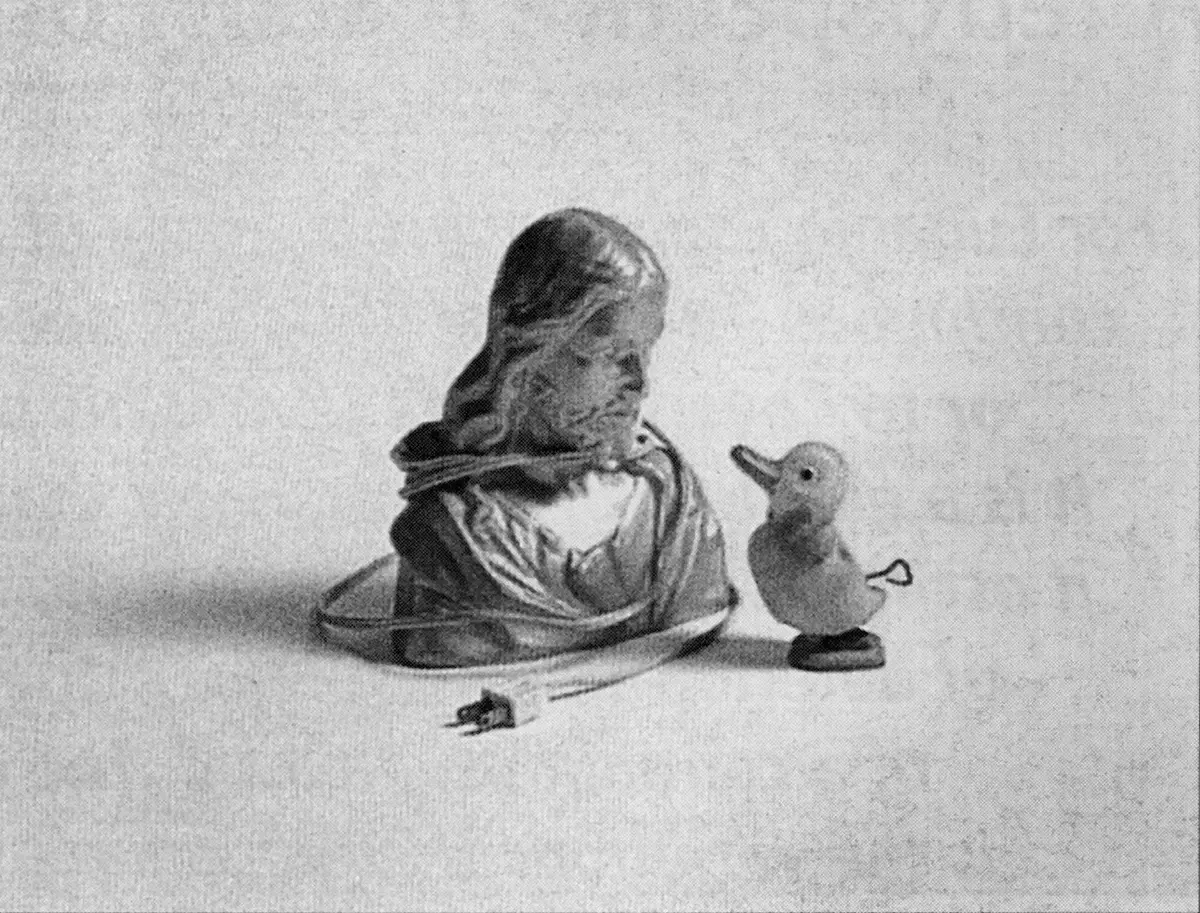
The elements, in real life, are mostly toys and kitsch objects carried over to the world of toys. In the world that she presents to us, however, they are de-objectualized. Each "thing" is brought to life thanks to the respect that the artist invests (here the astonishment and childish quality come to view). The object "awakens" from its reified state and acts first for her and then for us, thanks to a sort of conscience that Porter seems to be able to give it. It is the awareness of having been chosen from among infinite other objects that did not deserve to receive that energy. They are, in general, objects that request and return a certain minimal degree of tenderness. And it is here that something that could wind up as an atrocious piece of sentimentalism works thanks to humor. Humor allows for the introduction of light cruelty, satire, and frustration as it, at the same time, excludes aggression. The distancing contributed by humor also allows us to filter the interlocutors and the careful decisions about who may have a dialog with whom.
It is interesting that these three parameters —astonishment, childishness, and humor— that normally would translate into literary ingredients, become spatial coordinates in Porter's work. They situate the viewer very precisely as such and as an audience. The works, though without sound, are heard. They are secret conversations, expressive whisperings, and meditative soliloquies that we shall never fully understand although, through the fragments that we receive, we know that they concern us. They are coordinates that act like the velvet ropes of museums, inviting us to approach but, with apparent tact, keeping us at a distance.
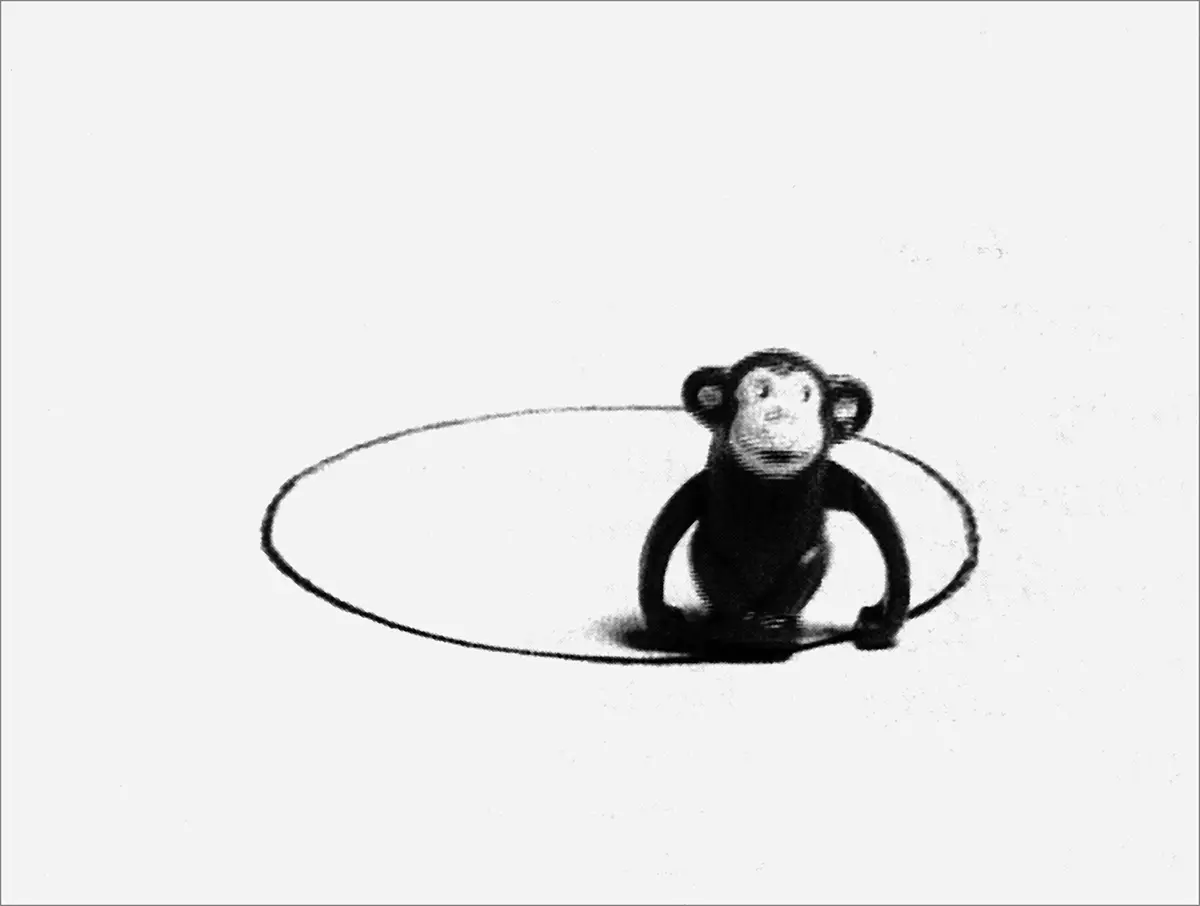
Her 1999 show at the Nosei Gallery was extremely elegant. The works spread out with great, empty surfaces, have the quality and appeal of new things. These are pieces with a "cool" appearance, a presentation that does not always seem necessary except as the product of a formalist decision. In these cases, Porter's sophistication as an artist comes into conflict with the process of giving energy to her characters. The simplest works are the ones that best keep the magic. In particular, when the prop is in a photographed space, that space acquires a mysterious atmosphere, even in its simplest states.
In a second room, one can see the projection of Para usted (For you), Liliana's entry into cinematography.2 Here the characters act out the life that is latent or frozen in the other pieces, and they direct it more toward us. Aided by a spectacular soundtrack composed by Sylvia Meyer, the subjects become unexpectedly extroverted and free beings. We no longer perceive fragmentary whispers —and in this sense, the mystery of other works may be somewhat weakened—but rather a smile that we want to continue smiling.
The film seems to be one of the inescapable consequences of Porter's creative process. After a long career setting up static images, setting up dynamic situations seems obvious and necessary, something that the perfection of this first work proves and illustrates, especially in the segment titled "Perfection." A little toy monkey jumps "perfectly" along a previously drawn circle on the paper. The elegance of the different sections of the film in its extremely clever simplicity generates the immediate desire for Porter to dedicate herself entirely to the cinema.
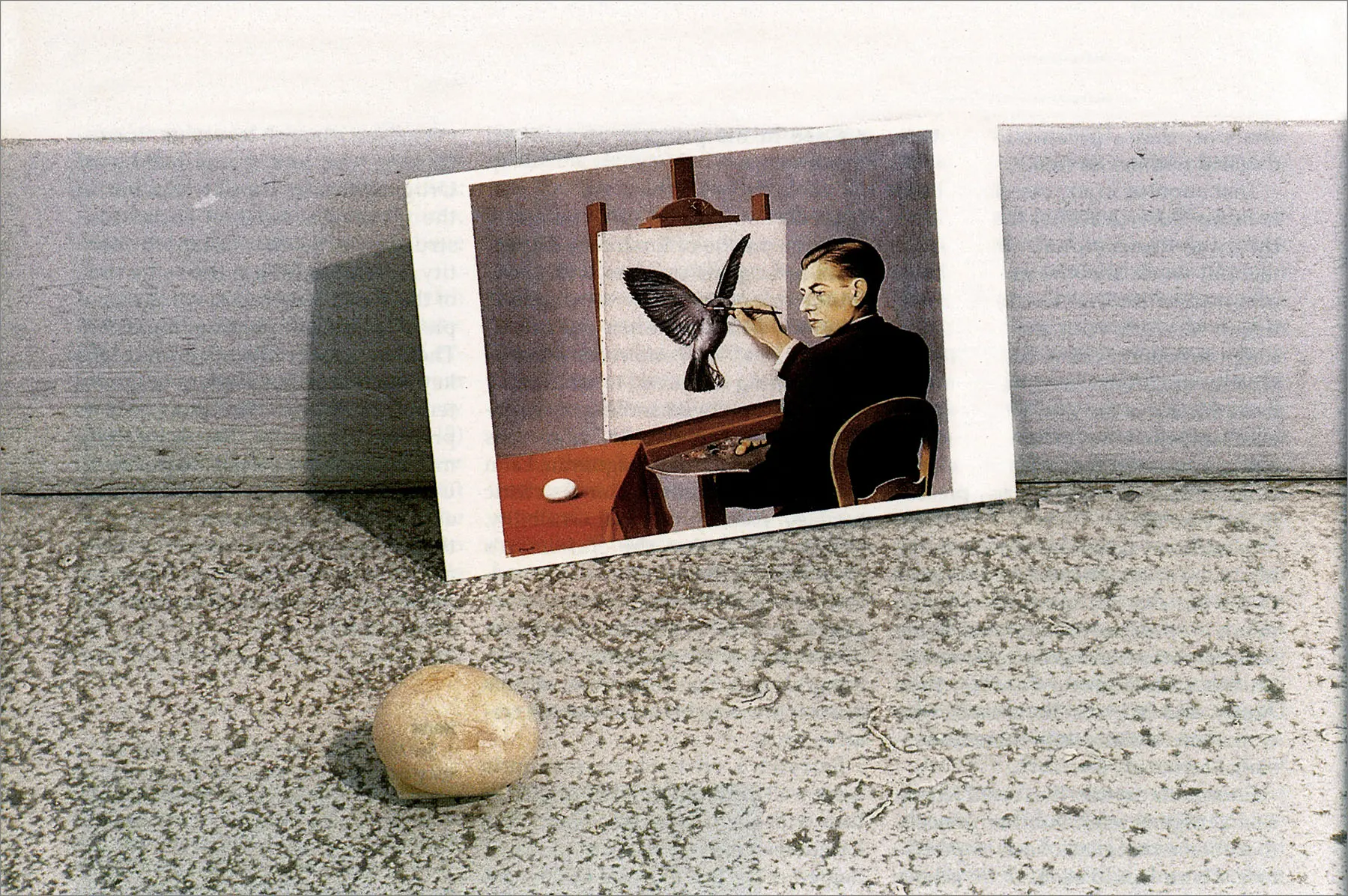
One almost misses a piece, thrown against the baseboard, which demonstrates that cinema is not the only desirable direction for Porter's work. La Clairvoyance consists of nothing more than a postcard of Magritte's painting of the same title and a small rock on the floor.
At first sight, it looks like an accident. We later discover that the rock absurdly has the same shape and color as the egg that, in the painting, lies before the canvas. The painter who paints a bird on the canvas, equally absurd, uses the egg as a model. As a painter, Magritte paints in time. Porter brings it back to space but cancels time. The rock is the fossilized egg that here would only serve to knock down the image of the bird by stoning it. At the same time, the size and position of the rock force Magritte's painting and the canvas painted by the painter shown by Magritte to enter into a perspective that allows space to be lived instead of contemplated. It is the most economical piece in the show, the one that least participates in the established codes of artistic presentation.
Precisely because of that lack of mediation, this is also the work that bears the essence of all her works. With it, Liliana presents a kind of tailor-made Borgesian aleph. The fact that it is against the baseboard is nothing more than an unconscious paraphrase of Carlos Argentino Daneri's "nineteenth step of the appropriate staircase."3
NOTES
1. George Sadoul, El cine, su historia y su técnica (Mexico City: Breviarios del Fondo de Cultura Economica, 1952) 135.
2. Juan Mandelbaum was the film's technical director.
3. Jorge Luis Borges. El Aleph.
**This essay was written on the occasion of Liliana Porter's exhibition at the Annina Nosei Gallery in New York.
Photos: Courtesy Annina Nosei Gallery.
LUIS CAMNITZER
Uruguayan artist and Professor of Visual Arts at the State University of New York, College at Old Westbury.