
The canvases in this exhibition by Luis Roldán appeared to the spectator like enormous landscapes. Constructed without any horizon, they offered a panorama seem from above and over which little organic forms seemed to be floating, like archipelagos crossing space. Rather than floating, the forms passed in front of the spectator and could disappear at any moment—like the geography seen from a plane or the forms and stains in a video.
The effect in the gallery was all-enveloping, as if the artist was trying to separate himself from the earth and see his references from above, and see them in movement. The effect was achieved because the stains had no weight: they seemed to be moving like tiny abstract rabbits subject to forces that made them drift a little. These forces were expressed in the form of the stain, with organic projections and a very particular and analytical theory of color. There were no lasting primary colors appearing on the canvas. The backgrounds, some of which were very black, were stained in such a way that the forms did not remain on them but seemed to subtly support them. The forms, which initially might be done with intense Colo’s, were covered with veilings which reduced their visual weight. However, the effect was ambiguous: some stains seemed to mimetize the background but were quickly surrounded by pink, yellow, or green colors which at first the spectator could recognize as being close to earth or other colors. But gradually, they seemed to be mixed with the intensity of the lime greens or magentas reminiscent of advertising, which again resulted in the forms appearing like islands in space. The paintings in this exhibition used the color white like an invisible gauze which, in addition to providing a source of light, acted as a support for the forms, sometimes fusing them with and other times separating them from the background. The painting was a complex effect of camouflage.
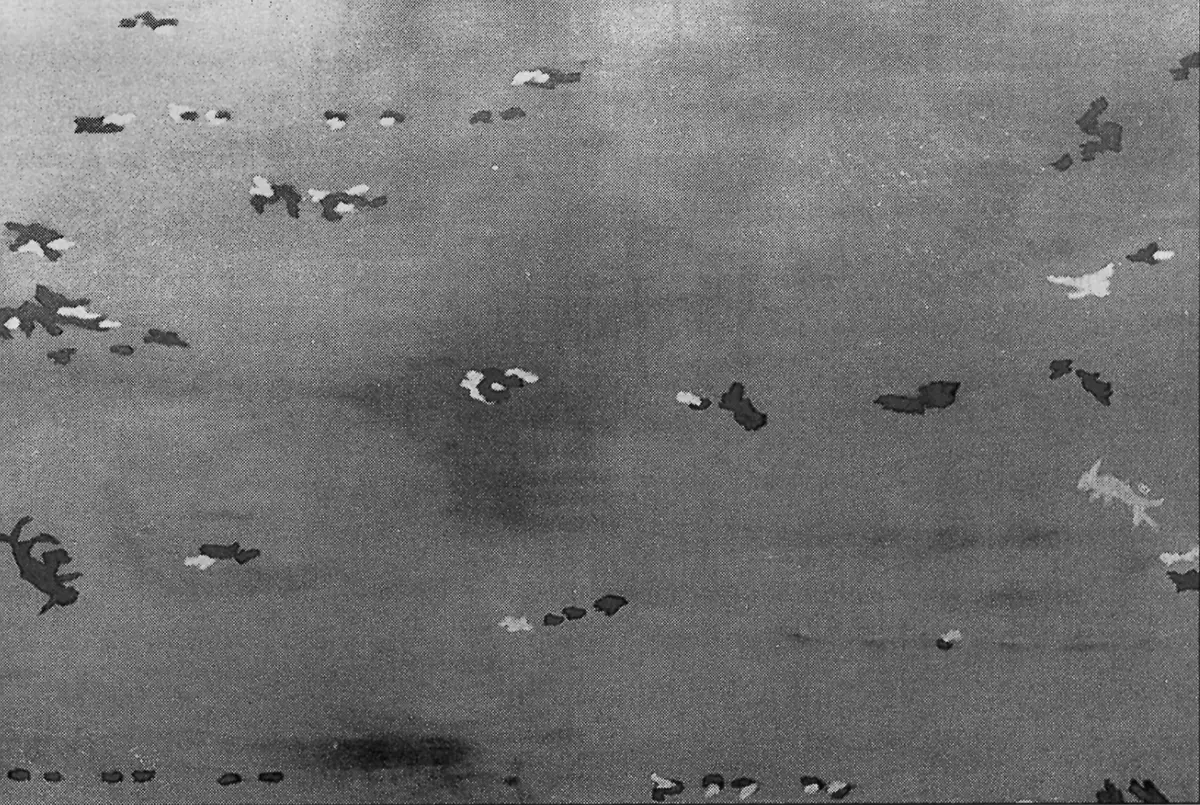
As usual, Roldán's work moves towards other territories; that of digital screens which undeniably transform the way we see form and color, for example. The principal effect is one of a certain momentary stability and an illumination of each color from behind which changes the tones. Through such changes, the painting becomes enriched. But what is important is that these movements by the painter that allow him to accept any kind of references are related to an accumulation of different layers of uninterrupted craft, as it were, and theory of color, which are fused within a mobile thought process that is sensitive to the history of art and changing perceptions in the contemporary world.
Roldán's attitude as a painter in these canvases might be defined as a concentration on the problems of a craft. For this reason, the painting might well refer to ideological problems. Without a doubt, the immediate antecedents of these works are The Fringes, constructed with stretchers extended one on top of the other, painted with organic forms reminiscent of camouflaged uniforms, with colors, sometimes mimetic other times not, and see a little from above. One of them was recently presented in Bogota in the Points of Intersection exhibition. These fringes are a clear reference to a country like Colombia which is living in separated ideological spaces of a military, political, and social kind: but a reference made from the realm of painting itself.
The capacity to transform a medium and move forward involves being conscious of the limits of a language. Just as a photographer or a video artist has to understand the possibilities of the apparatus he is using, so the painter works with color-an infinite limit with which Luis Roldán experiments with his sharp vision, like a bird, attentive to changes in perception and sensibility.
NATALIA GUTIÉRREZ