
Since she first appeared on the art scene in Argentina in the 1980s, Marcia Schvartz has produced work devoid of any peaceful experiences. Her recent exhibition at the National Museum of Fine Arts was no exception.
Her paintings disturb us, venting their fury through color and the human figure, which often seems to be cornered in some extreme way. But this is precisely Schvartz's objective; extreme limits, margins, and edges, territories which have always attracted her gaze. Dark-skinned persons from the provinces try to humanize their refuge in the merciless city, displaced indigenous women drag their desolation with them and the images of them have managed to transform the everyday passion of Buenos Aires on the margins, by coming from the margins.
It might be said that in the artistic panorama of Argentina over the last decade, accustomed as it is to various kinds of preciousness from afar, Marcia Schvartz has been the only artist who has tried to air the anguish of the "little black and cross-bred people" who have been ripped out of their original paradise, as well as the anguish of the other inhabitants of the city who live with the drama of hidden history. For these people, she has recuperated in her paintings the dream of bathing in the rivers under a full moon, swayed by the tangle of vegetation. Except that our urban river, the Queen of the Plate, has no such cradles, only beds of blood.
Schvartz's recent exhibition plunges like a dagger beneath this polluted current and drags to the surface the flashes of a memory that grants no truce. Her canvases and oleographs are transformed into works of love, madness, and death that, like the stories of the great Uruguayan writer Horacio Quiroga, fuse the drama with the disordered paroxysm of nature. Like her, they respond to some inner pulsation, which develops and changes in its expression, necessarily disregarding the dictates of good form.
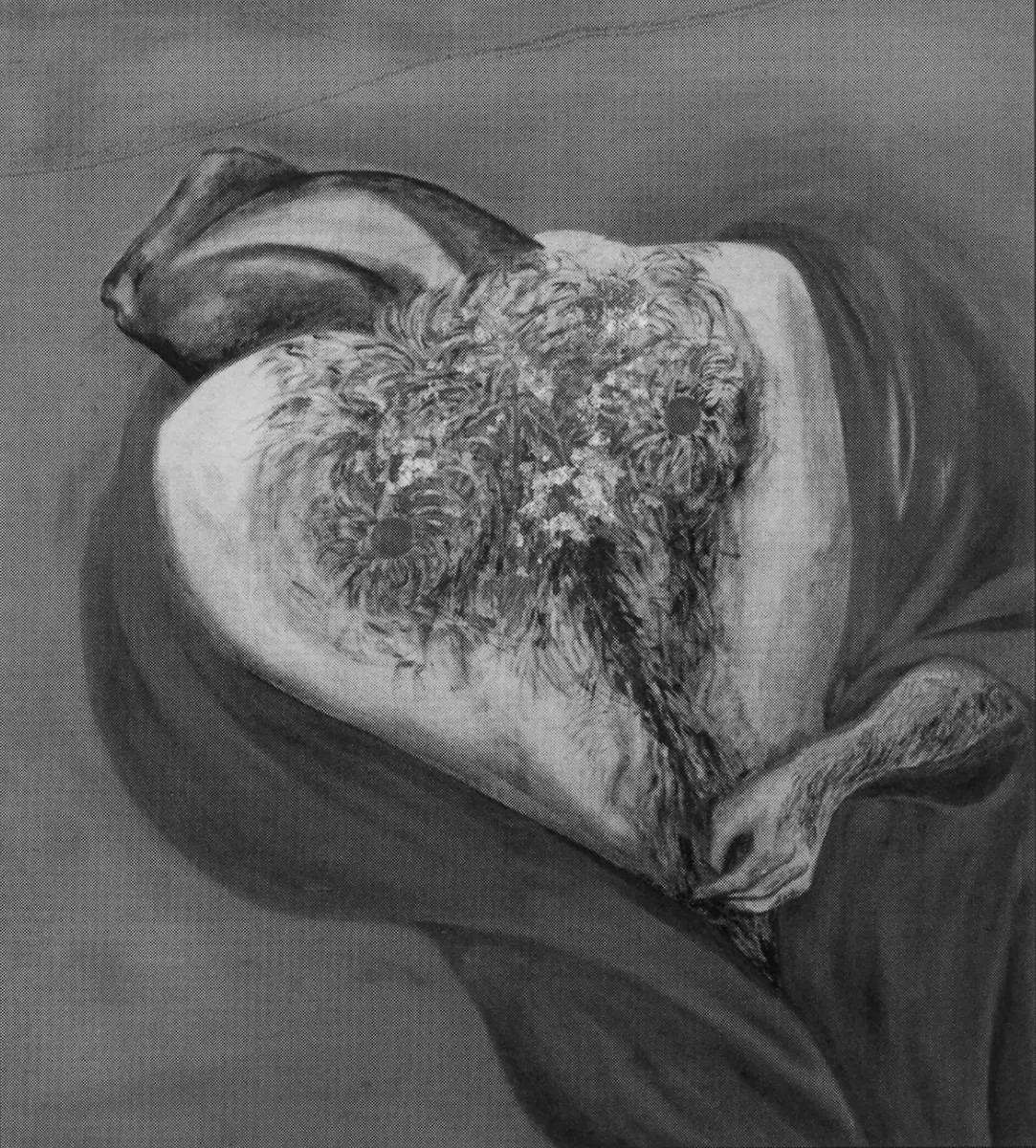
How then can we read the careless black scribble on the chest of the lover in the picture titled Taliban? For an artist with such an impeccable sense of craft, nothing of this seems to be comprehensible, except in terms of the rebellion of Eros against death.
We could say that the Eros/Thanatos dichotomy provided the organizational structure of this exhibition. This is the reason for the sensual surge of color that insists on bringing back to the surface, over and over again, the specter of death in the obsessive series titled The river is our river of blood. There is in these images a precise capture of the work of memory which, as Bergson argued, moves like a river.
But in this river/memory of ours, Schvartz's paintings recuperate lost bodies and make them flash in the moonlight, transforming them into the ghosts which watch over the city burning in its vanities:
In one of the catalog texts, the print-maker Fernando Bedoya, who collaborated with the artist on these images, refers to one of the foundational myths of painting: that of the potter of Corinth who drew on the wall the shadow of her lover, before he left for war. To place love and desire at the origin and birth of the image is to see the latter as a challenge by life in the face of so much death.
In this encounter Schvartz makes the breast of the lover emerge in Red Ink, one of the great works in the show, like a flower of powerful pictorial energy on which she places, almost invisibly, the wings of a real butterfly. And it is this small detail which links these violent and sweeping paintings with the group of boxes bound with locks of colored wool, branches, and thorns, which she presented for the first time last year at the Rojas Cultural Center and which were included again in this show. These little child-like garden herbaria, with tiny glass balls, silver thread, resin, and dissected animals reiterate the yearning for refuge which underlies all of Schvartz's work and can be seen as an essential counterpoint to the leitmotif of the show.
This clear identification between painting and physical desire which has run through all the recent work of this artist seems to be the same as that which characterized the monumental work on eroticism which Georges Bataille undertook when he himself felt invaded by the anguish of death.
ANA MARIA BATTISTOZZI