
It was a privilege to have had the opportunity to see most of the work of Max Jimenez—his documents, photographs, letters, and many other biographical materials-in this recent retrospective organized by the Museum of Costa Rican Art. Amalia Chaverri, the director of the Museum and an enthusiastic supporter of the work of this outstanding Costa Rican artist, describes his art as "innovative, avant-garde, critical, polemical, and subversive." The most subversive aspect of his work is that it is wickedly autobiographical, a means by which the artist legitimizes his artistic thought, theoretically summarized in his famous candelillas. The faces of his figures, which combine romantic elements with a humanistic visual content, as well as his own faces which reflect the changes that occurred throughout his life, clearly show that his paintings were the pretext for his own self-portraits, especially with regard to the marked facial characteristics. These are self-portraits that come close to what is really "real," because they are based on the spiritual, psychic, and moral characteristics of the artist. If we look at Jiménez's photographs in their contemporary context, we can clearly see that they have an aura of mystery that gives them a premeditated and ineluctable destiny. With his deliberate commitment to the most up-to-date forms of modernity, Jiménez's work reflects a modern spirit, intelligence, and sensibility without limits. This is not only because of his insistence on contemporary proposals, but because of the visible presence of the spirit and the body, both presented in fragments, bits, or perceptible strips of being. These fragments of life, which are his own, with their existential problems, become visible in images of whatever kind-which comprise an aesthetic category that reflects the visual culture of his time. This was his response to the universal collective psyche. Here there was no room for "scandal," but only chromatic sobriety, introspection, and intimacy; the innermost depths of a being almost ripped out of its own existence. With the passing of time, the artist increasingly comes to resemble one of his solid, excessive, and physically and spiritually bloated figures, where everything is expressed within a very unusual kind of aesthetics. He focused his attention on a man in general, who was found in the street, and on one man in particular, himself.
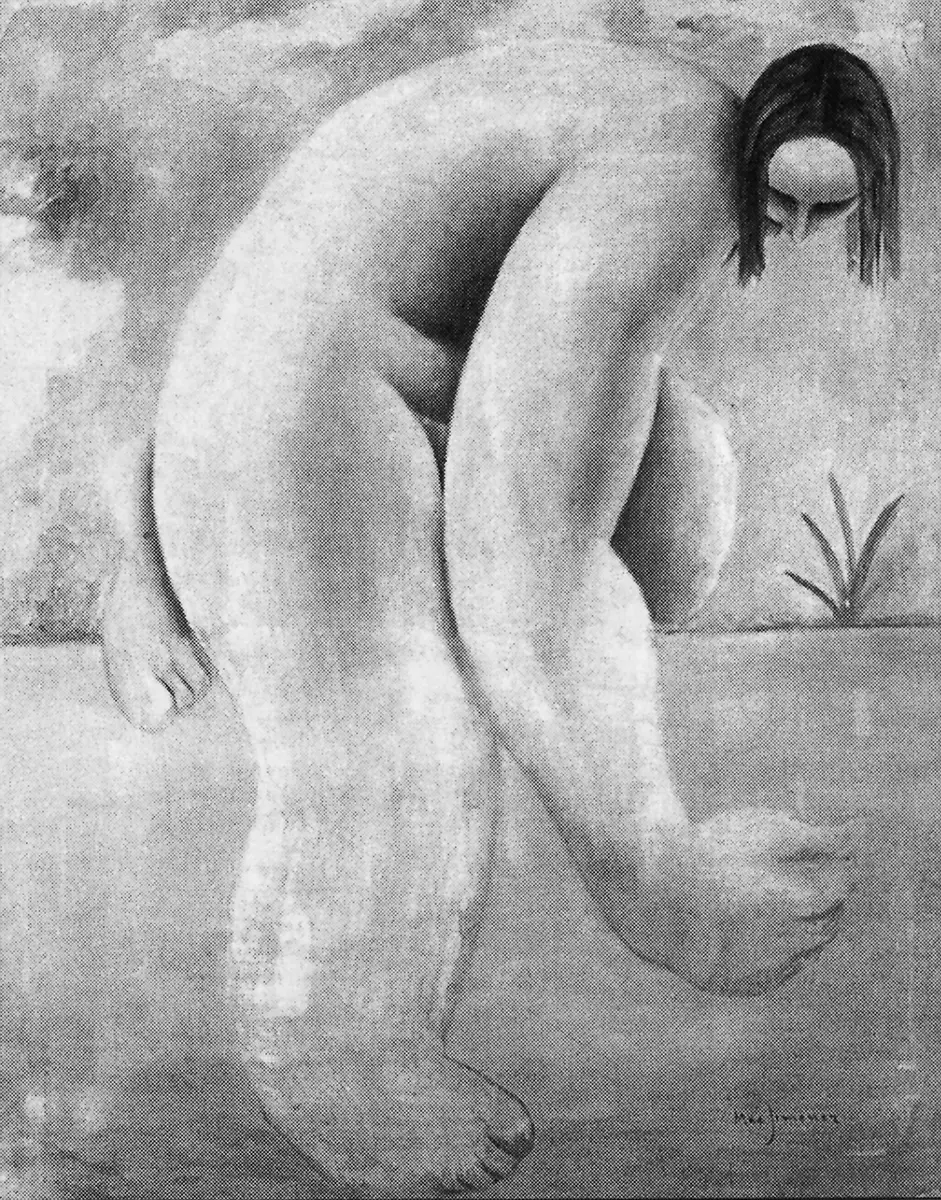
Throughout all his creative periods, Jiménez remained in direct contact with the major artists of the time and the principal centers of artistic importance. In this sense it is essential to place him within that context, bearing in mind the importance of the absolute and intrinsic value of his own artistic-plastic proposal. In the 1920s he began to set forth his plastic principles based on the excessive proportions of the human figure. This became the imprint of visual aesthetics from the 1930s onwards. Around the same time and under the same influence of Picasso's neo-classical work, a group of Latin American artists, in a process of collective fermentation, were doing exactly the same thing. In Brazil, there emerged the gigantic two-dimensional volumetric forms of Vicente Do Rego Monteiro and Tarsila do Amaral, followed by Candido Portinari and Emilio Di Cavalcanti. In Mexico, the deformation of the figurative form was well represented by the mural painters José Clemente Orozco and David Alfaro Siqueiros. Colombia saw similar tendencies in the work of Luis Alberto Acuña as did Argentina in the work by Antonio Berni (to mention only a few artists now considered fundamental to the art of Latin America).
What is absolutely certain is that Max Jiménez always took freedom as the premise of his life and his art, and without losing any of its essences, never misrepresented the mysterious world of painting as a horizon.
BELGICA RODRÍGUEZ