
This recent exhibition by Rubén Torres Llorca at the Freites-Revilla Gallery marked an important change in the artist's career, as well as introduced a new theme in his work. In four installations, which in fact should be seen as a single whole, the artist reflects on various aspects of the art market and analyzes the relationship between the market and the artist.
The first work, titled The Artist's collection, shows a series of fetishes sculpted in wood, painted black, and marked with the names of persons who have positively or negatively influenced his professional career. It is, in his own words, "a kind of poetic justice" through which he establishes a relationship with the persons represented, whether collectors, masters, curators, or art critics. Through this work, Torres Llorca alters the traditional relationship between the artist and the public. The persons represented in the work are no longer simple spectators but manipulated individuals, transformed into fetishes. The magical character (which in this case is closely linked to Afro-Cuban traditions) implies a control by the artist and a reaction by the public, which varies according to the impact (positive or negative) that the person in question has had.
There have been cases in which persons have seen themselves identified and have reacted with rejection, unease, and even fear, ratifying the power which the artist has in bringing about this reaction. On the other hand, the installation alters the role of the artwork within a more general context. Traditionally, an artwork is sold to a collector and the artist does not know what role the work will play in the everyday life of the person who acquires it. Torres Llorca modifies this situation.
Contrary to the logic of the market, the work is not for sale (although there has been a great demand for some fetishes). At the same time, it is an unfinished work, and in so far as more fetishes can be added over time, the work has an unlimited continuity. Finally, the work generates a bilateral relationship in which the artist and the public are both the receptor and the transmitter in the communication process established by the work. The spectator cannot see the work in an objective way, since he is also part of it. For his part, the artist takes pleasure in altering functions and causing reactions. It is a complex system of relationships that consciously and unconsciously affect both parties. The second installation in the show, History teaches us nothing, questions the way in which art history is generally taught.
Several small wooden chairs are placed opposite a wall with blackboards on which quotations from well-known artists are written. In all cases, the texts are related to negative aspects of the life or profession of these artists. By placing the blackboards almost at floor level, the artist forces the spectator to lower his gaze, as if in an act of respect. The use of quotations establishes a distancing (in previous works the texts were mostly autobiographical), inspires respect (particularly when the quotations correspond to the words of someone dead), and provide their own cure (the use of therapy is a constant in the artist's work), in so far as Torres Llorca has experienced similar difficulties throughout his own artistic career.
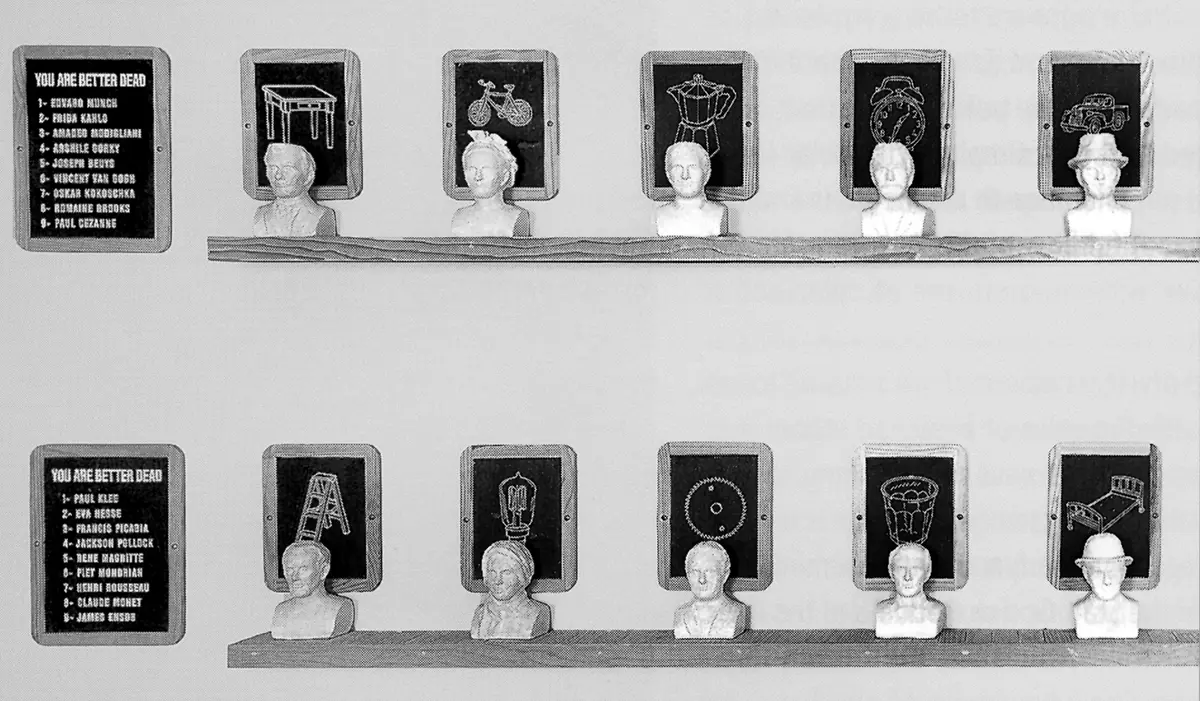
The third work is also based on the artist and criticizes the fact that in many cases, artists are Better dead than alive. Eighteen busts of artists who were not recognized in their own life or who suffered economic hardship, and whose works are now sold for enormous amounts of money, appear lined up on a wooden shelf.
Each of the faces is backed by a black slate drawn with chalk (the relationship between the artist and the drawn object can be interpreted in many ways). The irony of the work is heightened by the ignorance of the public concerning the identity of most of the faces, except perhaps those of Frida Kahlo or Vincent van Gogh. Were it not for the names which appear written on the side, these faces would lack identity, even though their works are sold today for thousands of dollars.
The work is a clear and direct denunciation of this kind of situation suffered by an artist in the flesh. The criticism is not only conceptual but also formal. On the one hand, Torres Llorca exalts the identity of the artists by depicting their faces in plaster with great detail; on the other hand, he unifies the other persons related to the world of art by depicting them as featureless fetishes. The contrast is also evident at the technical level. The dead figures appear in delicate busts of white plaster, while the fetishes are done in rustic carved black-stained wood. This subtle language is essential to the discourse of Torres Llorca, who not only knows the history of art but has lived it with great sensibility.
The final work in the show gives the spectator the chance to Fill in the Blank. The work comprises a series of blackboards drawn with few elements and depicting images of wrestlers, who within the context of the show can be interpreted as artists, critics, or collectors. The absence of any text gives the public some degree of freedom: the spectator feels less inhibited in front of much more academic two-dimensional work.
Of the different representations of figures from the art world, that of the artist himself is perhaps missing. The interpretation of his own role can be guessed from the four installations in the show, but the work of a clearly biographical kind remains in a sense still to be done, like the lost piece of some incomplete puzzle.
This exhibition, of great visual and conceptual content, reconfirmed the artistic quality of Rubén Torres Llorca's work and presented a new discourse that allows him to some extent to distance himself from his earlier work, without however losing the thread of his concern for the role of the artist as a professional and as a human being.
FRANCINE BIRBRAGHER