
A recurrent theme in the art of the last decade has been the thinking and reformulation of the past from various perspectives. This approximation of what has already happened implies an exercise of memory that artists frequently carry out. To be the witness and interpreter of past histories does not suppose a single or unique gaze; the works created may refer to the past as an intimate event, but also as something set within the public sphere, showing the permanent intrusion of the public in what is private. In this process of various explorations, these works by Trixi Allina, titled Absent, can be seen as an attempt to transform the personal experience and the artist's particular memory into a collective memory. Allina is conscious of the fact that collective time requires the presence of individual time, enabling a relationship to be established between the private and the public. This is where the challenge lies: to transform intimate experience into an aesthetic experience that makes a break with individuality and can be shared by others. The experience of the individual self furthers the search for identification with the collective self. But it is not a question of looking back with any false nostalgia, but of recovering elements that are vital and still present. Allina's project is based on a kind of autobiographical documentation that tries to offer a reading that is open-ended for the spectator, thus enabling the personal character of the experience to be communicable. She tries to reveal the memories contained in certain private objects which, when put on public show, can be seen as resources linking us to the collective experience. She thus begins with memories of her personal history, full of revealing meanings, such as photographs, clothing, and letters, and which she reworks in an attempt to allow the spectator, in the presence of these objects transformed into plastic material, to make his or her own reading. She thus strips them of the personal meaning that they have for her, A handkerchief, a suitcase, and the location of a family reunion, become resources with which she fills space in an attempt to resist the sense of absence.
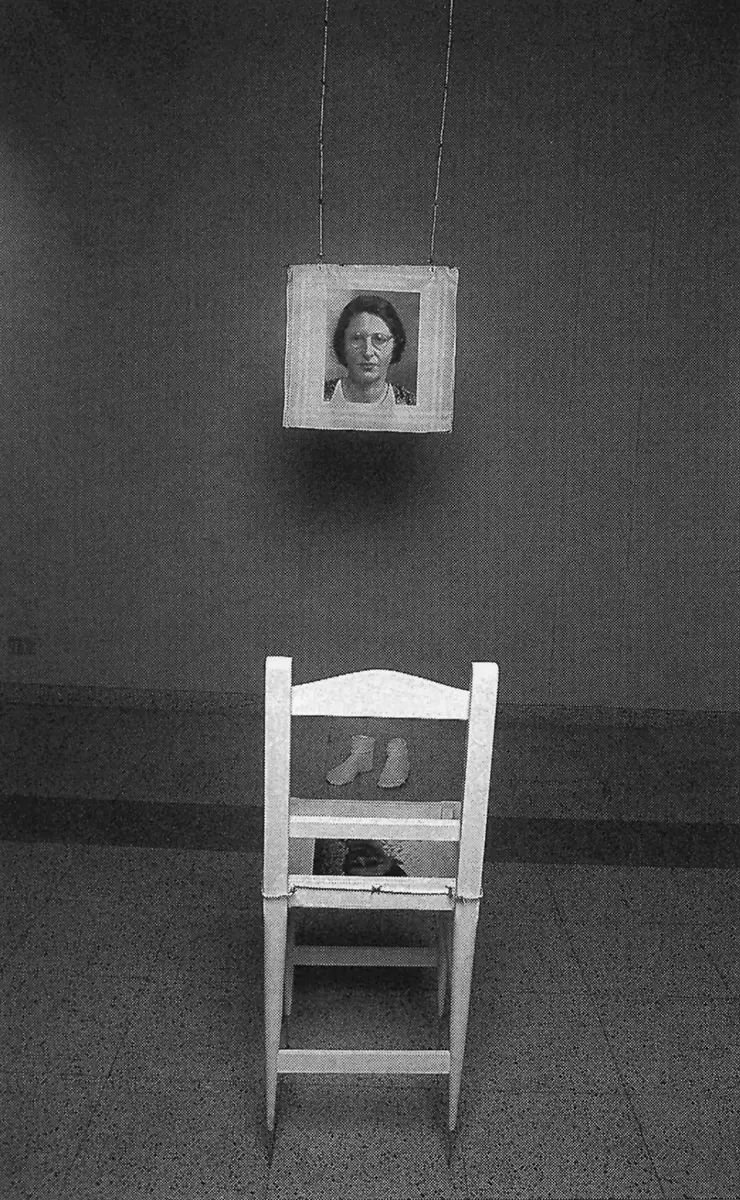
In the events which the memory tries to recover, some areas are illuminated, and others remain in the dark, escaping us. Allina is interested in the light which allows her to reconstruct the event, but at the same time, she is looking at what is disappearing, at what was but no longer is. For this reason, she proposes a two-fold approach to memory, with light and absence being the two basic elements around which she works. From this perspective, the concept of the public and the private comes to the fore, with the feminine and memory being seen as a form of resistance.
How can these three supports be tackled in conceptual terms? The private space of the artist is a place determined by previous experiences, a heritage that provides the means of recognition and sensitivity for dealing with what is happening today, and something which enables this experience to be socialized. This legacy, however harsh, is not a burden but an experience that can help further the work of construction. A construction that is not intended to be an explicit political denunciation, for example, of acts of violence, but an attempt to reach the unconscious level in the spectator. Allina does not forget that every spectator will bring along his or her own family album in reading this work.
Another support in the exploration process is her idea of the feminine vis-à-vis memory. Woman is seen as collector and container of memory. She recuperates the space of the private and the secret. If we accept this is part of the feminine condition, then there is much to explore, both in the elaboration of these concepts and in the kind of materials used to construct the project elements which all reinforce this concept. The difference in roles of men and women as regards memory indicates the place of each within our cultural model, and it is in the recognition of difference that the richness of both extremes lies.
The use of memory to generate art of resistance has been a constant characteristic of many contemporary artists. Allina's work is set within this context. Art analyzes what is happening in our society, it attempts to depict it, construct meanings as well as resist excesses.
Memory is one of the most characteristic and singular representations of the concept of time. The present contains the past but also the future and it is between these two that Allina's work moves.
IVONNE PINI