
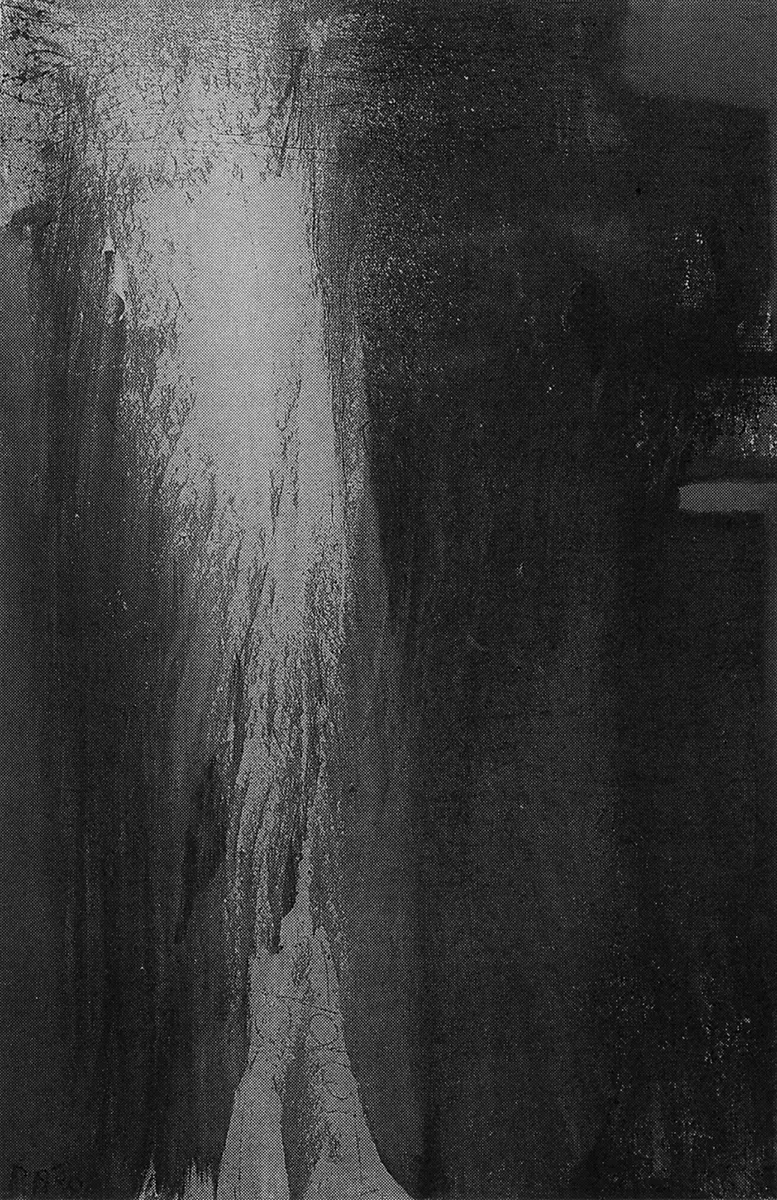
In the magnificent exhibition room of the new building which serves as the headquarters of the Peruvian-North American Cultural Institute (ICPN), the Peruvian artist Antonio Máro, who lives in Belgium, recently presented an exhibition of his new work. In the show, which included a good selection of paintings, as well as two sculptures, the artist revealed to his compatriots the work on which he has been engaged over the last two years. Without any major changes in his themes, Máro once again presented another facet of his artistic credo. For him, the most important thing is the "process of painting" since "it is the form which gives life to the theme, and not vice versa." I have been following Máro's work for a number of years, and in each of his shows, I have noted his great mastery of technique, the expressive overflowing of the stains, the "drips" of pigment, and the graphism, as well as the intimate and human dimension of each of his works, even those of very large format.
Although he has lived a long time outside his country, Máro is an artist who has not forgotten his cultural heritage. Born in Catacaos (1928), a town located in the Piura desert, he found himself transported as an adolescent to the rigorous environment of Germany, part of old Europe: but fortunately, this did not result in any contradiction. Being aware of the old and combining it with the new has left an important and indelible imprint on his work. The sense of nostalgia, the memories which returned thanks to the ever-pleasant presence of a grandmother, sometimes real sometimes imaginary, became themes for his painting. At this point, Máro makes use of a stock of images taken from his memories and which he combines with a pictorial practice that includes postmodern and new elements.
The plastic sequence of Máro's work, up to this exhibition, indicates that he belongs to the current of abstract expressionism, although major aspects of his artistic practice distance him from this category and indicate that he in fact belongs to an absolutely new current in his pictorial treatment of the surface of the canvas. His creative and completely personal experiences in front of the canvas, without the presence of any accidents at the technical level, have allowed him to achieve greater impact with his themes that, without being figurative, do express introspective and ontological concerns. In his painting, Máro addresses the Being and its circumstances. And it is precisely here that his twofold cultural ancestry appears. The presence of his original Latin American ancestors can be seen in the cosmic duality of the abstract and the figurative, the real and the non-real, while his European artistic training has allowed him to scale the heights of pictorial perfection. The first aspect is reflected in the veilings and the careful drawing of masks and indecipherable writings that function as mysterious codes for some concepts beyond the painting itself. The second aspect is evident in his use of the universal tradition of painting for itself. Without being either figurative or abstract, Máro combines in his work two contrary poles within a single pictorial concept. The "drips", free brushstrokes, and washed surfaces appearing on the canvas, which seems to be without any beginning or end, are part of a complex personal plastic language that is captivating in the fullness of its silence. Once again, with his profound plastic conception of color and the fresh alchemy of his experimentation, this Peruvian artist has confirmed the strength of his presence in the arena of universal art.
BÉLGICA RODRÍGUEZ