
The city of Cuernavaca enjoys a special peripheral situation with respect to the neighboring city of Mexico: as a separate city, it is engaged in a permanent debate about its union with or separation from the metropolis. Although a reading of the work of an artist in relation to the reality of a city may not be completely appropriate, it is undeniable that the work of Cisco Jiménez (Cuernavaca, Mexico, 1969) reflects this same sense of closeness and distancing and a fascination with the visual and verbal saturation of the city.
Jiménez's work has all the irreverence characteristics of Mexican roguery: inventiveness, sarcasm, parody, daringness, verbal aggression, and humor as the only defense against a reality that is generally adverse. His work has to a large extent made references to the subculture aesthetics and texts of the comic strip and advertisements in Mexico City: he takes what is tacitly an urban narrative and transforms it into an artistic narrative.
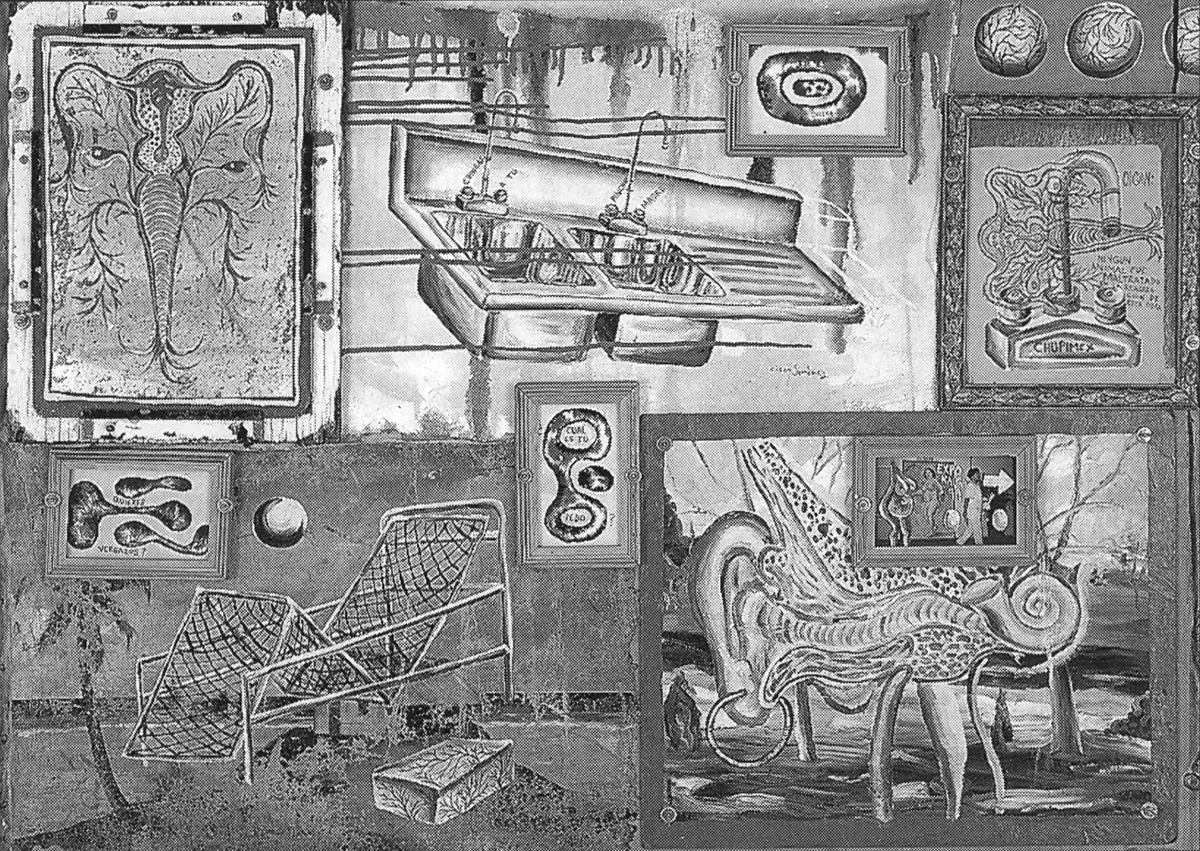
In a way that very few artists have managed, Jiménez has become a kind of enfant terrible who gathers together a whole series of phrases, images, and situations that are very familiar in Mexico, and which are usually taken for granted: enormous signs with the names of presidential candidates, which invade all the roads; logotypes and phrases taken from commercial advertising which have become part of popular life, the truck language of everyday life.
The artist's fascination with these cultural underworlds was reflected once again in his recent exhibition at Associated American Artists in New York, although in this case, the same narrative acquired a new twist, a much more personal and icier dimension. Buying a stove, but ovulating at the same time included works with apparently autobiographical confessions accompanied by burlesque comments in various visual diversions.
Jiménez undertakes a kind of revision of personal sentiments through his classic distancing, daring, criticism, and extraordinary sense of humor, but this time with a kind of self-reflective and merciless mockery of himself. Your matted hair is one of the texts in a work that includes the depiction of a cut on the skin, like some anti-romantic rapture on a symbolic element of love, such as the hair.
The use of diagrams of sexual organs (fallopian tubes, vaginas, and other organs appear in almost all the pictures), as well as the presence of stoves and sinks establish a visual vocabulary that draws its strength from the tension between the intimate and the impersonal.
Apart from the clear comparisons between women and kitchen appliances (refrigerators, stoves) as domestic possessions, and the references to the taps of the washstand and the sink as hermaphroditic sexual symbols (expelling and retaining liquid), these elements can also, strangely enough, be interpreted in terms of alienation, isolation, and even solitude. Jiménez expresses his personal meanings by recycling advertisements, and copies of images in stamp e-books and collages, but at the same time he makes us reflect on the emptiness of interpersonal relations in a world of buy and sell and function-based mentalities. In some works, in particular, Jiménez makes direct references to moments of his own life (waiting in the solitude of a station in Los Angeles), which function as a realistic counterpoint to the humor which predominated in the show. The autobiographical elements are particularly evident in works such as Portrait with my ex-girlfriend, which once again is a kind of mockery of personal incidents, but always accompanied with a humorous footnote: "the colors of this work are courtesy of Air France". The sensation that these works are comments in a diary is heightened by the fragmented composition of most of the pieces, which are made up of several little pictures or collage images, like pieces in a puzzle referring to the fragmentation of moments that have been lived.
Perhaps the most powerful aspect of Cisco's work is precisely this unmerciful self-examination of his own weaknesses, and the use of the kind of eschatological language employed by children at school as a means of defending themselves against those who are more powerful physically: an authentic survival tactic. Cisco's work is a self-portrait but at the same time a social critique and a reflection of our own impotence as human beings against the system and our own destiny. The way in which not even he takes himself seriously is, in turn, a general sign of an entire international generation of artists. Skepticism is the rule, sarcasm, satire, and parody as a means of defense. And melancholy as a complement to irony.
PABLO HELGUERA