
Elmar Rojas, Guatemala's renowned artist and cultural advocate, has long been associated with magical paintings that capture the spirit of a verdant landscape rich with mythology, history, and the ancient art traditions of weaving, stonework, and ceramics. In this radiant exhibition of recent paintings (1991-1999), the luminosity of his color contrasts with mysterious shadows for enchanting effects. These effects, for which he is well known, are particularly eye-catching when seen in the number of works filling this small museum. It is an exhibition that not only represents the best of the artist's now familiar palette and aesthetic concerns, but also demonstrates how he continues to experiment and explore for admirable results, particularly with surface and texture. The addition of new materials and a looser, more painterly application of paint greatly enhance an already vibrant approach to painting. The inclusion of small dolls and other elements drawn from the rich traditions of Guatemalan crafts is a fascinating addition to his artistry.
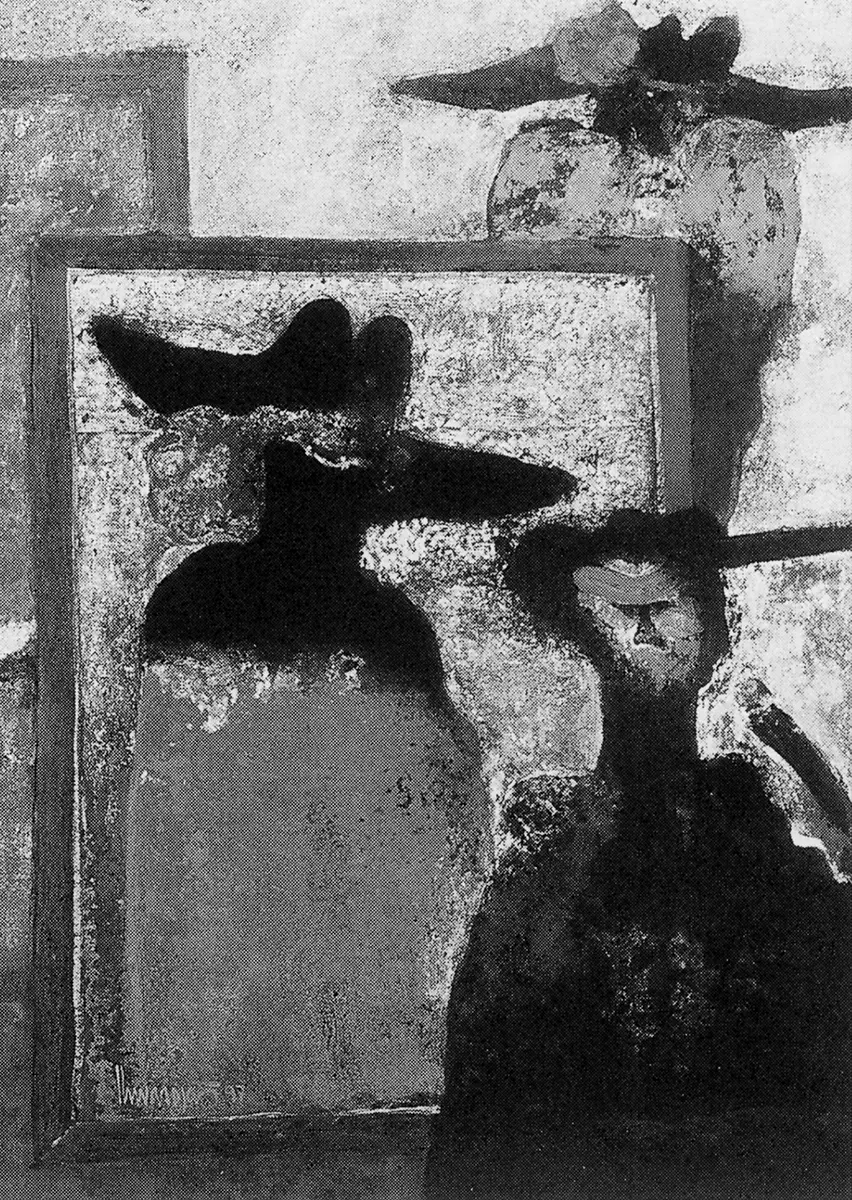
Over the years, Rojas has developed a distinctive technique and a personal repertoire of images that pay homage to the legends of Guatemala. Among the most familiar of these images are the performers known as espantapajaros, or scarecrows. Cloaked visages lacking anatomical definition but always wearing wide-brimmed hats and inexplicable eye gear, the scarecrows perform numerous roles and engage in bizarre activities that are at once earthly and unearthly. They assume a wide variety of poses, shapes, and colors as their flexible bodies inhabit a hazy world of iridescent silence. They often perform like spirits or ghosts who have returned to haunt their earthly inhabitants and continue their earth-bound activities. They may even be seen accompanied
by other ghostly creatures, some female in appearance, some animal, who share their vague countenance and eerie glances. The incorporeal nature of their existence brings to mind the transformative nature of so many of the characters in the myths of Central America who, as mysterious entities, possess the ability to move between physical and spiritual worlds, as humans and animals, and combinations of both. The scarecrow in De la Galería de los Espantapájaros (Gallery of the Scarecrows), 1997, performs as a vehicle for exploration into the lore of the country, while the dark shadows and the contrast of glowing colors enhance its bizarre locations as sacrosanct.
Deep shadows dramatize scenes and surround the characters with a velvet cloak of mystery. They distinguish the luminous blues, violets, reds, and yellows that dominate the artist's palette and interact with subtle tonalities. Within the depths of these rich colors is an iridescence that glows from within. These are especially effective when used to ignite the glowing ocular paraphernalia worn by the scarecrows in works like Temas de la Naturaleza - Despedidas (Themes of Nature-Farewell), 1997. Rojas employs a unique and distinct technique that reinforces this magical mood with seductive textures and layers of pigment that are systematically scraped to retrieve colors buried beneath. The layering and scraping result in a chiaroscuro effect with subtle gradations of tone that bring harmony to every surface; beeswax lends the surface a velvety touch. The technique requires meticulous attention to every color and can be compared to the complexity of Guatemalan weavings and the careful planning necessary to work the patterns into the structure of the loom.
The 1998 painting Velorio del solitario (Guardian of Solitude) hints at changes to come in his approach to the surface of the canvas with the addition of gold pigment to his color palette. Some work even reveals raw canvas rather than the carefully layered pigments
associated with Rojas' technique. In his most recent works, not only the surface textures but also the inclusion of fiber materials are welcome additions that bring a new dimension to his realm of fantasy. The theme of the scarecrow combined with references to El torofuego, a bull-shaped frame used in firework displays for festivals that he has played with for many years, is made as vivid as a Guatemalan textile. Painted in dazzling pinks and accented with tiny woven dolls, Fiesta de Cofrades con el Torofuego (Party of the Brotherhood with a Torofuego), 1999, pays homage to brilliant sunsets and the fire of a volcano-lit sky, while Temas del Palo Volador (Themes of the Flying Stick Whirlers), 1999, asserts the same bright tonalities with a palette of equally vivid blues. Swirling acrobats, descended from ancient Mesoamerican traditions, perform before a huge, seated figure with glowing eyes. Patches of opaque white energize the surface and bring the myth back to reality.
Steeped in the rich traditions of Guatemalan legends, folk art, and crafts, the exquisitely executed paintings of Elmar Rojas continue to lure the viewer into a world of magic realism, and the opportunity to see his recent explorations into form and content makes this exhibition extremely worthwhile.
CAROL DAMIAN