
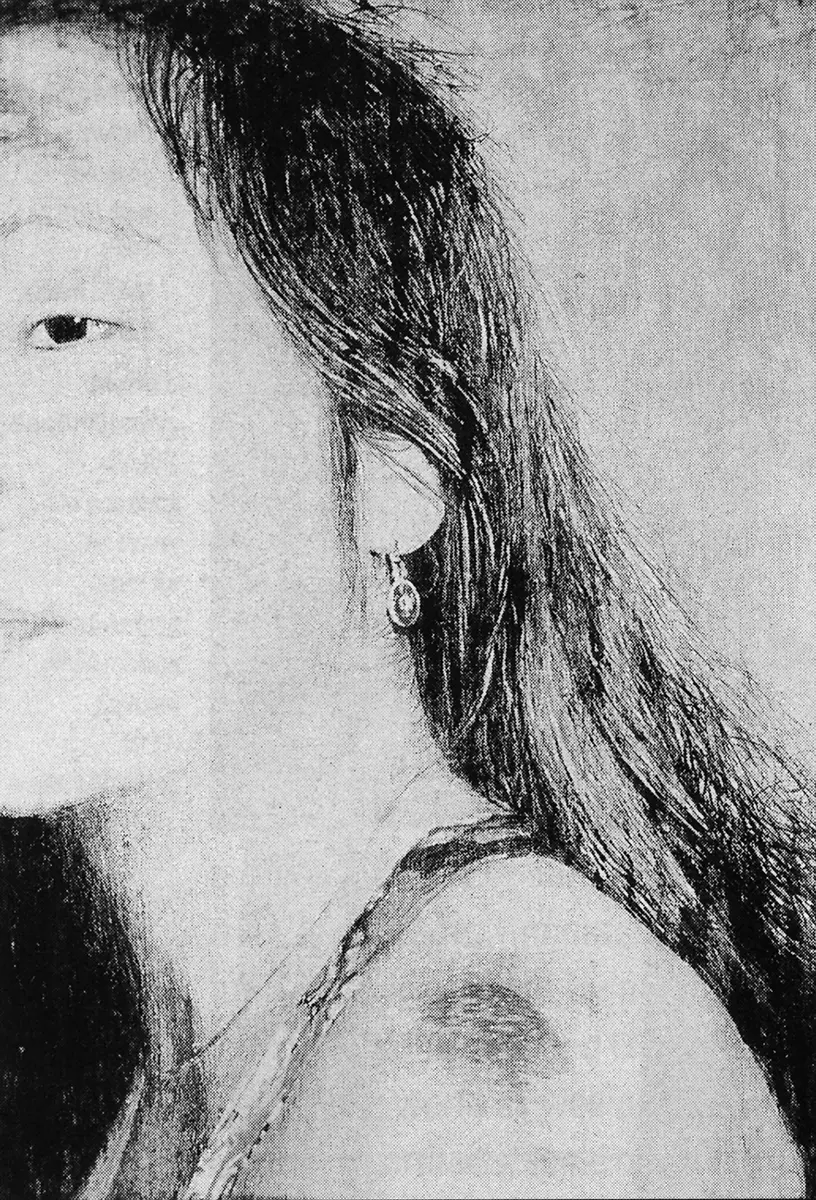
Only one of the paintings in Enoc Pérez's exhibition, Winter, appears to refer to the cold, bleak season of the title. That picture, Central Park, shows the tops of bare trees, leafless branches splayed out against the night sky, while the park's lampposts gleam from behind like Christmas ornaments. The branches are stark white, blanched, and delineated from the inky blue-black as if by the camera's flash. All the artist's works, in fact, are painted from photographs, but the remainder of the images on view seems at first glance to have been taken in less barren times of the year. Pérez's subjects include a bunch of massed daisies (Flowers), a palm beach in the tropics (Palms), and a pretty young woman's face in a close-up (Passerby). In Twilight, a woman in a sundress at a backyard garden party is rendered headless by some fault of the film's exposure. The accident shows a woman with bloody, raw scrapes on her forehead and shoulder, her face cropped in half by the canvas' edge. All in all, Pérez's photographic models seem haphazardly composed, but anyone who has ever witnessed the artist, instant camera in hand, snapping away without looking through the viewfinder, can only be amazed that his paintings are as balanced as they are.
Transcribed, the slick, glossy surfaces of the photographs that are his subjects become the parched, scratchy textures of Pérez's paintings. His is a hard-won photorealism; blowing up his images with an overhead projector, the artist makes color separations by eye alone, and places pigment on the canvas, one color at a time, in painstaking layers of transfer drawings. In effect, Pérez takes the technique of photomechanical color reproduction and refashions it into a handicraft. While the build-up of paint can produce lush and saturated color, there are no brushstrokes, and the faint indications of the pictures' making— marks of the artist's hand from the transfer-drawing process—serve to confuse rather than elucidate. Pérez's painting always feels contingent, conditional upon the strength of the image alone to give it form.
A snapshot aesthetic conspires with the chalky coagulate of pigment to intensify the sense of both distance and longing in Pérez's imagery. His subjects are forever seen in passing: objects, people, and moments that are fleeting and thus can never be held. Caught for only an instant by the camera's flash, Pérez's landscapes, still lifes, and portraits seem to escape from our grasp as we visualize them. The transitory nature of the world depicted in his images is the true desolation of his work; the winter Pérez pictures are that of his discontent. His longing is, in part, desire; portraits of gorgeous yet somehow unreachable women abound in Pérez's oeuvre, and the uncannily inviting blossoms with white petals and crimson centers in Flowers match the moist red wounds that bloom on pale ivory skin in Accident. And yet, the pictures reveal a world that is close at hand and precious to the artist. Palms depicts a view of his native Puerto Rico, while the sitter in Accident is a close friend who had recently fallen off her bicycle. Pérez's paintings picture what the artist knows to be ephemeral instants of his life, which imparts an air of sadness and alienation. That this knowledge does not ever diminish the deep meaning of these instants to him, and endows his work with a beauty born of grace.
JOSEPH R. WOLIN