
In 1972, a young artist born in San Juan de Los Morros a city located in the heart of Venezuela confused an audience unfamiliar with the new significance tendency of contemporary art. His first solo exhibition at the Museo of Fine Arts as well as his Impenetrable installation at the ' Ateneo de Caracas', both shows produced that same year, challenged the lines of kinetic art, a popular trend in Venezuela during the seventies. Eugenio Espinoza was in his early twenties.
Since then, Espinoza has always been surprising news. His work leaves its mark in each of its stages or process. It is the result of a ruthless reflection in which it each phase was 'devoured' by the next. Each stage takes a different place before contemporary art, to the extent that, at times, drastically opposes another. Recently Espinoza mentioned to me ' Contradiction saves you from being decorative', and undoubtedly contradiction makes up the impulse to a work of art that has reflected upon itself for over thirty years.
Humor and sarcasm are constant. The grotesque is handled masterfully in his diverse stages and on many occasions, creates public rejection. The discordance between juxtaposed images, when they are decontextualized or accompanied by some witty phrase; the addition of popular pieces or references in his compositions; the way he manages the impurity of color; the use of fragile supports and materials; or the disturbance of the values in order to create a 'bad painting' are just a few examples of his sharp sense of humor. These pieces are absurdities that tend to change the logical aesthetic experience of the viewer. In despite of the intellectual support that Espinoza used to define his work and place it within contemporary art we can't avoid the fact that he is a tremendous emotional and passionate artist.
The Seventies
Kinetics was a decisive movement in Venezuela. Through either adherence or rejection, it was impossible to avoid its presence. Esteemed, underestimated, criticized, or envied, through the years it established itself within the plastic tradition. This tradition, in some way, subconsciously or silently conditions the work of many artists. Jesus Soto's Penetrable, Julio Le Parc's distorted mirrors, and Carlos Cruz-Diez's chromatic environments, among other pieces, aroused admiration as well as adverse reactions. Its fundamental formulations took on validity. For the first time, works were created whose principal support was space. Artists worked with the sensibility and perception of the public, evil collaborated in the work. It provoked new concerns, but it also fostered interests, some foreign to art. The impeccable nature and cleanliness of kinetics, its fine, elegant production, and its condition of being a collector's article were disturbing.
In part, this determined Espinoza's first piece. In opposition to that art, his work was precarious through his choice of materials and the work's ephemeral condition. However, the artist reestablished the criterion of the "penetration" of space and induced the viewer's participation. In the Salon de Maracay in 1971, for example, the public penetrated below nine suspended cubes. They were metallic structures covered with canvas, painted with black lines around the edges. The image of a grid, the leitmotif of nearly all of Espinoza's later work, was foreshadowed here. Inside, occupying the area of the cube, were photographs taken by Vladimir Sersa showing the artist making grotesque faces—a mockery of institutional art, a mockery of the public, and also a mockery of the artist himself. Despite all that, with this work, plus two others that correspond to the current criterion for an installation, he won the Maracay Legislative Assembly Prize.
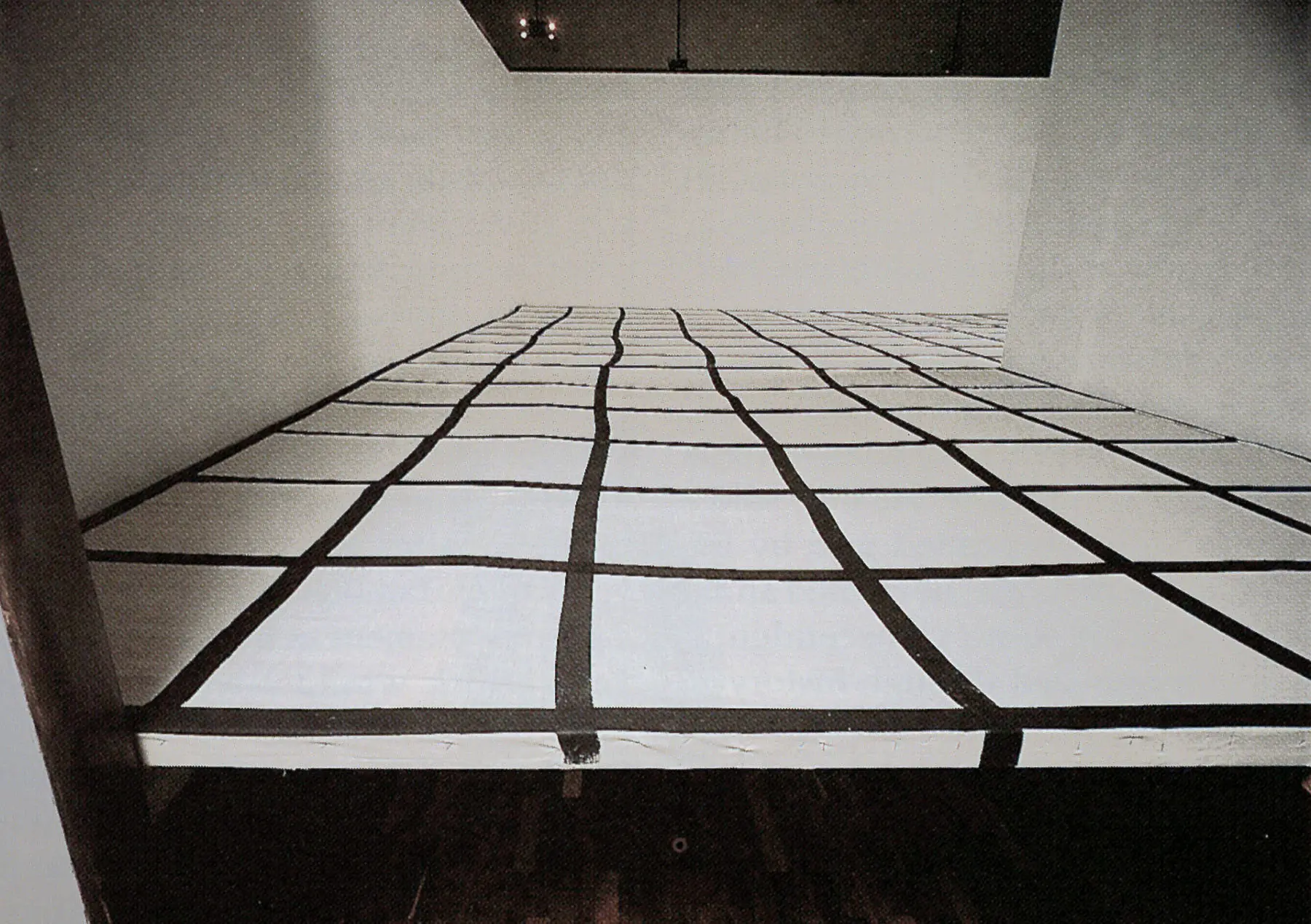
His aversion to pompous officiousness did not stop there. He turned the traditional concept of a picture into the twenty pieces painted with acro-vinyl on an unprepared canvas that he showed at the Museum of Fine Arts in 1972. They had neither a frame nor a stretcher. They were loose, cut, and folded canvases whose essential interest, as Lourdes Blanco indicates, lay in their "revealing the real character of matter": in their being canvases. He thus inverted the relationship between the rigid (the painted grid) and the flexible (the support); he reaffirmed his interest in the structure, at the same time as he negated it. Shortly thereafter, he attacked the idea of Soto's Penetrable when he installed his Impenetrable in the Athenaeum of Caracas. This piece was made up of a large "grid" canvas stretched horizontally eighty centimeters over the floor, and it occupied the entire room. The public could not "penetrate."
That "going against" transcends a simple rebellion. His actions corresponded to his adherence to minimalism and conceptualism, tendencies that occupied, at that time, the heart of his reflections. Some of these actions formulated "formal solutions" in a conceptual work: to climb a mountain stretching ten meters of contact paper or to make engravings through the tracks of a car's tires. Other pieces defied the established order, like when he covered five friends with bags of "squared" newspaper; they wound up being arrested while walking down Sabana Grande Boulevard. All these acts, deep down, were perceptual experiences in which the public's reaction (either acceptance or rejection) had (and still has) a great deal of importance. This determined his inclination to redefine his concept of art on a larger scale. In 1973, for example, at his show at the now-defunct Conkright Gallery, he did it in two ways. First, he transcended the limits of space and time when he "squared" postcards with photos of known works of art and architecture. He then sold a canvas with the painted grid by the yard. In the first case, he created an appropriation of some transcendental works recognized through history in any place in the world. And Espinoza, through his participation, could join this transcendence. In the second case, he opened up the criteria of art's utility from the moment at which the viewer could make use of the canvas as he pleased. It was a matter of conceiving the work as a useful object and questioning the function of art and its real "penetration" in society.
Between 1973 and 1976, he continued with these important inquiries. Together with Claudio Perna, he carried out diverse investigations on the nature of different regions of the country. He defied the limits of sculpture when he threw a stone upward wrapped in a "squared" canvas. The photograph taken by Perna himself recorded the creation of these ephemeral sculptures. In the exhibition 11 types (at the Sala Mendoza in 1976), he stalled a clearly conceptual work. He used the space assigned to him as an area of exploration of the viewer's visual perception. He placed a small red dot on a wall; and on the floor, spread out at different intervals, he placed sheets of cement that indicated the distance in meters from the dot. The viewer stood on the sheets with the idea of observing the dot. Slowly, the dot was lost from view. Moreover, numerous drawings, engravings, and printed matter gave shelter in those years to his famous "strikethroughs," a graphic element as important as the grid, which would later appear on numerous occasions.
Between 1977 and 1980 he settled in New York. He enthusiastically continued with the minimalists—without ever adhering to their rigid pragmatism—and became a tireless student of art history. As a sort of revelation, Albrecht Durer's "grid" allowed him to examine in depth the concepts of "penetration"/"non-penetration." Thus the paper draperies with painted grids were placed on real windows. He also conceived of a process work that consisted of observing the variations that came about in a grid through unevenness and glazing. For this, he drew the lines of a square, varying the direction of some of their sides. He extended them or erased them, at the same time as he complimented the composition through laths supported on the wall. All these experiences are made up of diverse focuses that emphasized the infinite possibilities that could arise in plastic creation starting with a simple and primary figure like the grid.
Slowly, Eugenio Espinoza began to take a place in North American conceptual art. Representing the United States, he participated in 1979 in a large international show of videos (Videos Show) that were transmitted by cable television in that country and later exhibited in Brazil. At that time, he presented his work Supporting Idea, Concluding Idea. In spite of the opportunity he was given for his decisive internationalization, he opted to reside in Brazil for two years—a period in which his interest in Brazilian art rose—and, finally, he returned to Caracas in 1982.
This is when his career as a painter began. His painting took up the formal concerns present in his initial installments from 1971: the representation of the grid as a structure of the pictorial surface and its disintegration. The difference between both historical and artistic periods is rooted in the fact that, from here on, the artist would resolve this conflict through the media of painting and not through the idea, a resource of ephemeral and conceptual art.
Abstraction: limits and possibilities
It is important to understand Eugenio Espinoza's conceptual period for several reasons: first, in order to avoid a fragmented vision of his work; second, because (as we shall see later) his entire career receives nourishment from his initial ideas; and third, because some recent studies have fallen into the grave historical error of underestimating or removing the role he played in the development of this tendency during the sixties. Not only was he a participant, but he also played a founding role. The importance of the final years of the '70s for the artist's career is rarely pointed out; all of the ephemeral experiences he realized are the essential core of his later thought and plastic work. This indicates that he never stopped working. There is no silence between 1971-1973 and the painting of the '80s. The proof is in the works themselves, his registers, and years of production. The actions, installations, and graphic work from the the'70s permit an integral comprehension of the work created between the '80s and the '90s.
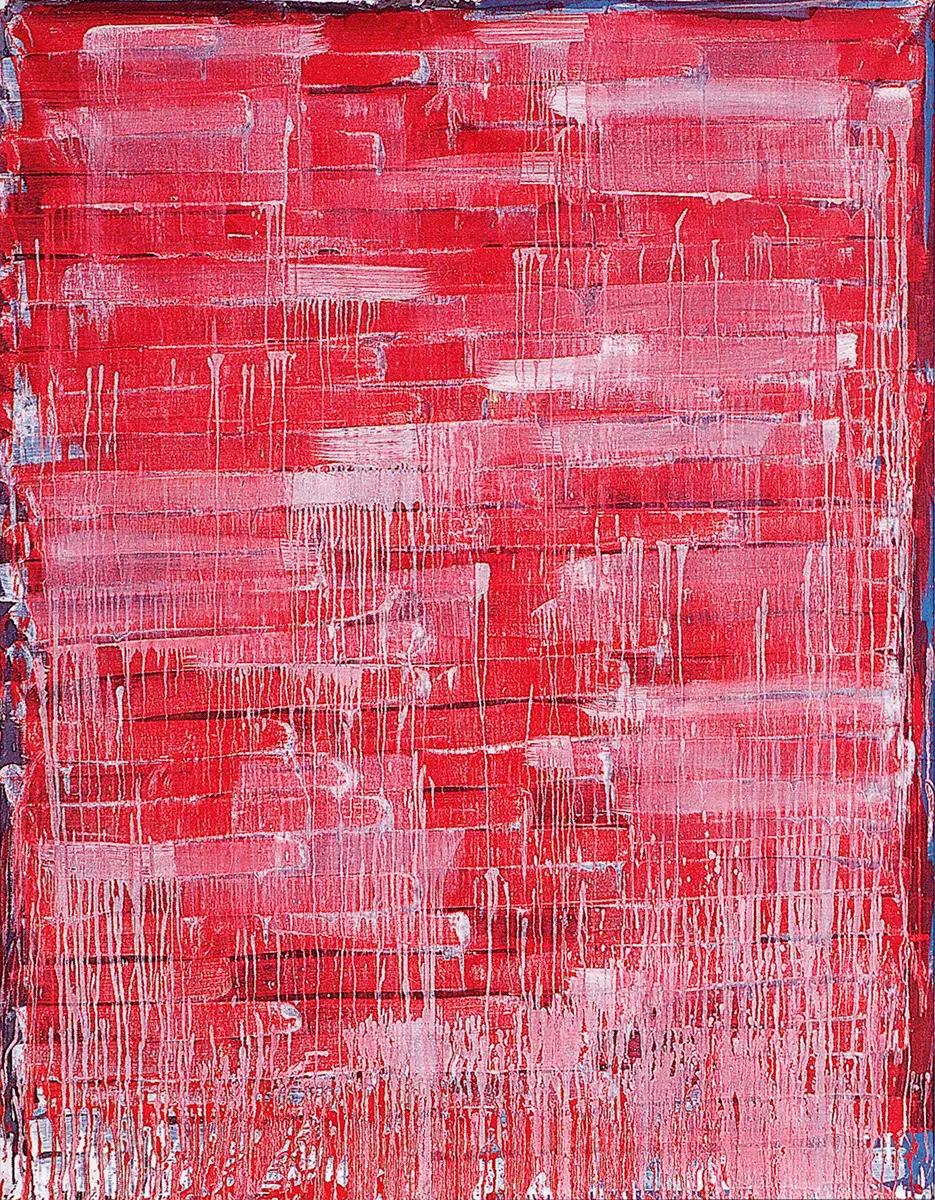
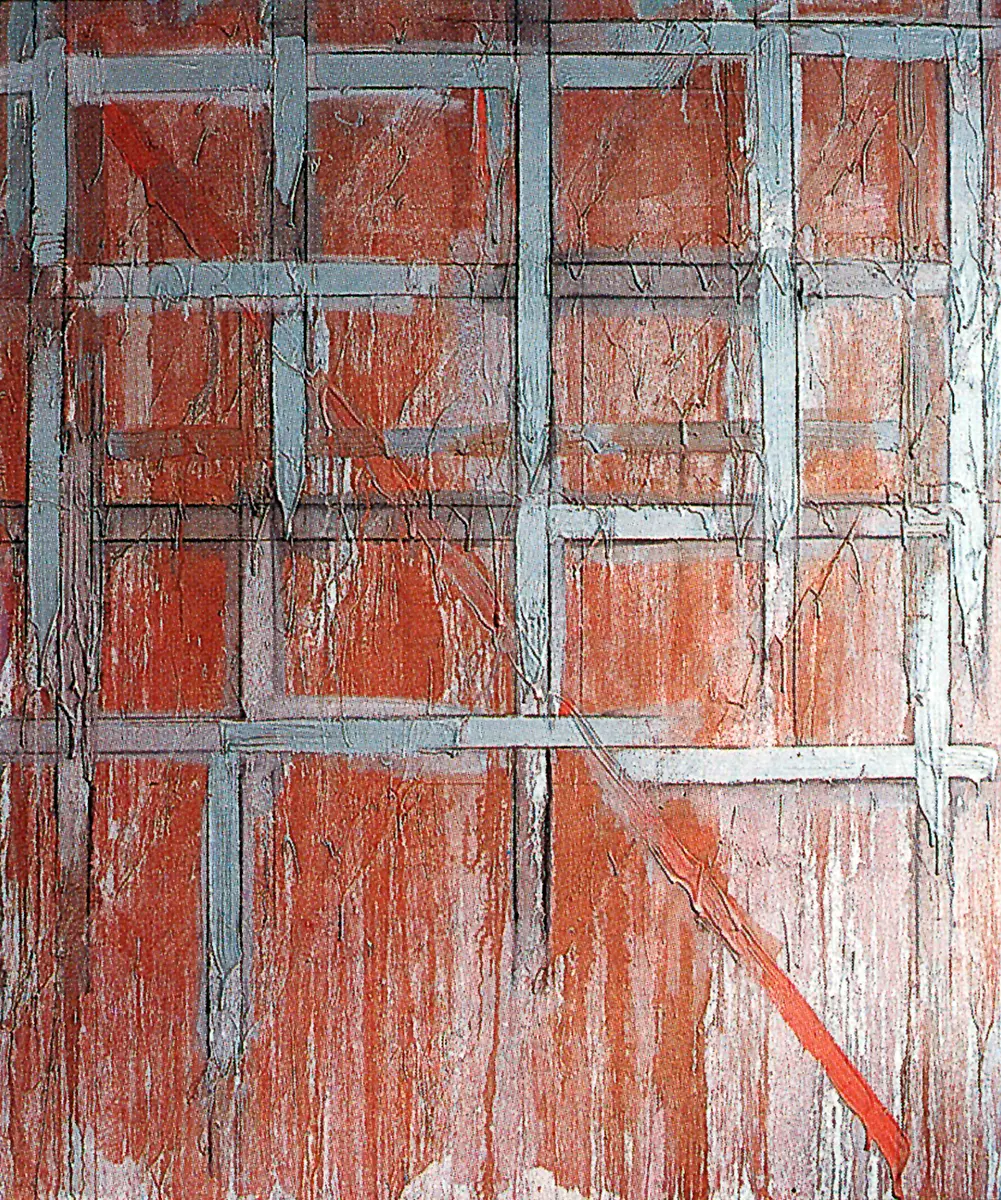
Under this premise, there is a clear relation established between the grids and the strikethroughs of the '70s and the series titled Karnkana, the indigenous name for "Caracas," developed through the '80s. It is a fruitful stage in which Espinoza rediscovers the painting's potential and he definitively recognizes himself as a painter. As Mariana Figarella has written, the artist's emotions, feelings, and states of being are concentrated in Karakana in order to make them communicable. In the pieces he presented at the São Paulo Biennial in 1985, as well as his solo show in 1986 at the Alejandro Otero Museum, the constant is the struggle between the affirmation and the negation of the grid by means of strikethroughs, splatters, and expressive brush strokes of dense, dirty color. The structure ends up yielding chaos and dissolution. This confrontation between the rational and the irrational generates a climax that, in Eliseo Sierra's opinion, forms the fundamental value of these paintings.
The violence produced in the creative process is also worth mentioning. The act of creating out of a conflictive and anti-ethical attitude in his way of proceeding and conceiving the work implies a violent relationship with art. Painting becomes a receptacle for his affirmation as a medium and, at the same time, it is continuously denied. Perhaps this is why the image cannot be beautiful or complacent, but neither can it elude an emotive, and momentarily delicate, condition. In Karakana, these moments are assumed with great passionate boldness through strong, expressive brush strokes. On the other hand, in Orla—monumental works shown at the Sofia Imber Museum of Contemporary Art in 1992—we do not find the same brush strokes, for the almost atmospheric surface is an essential part of this composition.
However, the artist's tempestuous temperament cannot "accept" a clearly contemplative work. If he arrives at a sublime condition in painting, he immediately reacts and looks for the least pictorial means possible for his next series. This occurred after Karakana and reoccurred after Orla. The contradiction, manifested through the permanent adherence-rejection relation that the artist maintains with painting, seems to be the unifying element among his diverse stages.
Already in 1972, Roberto Guevara anticipated Eugenio Espinoza's presence in the national panorama as a "virulent and radical" artist, capable of refusing "to adopt permanent positions." Tired of the "savage" expressionism of the Karakana, he went through a period of transition that would prove crucial in his later work. The detonator: the collective show Al filo de la modernidad (On the edge of modernity) at the Museum of Fine Arts in Caracas in 1986. After this experience, he once again defies the logic of the picture. The format of the work is composed of diverse assembled planes (or pictorial surfaces). The backgrounds continue to be very full of gestures, but its reading is abruptly interrupted by the superposition of strips of very flat colors. They are discordances that create "a ridiculous situation" and which, at that time, "were what saved me from the series Karakana."
His palette turns progressively darker. More and more, he tries to remove representation from the grid and violent gestures through brush strokes charged with painting. He needed to arrive at austerity as a pictorial expression and procedure. In Paramount picture (1988), he does not paint the grid, but rather he assumes it into the format he employs. Color is suppressed, and a monochrome, pasty, and flat surface remains. At times there are accents of color on the lateral sides of the frame. This dislocation in the relation between the foreground and the frame allows the work to constitute itself as an object of a perceptual experience whose transcendence, like a work of art, is grounded in the condensation of his own energy. According to Espinoza, this series (whose meaning can be seen not in the isolated pieces, but in those exhibited in the series) must induce the viewer to interact in a different way with the painting: not based on interpretations but through perception and sensibility. The picture becomes a cold, neutral object, "my most sordid work" which, more than the expression of emotions, is the expression of thought, another way of reinterpreting his minimalist and conceptual ideas of the '70s. Paradoxically, he no longer adheres to pure conceptualism and he reasserts, more and more, the work as an object of art.
Dissonance and imbalance as a picture's composite resources and modes of conforming give rise, in 1991, to the series Autoabstracción (Self-abstraction). This series sums up (or synthesizes) images present in reality that complement or oppose one another. These images refer equally to culture, city life, politics, economics, and sex, among other things. Allusions to art history are joined to elements of popular culture (to create a pink museum through the use of a stuffed animal of that color, for example, or to link European constructivists to Iris Chacón, etc.). This procedure offers him complete freedom. This is why he creates collages with the works of others (those of Paolo Gasparini, or Vladimir Sersa's portraits, for example), as well as with his own pieces from earlier periods. As he fuses images and materials that stem from diverse settings, he creates new readings that are underscored by humor and a cynical view of reality.
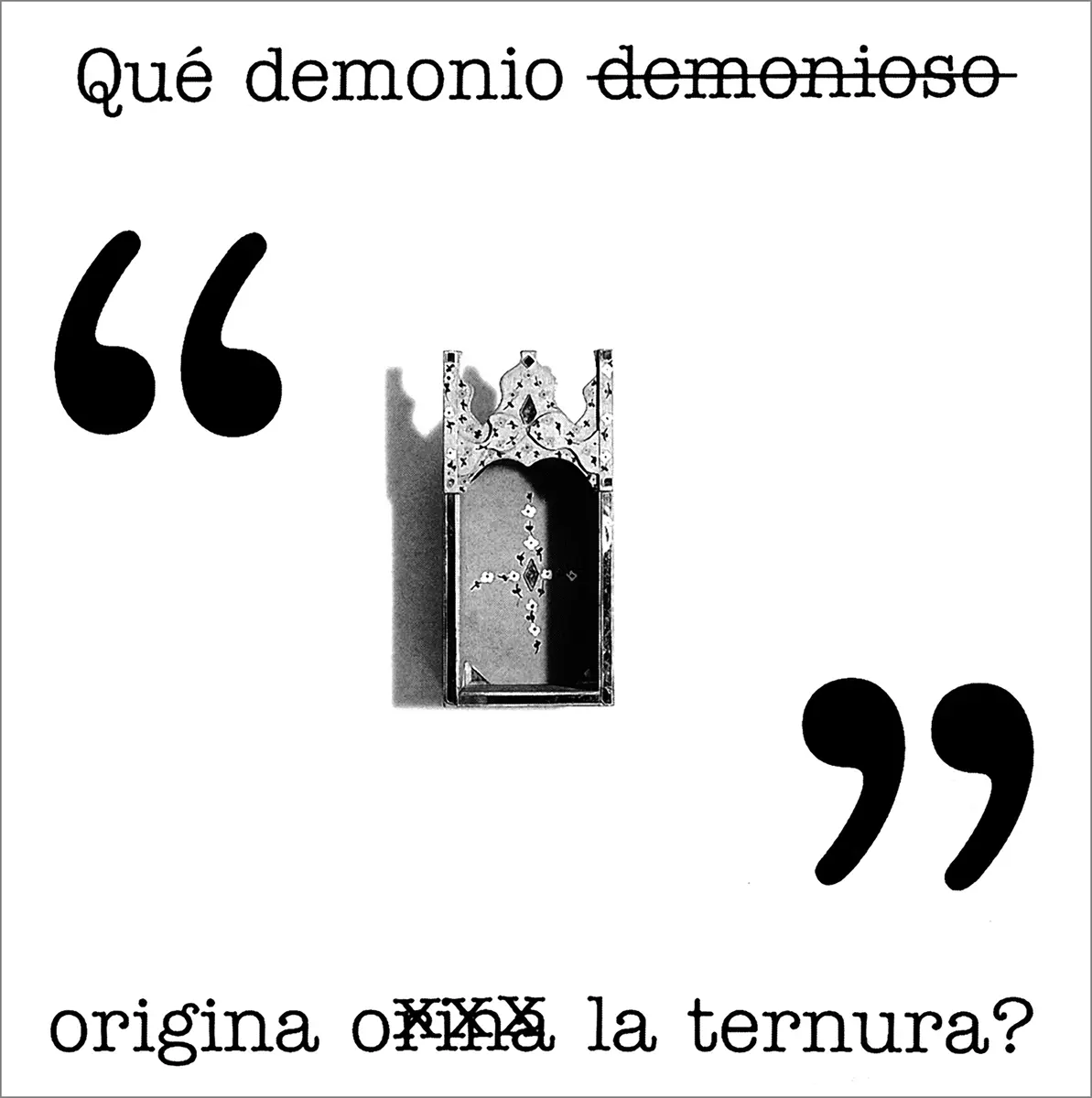
Ruth Auerbach points out that there is a perversity that distinguishes these pieces from those of constructivism, minimalism, and conceptualism, without removing them "from their spirits." Once again, Espinoza searches for definitions in art. The term self-abstraction builds on the concept of the "abstract." The artist begins with the principle that the world that surrounds him is abstract. From it, he may extract anything: a paper tapestry, furniture, a canvas, a work of art. As he decontextualizes these objects, he abstracts them, in spite of their figurative origin, and he uses them in his own work. This gives rise to a reading disconnected from meaning. As the artist himself indicates, this is the "abstraction of itself, of art, of reality" or, in other words, of an autobiography, a self-history, a self-abstraction. The following year, he surprised the public with his series Orla, where the painting is assumed as an aesthetic experience in which suggestion and atmosphere invite us into astonishment and contemplation.
Space, scale, object
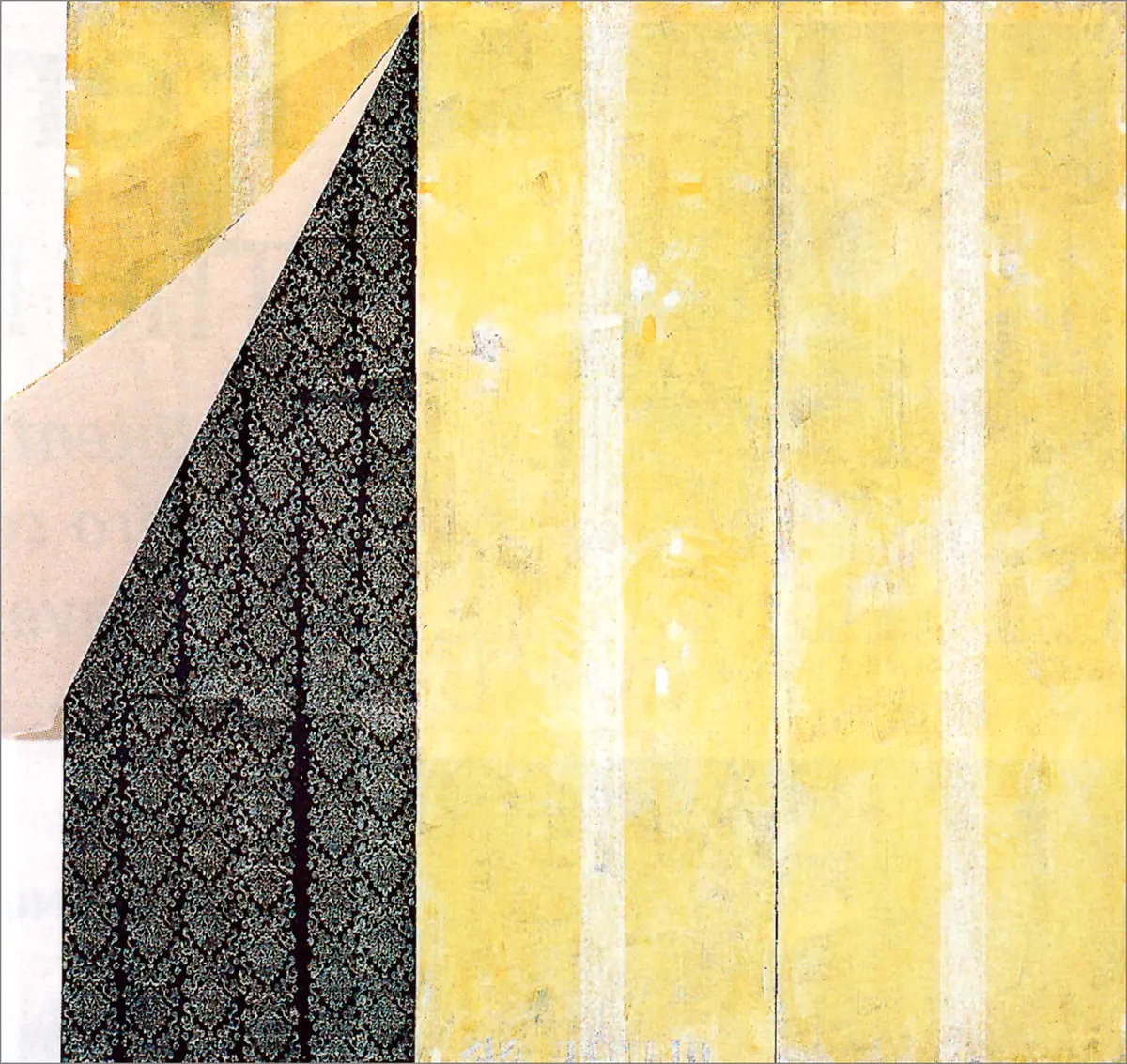
Orla (Edging) is Espinoza's second experience with large-scale works. There are nine pieces in all, and each one is made up of diverse superimposed canvases that fall like curtains or drapes, with different pictorial solutions for each one. Color and space seem to find a justification, for the gaze takes delight before immense atmospheres, both tenuous and beautiful. Four of the Orlas appear with their titles written backward: Anunciación (Annunciation), Obsceno (Obscene), Deseo (Desire), and Sudario (Shroud), which speak to religion, sex, and death.
The space of death is incarnated by the dark background canvas that hides behind the canvas in the foreground. The viewer finds the second canvas through the gesture of "looking under," like the lifting of the "shroud" that "wraps the deceased." In spite of the profound and transcendent meaning of this series, Orla simultaneously refers to banal aspects of existence. Its very name indicates this because an edging is an adornment placed on the edge of fabrics or dresses. By being the incarnation of death, the hidden canvas refers, at the same time, to a "banal interior decoration," as Félix Suazo defines it. All this response to a possible desire to hide or, as the artist said in one of his statements, to hinder an open expression of reality in order to avoid its vulgarization.
The decorative, however, is incompatible with the art world. But the artist removes this scorn and assumes its use as an expression of the popular. This awakens other concerns. Dama de noche (Lady of the night), an enormous full-scale installation set up in the collective show Caracas 20 (at the National Art Gallery in 1993), consists of the presentation of a black glass facade, just like the corporate buildings in Caracas, and an electronic screen of advertising messages. The grid, as Rina Carvajal astutely points out, circumscribes the urban reality and gives proof of the discourses of power behind this new architecture. Mockery is the strategy chosen to face this large machinery. He makes use of the electronic screen as an intimate diary. On it, he transcribes his thoughts about art, the history of the city, and diverse feelings, under the profile of caustic humor.
Espinoza seems to find himself in a period of absolute freedom. From the violent and debilitating expressionism of Karakana, from the rigor and austerity of Paramount picture, passing through the freedom that Self-abstraction began to offer him, he arrives at the maturity of someone who can say and do what he pleases with no fear or embarrassment whatsoever. Mamá latina (Latina mom) is a group of works on paper in which the artist traces directionalities through lines (fragmented pieces of squares) and phrases that express loving or erotic encounters and failed encounters. The manifest intimacy of these pieces brings about a change of orientation in the artist's career because, in spite of the fact that the public saw them in 1995 in a solo show at the Alejandro Otero Museum, it was on account of this series that Espinoza created the electronic screen in Dama de noche.
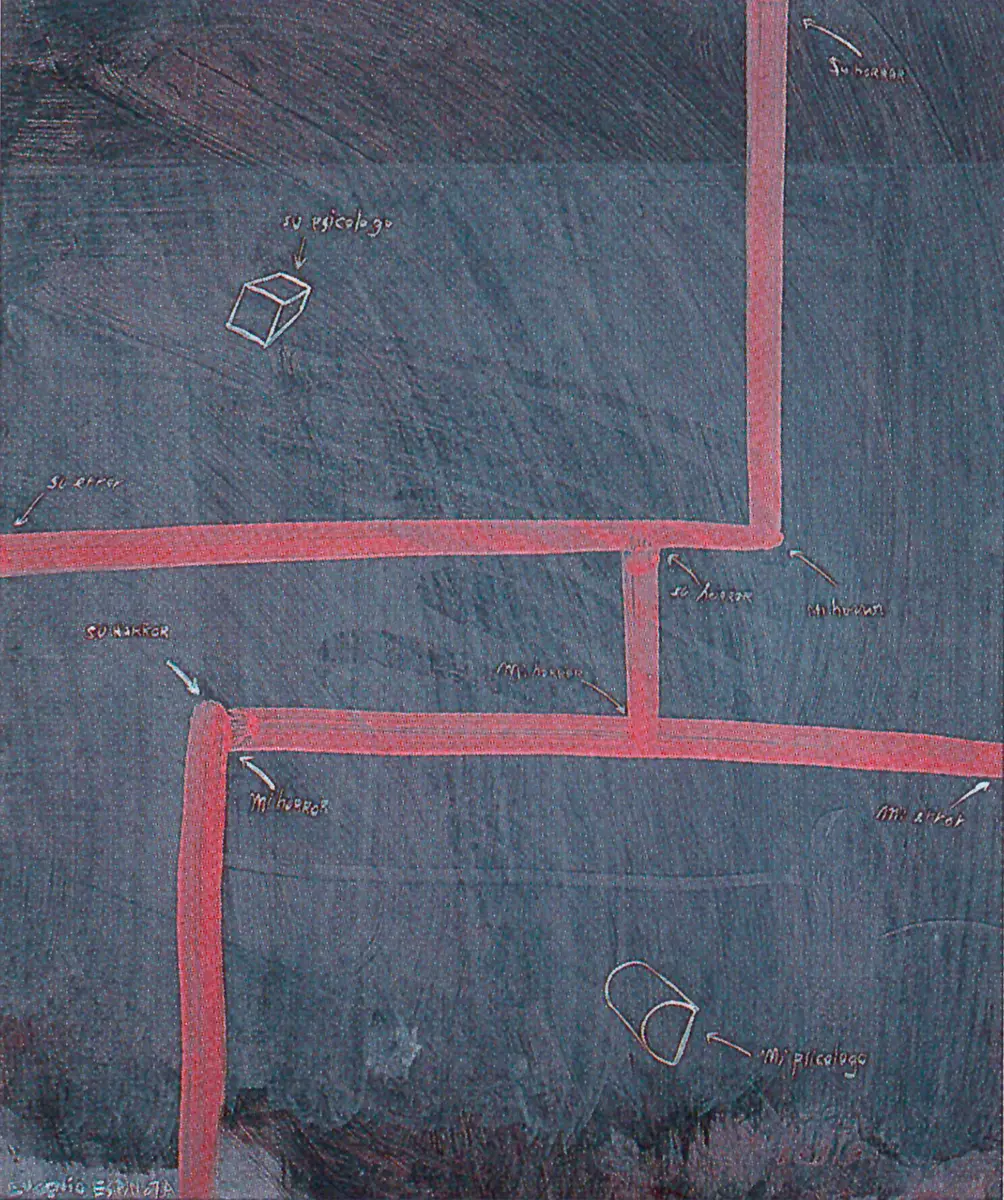
All of this was brought about as a consequence of a greater role in reality, which seems incompatible for an abstract artist. The work becomes an integrating space of quotidian dwellings, taken from the intimacy of the artist or the outside world. Thus, simultaneous with Mamá latina, he exhibits in the same museum the series Línea blanca (White line). This series is made up of squares of sheet metal painted white, made in the same way, and with the same materials, as those used for appliances. They are assemblages of objects of diverse origins whose new contextualization—between phrases and images—parodies reality. To be sure, they express the critical relation that Espinoza establishes with his surroundings but, at the same time, they are an expression of a desire to come closer to the public, since he attempts to involve the viewer through images that are familiar and accessible. This is why he does not paint, but rather he takes resources from the most immediate reality, like advertising and typography, as well as popularly known objects and phrases: spite, salsa, a replica of the Venus of Tacarigua, allusions to the "seductive mamacita" or to the "devouring mother," among others
Painting at the End of the '90s
Each series leaves new elements that are processed in different ways in works created immediately afterward.
In 1996, after a short stay in New York, he returned to painting and exhibited at that city's Caellum Gallery. Into the large surfaces painted with one single flat color (blue, green, or pink, "tonal ranges related to tenderness" and in agreement with the New York pop aesthetic), he integrates gestures and the pictorial, as well as plastic lines fastened with insulating tape, an inheritance of the strikethroughs of the '70s. This is how urban reality is expressed in his painting. Since he does not integrate objects, the picture is the object. On occasion, it is scratched or torn in two, as a challenge to gravity when one of the parts hangs from a thin piece of thread, or it may be another parody of the physical possibilities of the work and, therefore, of the idea of the "eternity" of art.
To the purity of these pictorial surfaces, he responds with others that are completely dirty and out of place. It is a non-conformist and profoundly aggressive painting. These pieces, on display at Caracas's Sala Alternativa in 1997, are the result of a period of exhaustion and saturation in which the excess of freedom began to be limiting and began to lack perspectives. "I saw myself forced to make the silence explode. In these pictures, within that space that is like a prison, I desperately had to do something. My resources are signs, symbols, doodles. . . just as prisoners scribble their utopia on a little piece of wall." Uneasiness, as Juan Carlos Palenzuela once wrote, is what stands before these pieces. "Good painting" is not a value,
nor is the aesthetic experience. Abstraction as a pictorial language turns out once again to be limited and insufficient for the artist. As compensation, identity with what is Venezuelan responds progressively to this need to belong. For this, he recovers images and symbols from the culture and history of the country as another form of bringing the public closer to known situations: Bolivar and Barbara Rivas; a traditional street of Caracas with discrepancies of direction, like understanding Giotto in Bogota, etc.
Before the slippery feelings toward painting, Espinoza reestablishes the possibility of recovering the beauty and the optimistic character of painting in the series Corozopando (1998). A trip to the "hot and impenetrable" lands of the estuaries of Camaguan in the state of Apure gives rise to this series whose name comes from a small town in the region. Rarely have surroundings affected the artist's inner world; this was not the case, however, with Corozopando. The place's solitude created the ideal emotional state for the penetration of natural and affective elements in the work, "with its birds' nests and wasps' nests," which form the graphic and pictorial structure of these pieces. The yellow backgrounds that characterize them somehow express his feeling for the earth, heat, and drought.
Space, then, plays an enormous role in his creative process. "The artist can only paint his madness when he finds himself enclosed in a small place."
Moving from one studio to another, and the difference in size between the studios, have determined his work to a certain degree. He arrives at this conclusion after having incessantly moved around. The spaciousness of one of his last studios gave rise to a new series, not yet titled, in which Espinoza reconciles the expressive wealth of Karakana with the atmospheres of Orla. The thick, firm brush strokes, attenuated by splatters and erasures, create framed spaces, definitely typical and consistent with the artist’s style.
For Eugenio Espinoza, art is a way of experiencing continuous "tremors." Thus the need to change or to "overcome stages" in his painting. It is a question of instability that, although it oscillates between euphoria and the feeling of deterioration, also impels the vitality of continuous creation. The result is the variations that make up his work. All this in order to realize, after thirty years of production, that that painted grid from the early '70s was more than the intuition of a young artist who was then misunderstood. It was the conception of the most austere and purest form of art, an aspiration that Espinoza hopes to recapture once more.
SUSANA BENKO
Venezuelan researcher in visual arts. Author of various articles and books, among them El símbolo y sus enigmas (The symbol and Its enigmas) and Vicente Huidobro y el cubismo (Vicente Huidobro and cubism). She is a member of the Board of Directors of the Museum of Fine Arts in Caracas, and an Editorial Advisor for the magazine ArtNexus.