
There is something archaic and almost ceremonial in the strange installations of Fernanda Gomes, something that goes beyond culture and evokes the survival of ancient and lost rituals. In Gomes’ work, traces of daily chores and activities appear transfigured through sculptures built of discarded and fragmented objects. Biological, mineral, manufactured, and decomposing elements meet in unpredictable, improvised, and intellectual arrangements that form a galactic model. Using the floor as canvas, she puts together intricate installations which float in a territory located somewhere between chaos and manic calculation. Gomes' pieces seem to be made either by scattering objects randomly or by meticulously building with insignificant debris like smoked cigarette filters, restored dishes, old dictionaries, water-damaged papers, guitar strings, ping pong balls, corks, and silk threads. The work of this Brazilian artist is at the same time emotional and impersonal; it can be read as a passionate catalog of desires and anxieties or as the anonymous manifestation of a superior force.
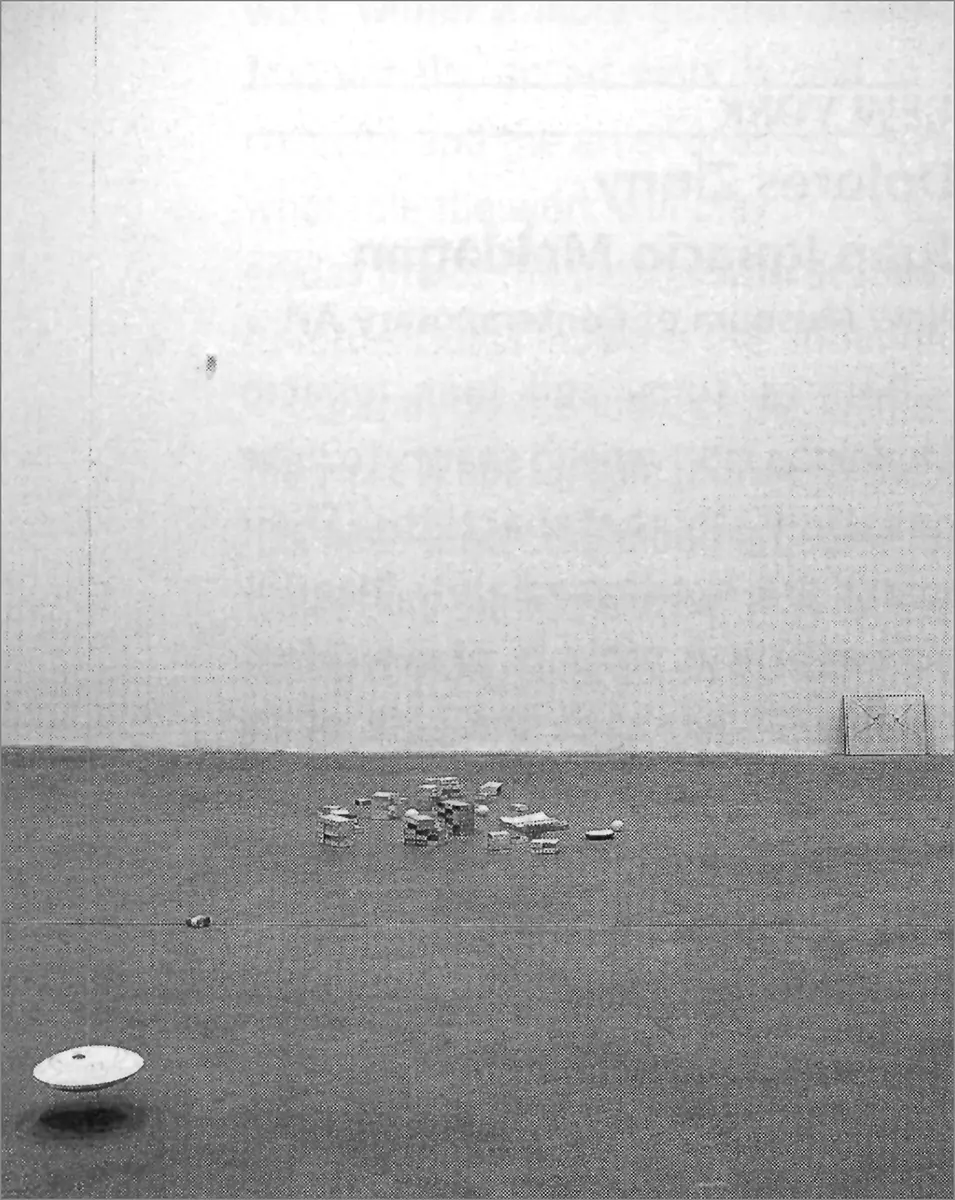
Gomes builds imaginary settings where an action has taken place, the protagonists are long gone, and the remains leave us with a sense of loss. Her juxtapositions of found objects could be products of some bizarre archeological search and reconstruction of a not-so-distant past that has been fragmented to the point of becoming unrecognizable. Gomes attempts to uncover and decipher traces of an alien civilization by reshaping its garbage and giving new meaning to industrially produced and disposable objects that are so pervasive that they tend to become invisible. Gomes' obvious references are the Minimalists of the 60s and 70s, but in particular, her work is informed by the work of Jannis Kounellis, Guiseppe Penone, Luciano Fabro, and Alighiero Boetti— members of the Arte Povera movement, characterized for evoking nature through "poor" and industrial materials. We can cite Joseph Beuys as an influence, though the most dramatic difference between his work and Gomes' is that her pieces are not charged with the political, moral, and mythical elements that Beuys mastered.
Gomes' work represents a rigorous and restrained attempt to attain artistic purity (even by her limited choice of materials); she tries to avoid cultural references and artifices of any kind and even erases herself from the process. At the end of the century, installation art has become an often annoyingly commonplace and uninteresting rhetorical device. Even the term itself has lost meaning. But Gomes' installations are a vibrant example of how this art form is still very much alive and well. Her pieces define themselves through their mutual relation and through their strong poetic austerity. Displacing any of the parts would put the whole out of balance. At first glance, her pieces tend to disappear in the vast emptiness of this Chelsea gallery, but closer observation reveals the minute and fragile objects and constructions being transformed into imposing presences capable of dissolving all proportional differences they have with the architectural space. Her pieces have an expansive quality due in part to the relationship they establish with the gallery. Once the viewer is immersed in this toy universe, spatial awareness shifts. Wherever the viewer positions himself to contemplate the works, he will inevitably feel his presence is a disturbance to the harmony of the whole.
Gomes' intimate sculptures create a powerful sense of place and order, like tiny galaxies or constellations of heterogeneous objects that seem to be attracted and repelled into a stable but tense equilibrium by strange and almost gravitational forces. One of the most interesting aspects of her work is the unity and coherence that she manages to create with the most disparate and modest materials. Through the attention that they demand from the viewer, these silent and reverential installations (there is not a single touch of irony in the whole show) turn inconsequential waste into reflections on the decay and vanishing of meaning in a fragmented culture where the concept totality is in the process of extinction.
NAIEF YEHYA