
The exhibition Razones de Estado (Reasons of State) by the Peruvian photographer Fernando Castro, confronts us with a stark, yet complex and disturbing portrait of political power and the individual human beings who inevitably coexist with it. Far removed from the easy categorizations of the Cold War era —when opposing ideologies neatly aligned themselves into two clearly distinguishable camps and when heroism was defined and justified within one of these two contexts— the "portrait" that Castro offers us of political power unmasks it as an anonymous, trans-temporal, trans-cultural web wherein ideologies and their symbols—the reasons of state—are viciously promiscuous, fluid, contradictory, and ultimately devoid of any significance, yet responsible for abysmal human pain. Castro shows that one and the same idea, one and the same reason and symbol, is used in one part of the world to justify an action and in another to condemn it. The only constant—he seems to be saying in the manner of Foucault— is power itself. With the intent of capturing the elusive face of power, Castro constructs a portrait of it from the traces it leaves after its multiple brutal manifestations. This show is, therefore, a portrait of power drawn from its traces.
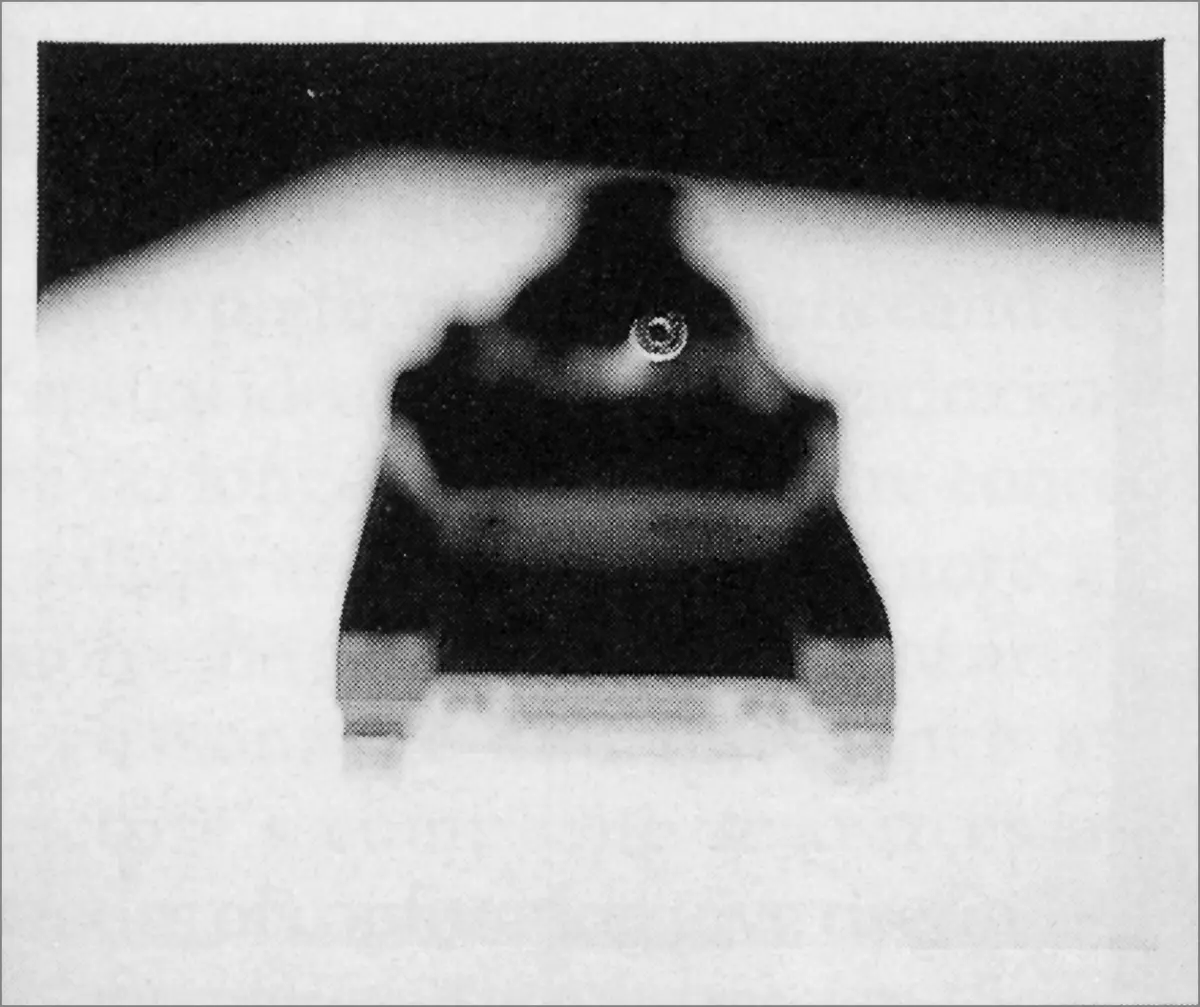
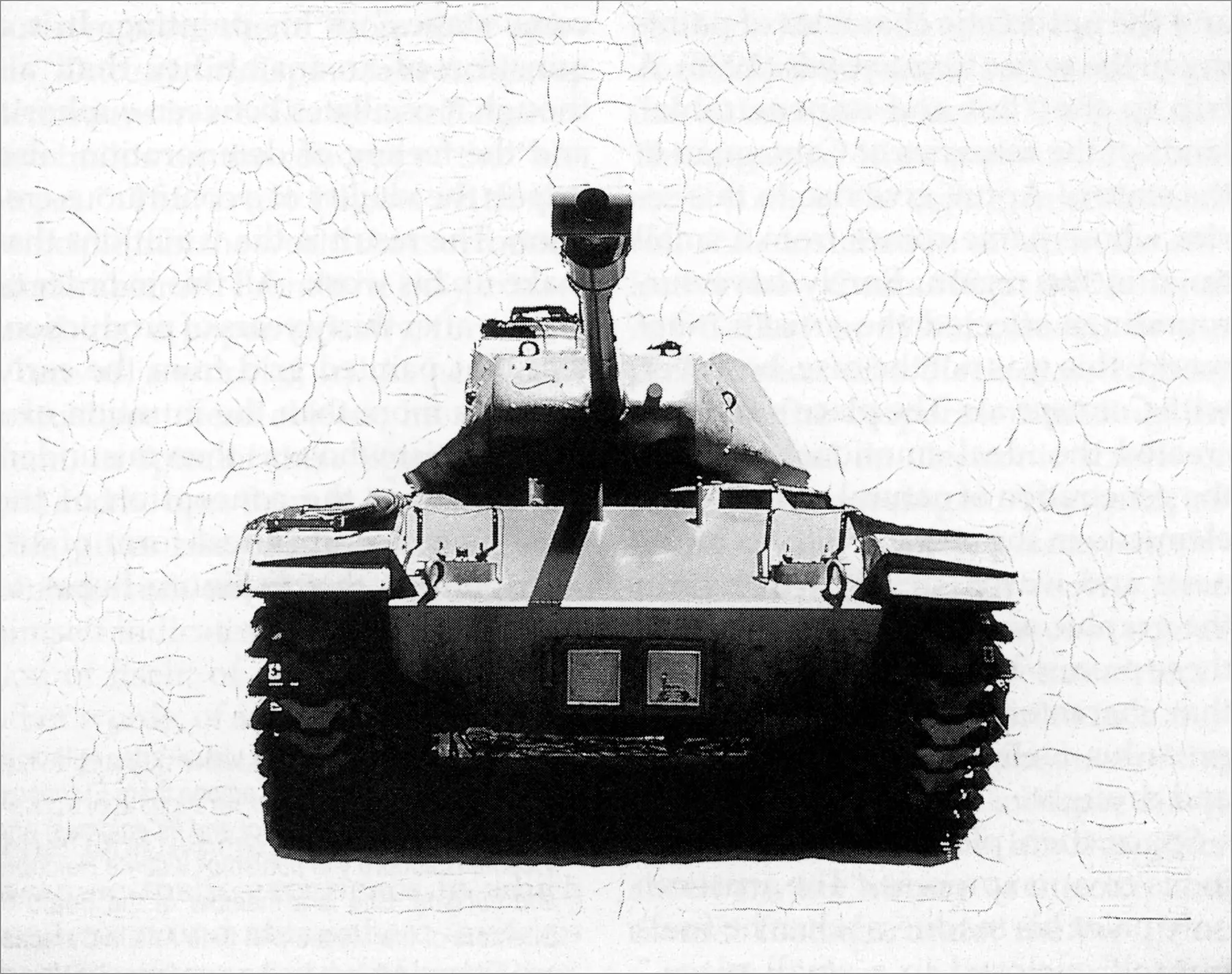
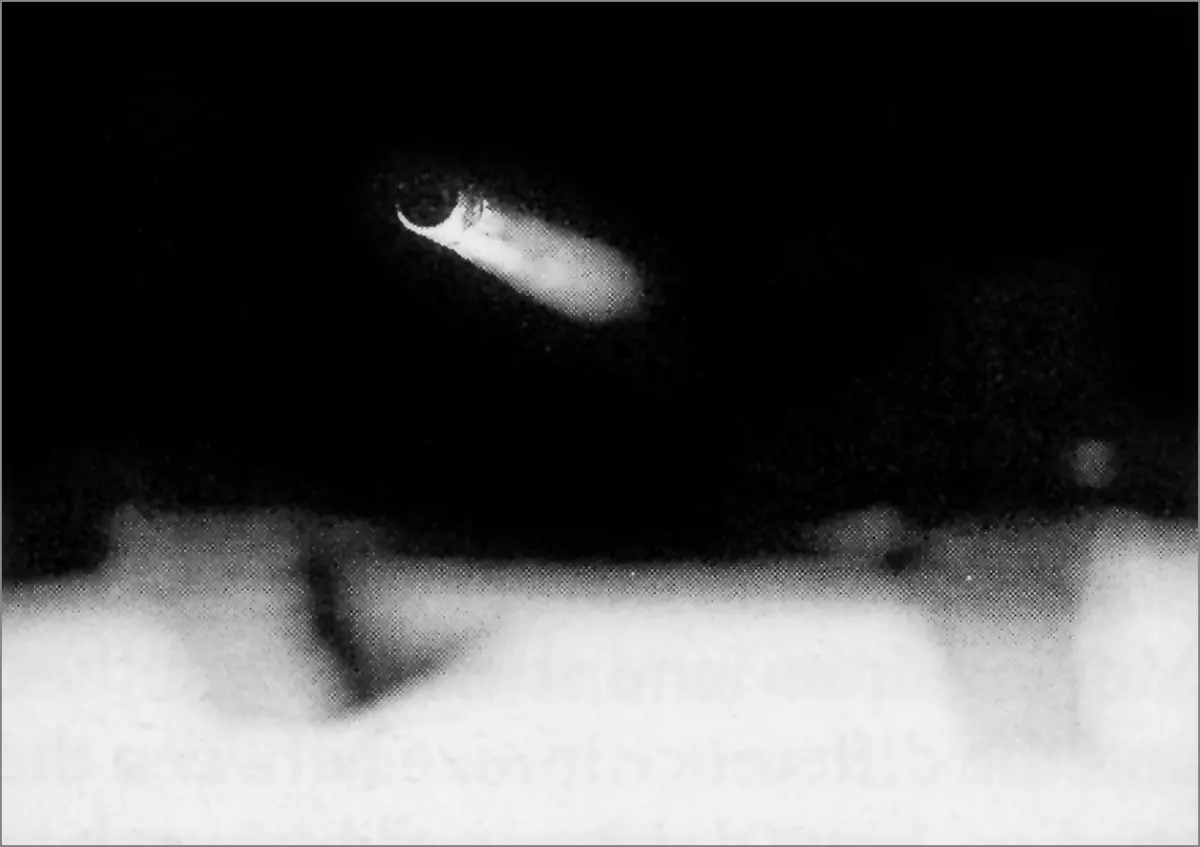
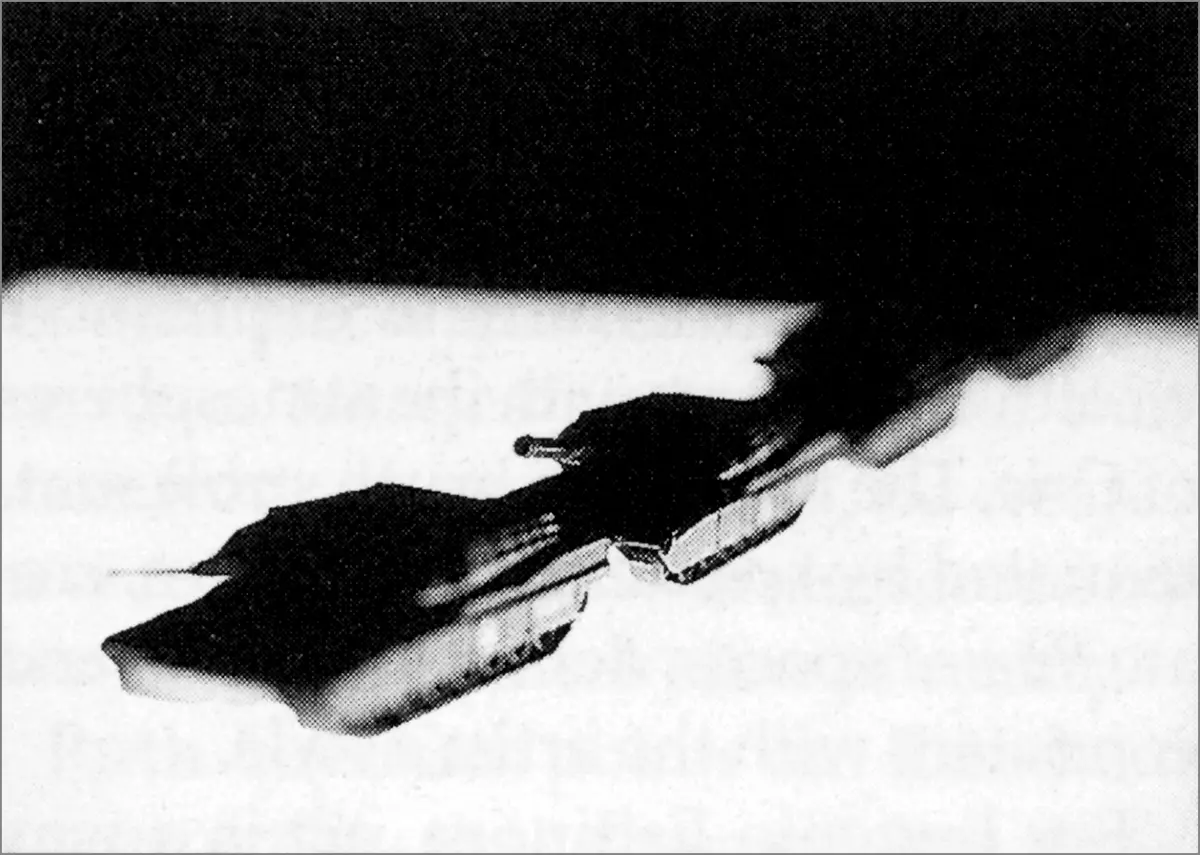
The wall facing the entrance to Sicardi-Sanders Gallery displayed four photographs: Tank B, Tank C, Tank G, and Tank H, Each of them was a very simple, yet terrifying image of just three elements: tank, ground, and background. The alphabetical titles of the works, as if taken from a bureaucratic filing system, are quite appropriate to the clinical mission of the tanks. In Tank G, the body of the tank disappears into a black background. All we see of the tank in this photograph is its gun—forcibly protruding with effective foreshortening —and its treads. The treads are blurry and gray, but the gun barrel, white and sharply focused, emerge ominously from the dense, deep black background. Anonymity, secrecy, and ultimately, absolute metaphysical mystery lurk behind this phallic manifestation of power. Tank C is similarly constructed except that its barrel has turned to aim directly at the viewer. Tank A depicts a stark, sharply focused tank, made all the more real by the direct overhead light source. This tank seems to float... not in a firmament dotted by sparkling stars, as one may be inclined to believe at first glance, but simply in form of a disturbingly black background whose surface seems to have been altered (perhaps in the negative) in order to create a misleading impression of a firmament. In fact, it offers no more than meaningless marks on a surface that has no other resonance than similar sparkles coming from the treads of the tank. In the very elegant image of Tank D, we see the same tank but now the background is an all too substantial white surface that is cracked all over. The differences in the black and white backgrounds do not necessarily allude to opposites but certainly to different polarities. The same tank rolls against black as against white, and anything in between These images of tanks belongs to a collection of works entitled The Wang Series, which also includes portraits of a so-called Wang. In each one, the viewer sees only Wang's back, never his face. That relationship of the viewer to Wang is perhaps worthy of consideration in itself. For now, it is important to notice that Wang himself is always facing either the instruments of power (the tanks, their traces, or a wall) and/or the undecipherable black or white background. In a sense, in these works, we become spectators of our own human situation vis-à-vis political power. While Wang represents the well-known Chinese man, who defied the tanks in the Tiananmén Square Revolt of 1989, he is also each of us confronting any tyrannical group of people. Although the identity of the model and whom he represents remain unknown, Castro has given him, for us, the name "Wang" which sounds somewhat like the Spanish name "Juan"—an intentional act that produces a trans-cultural confusion of identity.
The images in The Wang Series are visually flat, yet conceptually profound. The setup of the back of a human figure cut against an impenetrable background is indeed flat. Both background and figure seem to be stamped on the same slick surface. Yet these images have a seductive and hidden depth; a depth arising from the space that exists between the human figure and the background. It is a space inevitably hidden from our view, in the space, these two anonymous entities—Wang and the background—confront each other. This is the space of human tragedy, a private and personal space; the space of solitude and self-identity, but also a space where the individual human being intersects the social and institutional world—the world where political power unfolds its web. Moreover, if one were to move along an axis perpendicular to the photographic plane, from the background, past Wang, outwards, one would arrive at the position where the photographer stood, the same position as the viewer—you and I—who look at Wang from some point behind his back. Thus, anonymous political power, the unknown hero, and the implicit observer—three essential elements of the human political condition—are portrayed as essential elements of the human political condition. They are depicted in a masked and anonymous fashion as three signposts along the depth axis of these very flat and deceptively simple images.
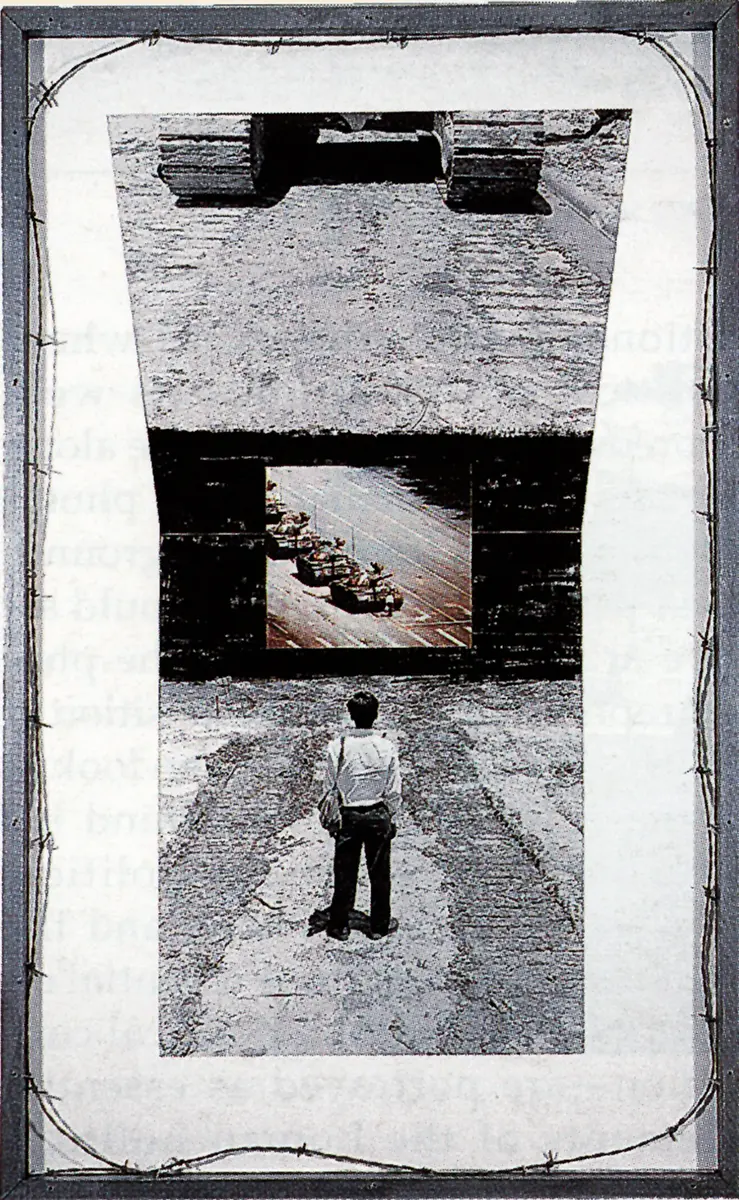
Consequently, the most compelling and profound aspect of these flat photographic images is—paradoxically but fittingly—their spatial depth. For it is this depth and its very occultation that bring forth the pain and significance of the human situation. Trapped between a tank and a photographic plate the unknown hero defies an overwhelming and unfathomable structure. Finally, the simplicity of the background and the secret and personal nature of these spaces suggest that the confrontation that Castro is depicting here transcends the human institutional realm. It involves metaphysical sources of power—call it god or the absence of god—it is in that space in which the discourses of religion, human rights, race, science, art, etc., are articulated. It is in that space that the tank runs over the individual, or alternatively, the space wherein the individual and the photographic camera behind him stop the tank. Perhaps that too is the space alluded to in the title of the work Reality Gap.
Oppressive political power takes many symbolic forms—i.e., the Berlin Wall, a tank, Mao's Little Red Book—and Castro is determined to unmask them in their promiscuous exchanges. The exhibit's inclusion of Castro's video Art will not be complicitous with the forces of repression suggests that the hymn of communism, The International, is a symbol of liberation in one part of the planet (Mexico), while in another part of the planet (China), it is a symbol of oppression. Reasons of State compel us to conclude that Power exists within a very elusive field, a web, a ground that is opaque to understanding, opaque to the camera, and indifferent to the feelings of any individual. Castro's works merely capture the traces of power by means of manipulated and staged photography.
In order to achieve his portrait, Fernando Castro, a philosopher turned photographer, begins by reconstructing theatrically the embodiments of political power. These are photographs of reenactments—a second order of reality, as Plato would say. The Wang in the photographs is a stand-in model acting as the unknown Chinese man, the tanks are miniature model tanks (except in the case of the Sherman tank of Tank A and Tank D), and the Berlin Wall is real but is just a sample piece removed from its original location, now on permanent display at Rice University, etc. To be sure, Castro's works are built from traces of traces.
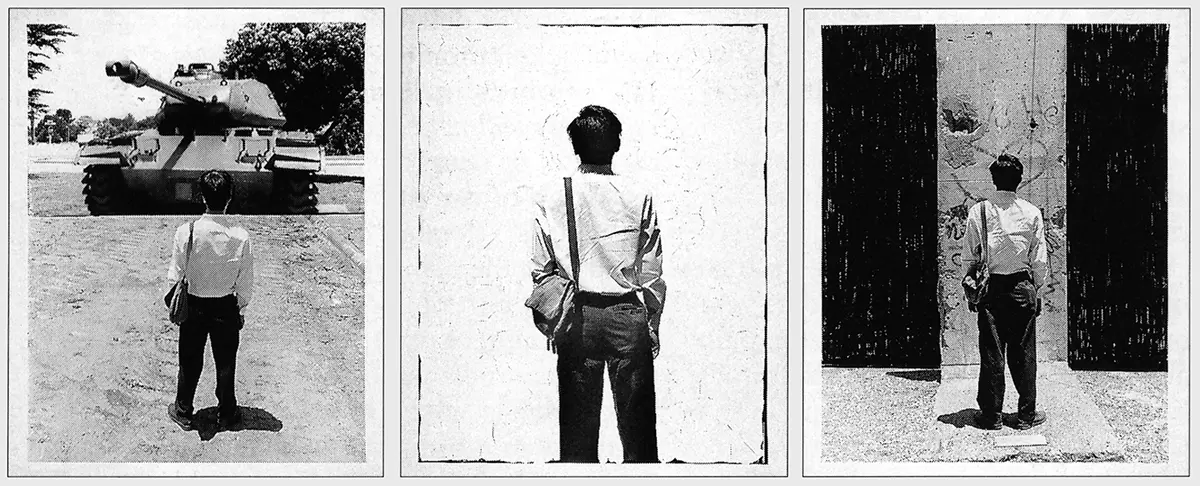
At almost every step of the way, Castro intervenes in the photographic act, preempting its automatism and eliminating irrelevant details, with the purpose of tracking down the elusive stamp of power. Far from existing as an archetype and an ultimate category of the universe, the actuality of political power is real, and even its "traces" hurt. These traces do not emerge from perfect Platonic categories. Rather, as if in a nightmare, the gun of the tank emerges from the absolute black and impenetrable reality on us in the very same way that the treads of a tank stamp their tracks on the ground —a conspicuously recurring image in Castro's exhibition.
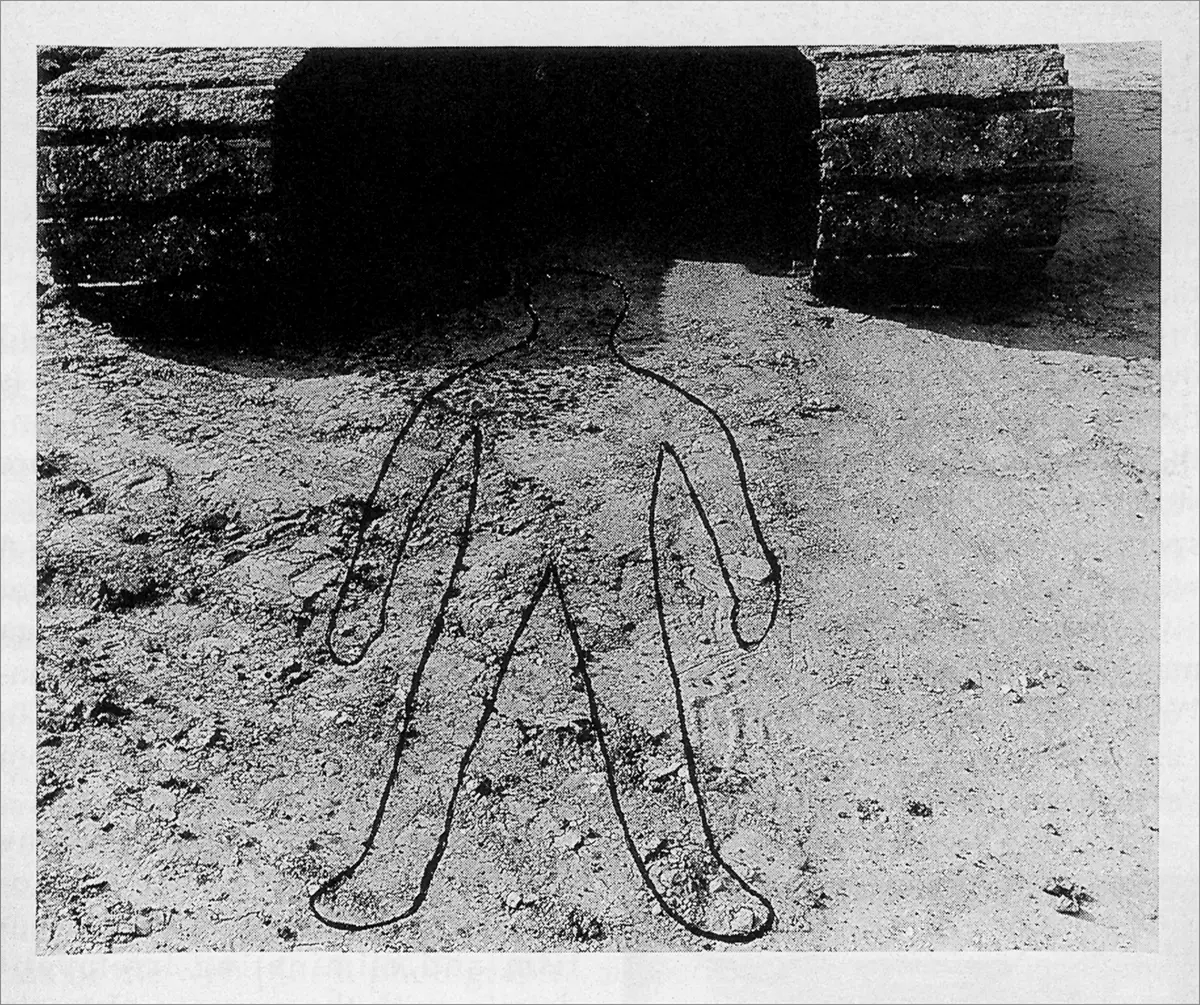
In the work White Outline, Wang himself is gone but a police chalk outline (a tracing) of his corpse on the ground in the middle of crisscrossing tank tracks shows evidence of the culprit. This is also an image of traces; traces left by traces. Similarly, in Wang's Outline on the Dirt, we recognize a form scratched in the negative that could be Wang. What is the status of this victim? After all, a repressive government interested in making a person disappear would erase not only a body but all traces of the person as well. But before doing this, such a government would do precisely the opposite in order to make sure they have eliminated not just anybody, but the right dissident. Then and only then, would such a government be interested in making that individual disappear without a trace.
In the midst of this intricate and conflictive dance between the photographer and us, Castro then scratches off the very images that he has made of Wang and others. The photojournalist that documents anti-government activities often finds himself/ herself in a position of helping an oppressive government by inadvertently providing the identity of dissidents through the very publication of the photographic document that intended to denounce it. Castro, re-tracing this double edge of photojournalism, expands on the problem in the above-mentioned video anti-government demonstration in Mexico City's Zócalo. This video was placed in a small, adjacent room to the main gallery space of Sicardi Sanders. For the purpose of protecting a woman easily recognized in the video, Castro place on the TV screen pieces of masking tape that blocked the face of the only person that could presumably be identified in the video.
What is ironic about the photographic act, is that the photojournalist is doing the very same thing that a repressive government would do and vice versa. What is striking about the artistic act is that although the pieces of masking tape may be effective in masking the identity of the person in question, in the process, by their continuous presence on the screen, they also efface everything else that appears of those spots of the screen as the video rolls. What else is this masking tape blocking from view? This is the inevitable price in terms of truth and beauty that must be paid in order to protect the innocent.
The lone large-scale installation of the show bears a title extracted from school texts of the official history of the Incas: They knew neither the wheel nor writing. The work documents the attempt to publicly execute by dismemberment the eighteenth-century Native-American rebel and last Inca, Túpac Amaru. A written eyewitness account describes how the Spaniards tried, unsuccessfully, to draw and quarter Túpac Amaru's body by tying his limbs to four horses. As the horses pulled apart, the ropes lifted the body from the ground, we are told, in such a way that the stretched body of Túpac Amaru resembled a spider in its web. Castro takes the lead from that historical source and offers us an unsettling installation where one is confronted by a huge, menacing yet almost invisible spider's web. Five photographs complete the image of the fragmented body of the Inca: two of the tied hands and two of the tied feet placed at the extreme ends of the web plus a photograph of the abdomen at the very center of the web. In this latter piece, the word Qosqo is inscribed, and the navel is conspicuously shown. Qosqo is the Quechua word meaning "navel" but also refers to the capital of the Inca Empire today, erroneously known as Cuzco.
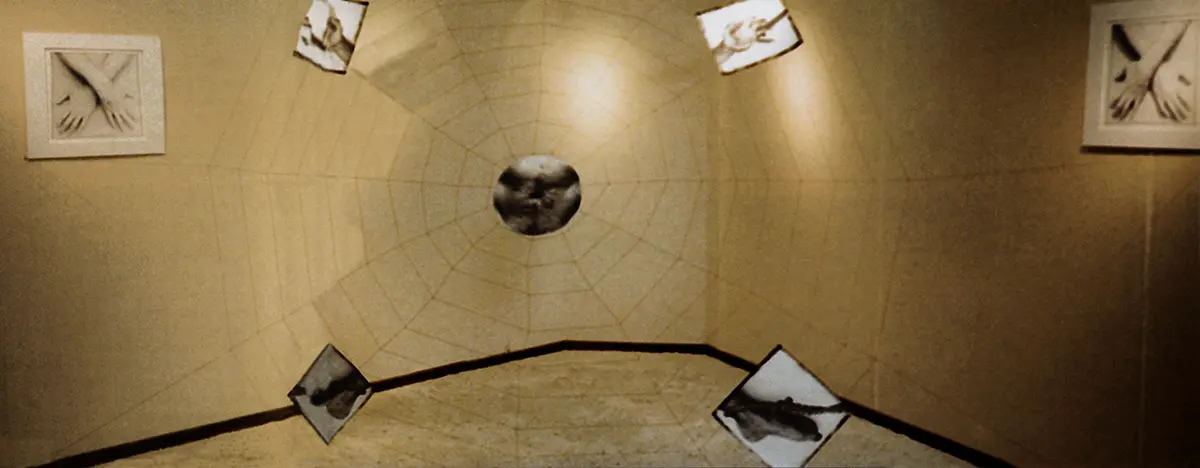
This construction is unsettling from the very first recognition of human body parts trapped on a spider's web to the ultimate realization that Castro, in a sense, has succeeded here in doing what the Spanish executioners failed to do— sever the body of Túpac Amaru. The image is gruesome, but most relevant to the exhibit as a whole is the web itself. This work makes visible for us Castro's basic metaphor for political power: a web with radiating and concentric lines of force that articulate a hypnotic pattern that attracts us, and yet it can tear us apart. Faced with this work, one cannot avoid posing the basic question of political philosophy: what makes political violence legitimate? One general answer is, of course, "reasons of state." In this particular case the very "good" reason why Túpac Amaru is being executed by a literate power is that, although he himself was literate, he is the symbolic leader of a culture more iconic than literate. Or is there another more preferred reason of state? Reasons for the state may be arbitrary, but power articulates them to fit its web.
At first impression, Reasons of State strikes the viewer as a brutally sparse exhibition constituted by terse, stark, black and white, elegantly cold even beautifully composed images. In fact, with a higher level of interpretation, the works reveal a mesmerizing web: the elusive network of embodiments of the promiscuity of power in our postmodern era.
* All works illustrating this text belong to the exhibition Reasons of State held at the Sicardi-Sanders Gallery.
FERNANDO RODRÍGUEZ CASAS
Bolivian artist. Philosophy and Humanities Scholar at the Rice University