
Under the title Sapce in Construction, Carrillo Gil Museum presented between August and December a selection of works done over the last twenty years by Francisco Castro Leñero (Mexico City, 1954). The show was curated by Paloma Porraz and based on a chronological presentation of the development of the artist, who has always preferred painting as his means of expression.
The abstraction which became an international style after the Second World War is an inexhaustible source of inspiration for Francisco Castro Leñero, who in his early works seems to give the textural painting a kind of minimalist accent. It should be noted that the "informalist rebellion" which characterized modern art during the years following the Second World War coincided with one of the most tragic moments of the twentieth century. It was a time of profound nihilism in which the idea of man floundered in a sea of rootlessness and shifting sands when the modern project seemed from the beginning to be breaking up. This was of course compounded by the horrors of the war followed by the sinister epilogue of the concentration camps and the tragic episode of Hiroshima. The result of this malaise was the philosophy of existentialism, the stark assumption that the world was a place without foundations or anything to hold on to. The category of the absurd was born. However, little remains in the contemporary painting of this profoundly philosophical expressionism; perhaps one of the most outstanding descendants is the German artist Anselm Kiefer, who oscillates between figuration and abstraction. In Mexico, Castro Leñero belongs to the tradition, which we can now label classic, of abstract art that has lost a lot of the philosophical energy which engendered it but continues to be a rich vein for pictorial exploration.
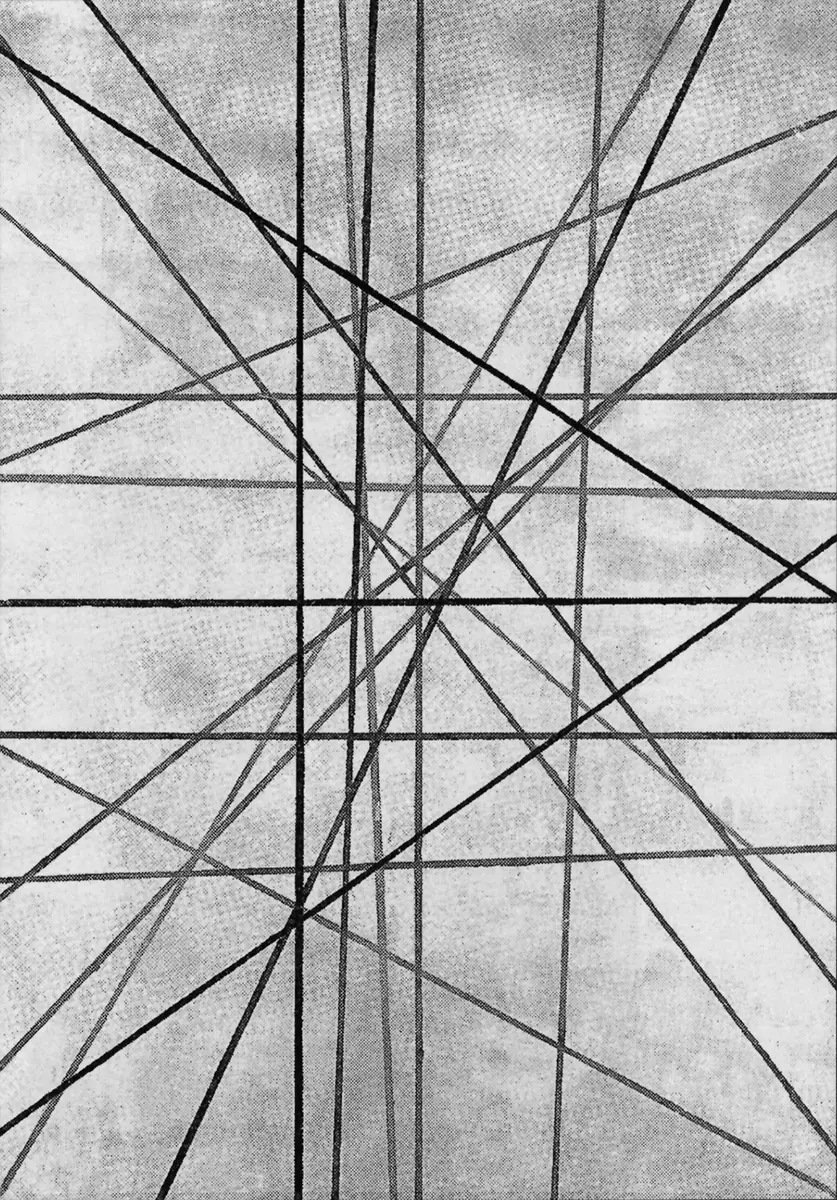
When we look at Castro Leñero's work, we are inclined to think about archaeology, both in the strictly literal sense as well as symbolically. In the first sense, there seems to be a search for origins, a primary expression, the element from which pictorial work becomes a search for the "zero degrees" of painting, which takes us back to the suprematist experiments at the beginning of the century. In the second sense, there is a reference, particularly in the artist's more recent works, to construction elements, such as cradling, wooden rollers, rods, leveled surfaces, and pavements. Sometimes the reference is merely a pretext, but the very mention of the word "construction" in the title of the show recalls the rudiments of architecture or elements of the urban landscape. These architectural concepts are the counterpart of the means of visual composition that his own painting contains, such as the surface, the point, or the line.
The early and very pure works of this show illustrate the artist's interest in texture, with their subtle rugosity which obliges us to examine their qualities with almost microscopic attention. This is the case with Everyday Presence (1982), a painting full of grey nuances and little assignations appearing on the pictorial surface contained within the rectangular format of the work itself. In some pictures, such as Necessary Structure, Castro Leñero uses wood in
the form of a stave along with textural surfaces which become a kind of wall fence, in contrast to what used to be called the "picture window", conceived as a simulacrum of reality.
Around 1991, as can be seen in Chinese Sticks, his work acquires an atmospheric quality through the incorporation of a certain kind of suprematist spatiality, in which the compositional elements appear suspended in space against the light-a technique which reappears in Dots, Variation I, II, III. Furthermore, the purity of the forms is clearly visible in Architect's House, 2nd Movement (1998), in which the clear surface emerges in an almost square format with little touches of barely perceptible color and a line in the central part towards the left and lower edges. The work achieves an optical dynamism with minimal plastic elements, as in a set of architectural plans, in a delimitation of space that marks out the open and the closed, the inside and the outside.
Something similar occurs in Casas Reales (1998-1999), where the artist makes new proposals in the use of different colors in the same composition, like chromatic exercises assigning colors a specific perceptive value. In these pictures, there is also a clear link with Velázquez, and in particular the background scene in Las Meninas. This relation of the non-representational with the narratives of classical painting can be seen as an attempt to establish new referential content, or perhaps an intention to give abstraction an air of our times, with at the same time the introduction of certain ironic elements that replace the search for the sublime that was one of the objectives of expressionist abstraction after the war.
It is undeniable that abstraction represents, in chronological terms, only a moment in the history of Western art, but it is one of the most revolutionary formal and stylistic innovations. Painting at the beginning of the twentieth century lapsed into a crisis of representation, which was just one more symptom of the cultural pessimism of modernity. To represent the unpresentable and to give words to what was ineffable were the artistic concerns that engaged both painting and literature. As in Hofmannsthal's Letter of Lord Chandos, in which the deterioration of words, the 'oxidation of the signs", makes it essential to recreate language, to give it a new range, to transgress its limits, so the primordial mimesis from which painting emerged had necessarily to be called into question. The crisis in representation and language contributed to this, as did the abstract categories that mathematics and modern physics introduced.
And it was because of this, and the fact that the original crisis is far from being resolved, that abstract painting will continue to have a timeless relevance. Its capacity to pose questions is proof of this. It is a space of constant experimentation in which the quest may lead to unexpected solutions. As the title of this exhibition indicated, it is a space in construction.
ERNESTO SOSA