
In a season filled with exhibitions of new photography and digital art, Juan Lecuona (Buenos Aires, 1956) was bold enough to present a show at Diana Lowenstein Fine Arts that highlighted his preference for painting. Lecuona persists in his endeavors. He paints and produces prints in an artistic climate (Buenos Aires) that is now showing a preference and predilection for new media. In a 180-degree about-face, two of the most important awards by the traditional Fortabat Prize recently went to digital works.
Lecuona's exhibition, which opened a few weeks after he placed second in the Costantini Prize, clearly confirmed his lack of interest in brilliant novelties, strident passing fashions, and visceral scandals.
The works presented appear to be increasingly austere and bare. However, far from any kind of simplification, the works also seem to be increasingly problematic. Their complexity lies in the sense of solitude and uncertainty generated in the spectator-the result of a lack of data on the canvas and the invitation to view them in multiple ways.
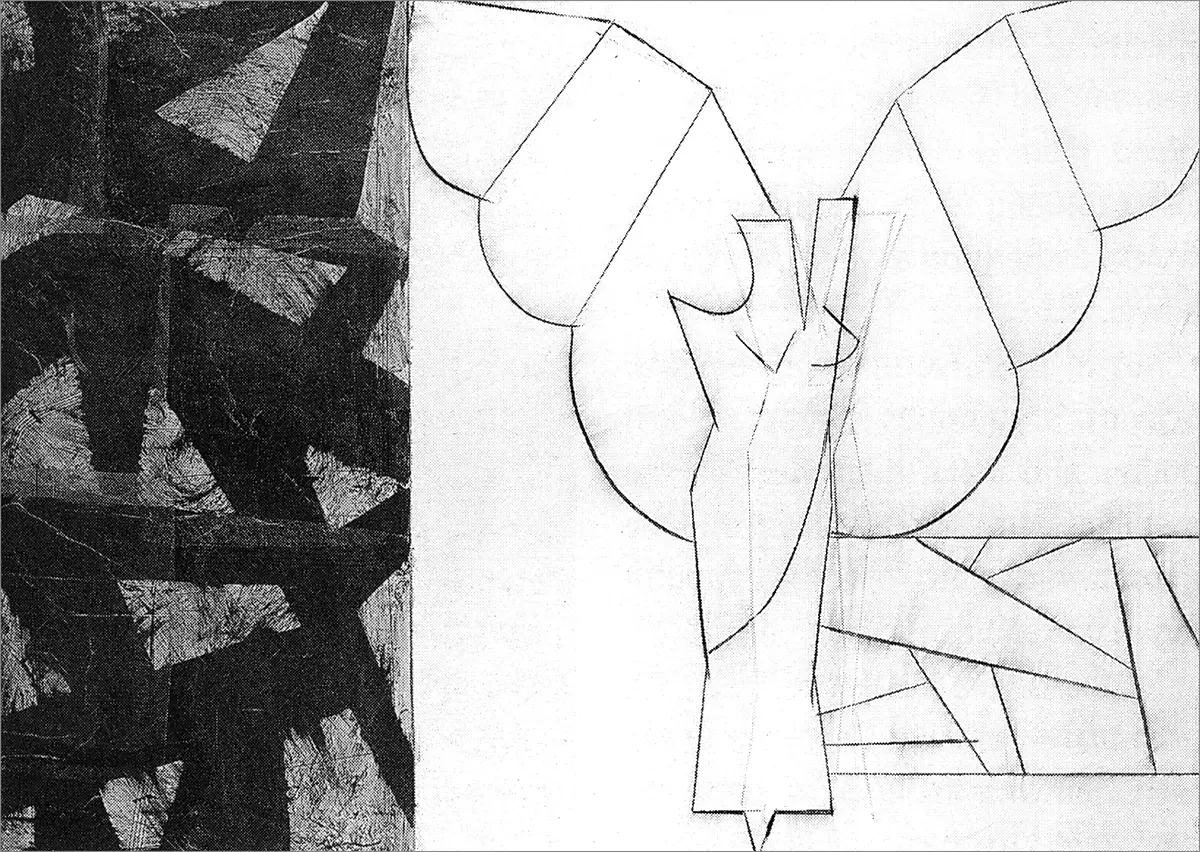
Lecuona, who divides his time between neurotic Buenos Aires and the resort city of Mar del Plata, seems once again to be utilizing certain basic skills practiced by his mother and grandmother, both seamstresses. This time, he incorporated dress patterns as part of the background of some of his paintings, on which he traces fragments or female figures. These are not fully structured or in any way static or geometrical but, as a result of the movement generated by the linework, the source of a dissimulated dance that has its own logic.
In these new works, the background appears mixed, but not turbulently so. The canvases create a contradictory harmony of various textures and colors. One work may have sections with almost transparent dressmaking patterns stuck onto the canvas-perhaps suggesting a kind of map marking out, delimiting but also repeating absences and empty planes painted with a single color.
Distorted and imperfect, the fragments or sketches of the female silhouettes which the artist usually superimposes-in his imaginary cartography or monochrome backgrounds- seem to speak of bodies that are paradoxically not there. Beyond the artist's own intentions, his works in their appearance and festive titles can be read as a metaphor for the fate of all those who were arrested or who disappeared in Argentina during the last military dictatorship (1976-1984), in a country inhabited by bodies without any known burial place.
But is this the case? Because the I6 works in this show seem to be full of clues that do not lead anywhere. Are these patterns precise instructions on how to make clothes, the maps of a city without a name, or the marks of invisible tombs?
Lecuona's images promise something which they do not deliver in the end. In his earlier shows (Lecuona has had more than 20 one-man shows and participated in dozens of group shows in the Americas and Europe, with painting, prints, and installations) the effect of the decentered fragments was to project the spectator towards possible reflections on the absent body and the wounds of a society which have not healed. But now the questions are larger ones. Why do these planes of supposed neutrality emerge? Will the decomposed figures come together again? Is the artist familiar with it, or does he desire some kind of order?
Are the silhouettes merely ghosts dancing alone? The question is not an innocent one and in the south of the continent, the phrase has a certain resonance. On his tour in Buenos Aires, the British singer Sting sang a song titled They dance alone, which referred to the theme of the mothers of those who disappeared. Are the figure's cheerful shadows promising us happiness? Are they the remnants of dreams of a sensuality that is difficult to grasp?
Intriguing and ambiguous, these images do not seek to establish any aesthetic or political position. At first sight, they are passive and have no specific intentions. But these works become deeper with contemplation and even when they avoid revealing any explicit meaning, it is the eye of the beholder who constructs its own story. Does one exist?
VICTORIA VERLICHAK