
The most recent work of Julio Pacheco Rivas and Sydia Reyes was recently presented in an exhibition titled Escapes. Each artist has developed a solid body of work that has brought them well-deserved recognition, including the opportunity to exhibit in the major museums of the country and to represent Venezuela at international events (such as the Venice Biennale in the case of Pacheco Rivas).
Events proposed an interesting dialogue between two and three-dimensional elements and illustrated the challenge faced by these two artists in their sharing of ideas and the joint presentation of their work. The paintings of Pacheco Rivas recreate the world of childhood memories. The scale of the objects depicted matches the perception children have of the world of adults. The works seem to take us back, after a long period of time, to the places where we spent our early years. Everything that we believed to be enormous we now see as much smaller, as if we were now giants in a world of dwarves. The works are done in acrylic on canvas and with grey tones that heighten the impression that this is a collection of memories.
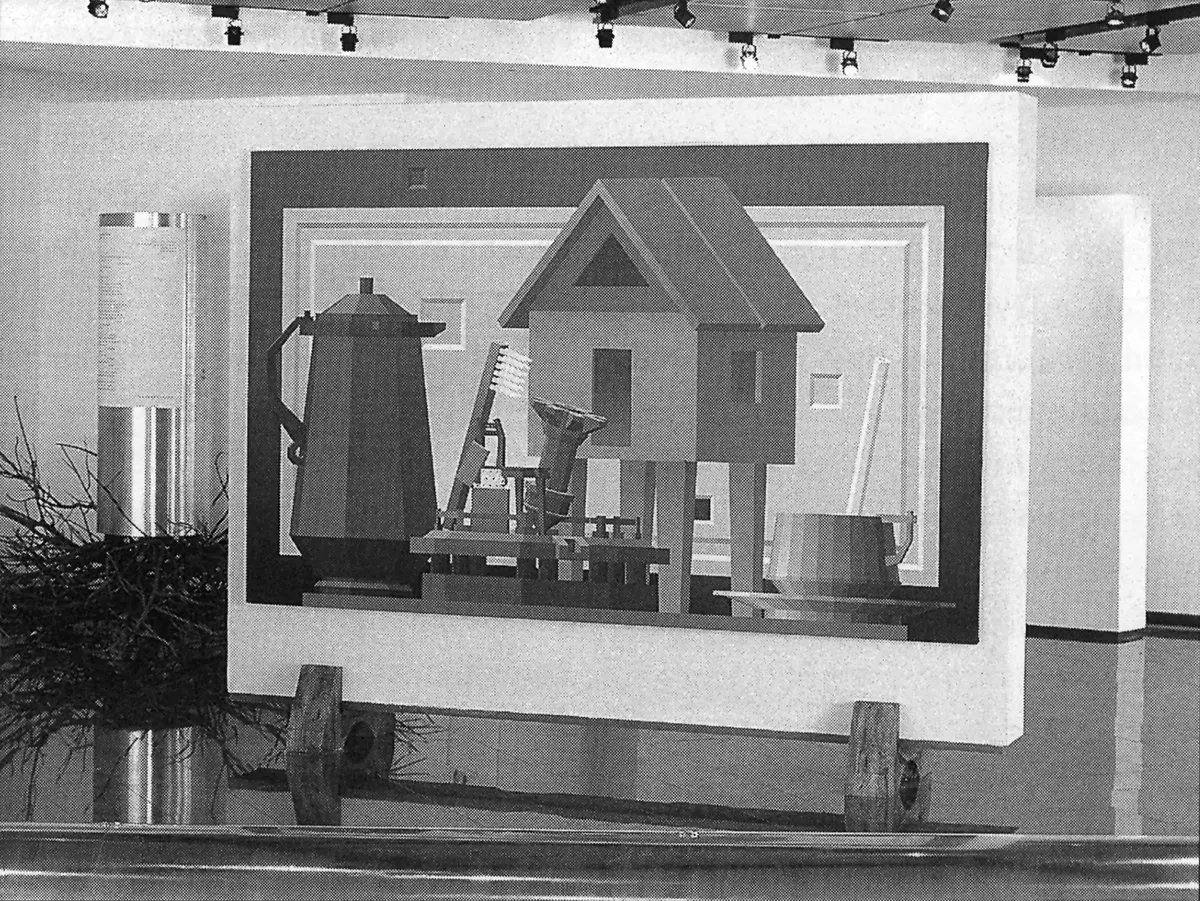
It is admirable to note how Rivas reaffirms the craft of painting, at a time when painting seems to have little to say. The artist makes use of the traditional resources of the genre, as in Con/clave (With a Key), the only work in the collection not based on a preliminary drawing that raises problems of perspective in the purest Renaissance style. Perhaps this was the only piece in the show which brought us back to the artist's earlier works like Compendium, which is now in the Gallery of National Art collection. Rivas' other paintings were done on the computer. The traditional theme of the still-life, as conceived by the academy, is here replaced by the use of the machine, which the artist uses as an ally to play around in an arbitrary way with scale (an enormous toothbrush alongside a coffee pot of the same size). Pieces such as Instructions on the back show us two sides of the same space. This possibility of introducing us into the pictorial plane, with the option of seeing only what the three-dimensional elements allow us to see, makes us the accomplices of the ludic situation that is present in all the artist's pieces. Pacheco Rivas creates an absolute sense of freedom and is not inhibited by any need to be faithful to reality. To some extent, his intention is in fact the opposite, almost to the point of taking pleasure in transgressing the nature of objects.
The use of grey tones in these works has a twofold function: the first is to avoid diverting the spectator's attention to the most striking aspects, such as the colors themselves of the still-life; the second is that the grey tones act as a link between Pacheco Rivas' paintings and the pieces by Sylvia Reyes, who shared the exhibition space with the painter. Reyes' work is more extroverted than her colleagues. While Pacheco Rivas restricts his paintings to the workshop world, Reyes looks out towards the landscape, a city filled with modern buildings placed arbitrarily in the geography.
The result: her silent sculptures, mimetic of trees, of the vital and handsome aspect of the city. But it is here in the gallery. It is not a tree extracted from its natural environment, but a decontextualized trunk in which the steel becomes a substitute for the wood. The tree is planted inside cold structures, with artificial climates, and with no consideration of the natural environment. This is not the first time that Reyes has denounced the environmental problems of our great capitals. A few years ago, she surprised us with her sewers and drains which, like parasites, altered the physiognomy of our streets, becoming another awkward and useless object, which is what in fact they were. More recently, at the first MERCOSUR Biennial in the city of Porto Alegre in 1997, Reyes focused her attention on one of the problems requiring urgent attention by our governments: street children. The result of this proposal was a kind of environment, where images taken by the artist in the market and central areas of the city were projected to highlight the gravity of the situation.
Perhaps what distinguishes her current work from her earlier production is that she has now become more synthetic and subtle in her proposals, indicating her increasing maturity and growth as an artist. Her large cylinders are conceived with considerable aesthetic sense and economy of scale.
Far from having any apprehension about sharing the exhibition space with the paintings of Pacheco Rivas, Reyes exploits the situation to the maximum. Indeed, at times the spectator feels that these sculptures have in fact emerged from the pictorial plane and have taken possession of the walls and floors. Thus, Escapes can be seen as a fortuitous alliance between two disciplines (painting and sculpture), between two visions of the world (the intimate and personal and the emphatically urban, permanently altered and violated).
ANITA TAPIAS