
This exhibition of paintings and drawings by the young artist Julio Valdez, who lives in New York but remains very close to his native country and the Caribbean, confirmed his surprising maturity. He himself is at the heart of his works, through the repeated physical presence of his own self-portrait.
Let us recall the question that André Breton asked Alberto Giacometti: "Why heads? Everyone can do that." To which the artist replied: "I want to try it." We could ask the Dominican painter the same question as the self-portrait is a rather hackneyed resource. And he might reply that he too wants to try it, that self-representation has many unknown dimensions for him, and that over and above the physical similarity and narcissism, the picture mirror is a vision of the world.
Valdez's interest is focused on form. In his paintings and drawings, he designs faces and busts, vertical bodies, and profiled figures, with some even including legs. Although each form is expressed at any given moment, the artist tends to produce an increasingly complete anatomical image. At the same time, in a contrary process, a hand may acquire a totally introspective meaning: the silhouette which was formerly very marked now gives way to a different sign, or fades into the surroundings and disappears.
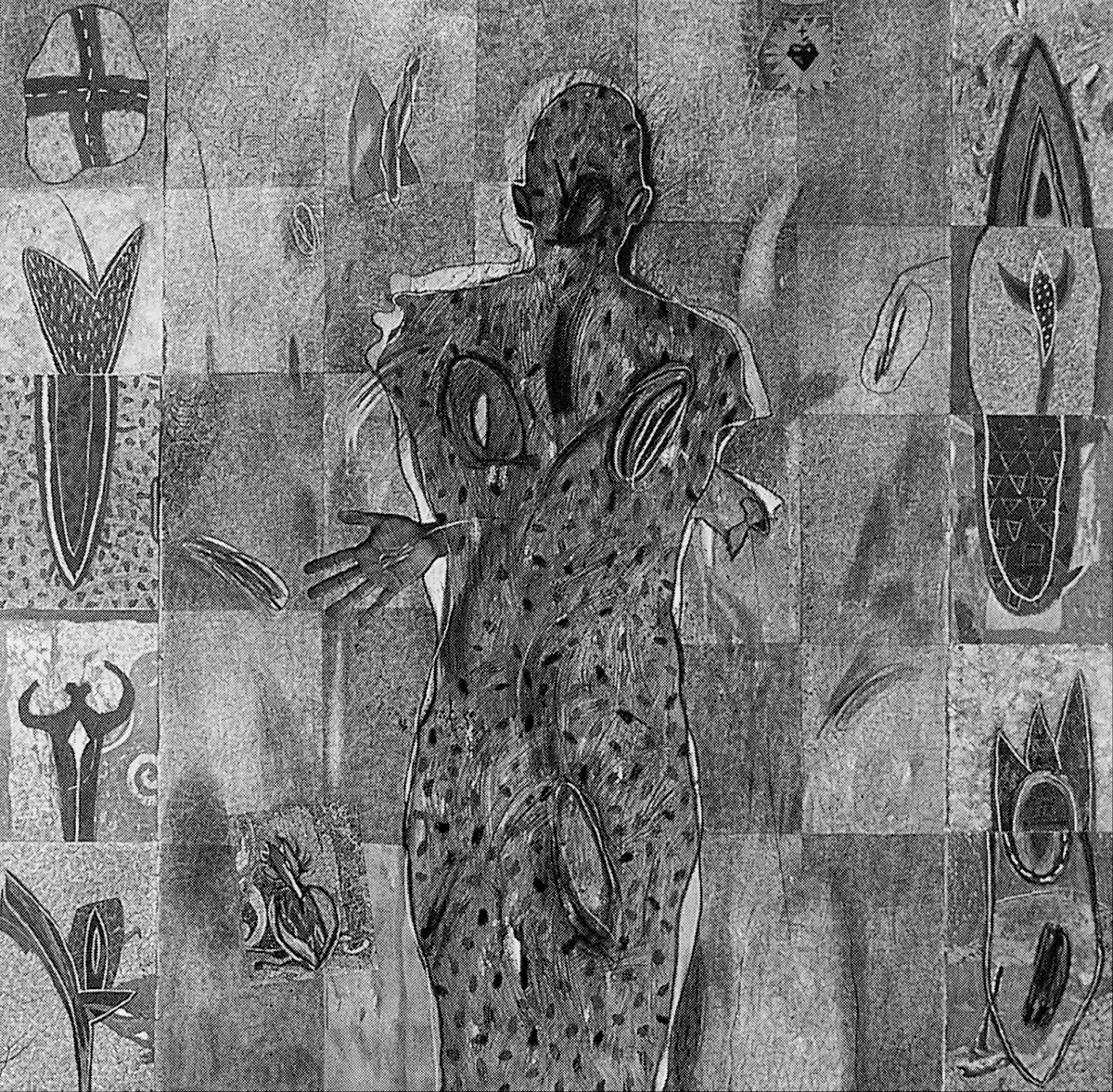
The self-portrait here is not intended to capture a similarity with the model. Obviously, Valdez is not motivated by, for example, Picasso and Bacon. He does not want us to identify or recognize an unequivocal resemblance. The reading is much more open, and the spectator is free to participate at the conceptual level.
The figure, placed in the center and thus dominating the surface, moves from individual representation to a metaphorical level, acquiring an allegorical dimension. In a metaphysical sense, we see man as a focus of greatness: we explore the visual and existential field which surrounds him and which, to some extent, determines his destiny. Julio Valdez offers us an evaluation of the human condition.
The key is provided by the painter in his references to the "end of the century", the end of an era, "reaching the bottom", immersed in the world. We see a location in nature and in history. We will speak of geography a little later. The artist skillfully guides our perception both optical and sensorial-and simultaneously takes us on a conceptual and intellectual journey. Lightness and darkness, fused together through layers of superimposed pigment, encourage the spectator to engage in a reflection on existence based on the plastic order and the ambiguous sense of light. A magical and enveloping atmosphere, which is particularly rich in certain works, communicates the density of the world which pursues us. The artist knows full well that trapped as we are in our specificities, we need purification through air, plants, and animals. A victim of the end of the century, he presents himself in a cage, with the chromatic tones becoming dark and lugubrious. But in another image, he manages to "offer a rose” and become intoxicated with nature-regaining his sense of calm and abandoning despair.
Nothing is definitively lost when a flower springs from the heart, with a window of light projecting the brilliance of noon on the nocturnal zones. Signs and symbols merge with one another and a kind of landscape art, which is both internal and external, gives universal meaning to individual sensations, allowing the self-portrait to reflect something of the condition of mankind. The artist comes to symbolize all living creatures.
We would not be wrong to see hagiographic imagery in these self-portraits. The creature is made sacred through its placement in space: the center and the picture within the picture, the emphatic surroundings, the carefully marked-out frame, or changes in tone. Here man is both reality and myth and occupies the main place in the universe. Then the artist adds the presence of a hand, a sign of warning, a "powerful hand", or the palm of a hand with the marks of the stigmata. All of which takes us back to religion and the concept of sacrifice. Without a doubt, these aspects of his work are worth further investigation.
I said that the self-portrait acquires a universal dimension and speaks to us about the human condition. There is a further aspect that concerns geographical reference. Julio Valdez, an "absent Dominican", as those citizens who live outside the country are called, deeply misses his country, his island, his archipelago. He is from Quisqueya and the Caribbean, and we can see this in his representation of the island man, the replacement of the self-portrait by a map of the Dominican Republic and Haiti or the Caribbean region. His roots are there, along with his dreams reflected in the title of this show, Root of Dreams. The lizard, an archetypal symbol and mascot, a survivor from the prehistorical period, is one of his favorite icons.
A labyrinth protects the island, making it difficult to injure it. A circle surrounds the man-island, the resuscitated ancestor. These surroundings and contours become mandalas, figures, and expressions of supreme harmony. The sacred element once again emerges and encourages us to meditate.
Valdez is not a geometrical or constructivist artist. For him, geometry, constructions, structures, polyptychs, and internal frames are elementary elements for containing and enhancing signs, for clarifying or masking their respective functions: between the graphics and motifs which can be read immediately, there are others that retain their mysteries, like the taina iconography which has still not been fully deciphered.
The artist, who is surprisingly mature for his young age, is enjoying increasing success, winning prizes and awards, sought after by museums, galleries, and prestigious collectors. His enthusiasm for his work, his passion for inquiry, and his sense of professional conscience continue undiminished. His personality is an essential part of his art.
Man-island, the root of dreams, remains faithful to his origins. The historical setting of the Museo de las Casas Reales was perfectly in keeping with this impeccable exhibition, which was handsomely mounted in the great salon, a symbiosis of collective memory and individual reaffirmation.
MARIANNE DE TOLENTINO