
Lina Espinosa, who is currently director of the Department of Plastic Arts at the University of the Andes, is an artist who has taken a firm position in the debate in recent years on the traditional practices of art concerning the power of painting and the validity and relevance of the painted image. Her belief is based on the conviction that beyond the verbal language, there exists a form of reference to the processes of mental construction with which we structure reality, and that can be achieved only through the pictorial process or poetry. This is because these languages are not determined by the logic of discourse, they give priority to intuition and their final goal lies in the construction of an image. Thus, many of the works presented in this show at the Diners Gallery in October used titles taken from various poems, i.e., Along the Path of your Tongue, and To clothe oneself in silence, from texts by the Colombian poet Piedad Bonnett, as well as Borges, Cavafis and other Colombian poets including the late Raúl Gómez Jattin.
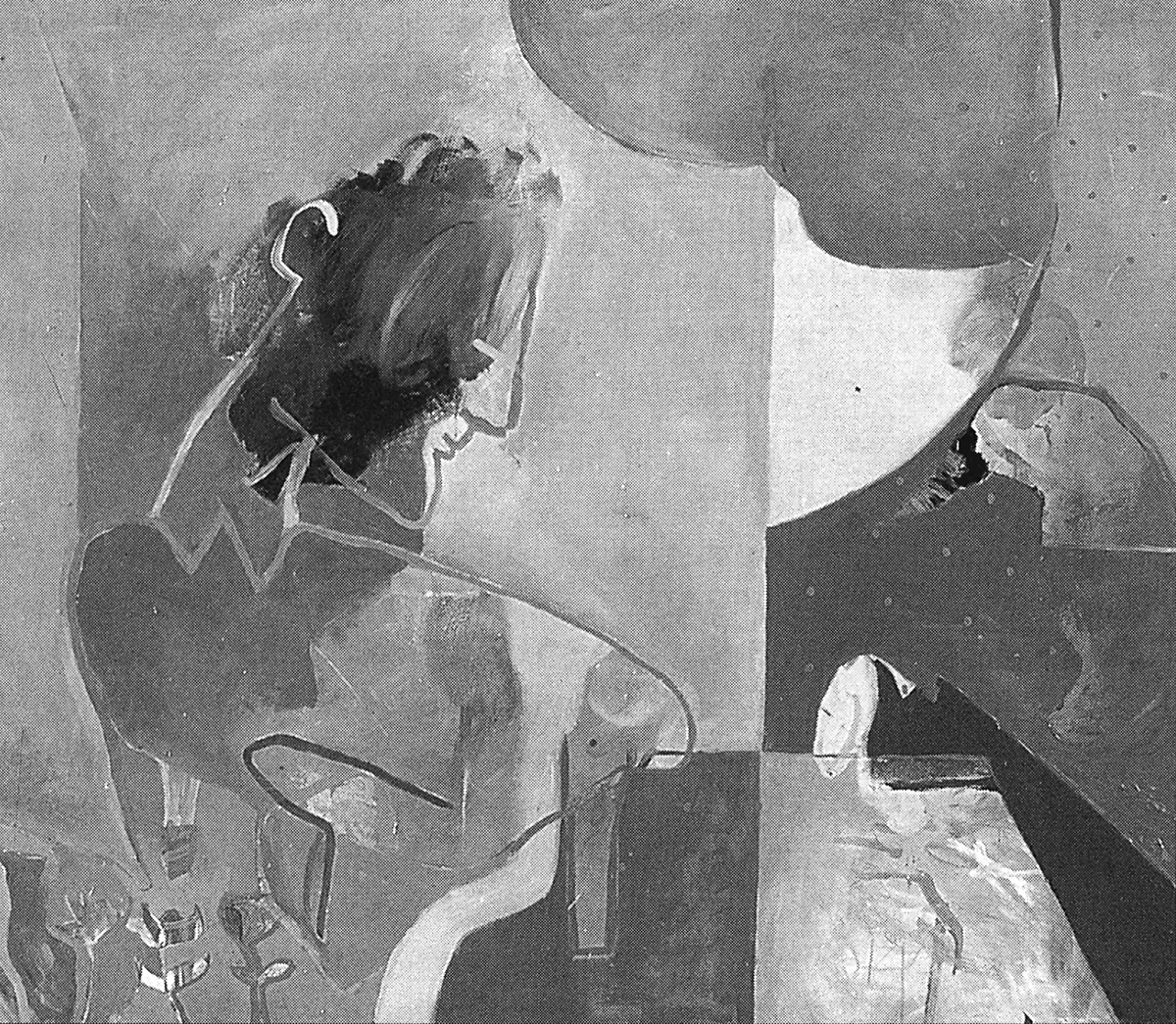
The show included recent canvases of various formats, all worked in acrylic. They were characterized by a reflective attitude to the medium used, as well as a strong desire to reiterate expressive possibilities based on the spontaneity of gesture, the flowing of the pigment on the canvas, and, above all, a fine sensibility in the handling of color. Sometimes, the artist created an interplay of grey tones, while in other works she opted for a chromatic range that included various shades, with the color red appearing in a rather abrupt and violent manner.
The terms by which Lina Espinosa refers to her paintings—as mental maps and territories—define their character exactly. Each work is a complex structure of spaces made up of various layers of pigment in which the object world appears through various procedures like a sign or a wink to the spectator, and which alters the abstract nature of the pictures when seen for the first time. Sometimes the drawing is schematic, and other times the representation of fragments of images is worked in great detail. Espinosa also makes use of purely pictorial methods. As our eye travels over the two-dimensional surface, we begin to discover the subtle relationship which the artist has established between the signs and fragments which seem to be floating and sometimes even go through the color surfaces. Unexpected associations emerge that in turn give rise to new and playful sensations, as in the case of the body of a woman floating in the middle of two surfaces, a body which is resolved in the form of a rapid and schematic drawing (Furtive the house). Other times, frightening sensations are suggested: for example, as in the red and half-open mouth of a woman, in which we can clearly see the row of her teeth at the far end of a dense pictorial field; or another mouth blowing a kind of balloon and emerging strangely from a little square compartment; or the black silhouette of a helicopter moving threateningly over a blue surface. These surprising and fragmentary appearances from the object world both intrigue and question the spectator.
This schematic linework was repeated over and over again in the various images which made up this show. Almost always they presented female silhouettes, which could sometimes be read as a kind of self-portrait, but the linework did not linger to capture the details of precise faces but rather sought to evoke a feminine presence. This was the case with Dialogue of the Dumb, a work done in earthy grey tones in which the brush, impregnated with green color, skillfully transformed the contours of a face into a table and then into a bunch of flowers culminating in a zone of color. In other works, like To clothe oneself in silence, a small format piece, the presence of the woman is suggested through a body constructed with superimposed glazing. Various areas of diffuse color float on the surface suggesting the presence of a torso, and legs with colored striped stockings, a presence set within an atmosphere of various pastel tones ranging from green and blue to dashes of orange. Chromatic resonances are suggested that, as in Along the path of your tongue, emphasize the possibility color has to create vibrations and chords, which, as Kandinsky noted, takes us back to the world of sound.
Given the density of these canvases, the spectator was required to adopt a contemplative attitude, taking the time to look and concentrate on what was happening on the canvas, and so establish a visual dialogue with each of the painted images. These images, like a lot of paintings in recent years, suggest that painting, in addition to being a way of seeing, a way of depicting and presenting the world, is, above all, a slow process, full of sensuality and reflection. It is a process that encompasses a large part of what Western art is all about and one which, as in the case of Lina Espinosa, reflects a specific way of structuring and conceiving reality.
MARTA RODRÍGUEZ