
Luis Fernando Peláez is an architect from Antioquia who some twenty years ago entered the world of plastic arts with three-dimensional works of various sizes that have the capacity to evoke the infinite nature of the natural or urban landscapes, and the vast extension of memory. These are aspects that can only exist together in his work, as he himself has said: "My landscape comes from memory and my memory from the landscape."
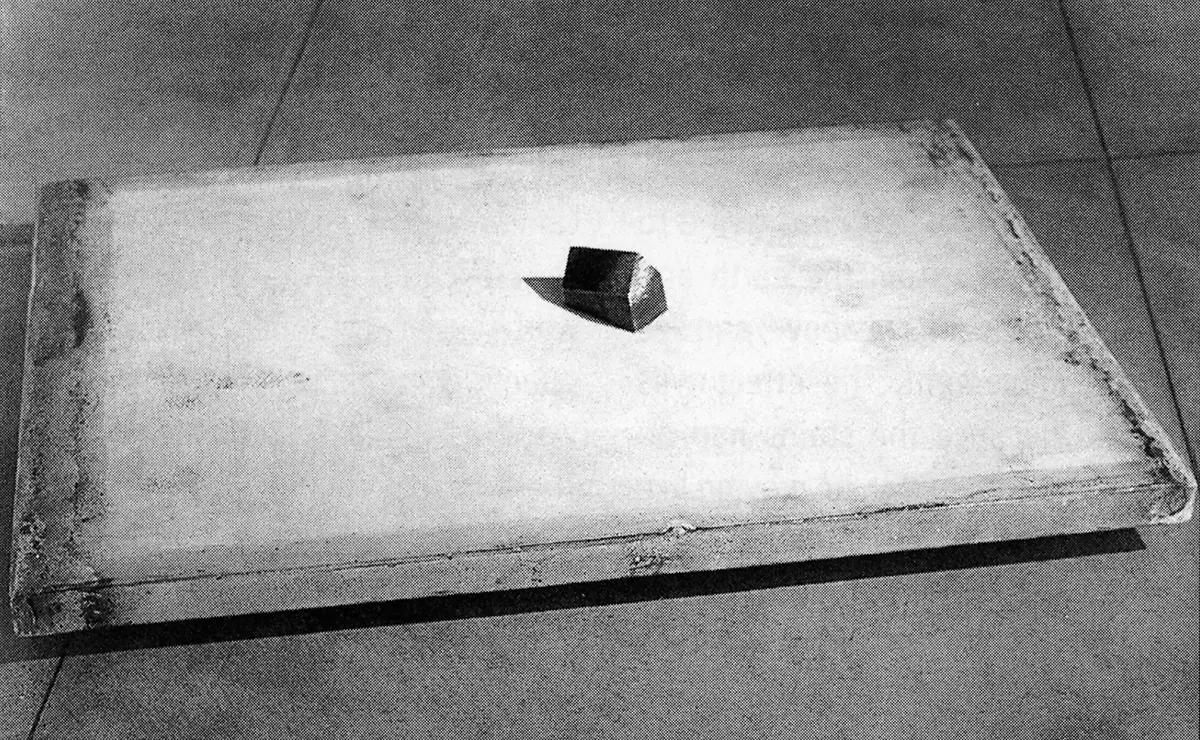
The house, the "dwelling" seemed to be the privileged place of this recent exhibition by Peláez, titled Rain in the Mountains, which was shown at the El Museo Gallery in September. The exhibition consisted of seven-floor pieces, nine wall works, and a metal and glass column that was placed at the exhibition entrance. In the presence of these works, as is customary for his works, we sense a great economy of plastic resources. The forms are schematic, devoid of any detail, and the preferred materials are glass and metal so that in their appearance they resemble the rigor of concrete and minimalist art. But there is an essential difference. Instead of the coldness and lack of meaning beyond form itself, in each of Peláez's pieces time seems to be frozen and preserved, so that each work acts like a visual detonator that in the midst of its hierarchic silence has the capacity to activate our affective memory, plunging it into subterranean layers beyond the immediate present and into realms close to oblivion-all of which is quite foreign to concrete or minimalist art.
The floor pieces done in metal and covered with resin (some dark and some white) were set out diagonally over the floor of the exhibition room. Each one used a minimum of resources to evoke a place rectangular shape in which, in a strategic and solitary manner, a house has been placed at the end-the archetypal house of two or more floors with a two-slope roof. The works referred to the concepts of localization and inhabiting, the appropriation of a place-an action which seems to have occurred in some remote and distant, but at the same time, a decisive past which for some strange reason has been frozen on the metal and under the varnish.
Because of the relationship established with the wall, the wall works recalled the functions of naturalist painting, in that they could be associated with the idea of a window with a metal frame which, because of its transparency, showed a distant, misty, and cold landscape in which time has been accumulated on the slanting roofs. But given their appearance and structure, these works, with their elegant and sometimes square forms, also functioned as boxes in which between the heavy frame marking them out and the presence of the glass which encloses them, almost always blurred with humidity, time is preserved intact. In these evocative boxes or windows, between the rain which pours torrentially on the glass, or behind the layer of vapor which mists them, the house rises up solitarily; the house, which is inhabited, hermetic and silent, but always warm and welcoming, sometimes made with rather oxidized metal, other times slightly colored.
In this show, Peláez insisted on his allusion to landscape and memory, features that have been present in other series, such as City, Instants, and Ports. In all these works, perhaps because of the proportions or the peculiar scale of his objects, there is a strange atmosphere of silence, solitude, and absence. But it is an atmosphere that suggests the presence and warmth of certain human gestures associated with a particular and decisive act of existence, for example, the precise moment in which man becomes conscious of his "being" in a place. A privileged moment in which time seems to stop and which seems to be the basis of all that subsequently happens in life. It is this experience that unfolds in time that seems to remain always caught or suspended in his works, with all the affective force that brought it about, in this particular case the presence of the everlasting house, the ancestral house which lives in memory and which can be perceived through a persistent drizzle slowly falling from the mountains.
MARTA RODRÍGUEZ