
Rony Vayda's place in the panorama of Colombian art in recent decades has been clarified by this rigorous retrospective exhibition which highlighted his strong faith in the aesthetic principles which he adopted and imposed on himself early on. By this, I mean that his creative process is not characterized by intuitive elements, but rather that there is a persistent idea of rationality in his work which determines the development of his artistic process.
The danger of his sculptures in the early years was that they risked becoming a kind of architectural workshop in which the artist mentally avoided the specific problems of sculptural work (voids and volumes) in favor of merely graphic elements. But the challenge and problem of placing the sculptures in public places, thanks to a policy —now unfortunately discontinued– requiring that works of art should be placed in buildings and residential complexes, enabled him to resolve demands of a sculptural kind.
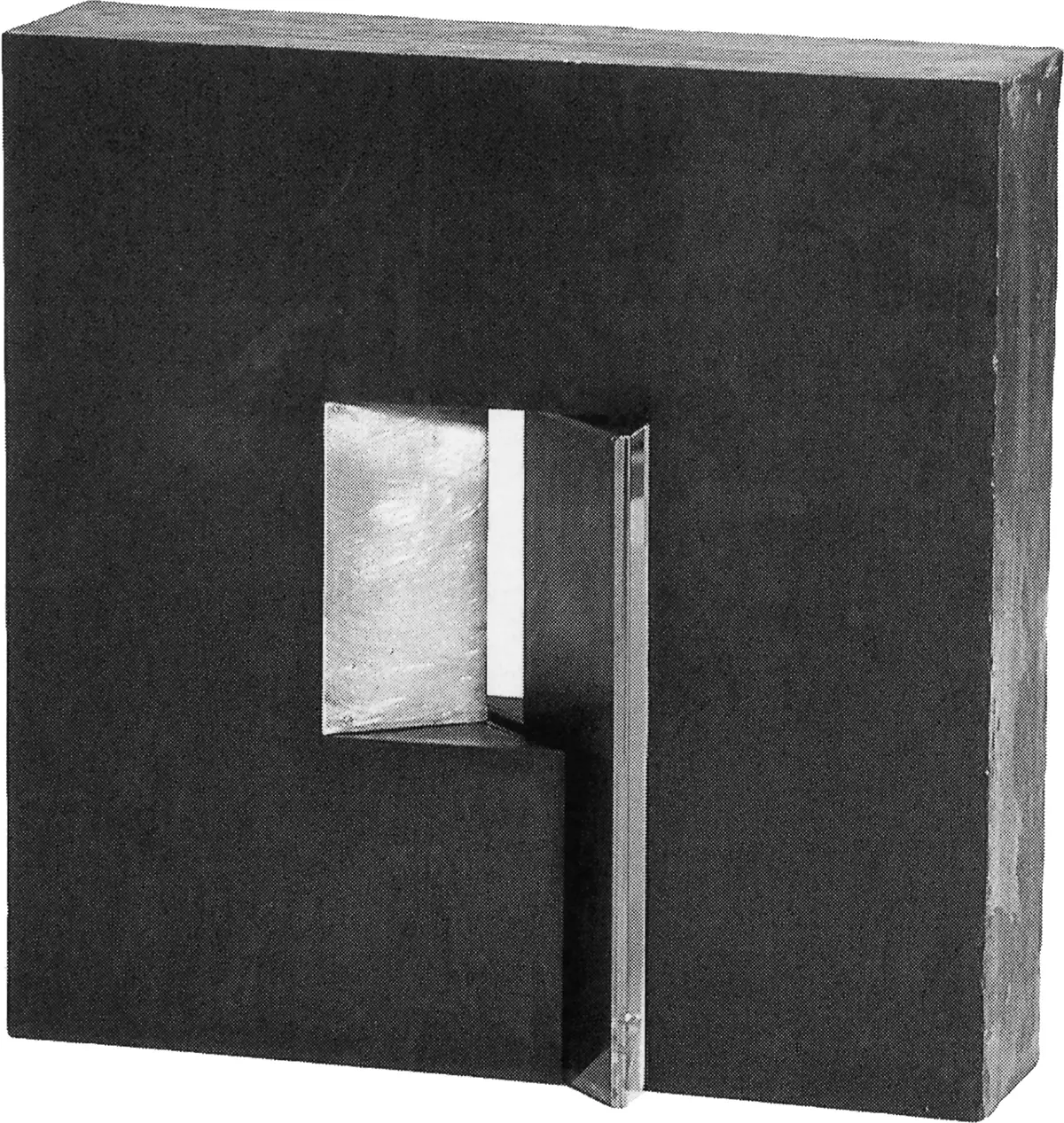
Here the artist must respond not only to modern geometrical traditions, but also to something more difficult, such as local traditions, deep-rooted habits, and deformed ideas of considering sculpture only in terms of the monumental style or the rhetoric of Arenas Betancourt, for example, or the works by Salvador Arango or Justo Arozemena, a sculptural response ever ready to satisfy such habits in the simplest manner.
The placing of work at the entrance of a residential complex already supposed, vis-à-vis a consumer-based architecture almost devoid of quality, the need to create with the geometrical object a kind of mental reference that is much more potent than any mere anecdote with names of flowers, battles, and other ephemera. Here is a process that recalls the need for an order.
The sculptural object in all its roundness of form challenges by its very form the pernicious irrationality of the telluric, the false idea that the genius loci is made up of what is there in the topography, rather than what is constructed on the basis of a new sense of space, a proposal which is different from that of space in its everyday dimension.
These forms which are set within a personal geometry are autonomous precisely because they reject any kind of mediation by the surroundings, of things that are there by the fatality of geography.
The dialogue of the artifact is not a priori, as in the case of the organic element which attempts to enhance the surrounding landscape, the original texture of the earth or rock, but rather a posteriori, since the effect of modifying the surroundings is barely beginning.
And the dialogue will be with an interlocutor who is waiting, an interlocutor who has managed to escape from anecdotes and false localisms. Another virtue of these geometrical artifacts is thus their discretion, an extraordinary virtue that disregards the colossal or rhetorical contortions. I have not deliberately avoided referring to the rationale here but another virtue of Vayda's proposal is that he has managed to overcome the aesthetic polarization with which this term has been associated in recent decades. Gabo and Pevsner have taught us about the existence of forms whose irrationality involves, in addition to the proposal of some other order different from the existing one, a sub-stratum of signs where there is a latent idea of the dream, an idea of poetry.
What else were they looking for than the spaces of a necessary symbolism, one stripped of religious and telluric traumas? The small sculpture here is not part of a process or an investigation, as is usually the case with a certain kind of rationalism intended to modify an entire order, but rather an invented form, an object added to reality.
The rationalist tries, as Eduardo Subirats has pointed out, to redesign the world in all its spaces and orders, without leaving any options for other proposals. The object which Vayda makes is placed in physical reality in order to move and affect it silently, by reminding us that in the face of disorder and vulgarity there also exists an inner need for harmony and that the task of sculpture is to give life new contents.
The sensation of roundness that emerged from this retrospective was the result of another virtue rare in our art: serenity. Serenity rather than the cacophonous shrieks of those who destroy without proposing any alternatives the lesson to be learned from seeing the task as an everyday search, vis-à-vis the void, for the autonomous form which is the expression and achievement of a new spirituality.
DARÍO RUIZ GÓMEZ