
The Puebla de los Ángeles Biennial, which is organized in the city of the same name by the Ibero-American University, just presented its second edition. This is one of the most important efforts made in this part of Mexico to promote and present to the public some of the most representative creations in various branches of the visual arts.
The main theme of the convocation for this second edition was "the Baroque". In a city whose center has been declared by UNESCO as belonging to mankind's cultural heritage-in this case mainly due to the large number of representative buildings of this style from the period of the Vice-Royality-it might be thought that the participants in this event considered themselves to be champions of this particular style. But this was not the case. The participating works included a number of references that made the jury reconsider the traditional concept of the baroque that has prevailed in this part of the Mexican Republic.

It was clear that the simple coexistence of representative buildings of this style with the modern inhabitants of the country was not enough in itself to make any difference; it was not only that the prototypical symbols of the Baroque that had to be recovered or reconsidered, but there was also need for a new reading that would decodify the motley environment in which we live. The final moments of the millennium appear to be urging us more in haste than in repose to envision new ways of dealing with our surroundings and their representation in visual and objectual terms.
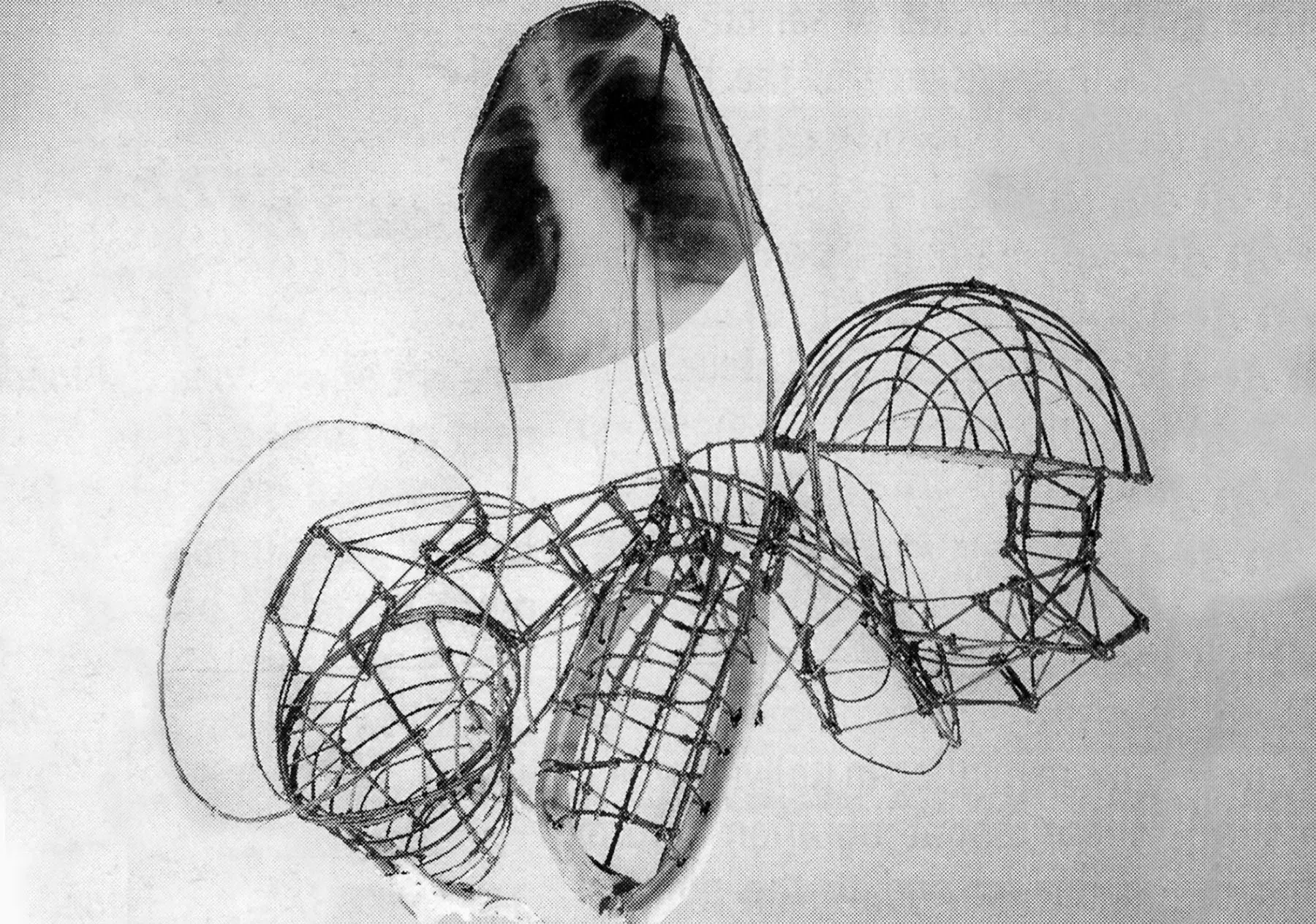
The first prize for sculpture went to Emilio Allier, for a piece titled Forms of a suspended process 5, the materials of which included bones, wire, X-ray plates, and rods. All these elements were used in such a way that allowed the work to be suspended in the air and thus be read differently from the other works in this section.
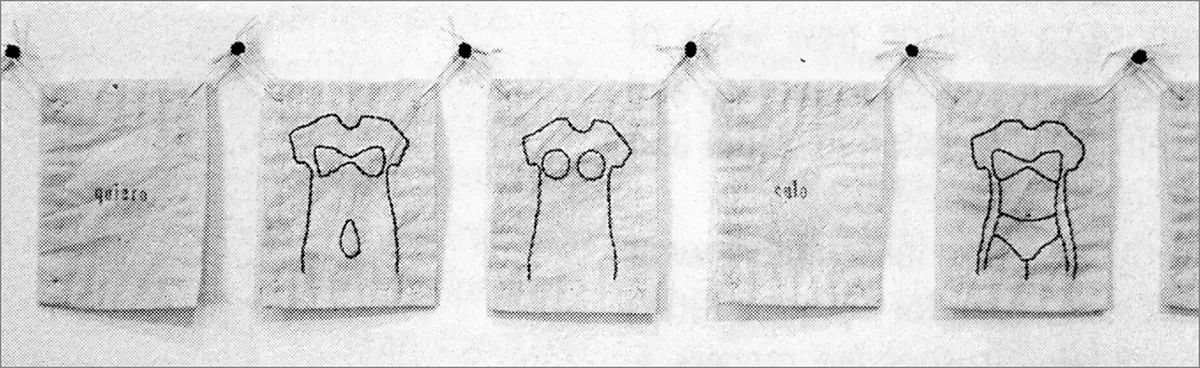
Claudia García Calderón, a painter by vocation who has made some important pieces which she presents like large banners hanging from a crossbar, presented a delicate installation (no less serious for that characteristic) of embroidery done with little pieces of fabric on which she reconstructs the female body, with its transparent clothes and the physical evidence of the wearer. Calderón's works are accompanied by words that refer to the treatment of women by men and their status as sexual objects: Sabrosa, Buenota, Mamacita, Quiero, etc. This is a language that has been assimilated into social terms and which is at the same time both humorous and popular.
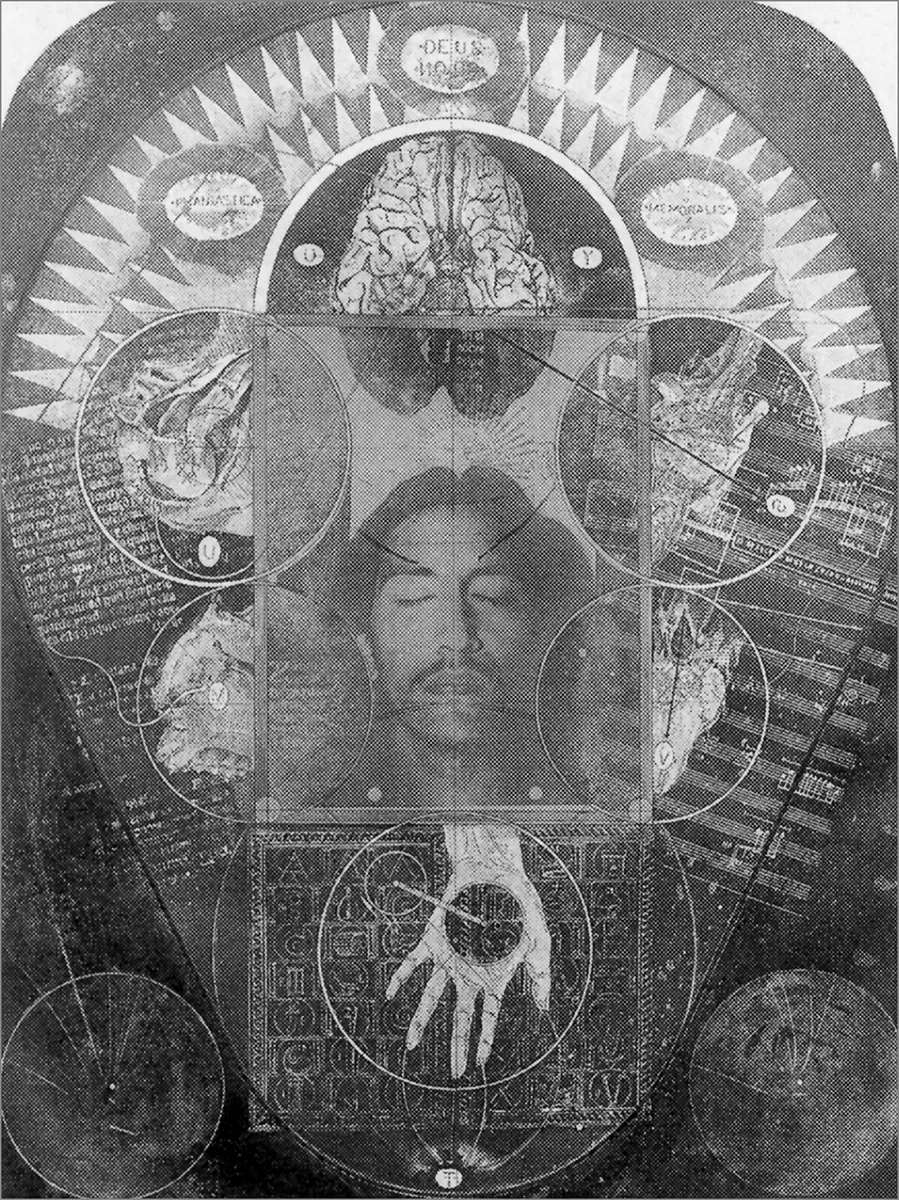
In the photography section, the prize was awarded to Jesús Torres Torres, who presented five pieces from his extensive series titled Apparitions, Reflections of personal heaven, in which he used various techniques (reprinting, superimposition, and the manipulation of negatives) to propose a careful analysis of the theme of the baroque. Through nudes, religious images, and dried flowers, Torres creates a visual variegation full of familiar codes, the combination of which, in this altered environment, suggested novel and contemporary readings.
It is important to note here that the jury's decision was made extremely difficult by the high quality of the works presented. For example, one of the works on display was a photograph from the series The taste of the times, titled The breakfast of the young princess, by Alberto Ibáñez Cerda, who was recently selected to participate in the Monterrey Biennial and the Fifth Bancomer Salon because of the contemporary nature of his proposals and the thematic impact of his work. The piece in question was a little porcelain doll placed in an equally kitschy setting that offered an acerbic critique and implacable questioning of objects that acquire different meanings depending on the merits or demerits of the places in which they are presented. Francisco Daniel Quintanar obtained the first prize for printmaking with his piece titled Mens Agitat Molem, a work full of precise and fine details on copper plate.
One of the jury members, Fernando Solana Olivares, explained in the exhibition catalog why the jury decided not to award a first prize for painting. "Eventually, there was a majority in favor of one painting, but opinion then changed. However, the jury decided to award three mentions and not to award a first prize. But at least three paintings could have obtained the first prize." Honorable mentions were awarded to Marianela de la Hoz for her work From absent fathers, Imaginary Sons, to Daniel Ruben Rosel Burgos, for his City happiness, with a country touch, and to Angela Arciniaga and Maru Eugenia Jiménez, for their Ways of Taking off a T-shirt.
The work by Marianela de la Hoz consisted of a doll's house the front of which had been removed and inside of which, connected by the different levels of the house, a series of disconcerting scenes are enacted by monstrous figures with the tails of reptiles, two heads or no head, mutilated or transformed into fantastic creatures flying around the room. It was a mise en scène in which the events occur without any sense of urgency and within a clear atmosphere-although the context itself is ominous.
Another honorable mention was given to a landscape that incorporated elements of the circus and of the region, not so much in terms of the characters themselves as their place and activities within the work. Some figures in the work are riding bicycles, others are playing on a table and others a playing a guitar.
Flavia Hevia was awarded the prize in the art-object section, for the Oedipus complex, which consisted of a box containing maps, equestrian figures, texts, letters, and shelves with an interior light. A representative of the important Mexican tradition of artists who produce art objects, Hevia reworks an iconography that many people consider obsolete or hackneyed.
In conclusion, the second edition of the Puebla de Los Ángeles Biennial, with the help of the organizers, successfully avoided some of the conflicts that exist in some sectors of the artistic community of this city. The Biennial has now emerged as one of the most relevant cultural events in the country. Significant progress has been made since the last edition with regard to the structures that will help the show to survive in a context where salons and biennials are proliferating and where their future life will depend on their capacity for research and follow-up within the vast field of contemporary visual creation.
SANTIAGO ESPINOSA DE LOS MONTEROS