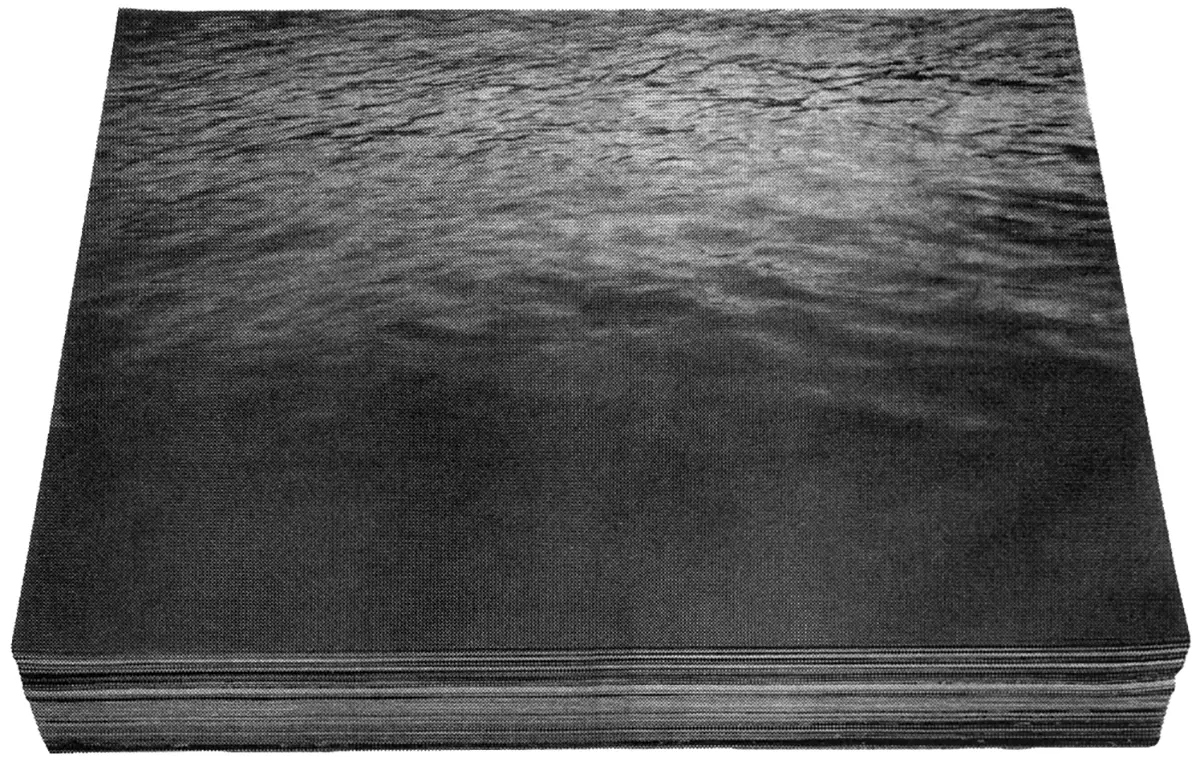
Curated by Gerardo Mosquera, an exhibition entitled Absent Territories at the Casa de América in Madrid brought together the work of seven artists. Nomads? Global artists? Immigrants? No term seems able to explain their territorial status. As Mosquera points out in the catalog, the show begins and ends with the sea: with The Pile of Marine Posters (1991) by Félix González-Torres and The Book Thick of Ocean (1993) by Lani Maestro. On the one hand, with the sea which expands as the posters are distributed among the visitors, and on the other with all the oceans of the world enclosed in a bound book (the word “bound” here is fundamental to understanding the subtlety of the piece). Nothing would appear to be more appropriate to evoke an absent territory than the sea—a privileged non-space that seems only to flow, to swim, to navigate, and to move. Thus some of the selected works proposed a particular configuration of this non-spatiality (the most contemporary would call it virtuality), this absent territory, reflecting the privileged capacity of art to depict what is unrepresentable.
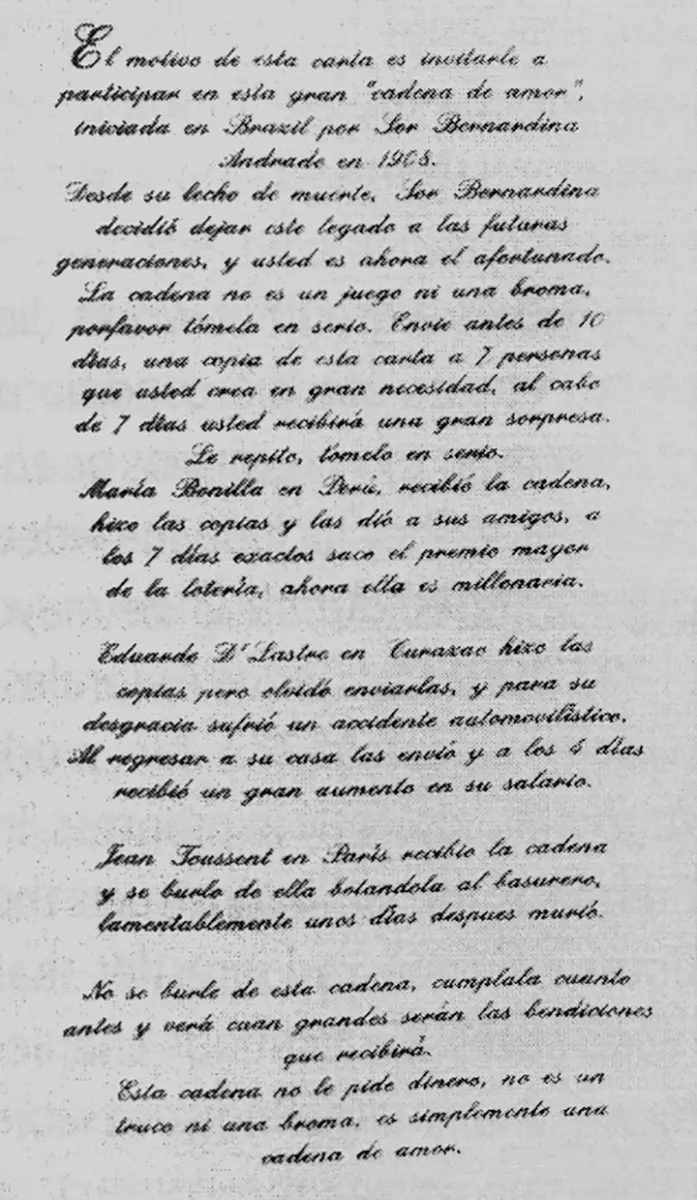
Priscilla Monge presented a series of seven embroidered Chain Letters (1993-1999) in which she revealed the tension between the physical and mental territorial expansion implied by the theoretically infinite continuity of the chain letters and the almost static and localized activity of the embroidery work.
In addition to the transgressions between cultural frontiers evident in the work of Liliana Porter both in her photographs, such as Gaucho (1995), The Great Burden (1996), Piñata (1997), and her video piece entitled For You/Para Usted (1998), it is very significant that Porter’s objects—these everyday toys that nevertheless have a disturbing personality (perhaps because they are so evocative?)—are always located, both physically and conceptually, at the limits of the support, the neutrality of which (the background is almost always white or at least smooth, and lit in such a way that some shadow is cast) cancels out any attempt at localization. Porter’s figures are protagonists in a place that is impossible to place: hence the tension between the narrative principle which she seems to want to respect and the dislocation of any clear space-time coordinates.
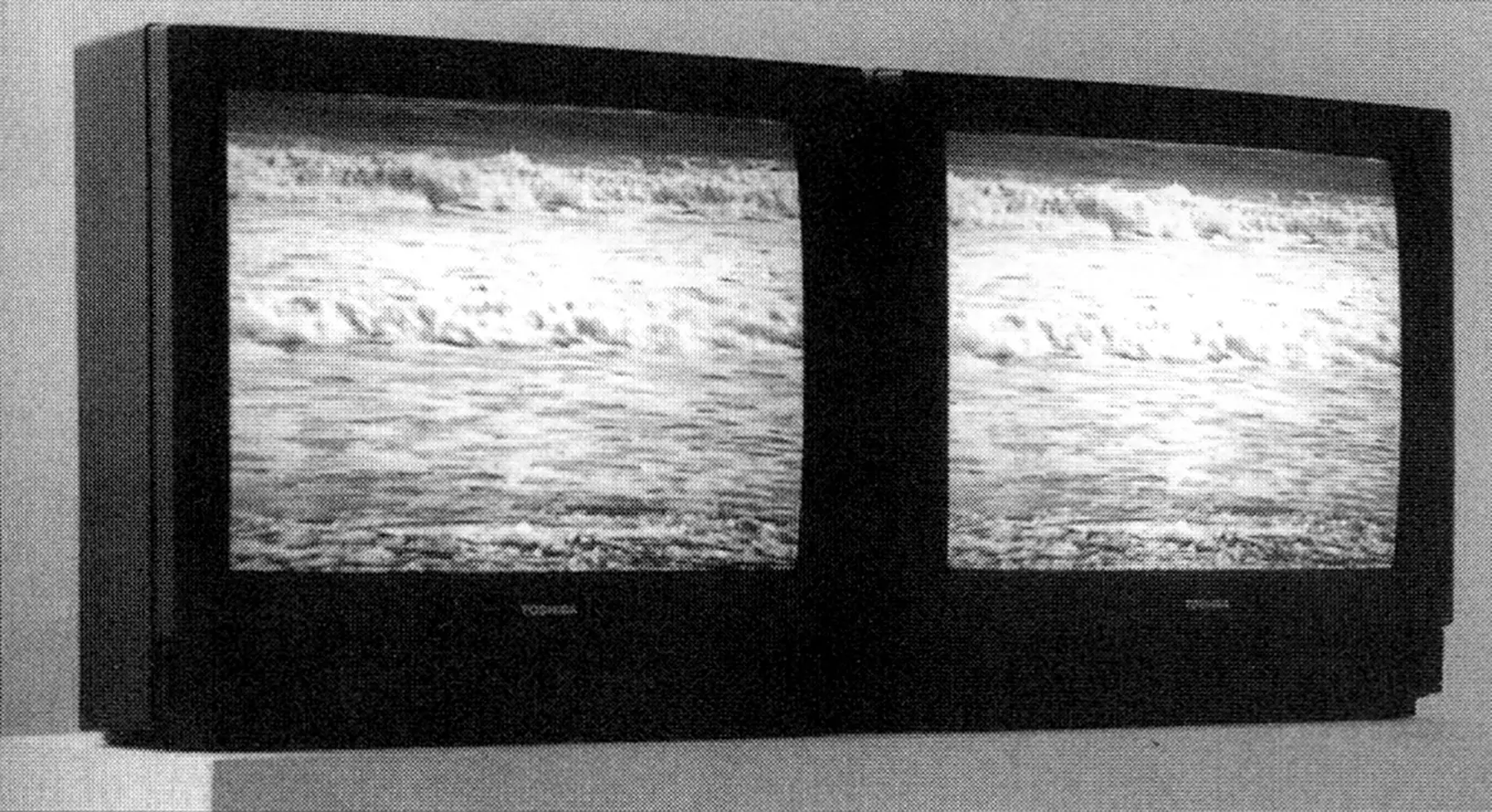
Of the pieces by Diego Gutiérrez included in the show, perhaps it was The Absent (1996) which was most closely linked to this out-of-synch effect that we find in Porter. In this work, of which the video documentation was shown as well as the text describing the piece, Gutiérrez plays with the ways of being and not being in a place: after a long period spent outside Mexico, his native country, he returns, but only gradually, as he shows himself to, or hides from, his close friends, who afterward will have to confront themselves and their meeting with the artist, who has recorded them in secret. Here the proposal seems to refer to that aspect of presence related to the games of memory, a feature which is also dealt with in A Voice Remembers Nothing (1995) by Lani Maestro, consisting of two television monitors with the repeated image of the sea while a voice which seems to come from the depths accompanies the to and from movement of the waves.
The conceptual nucleus of the show thus tried to show the plastic results of a group of artists who seem to be in a process of constant transit that is not only geographical but mental and clearly cultural. The image of the sea is a fortunate one in that it is the place where all frontiers and all identities are erased, where any attempt at definition in these terms seems almost useless.
However, a group of works did try to repostulate the conditions of identity in this precarious or absent space. They include the video piece entitled Arena 2 de Mayo (1997-1998) by Carlos Amorales, which is part of his work Amorales is currently in progress. In this piece, the artist constructs the figure of a masked wrestler that recuperates the fictitious character of identity as an indispensable condition within the context of professional free wrestling. In the video, the figure Amorales, a novice whom we only recognize because he is wearing the mask, which is an abstraction of the artist’s own face—is opposed to another masked figure a former— professional wrestler—who tries to take him through a number of routine techniques. This is the starting point for a series of reflections on the possibilities and limits of communication between the figure who is externalized and the person behind the mask, between the amateur and the professional, whether wrestler or artist.
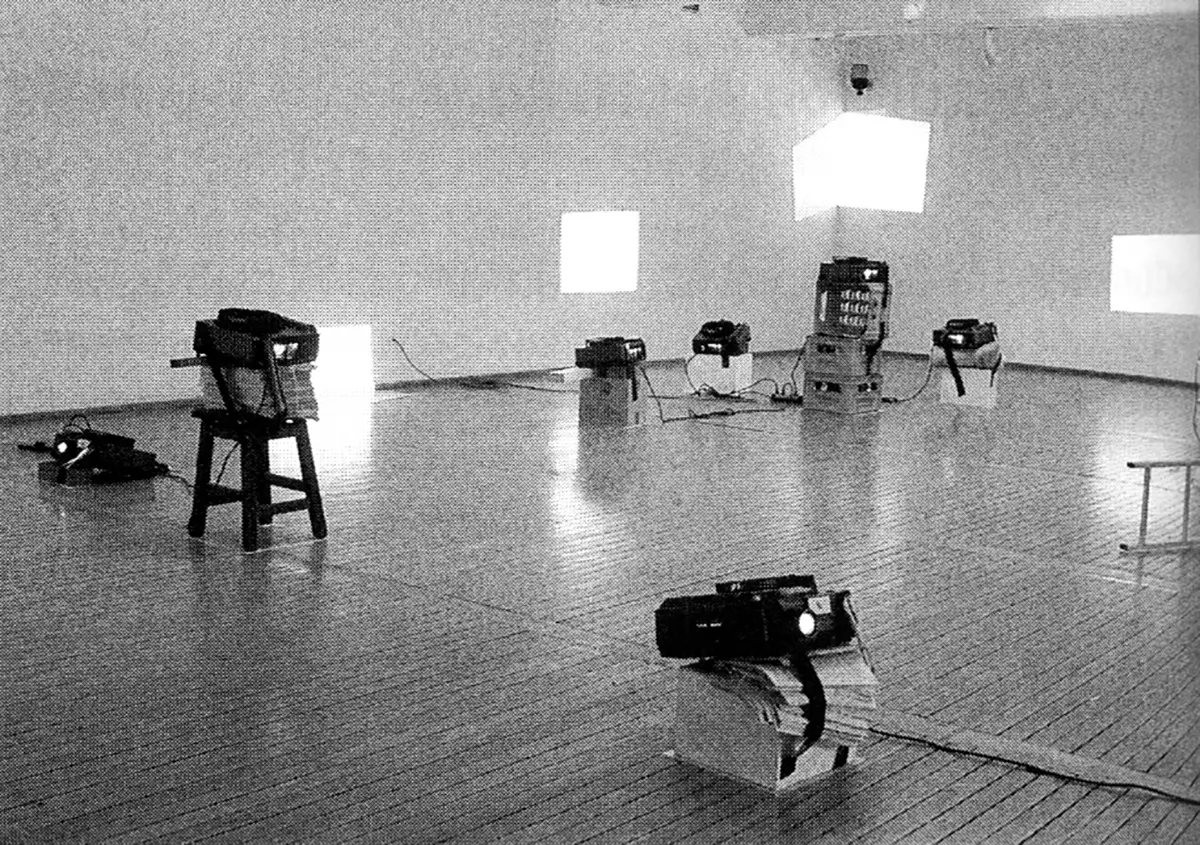
It is useful here to open a parenthesis. By a fortunate coincidence, at the same time as this exhibition, Luis Camnitzer was presenting his installation entitled Lecture on Art History in another room of the Casa de America. This work consists of a series of 12-15 slide projectors distributed around the room, apparently at random. They were all placed at different heights although none was more than a meter or meter and a half above the floor. Positioned precariously on boxes, benches, chairs, suitcases, and piled up with newspapers or books, they all showed their projection simultaneously, so that the impression on entering the room was much like that of finding oneself suddenly in the midst of a bombing or the crossfire of guns. The sound of the projectors drowned out any other sound, and the arrangement reminded the visitor of a war zone. Each piece of apparatus had a set of slides, which rotated non-stop, but each slide was transparent so that the only things projected were beams of white light. This unusual lecture on art history also in a way evokes the idea of a non-place, in this case, that of art history. In the installation, each visitor could imagine the images comprising his or her own version of that history, or even better speculate on what is possible. What is important is the absence of art itself, thus establishing a deep relationship between the respective authority of the discourse of identity and the discourse of art. Within this context, we can also include the very complex and literal installation entitled Back to the Backyardeden Express (1995), by Sergio Vega. But the most suggestive piece in these works of reflection on identity—and in a sense on art itself—was probably Untitled (Passport), 1991, once again by Félix González-Torres. It consists of another of his piles of paper to be consumed by the visiting public, but this time made up of enormous perfectly white sheets. The immaculate paper is already a reference to the origin of the creative process, to the principle of the infinite possibilities of the imagination. But it is also the passport of no country, with no place for the usual list of physical characteristics and marks, names and addresses, dates and titles. A passport has rendered obsolete any dream of static identification and, with it, the requirement itself to have any such documentation. To paraphrase Gerardo Mosquera, it is a passport to freedom.
ISSA MARÍA BENÍTEZ DUEÑAS