
In the trajectory of contemporary Brazilian art of the last 50 years, Cildo Meireles has had and continues to play a vital role. Emerging in the mid-60s when international art was undergoing formal and conceptual shifts, Meireles’ work helped galvanize theoretical discussions about art and its relationship to the larger social world in which it operates.
Works such as Moneytree and the Insertions into Ideological Circuits series of the late 60s and early 70s were, in hindsight, germane to Conceptualism’s ontological reconfiguration of the art object. Meireles’ rereading of the monochrome exemplified in A Very White Sandwich of 1966 also expanded the purview of formally reductivist strategies to critical and poetic ends. What underscores Meireles’ prodigious oeuvre in general is that it is marked by a consistent conceptual complexity, thus any retrospective of his work would be a curatorial challenge even for the most seasoned of exhibition organizers. This challenge was met with his one-person show at the New Museum of Contemporary Art.
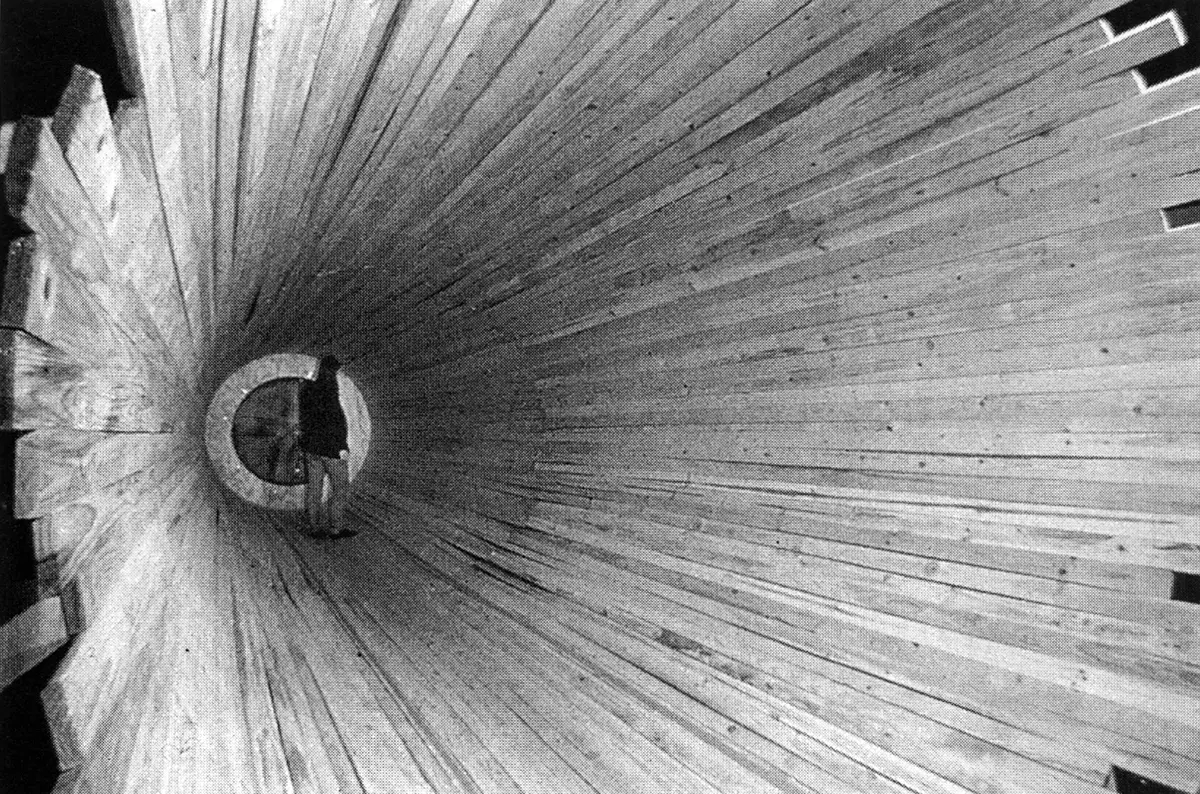
The exhibition organizers, New Museum curators Dan Cameron and Gerardo Mosquera, had the difficult task of choosing works representative of Meireles’ career while paying close attention to the spatial logistics of the New Museum’s galleries. Faced with such circumstances, the curators exhibited pivotal room-sized installations as well as key sculptures and drawings that offered a coherent perspective on a major international artist.
One entered the exhibition on the first floor through the labyrinthine yellow monochromatic Fontes (Fountains sources, 1992) and exited on the second floor with the Malhas de Libertad (Meshes of Freedom, 1978). Fontes deftly unpacked the notion that clocks, rulers, and numbers are outside the sphere of ideology; this uncritical assumption is based on the ostensible raison d’etre that situates them as tools of objectivity that innocently chart such “asocial” phenomena as time and space. The installation articulated this through the melange of rulers that hung from the ceiling with incorrect measurements, clocks with misplaced numbers that could not keep the correct time, and the thousands of numbers strewn on the ground in a disarray of empirical inertia. Fontes was simultaneously atrophic and exhilarating, and a testament to Meireles’ signature strategy of seamlessly integrating disparities such as logic and its other to paradoxical and poetic heights. After exiting Fontes, one was confronted with three sculptures before entering the visually intoxicating Devio para o Vermelho (Red Shift, 1967-1984). The sculptures between the two installations were Flo (Thread, 1990-199 5) and two versions of the early Espacos Virtuais: Cantos (Virtual Spaces: Corners, 1967-1968). Working one’s way through this area one was then transported into the monochromatic utopia dystopia of Red Shift.
Red Shift was a U-shaped installation of three sections formally unified by the color red: the first section Impregnação (Impregnation), was a living room that contained objects of leisure and comfort set within white-colored walls. The monochromatic saturation of the red objects caused them to shift from an amorphous convergence that was purely optical to an emphasis on their tactility via their readymade sculptural qualities. Exiting Impregnação one encountered Entorno (Spill/Environment). Entorno counterpointed lmpregnacao by way of its black, dark, cavernous interior that contained a tiny illuminated bottle that had spilled an enormous puddle of red liquid. Entorno is more than a segue to the next piece entitled Des vio (Shift), though it ingeniously operates as a formal and conceptual link between the first and last sections of the installation. Desvío continues with the motif of the darkened interior, and the liquid that was inactive in Entorno has now animated itself with a vengeance. Opposite the entrance to Desvío is a spotlighted sink that is slightly tilted and gushing from its faucet is a red liquid that evokes blood. Devio para o Vermelho is a tour de force on numerous fronts: it shifts across the sensorial spectrum while critically emphasizing the epistemological limits of visuality, but this subversion is not through negation but through visual and sensory overload. On the second floor’s installations, Meireles expanded the optical and tactile as social and aesthetic receptors by including the sense of taste as an integral experiential component of the work of art.
The second floor consisted of three installations: Cinza (Ash/grey, 1984-1986), Entrevendo (Glimpsing, 1970-1994), which required the viewer to place salty and sweetened ice in his/her mouth, and Volátil (Volatile, 1980-1994). Interspersed with these works were the sculptures Desaparecimientos (Disappearances, 1982), Obscura Luz (Obscure Light, 1982), and Malhas de Libertad. Also on display on the lower floor were other important sculptures and works on paper including the Insertions into Ideological Circuits series (1970), Espelho Cego (Blind Mirror, 1970), Para Ser Curvada Coin os Othos (To Be Curved by the Eyes, 1970), and Zero Dollars, 1978-1984, and Zero Cruzeiros, 1974-1978.
The intelligence of Cildo Meireles was evident in the New Museum retrospective. Although the exhibition deviated from the conventional chronological format due to spatial constraints, it was able to convey the complexity of an important artist whose work can operate on numerous yet simultaneous registers: it can be at once philosophical, political, conceptual, formal, critical, art historical, and meta poetic.
RAÚL ZAMUDIO TAYLOR