
The works of Dianna Frid seem to be living beings breathing, palpitating, and growing in the space they occupy. Her montages on canvas or paper never have any frames: in fact, they rarely show any kind of container, since any sort of limit would run counter to their free nature, both formal and conceptual.
Frid’s solo show at the Esso Gallery in New York brought together works that, although maintaining a definite individuality, shared the appearance of being precious objects the result of the extraordinary amount of time and care lavished on them by the artist. Both her works on fabric, as well as her artist’s books, are difficult to discuss in words, perhaps because they are intuitively very visual and because their best interlocutor is our own subconscious.
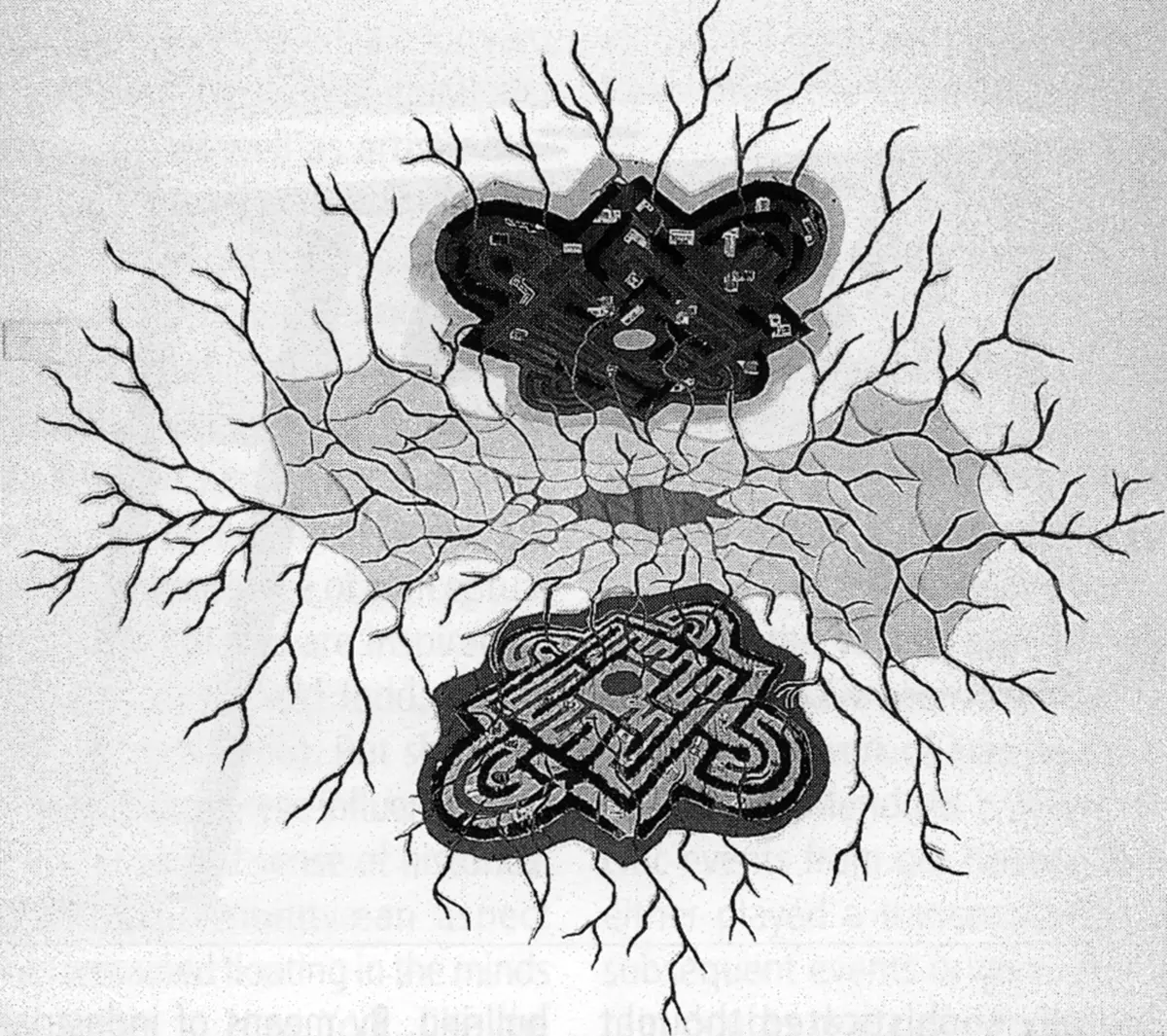
Dominating a large part of the gallery were two large format works, Irrigation and Tributaries, made with montages of hand-embroidered fabric and heat transfers, and barely held together by small pins. At first sight, both works seemed to be images taken from some huge map. Tributaries consist of the depiction of several connected together, but appearing to be living organisms, like neurons joined by their axons and dendrites. Irrigation juxtaposes images of the natural irrigation of water with the plans of two labyrinth-like gardens, one of which includes fragmentary images of the gallery plans of various museums throughout the world. While Frid seems to be referring to the great inevitable processes of natural forces, she also encourages us to reflect on the comparative values of artificial beauty, such as gardens or the museographical space. This can lead us to an interpretation of the museum gallery as a garden of art, such both the museum and the garden are examples of artificial spaces created by human beings.
Frid’s elaborate and at times hermetic selection of images makes us want to decipher them, but there is no easy interpretation here. Works like Irrigation and Tributaries provide us with illustrations of objects and ideas that are easy to identify. Frid has a preference for the conventional iconography of dictionaries and manuals, in particular those establishing codes or systems, such as the map of a river, the representation of terrestrial strata, or an eighteenth-century French garden. But the manner in which these are presented in the general context of her works especially their unusual representation in hand-embroidered fabric-transforms them into enigmatic emblems. This is due perhaps to the apparent distancing in the use of schemas contrasting with the manufacture, a paradoxical and at times disconcerting aspect of Frid’s work.
There is a certain pantheism in her images, perhaps the result of her long process of conceptual purification and physical fabrication, almost reflecting the actual erosion of the work. At the same time, although each element appears to be an essential river embroidered with blue thread, each piece of patched fabric, each little image of greenhouses in her the works are in no way closed circuits. They are open ideas, without any planned beginning or end, like the rivers or meditations full of apparent certainties, but without any decisive conclusion. Her montages and books, which are usually based on classification systems, are disturbing, perhaps because Frid shows us both what we know and what we do not know about the world. Her work shuns any kind of adjective because it constantly communicates without passing judgment and because it always reveals some new layer, making any single reading impossible. But it is a work that unequivocally points toward the great philosophical subjects of time, change, and places and their relationship with human beings.
Her strategies in the use of iconography and materials-as well as the interplay of sequentiality-are particularly visible in her artist’s books. The book entitled The Same River Twice (which refers to the famous sentence of Heraclitus about not being able to bathe twice in the same river) is a sculptural object in a single edition made with seductive materials that make us want to touch and open it. The book opens up to reveal two rivers that become intertwined. Frid’s recurrent use of the river metaphor in other works in this show can be seen as a reflection on the strange sensation of being the same and another at the same time, or of discovering the possibility of maintaining change and permanence as complementary forces.
The finite nature of the book as an object contrasts with the uses that Frid gives it, creating anti-narratives and images which may suggest certain meanings, but which never actually become traditional narratives.
Her works retain features of the medieval manuscript that contain within its pages the great secret or revelation. They can also be compared to diaries, unfinished narratives in a constant state of flux.
PABLO HELGUERA