
Enio Iommi (1926) recently presented a series of new sculptural works, entitled My Utopias vs. Reality, in which he ratified the complexity of his critical gaze. Iommi is one of the most stubborn and lucid survivors of the generation who, in the mid-1940s, introduced the ideas of abstract concretism into Argentina. After making a fundamental contribution to his research into spatiality in the work of art, he moved away from the principles of non-representation —the banner of the Concrete Art- Invention Association of which he was a member— and recovered the discursive power that has become his hallmark. Since the 1960s, his work has used objects and waste materials to express a political intransigence, which has now made him one of the most corrosive Argentinean artists.
In his previous series, entitled Space as Form, Iommi proposed an exquisite journey into the interior of various everyday utensils. By means of dissections carried out on pieces of chinaware and aluminum receptacles, he reformulated the notions of background and figure, inside and outside, arranging the fragments according to new parameters, the product of his imagination rather than functionality. In his new work, the technique of destroying is taken up again, but much more crudely. It is as if his cultural malaise has deepened: now he not only cuts the pieces but melts them with fire and dirties them with tar.
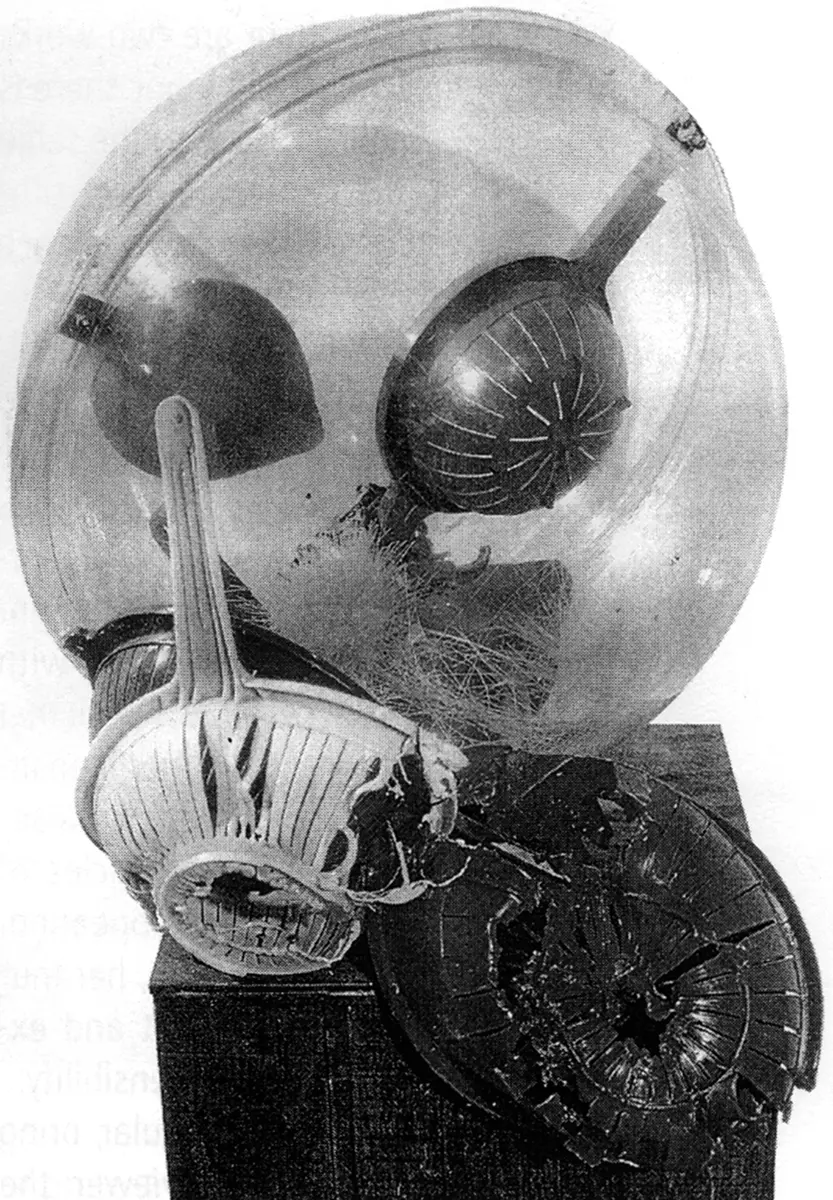
The starting point of this new series is a piece from 1947, Four Transparent Volumes, which has been recuperated for this show. In that work from the heyday of abstract rationalism, Iommi used a set of ordinary objects—worn tennis balls—to create a spatial composition based on the volume of the spheres and a cut-out piece of glass. More than fifty years after this pioneering work, Iommi gives art a dimension of rupture that is directed not only against the social and artistic environment but also against himself.
Renouncing his own capacity to create beautiful objects, the artist transforms himself into a kind of martyr: the ugliness of the current pieces converts perfect compositions into a call to attention and a warning. A cascade of china cups smashed into pieces and stuck on a panel; three plastic buckets in a line and which, through the artist’s intervention, bear witness to the passage from splendor to decadence. The invitation to metaphor is taken to extreme conditions: Iommi has abandoned all euphemisms and relentlessly targets the aestheticist demands of the contemporary market, decorative, and banality, the shiny surfaces of cultural products made in the style of advertising language. With their dirty tar, Iommi’s utopias impose themselves with brutal force.
EVA GRINSTEIN