
The piece, entitled Paintants, occupied the entire gallery space. It consisted of a large canvas measuring some ten meters, which was attached to the wall by means of a light cane structure so that it undulated slightly. To be more precise, the work occupied three of the four walls of the room, and offered a kind of panorama, with the graphic elements giving the spectator the impression of being in the center of an unfolding event, a battle, an armistice, a market or a temple. And indeed, it was an unfolding event. In the final analysis, the ambition of the artist who created this work, Fabián Marcaccio, is not very different from that of Delacroix: to depict, through the painted surface the profound vivacity of a period through some emblematic event (it matters little whether, as in this case, the image has been mounted with a computer, and then retouched with various materials, and that objects with uncertain shapes have been attached to it, since for the purposes of the spectator’s gaze, the work functions like a painting).
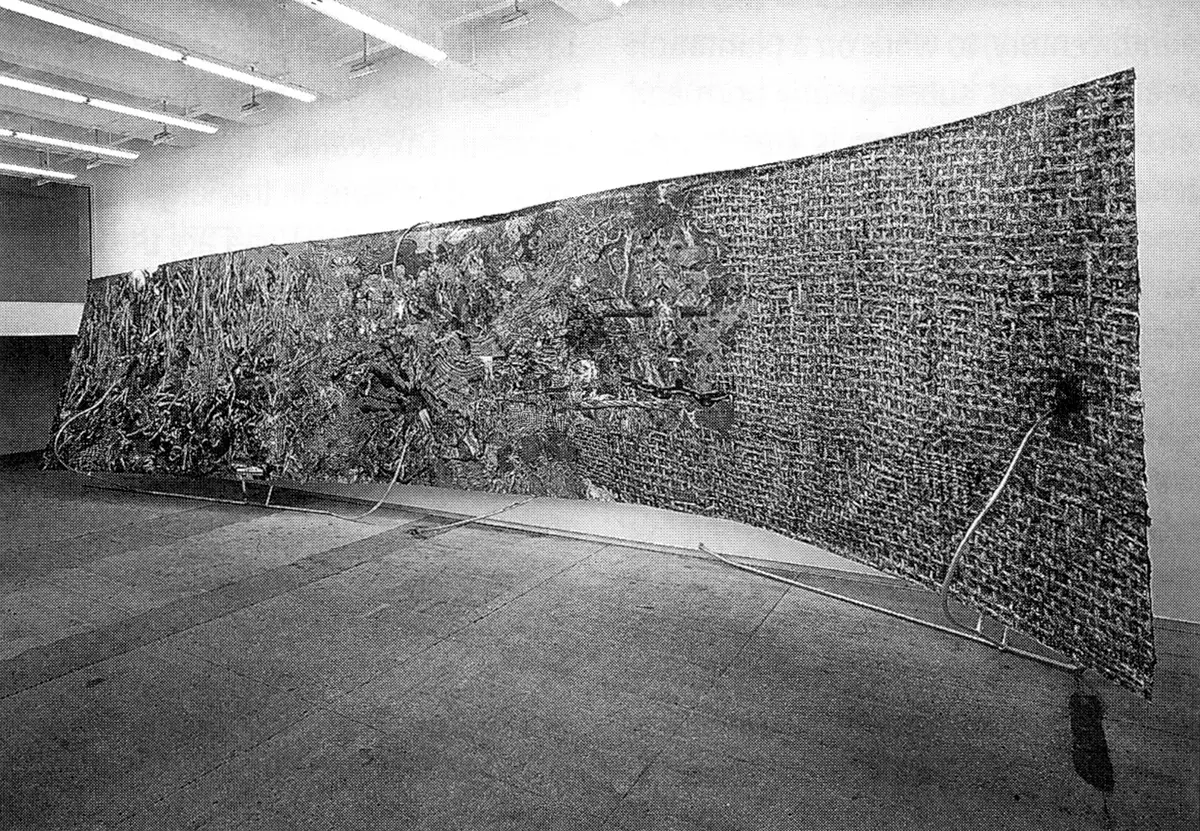
Paintants is a narrative work in which things happen and stop happening, emerge and become aborted, and live and die. But what is being narrated here? This is indeed difficult to ascertain. At the beginning of the painting, to our left when we enter the gallery, on (or under) an image of grass and sky, we can see a mass, an infamous heap of vaguely recognizable signs: signs of peace, warnings of biological dangers, swastikas which have been deformed into the coat of arms of some unknown power, that are combined with pictorial features broken or sweeping brush strokes, clumsy or elastic lines, distributed at random. In the beginning, there is an excess of images, signs, and graphic elements that seem to have been piled up to create tension that is the driving force of transfiguration. Because on the right, everything becomes transfigured into a field of explosions, inhabited by sordid metallic entities of uncertain dynamism, where the blues and greens give way to an acid grey.
At this point, a few meters away from the work, we cannot help wondering where we are. In the middle, we think, of a continuous metamorphosis, where the most unlikely kinds of communications are being produced that do not allow us to place ourselves in a stable way. Faced with this image, our gaze wavers, loses its focus, its place of residence, and our eye is constantly engaged in making adjustments. The effect is clearly hallucinatory. One of the virtues of this work is the way in which it imposes, with the force of some hallucination, things which in the end are mere nothingness: little brush strokes that move, minor signs that break, parts of bodies that are exposed, landscapes that decompose. And this is, perhaps, what makes the work so deliciously disconcerting: the fact that its roaring and exclamatory character and its stupefying brilliance are used in the end for almost nothing. The gesture of great historical painting, in the style of Delacroix, for example, is used here as in certain images by Jeff Wall, an artist who is superficially very different from Marcaccio, but who nevertheless has other secret links with the latter in the service of insignificant things. Think of a scream, which, at its highest point breaks up into a thousand whispers, and you will have a very good idea of the piece. Or, on the contrary, a thousand whispers which are suddenly organized into a scream. Because, in its progressive undulation, with fields of nudes and expanses of ripped canvas, the painting concludes with a tutti a large blue brush stroke that marks a kind of triumph of the painting which is singularly convincing because it proceeds from a half recognition of its fundamental fragility. The Cuban writer José Lezama Lima once wrote that "an ancient legend of India reminds us of the existence of a river, whose flow cannot be determined. In the end, the volume of water becomes circular and begins to boil. Excessive confusion can be seen in its movements; dissimilarities and flatnesses combine with diamond-like symmetries and coincidental tendernesses. This is the effect I felt in the presence of Paintants."
The work (in a rather different version) was first shown at the Secession Gallery in Vienna last year, where it was mounted on a structure by the American architect Greg Lynn, and presented as an intervention into architecture. For the show at the Bravin Gorney Lee Gallery, the artist also made a modification in the appearance of the building, with the extension along the front of a vast and splendid motley mural, done in the style of Paintants.
REINALDO LADAGGA