
In the large spacious environment of Ambrosino’s alternative gallery in Miami, Glexis Novoa had the opportunity to create an installation of paintings, drawings and objects that could exist as separate entities, but take on a commanding conceptual presence when seen together. The conceptual ideology that informs his work is based on the artistic fusion of geometric/mathematical elements with references to those that are human/organic. His precise, and now quite familiar, drawings have an architectonic quality that situates time and place in the realm of the present, while the gentle curvilinear rhythms of other shapes and forms, including those found in the written word, make references to the nostalgia of the past and the technology of the future. It is as if we are witnessing both sides of a personality struggling to assert its own identity in time and place as well. His works are meant to be “read” from left to right, from interior to exterior, from the ephemeral to the solid and constant. This exhibition invites the viewer to walk around its large cavernous space and use the wall as a text or guide to link the different media. The works are carefully arranged along a “horizon line” that may also extend as a drawing from an image itself to indicate the presence of the artist, while invoking the fragility or temporality of artistic evidence that will disappear when this exhibition is removed and the wall prepared and painted for the next.
The wall has long been Gexis Novoa’s friendly accomplice, and his most provocative works are those that are drawn directly on the wall or as extensions of a work on canvas or paper onto the surface of the wall. He has the remarkable ability to create and recreate from a central theme and adapt it to different and unique circumstances, while never losing the theme’s impact. Walls go beyond mere surfaces for display and are transformed into landscapes for his work, which often begins as a landscape or seascape, real or imagined. On one wall, dedicated to La Patria or The Motherland, his journey from Cuba (cynically symbolized by a silhouetted image of a gigantic Russian monument) to freedom in the United States is presented as a series of fragmented objects, drawings, and shapes. The words drawn directly on the wall capture the remnants of critical rhetoric used to describe his work over the years like undulating waves. Connected by the horizon line of the sea, words and shapes become self-referential and increasingly more technical and futuristic. Tinted automobile windshields contrast with the delicacy of the graphite to complete the artist’s personal trajectory into creativity, while commenting on the car as the ultimate American icon and symbol of rampant consumerism.
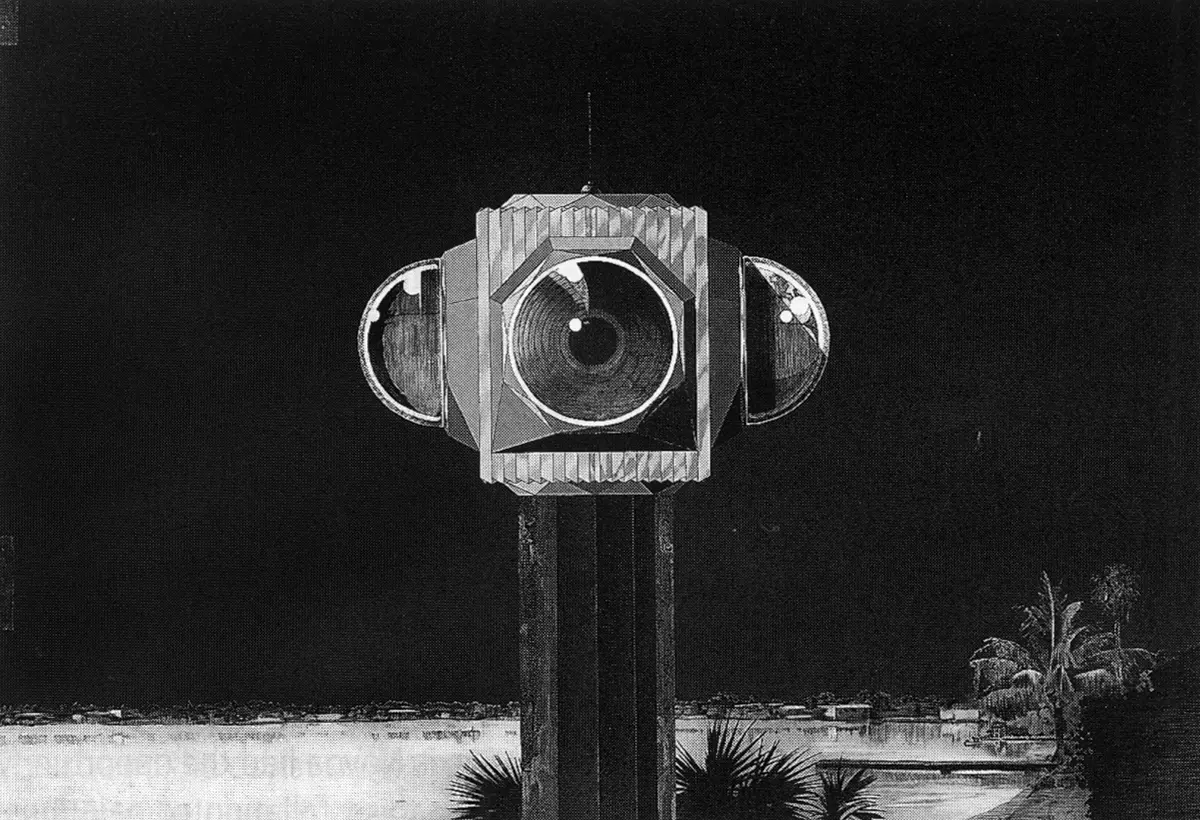
The tinted windshields conceal and reveal another large landscape as a fantasy continuum that began with a powerful installation he did in Germany a number of years ago. Based on a towering architectural structure with overt references to socialist propaganda art, the building now appears on the edge of a tranquil lake that gives way to the Miami environment of palm trees and pleasure boats. The scene is exposed in confused shapes, like memories captured in bubbles, floating and waiting to burst, or reflections in the eye. The same lakeside location appears in the only painting in the exhibition, called Paranoia. A large canvas dominated by the red of a fiery sunset, it contains a strange control tower with huge projecting camera lens eyes whose vigilance disturbs the tranquility of the scene.
Numerous references to the eye or oculus appear in this exhibition. There is an oculus made from a porthole that transforms the found object into a radiating force of universal dynamics. Another large drawing of an ocular image refers to the eternal vigilance of power. Frente de vigilancia eterno borrows from Napoleonic, fascist, and other military emblems, but is marked by concentric circles of knives surrounding the pupil. For all its aesthetic beauty, this futuristically rendered jewel-like form is as threatening as it is kaleidoscopically mesmerizing.
Sets of small drawings are interspersed among the objects and wall markings of this exhibition that merit special attention. The first set of four is comprised of words taken from letters written by his grandmother in Cuba. Glexis has incorporated the letters into several installations and wall pieces and for this small series he uses only a very personal selection of words and floats them in space in the same wave-like patterns that appear as a consistent element throughout the installation of the exhibition. Although they are very personal and nostalgic, everyone can relate to such words as viejos, te quiero, tu abuelo, etc. Another set, entitled Four Views of a City, captures cityscapes from past, present and future at the four different times of the day and as if from a security camera or singular perspective. No people occupy these scenes, but “Big Brother” is definitely watching. Elegantly rendered with the precision of an architectural draughtsman and shaded with velvety chiaroscuro, each symmetrical composition celebrates and condemns the empire builders of lost worlds and the soon to be created.
CAROL DAMIAN