To the memory of Luis Cardoza y Aragón
(1904-1992)
In 1927, Mexico was in a state of turmoil: the Cristero war was in its second year and President Plutarco Elías Calles was crushing the independent anarcho-syndicalist labor movement. On the cultural front, José Vasconcelos had resigned from his post as Minister of Public Education three years before, and J.M. Puig Casauranc had replaced him. At this point, the initial, enthusiastic phase (1921-1927) of the mural movement in Mexico was over. Mural commissions ceased; many artists (Siqueiros, de la Cueva) went to the provinces to execute murals there, while others (Leal, Charlot, and Orozco) temporarily returned to easel painting and printmaking. Diego Rivera continued to receive patronage until 1930, but even he had to consider leaving Mexico in search of better opportunities for his art.
By mid-1927, José Clemente Orozco (1883-1949), had completed three major murals: Escuela Nacional Preparatoria San Ildefonso (1923-1926), Casa de los Azulejos (1925), and the Escuela Industrial in Orizaba (1926). The Preparatoria murals were Orozco's first monumental works, and as such these walls are filled with experiments, indecision, and transitions. His experience as a political cartoonist is reflected in several panels on the ground floor. The more stylistically focused paintings are found in the Franciscan panels, and the iconic Revolutionary Trinity, The Trench, The Farewell to the Mother, etc. In these works the forms are monumental yet simple, and charged with a depth of feeling comparable only to Baroque religious art. The arches in the Preparatoria's corridors contain decorations of powerful hands juxtaposed with hammers and sickles (at this time Orozco was a member of the Sindicato de Obreros Tecnicos, Pintores y Escultores, founded in 1923, whose tenets and symbols were the same as those of the Mexican Communist Party). It is important to note that during this period Orozco was close to the Mexican Communist Party (according to the artist's FBI file this flirtation lasted from about 1923 through roughly 1927). Although he "was never a party member, he attended meetings and occasionally gave financial aid."1
In 1925, while work at the Preparatoria was interrupted, Orozco painted the mural Omnisciencia in the private residence, Casa de los Azulejos. The building's owner, Francisco Sergio Iturbe, commissioned this work. The subject is an allegory of theosophical content, where male and female nude figures (reflective of the influence of Art Nouveau) represent a story of creation. The last mural of this period is Social Revolution at the Escuela Industrial in Orizaba. Here, once again, Orozco takes up the theme of the revolution. On a wall the shape of an inverted U, he depicts workers-soldiers doing masonry work on the top panel, while on the lower side panels, women weep and hide a terrified soldier of the old regime.
Prior to his flirtation with the Mexican Communist Party, Orozco's only known political association was with the anarchism of the anarcho-syndicalist Casa del Obrero Mundial. The Casa's agenda was urban, pro-worker, secularist, and decidedly anti-peasant. Orozco's association came through the painter Gerardo Murillo (1875- 1964), known as Dr. Atl. When the Casa took the side of Venustiano Carranza and Álvaro Obregón during the struggle against the forces of Villa and Zapata in 1915, Dr. Atl enlisted Orozco to join. Orozco became the political cartoonist of the newspaper La Vanguardia, and as such he traveled throughout the countryside with its Red Battalions, as these engaged in battle with the Zapata and Villa forces. The Casa's heyday lasted from about 1915 through the early 1920s, when they transformed themselves from a revolutionary movement into an independent labor union, the Confederation General de Trabajadores (CGT) in 1921. By the spring of 1927, the CGT, which had been clashing with the pro-U.S. policies of President Calles, was disempowered by the government, and in effect replaced by the non-radical and pro-government Confederation Obrera Mexicana CROM2.
As someone who had been involved with the anarcho-syndicalist movement as a political cartoonist, Orozco had to be affected by the persecution and eventual repression of his one-time comrades. The other sociopolitical conflict of this period was the Cristero War (1926-1929). A complex and internally contradictory confrontation between the Mexican government (first under Obregón, then Calles) and the institutional Catholic Church; its real victims were the rural teachers who taught literacy in the countryside, and the Cristero peasant-soldiers, who in earlier years had been followers of either Zapata or Villa.
In 1927 Mexico was an inhabitable country in every way in art, politics, and daily life. José Clemente Orozco decided to leave. In time both Diego Rivera and David Alfaro Siqueiros would follow him into the United States, also in search of mural commissions, and fleeing political instability and persecution.
Orozco left Mexico City by train on December 11, 1927. He arrived in New York City right before Christmas.
The Imperial City
José Clemente Orozco lived in the United States from 1917 to 1919. During this first trip, Customs officers in Laredo, Texas had destroyed some sixty of his watercolors (Casa del Llanto series) due to their immoral subject matter. Orozco traveled from Texas to San Francisco, where he made a living as a sign and movie poster painter, and eventually found his way to New York City. He caustically called New York "the imperial city."3 During his first visit to Manhattan, Orozco explored Harlem and Coney Island, where he was quite taken with the freak shows, tattoo parlors, and the Flea Circus.4 What is interesting about this visit is Orozco's connection to both Harlem and Coney Island; both marginal and extraordinary places. This connects with the poet Baudelaire's notion of modernity as interwoven with urban marginality. Orozco was reading Baudelaire in French, as early as 1914.5 In 1919 Orozco returned to Mexico, married Margarita Valladares, started a family, and embarked upon his career as a mural painter. In the critical year of 1927, he decided once again to head north. To facilitate his departure he sold two oil paintings; Combate to Foreign Secretary Genaro Estrada, which gave him enough funds for trainfare and three months subsistence, and Soldaderas to the new Secretary of Public Education, J.M. Puig Cassauranc. He left the funds from this second sale with his wife, two small sons, and one-month-old daughter, who stayed behind in Mexico.
Upon arriving in New York in December of 1927, he wrote to his wife:
"My adored little wife: Here I am finally in Gringoland, trying to make a name for myself and promote my work. This incredible city, part amusement park, and part growing monstrosity, has changed a great deal since I was last here..."6
New York and the entire country had indeed changed since he was last there, a decade before. The large cities in the United States entered the modem era after World War I. The 1920s were the "Roaring" decade, the one that produced and contained jazz, skyscrapers, new technologies, gangsters, Prohibition, the Harlem Renaissance, the prose styles of Willa Cather, F. Scott Fitzgerald, John Dos Passos, and Zora Neale Hurston, and the poetry of William Carlos Williams, Marianne Moore, and Wallace Stevens. But from the "Roaring Twenties" right through the Depression, there was another United States: one where lynching took place in the South and parts of the Midwest, where immigrant labor was exploited, and radicals like Sacco and Vanzetti were executed. All of these worlds would be affected, in some cases even annihilated, by the catastrophic stock market crash in October of 1929.
But Orozco was leaving behind a country torn and exhausted by social conflict and religious strife. New York City in 1927 was radically modern and far less disrupted. Diego Rivera's paintings had been exhibited in Manhattan as early as 1916, and Tamayo's work had been on view at the Weyhe Gallery in the autumn of 1926. Mexican painting, printmaking, and folk art were in vogue in New York, Philadelphia, and Los Angeles from the mid-twenties through the thirties. Before Orozco's arrival in New York City, the journalist Anita Brenner had paved the way for him by publishing an article on his work in the October 1927 issue of The Arts. Entitled "A Mexican rebel", the piece described Orozco as an artist who will not attach himself to a class, a movement, or a school. To endorsement he is hostile or indifferent. He lives as he does, not to épater les bourgeois or to please his friends. Destroying and creating, he suffers. He has a habit of pain.7 Through Anita Brenner, Orozco met Alma Reed (1889-1961) in August of 1928. Reed would become his art dealer, first biographer, and occasional lover. Reed was a left-wing journalist, fiancee of the assassinated governor of Yucatán, Felipe Carrillo Puerto, and the translator of the poetry of Angelos Sikelianos, the Greek author, and founder of the Delphic movement. Before this meeting, from December 1927 through early 1929,
Orozco led an isolated existence, which was relieved by his correspondence with fellow artist Jean Charlot (1898-1979), and his wife Margarita Valladares (1898-1993).8 With Charlot, Orozco discussed his encounters with, and opinions of art in Manhattan, while with his wife he discussed issues of daily life.
By mid-September of 1928, Reed had introduced Orozco to Eva Sikelianos, the poet's widow, with whom she shared an apartment on Fifth Avenue. Orozco was invited to visit the Ashram where the adherents of the Delphic movement met. The Delphic movement was both elitist and nationalistic in its essence. The movement favored the creation of an elite class that would provide leadership to the masses, and the revival of a national culture that consisted of both high art as well as folk art. It was at the Ashram where Orozco met Greek clergy and intellectuals, re-encountered the Greek and Roman Mythology he had known as a student, and became familiar with the followers of Gandhi. In October of 1928, Orozco had his first solo show in New York City; he exhibited his ink drawings, Mexico in Revolution, at the Marie Sterner Galleries. The artist would continue to exhibit regularly in New York and other parts of the country, in both group and individual shows, right through his return to Mexico in 1934.
Alma Reed opened The Delphic Studios on October 14, 1929, with an exhibition of drawings by Thomas Hart Benton (1889-1975), and easel paintings and lithographs by Orozco. Unfortunately, a few weeks after its opening, the stock market crashed, undoubtedly affecting the sale of Orozco's work. During this period in New York, Orozco met and befriended the art critic Walter Pach, painters George Biddle and Thomas Hart Benton, urban historian Lewis Mumford, poet Federico García Lorca, art dealer and curator Carl Zigrosser, and art critic and future Whitney Museum director, Lloyd Goodrich.
Because of the circumstances of the Depression, Reed was forced to sell antiques, Greek folk art, and Orthodox icons, to keep the gallery going. Even though prices for Orozco's work were modest, Reed continued to promote his work. If we look at The Art Index for the years 1929 through 1935, we find 39 entries of Orozco reviews and articles, as well as 18 reproductions of his work. Moreover, some of the articles appeared in leading periodicals of the day such as Creative Art, Art News, and London Studio.
While in the United States (1927-1934), Orozco took up the medium of lithography, executing 19 prints, most of them printed at George Miller's 14th Street shop, and others at the Art Students League. He also painted a number of important easel pictures, the best of which were produced in 1931, between two mural commissions, and three important murals: Pomona College in Claremont, California, The New School for Social Research in New York City, and the Baker Library at Dartmouth College, in Hanover, New Hampshire.
In the January 1929 issue of Creative Art, Orozco published what for many years has been considered his credo, "New World, New Races, New Art." In this two-page essay, Orozco states with clarity his position regarding art and mural painting, one quite different from either Rivera's or Siqueiros' positions:
"The Art of the New World cannot take root in the old traditions of the Old World nor in the aboriginal traditions represented by the remains of our ancient Indian peoples...
To lean upon the art of the aborigines, whether it be of antiquity Or of the present day, is a sure indication of impotence and cowardice, in fact of fraud. If new races have appeared upon the land of the New World, such races have the unavoidable duty to produce a New Art in a new spiritual and physical medium. Any other road is plain cowardice."9
Orozco makes clear his rejection of both a Eurocentric optic, even if modern, and a romanticized indigenismo. He is in fact calling for an art that reflects the meztisage of the Americas, the very hybridity produced by the collision of Native populations, Europeans, and Africans. He concludes this essay with a powerful defense of mural painting:
The highest, most logical, purest, and strongest form of painting is the mural. In this form alone, it is one with the other arts-with all the others. It is too, the most disinterested form, for it cannot be made a matter of private gain; it cannot be hidden away for the benefit of a certain privileged few. It is for the people. It is for ALL.10
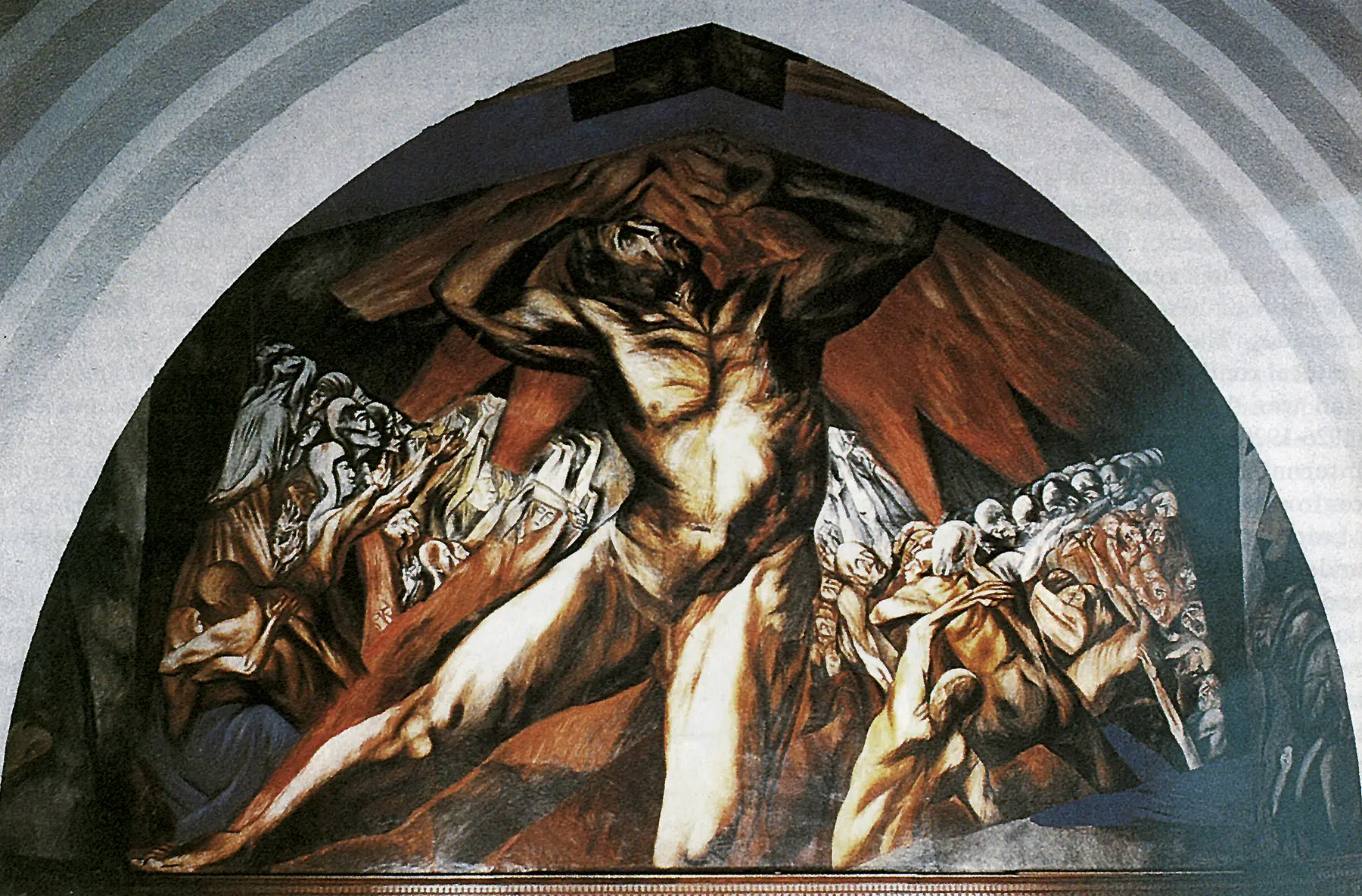
Prometheus, 1930
Orozco's first opportunity to paint a mural in the United States took place not in New York, but in California. The Catalonian art historian, José Pijoan, who was a member of the faculty at Pomona College in Claremont, California, invited Orozco to come out and paint a mural. He did this without permission from the administration or secured funds for the commission. Nevertheless, Orozco accepted and traveled to California. Once he arrived, he was assigned the then-young Mexican artist and teacher, Jorge Juan Crespo de la Serna, to be his assistant in the project. Crespo de la Serna, at the time a professor of drawing at the Chouinard School of Art, knew Orozco back in Mexico and had served as an intermediary between Prof. Pijoan and Orozco.
Orozco arrived in Claremont on March 22, 1930, and by mid-June, the Prometheus mural was completed. Physically the mural consists of a niche-like area, which is visible through the arch of Frary Hall's north wall. The fresco is roughly 100 square yards of painted surface. The central niche-like panel (20 x 28') depicts Prometheus bringing fire down to the mortals who live in darkness. The two panels on the side (both vertical rectangles, each 15 x 7') represent Zeus, Hera, and Io, and monsters and Chaos respectively. Crespo de la Serna, following a basic design probably executed the last two by Orozco is one of Orozco's earliest depictions of a heroic nude. Powerfully drawn, the figure is Michelangelo-like in its structure. The mortals in the background prefigure the betrayed and abandoned masses that Orozco would paint in the Guadalajara murals during the late 1930s. They are emaciated, their faces twisted, in agony, their arms raised upwards to the fire that Prometheus is bringing. It is true that the theme is a direct reflection of the Greek cultural revival that Orozco encountered in the Delphic circle of Sikelianos and Reed. But it is also more than this.
The interest in the epic dimensions of ancient myths is also found in the Modernista literature of Latin America (Ruben Dario, etc.). Two of Orozco's compatriots, Alfonso Reyes and José Vasconcelos, meditated and wrote about Greek and Roman myths in connection with the myths of Latin America. Reyes in particular, deciphered Prometheus as "a villain to the Greeks, someone who stole from the Gods."11
I propose that Orozco, with his anarchist background, embraces a variation on this notion, as expressed in this mural. Prometheus is a rebel, not a villain, who takes away power (fire) from the privileged, and shares it with the underclass-the mortals, the insulted, and the injured, who live in the cold and the dark. Prometheus' end, not visible in the mural, yet evoked by the hero's disturbed and sad countenance is tragic: he is condemned to an eternity in chains while a vulture eats his liver. Thematically, this Greek rebel prefigures the solitary and doomed rebels of Orozco's later works: Quetzacoatl, Christ, Zapata, etc. Formally this mural presents a new coloristic direction for Orozco, one that surpasses the best panels in the Preparatoria, in its balance between intensity (reds and blues) and coolness (grays).
A Call for Revolution and Universal Brotherhood, 1930-1931
After the completion of the Prometheus, Orozco spent some time in San Francisco with Alma Reed's family and then returned to New York in early autumn. Awaiting him was the commission at the newly opened New School for Social Research. Yet, as with the Pomona commission, Orozco would have access to walls, but no fee for his work.
Philosophically, the New School mural depicts an anti-imperialist dialogue between nationalists like Gandhi and Felipe Carrillo Puerto of Yucatan, and communists like Lenin, dead in 1924. The murals measure eighty square meters of wall space, counting the introductory panel outside the seventh-floor refectory. This panel, entitled "Science, Labor, and Art" is an intense allegory of these disciplines. Inside the room, the central panel contains The Table of Brotherhood, followed around the walls counterclockwise by Struggle in the Orient, Gandhi and Imperialism, Home, Struggle in the Occident, Felipe Carrillo Puerto of Yucatán, and Soviet Russia. All of the panels stress horizontality, and the overall color scheme is one of the browns, reds, oranges, and ochres, with subtle highlights of blue throughout. Since the murals are located in a small space, the manipulation of scale is essential. In contrast to Rivera's scale, which is fixed and fixes the spectator into a single position, Orozco uses consistently a shifting scale which makes the viewer, and not the building, the active participant in the visual dialogue. Formally, Orozco was basing his composition on the laws of Dynamic Symmetry developed by Jay Hambidge. Orozco had met Hambidge's widow, Mary, through the Delphic circle reunions. Hambidge stressed the importance of diagonal shapes and rhythms within a composition, something which Orozco already had a preference for in his work. Perhaps Dynamic Symmetry was for Orozco what classicism was for Picasso, Derain, and Severini after World War I; a search for a structured way of working and a reaction against previous aesthetic waves, which had been more experimental. I believe that Orozco used Dynamic Symmetry in the New School murals critically, that is as a system of composing to be utilized with flexibility, not dogmatically. Yet, when the murals were unveiled, the critics reacted negatively; they thought Orozco was suppressing his visual expressiveness to an abstract geometric system.
The Carrillo Puerto and Soviet Russia panels are interesting for various reasons. Both leaders loom larger than the masses they are meant to lead, and this is a direct reflection of the elitist component of the Delphic program. But beyond this, a number of contradictions are evident. Carrillo Puerto, a member of the peasant class, is dressed like a European statesman, in a suit and tie-this separates him further from the modestly dressed Indians at the bottom of the panel. The figure of Lenin is an image of an image; he is painted on a waving banner, yet the intensity of his facial expression seems more real than most of the other faces in the mural. A multi-racial family of communist men surrounds the banner, with Stalin in the foreground. This is interesting, considering that Orozco was a staunch anti-Stalinist, one who would satirize Uncle Joe in his Guadalajara mural El circo de las ideologias. Lastly, the helmets of the Red Army, nothing else is visible of their bodies, have a robotic quality. Is Orozco pointing out the "killing machine" aspect of this army, any army? Perhaps, for me, all of these contradictions point to the essentially unresolved nature of this mural, not just formally, but conceptually. Orozco is trying to create a dialogue between nationalists and internationalists; we know this to be an impossibility. But more important than this, he is trying to be optimistic about revolutions- while he no longer believes in them.
The revolutionary subjects of this mural were a target of controversy from the start. According to Orozco's autobiography, trustees reacted negatively to the figure of the black man heading The Table of Brotherhood panel, as well as to the figure of Lenin. During the McCarthy period, the New School covered up the entire west wall (with Carrillo Puerto and Lenin) with a yellow curtain.
Zapatistas, 1931
After the completion of the New School murals, Orozco returned to easel painting, producing some of his most iconic images, such as Zapatistas and Barricade. Zapatistas reflects Orozco's observance of the Zapatista prisoners brought into the Carranza camp:
"I was with the Carranza forces, and I saw their defeated victims like the poor Zapatista peasants brought in to be executed. There was something suicidal about those Zapatistas, like their leader, they were marked for doom, death."12
Zapatistas does not exhibit the positive imagery found in works by the first generation muralists like Rivera, Leal, Alva de la Canal, and others. These peasants are not distributing arms, land, or weapons, nor are they embracing workers in a show of solidarity. The painting is somber, with dark areas of viridian and brown. Reds and blues are scattered across the picture plane, in the shirts and robes of the marching men and women. Pour men on horseback loom large over the marching line. Behind them are dark hills and a stormy sky of dark gray and pale pink. An angular tension is created throughout the composition, as the line of figures leans left, while the hills in the background lean toward the right. The painting is sober and dramatic. In this picture, the red of the clothes is associated with the viewer with the blood of martyrdom. This work evokes traditional Christian iconography; the captured Zapatistas are believers being led to their death. They have kept their faith in the agrarian revolution, the world has turned against them, and they are meeting their end.
Orozco's easel paintings of this period, be they Mexican or New York subjects, evoke either the tragedy of political turmoil or the brutality of modern life.
An Epic of American Civilization, 1932-1934
In the summer of 1932, Orozco made his first and only trip to Europe. He visited England, France, Italy, and Spain. He was already a mature artist who was confirming, rather than discovering, the art of Europe. According to his autobiography, he admired Raphael's cartoons, Michelangelo's Last Judgement, and above all, El Greco. For Orozco, Europe as an environment was dirty, filled with unemployment and fascism on the march. Back in the United States, he commenced his mural cycle at Dartmouth College.
Orozco first visited Dartmouth College, in Hanover, New Hampshire, in mid-March of 1932, to inspect possible sites for his mural project there. On February 13, 1934, he completed his most ambitious mural project in the U.S.A.: An Epic of American Civilization, covering 3,000 square feet of wall space in the reserve room of the Baker Library.
The origins of this commission are straightforward, and as usual, they diverge from the "official" version given by Reed in her writings. Lewis Mumford, who knew Orozco from the New School and admired his work, recommended him as a muralist to professors Artemas Packard and Winthrop Churchill of the art department at Dartmouth. Funds for the commission were provided by Mrs. Abigail Aldrich Rockefeller (her son Nelson was a Dartmouth graduate), and for the first time (while in the U.S.) Orozco received an honorarium of $7,700 for his mural as a "visiting professor of art." Dartmouth College President, Ernest M. Hopkins, was supportive of the project in that he saw Orozco's execution of the murals as an essentially educational tool. Students would learn about mural and fresco painting by watching the Mexican work, and the artist's presence among the students would be a lesson in Mexican art.
This mural cycle consists of sixteen panels (including a small panel above the doorway, leading from Carpenter Hall to the low level of the Baker Library); almost all of them are linked architecturally or through the painting's narrative. The various panels Ancient Human Migration, Ancient Human Sacrifice, Aztec Warriors, Coming of Quetzacóatl, Departure of Quetzacóatl, Europe, Cortes, Modern Machine Age, Anglo-American Society, Hispano-American Society, Stillborn Education, Modern Human Sacrifice, Modern Migration of the Spirit, and Modern Industrial Man, stylistically, these murals represent Orozco's abandonment of dynamic symmetry, as well as his integration of his innate expressionistic forms with a more Byzantine- like pattern within both the figures and the composition.
If we examine individual panels like Hispano-American Society and Stillbirth Education, we not only detect this formal synthesis, but we also appreciate Orozco's power as an intense colorist. Conceptually, these two panels are perfect examples of the mural cycle's program. Hispano-American Society depicts a Zapata-like figure about to be stabbed in the back by a member of Latin America's infamous military oligarchies, while all around them; greedy bankers/businessmen fall over sacks of money. The background consists of crumbling buildings-perhaps the remains of both social unrest and a natural disaster. Stillbirth Education is both Orozco's homage to the calavera prints of José Guadalupe Posada and a critique of the mechanical, repetitious, and therefore deadly quality, of higher education. Here, a large skeleton, resting on a bed of books, gives birth to smaller skeletons, which are then encased in glass domes. The "midwife" and six spectators in the background are also skeletons dressed in academic robes. An apocalyptic fire rages in the background. These images are so critical of "things as they are" that they border on nihilism.
In this epic, Orozco has matured and crystallized two principal ideas that will continue to manifest themselves throughout the rest of his work. The most important one is his pessimism regarding history—for Orozco history is always written by the victors, revolutions are either crushed by the ruling class or betrayed by its leaders, and technology is to be feared. The second idea, one often overlooked by scholars, is that Orozco depicts the hybrid nature of the Americas, always from a critical perspective. His vision rejects a romantic view of pre-Columbian cultures and a glorification of the Spaniards. In his narrative, both are capable of horrors as well as greatness.
After the murals were finished, the initial reaction from the press was negative. Writers like Lewis Mumford defended Orozco's epic in the pages of The Nation. 1940 considered the murals at Dartmouth one of the most important works of public art in the United States.
In a letter of June 7, 1934, Orozco wrote his wife:
"I am sending by express through Laredo my boxes of books and other things accumulated over the years here. My paints and brushes I will take with me. I cannot wait to see you and the children, also a landscape that is not New York or Hanover. Although these have been positive years for my work, they have not been easy and I want to return home."13
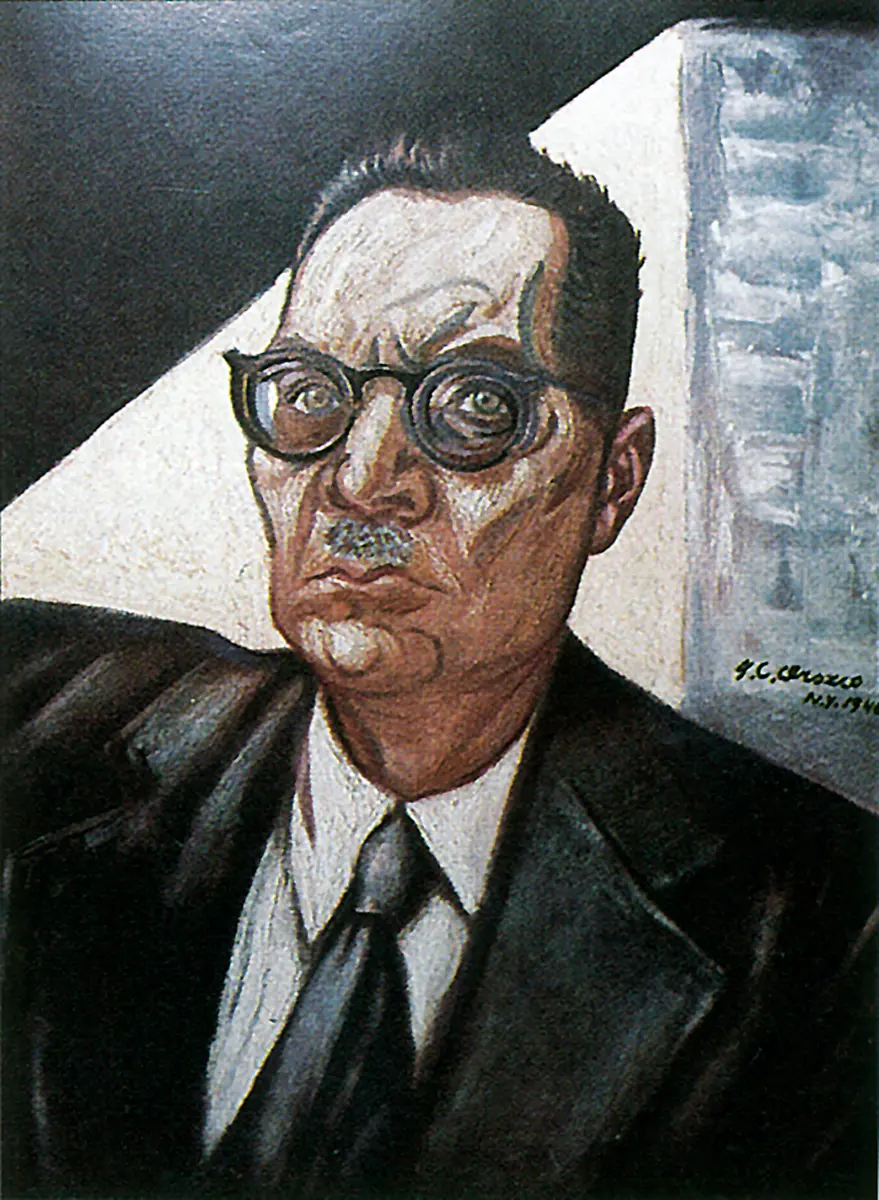
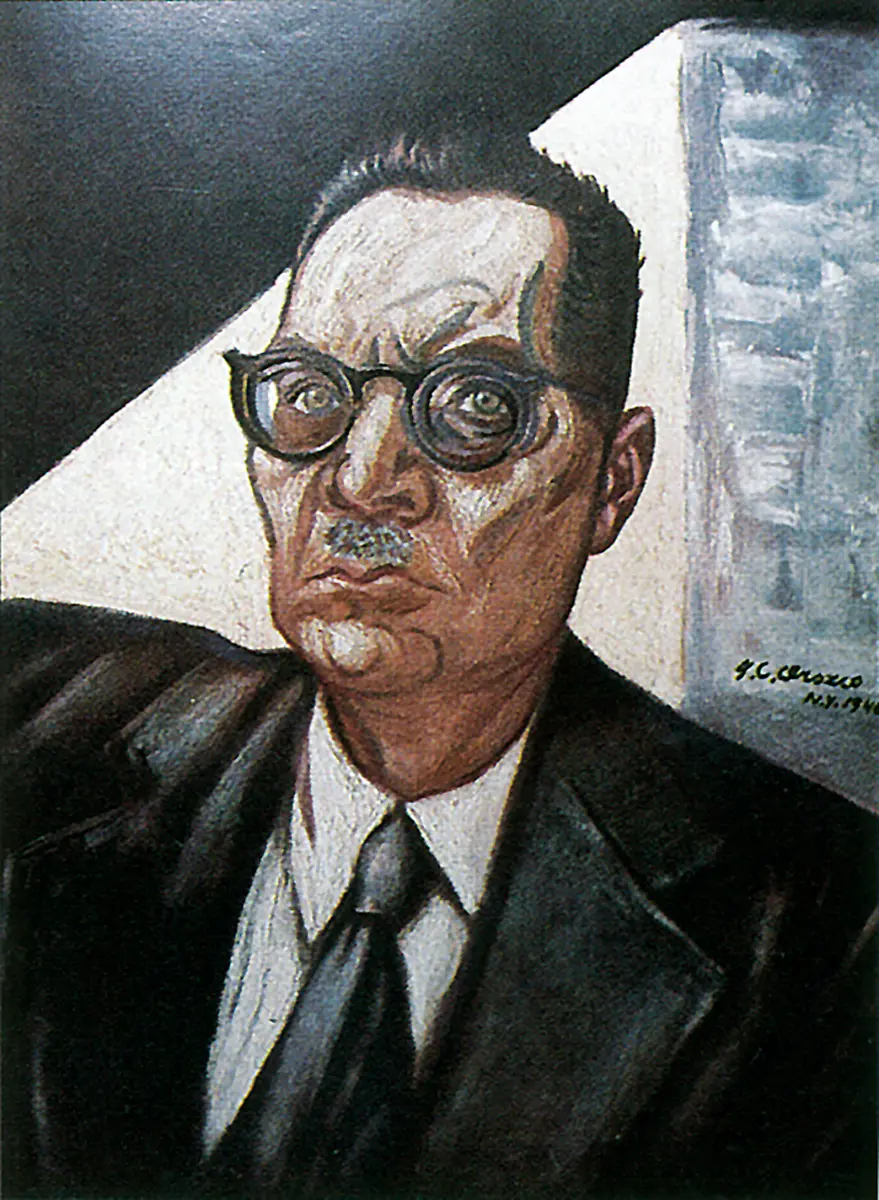
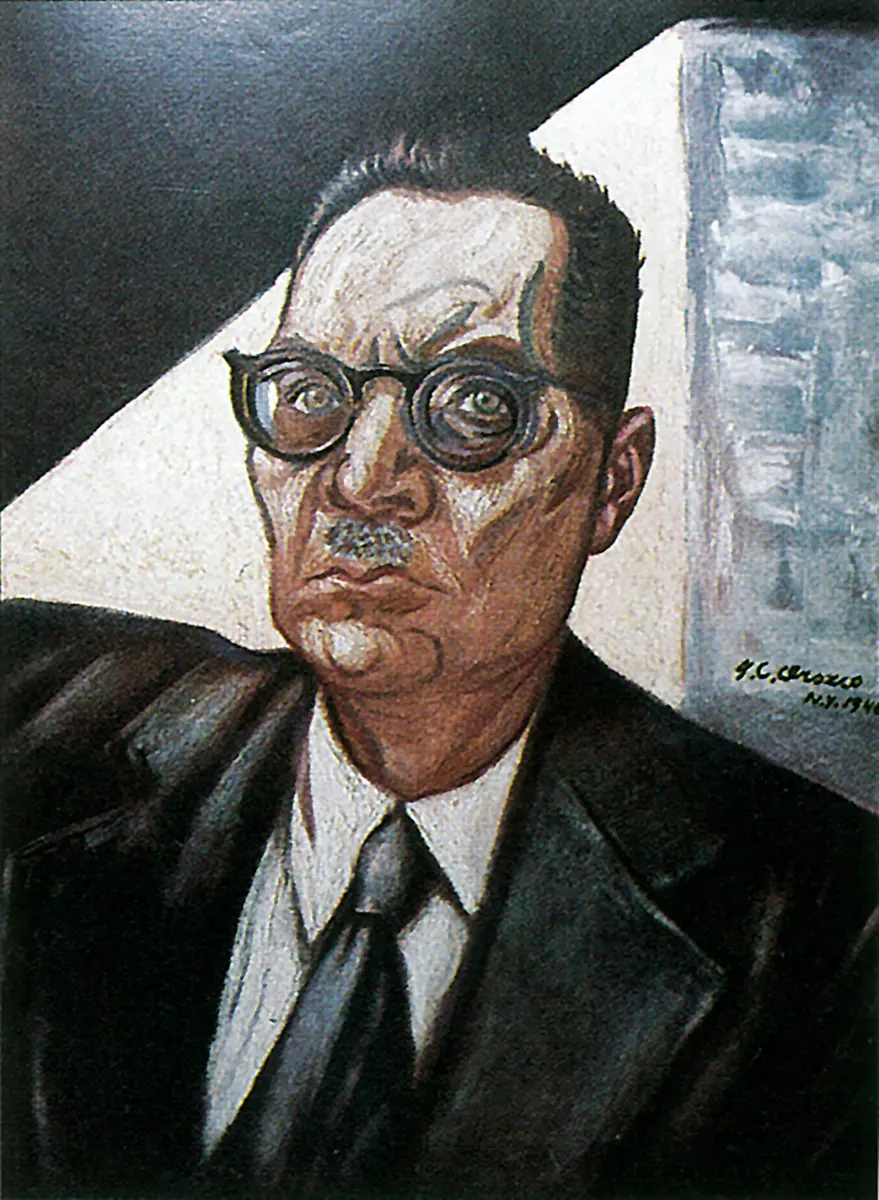
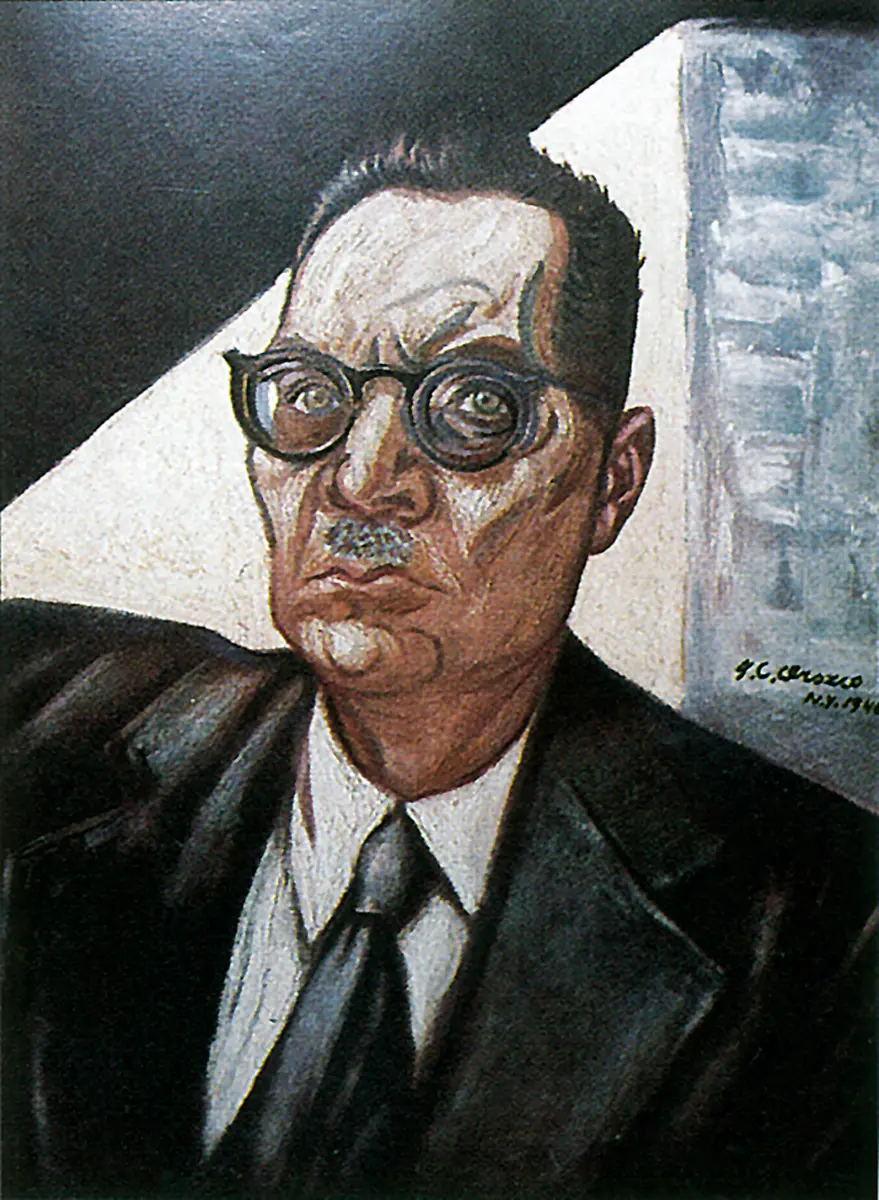
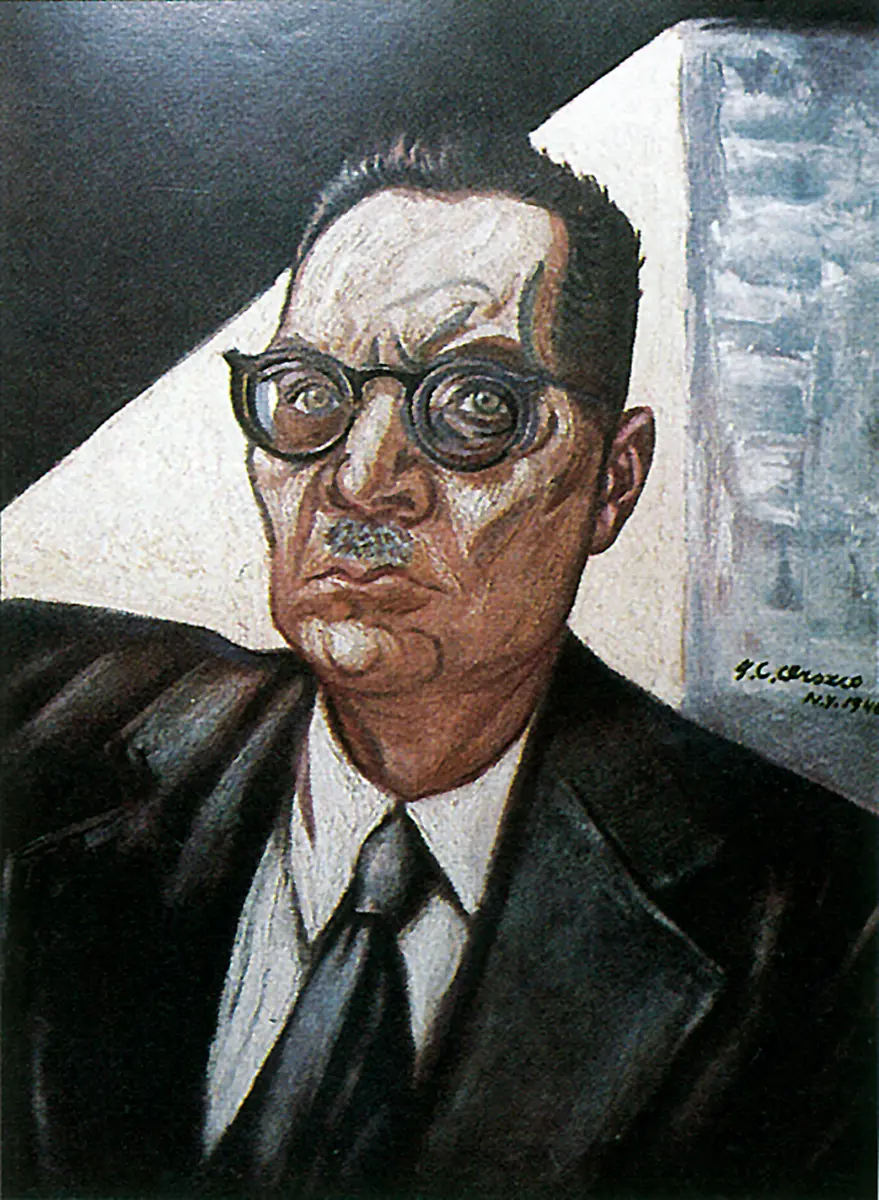
Once he was back in Mexico, Orozco would execute twelve mural commissions between 1934 and his death in 1949, among them his masterworks in Guadalajara. Orozco returned to New York City three more times: in February 1936 as one of the representatives of the Liga de Escritores y Artistas Revolucionarios, to the first session of the American Artists Congress; in the spring and summer of 1940 to execute the mural Dive Bomber and Tank, for The Museum of Modern Art's exhibition, 20 Centuries of Mexican Art, and finally in the autumn of 1945 to look for a gallery to represent his work. During this last visit, he stayed through the spring of 1946 and painted one of his most powerful self-portraits. In this oil painting, Orozco depicts himself in the foreground of the picture plane, giving his body the massive shoulders it did not have in life. He wears a suit and tie, and his head is drawn vigorously, emphasizing his forehead, cheekbones, and chin. The facial expression is intense and serious. The paint is applied vigorously, emphasizing texture in key areas, like the eyes, nose, and mouth. He sees himself as an older man, filled with a critical vision of reality in the sharp, birdlike eyes-a a man still in the plenitude of his powers.
When Orozco left New York City for the last time in April of 1946, he left behind a city and an art world that were changing very quickly and were radically different from the ones he knew in the 1930s. Politically, the left-wing ideologies of the Popular Front were practically over, and the Cold War was about to commence. Artistically, mural painting was a thing of the past, and the ascendance of Abstract Expressionism was starting. Orozco did not find a gallery; he returned to Mexico to continue his work, regardless of the latest fashion. At his death in September of 1949, all the leading New York City papers and art magazines carried his obituary.
Orozco's years in the U.S.A. served as a laboratory, where he experimented with his formal powers as a painter. It was in "Gringoland" where his pessimistic vision of history matured.
NOTES
1. U.S. Department of Justice, Federal Bureau of Investigation, José Clemente Orozco file, No. 403427, p. 46.
2. John M. Hart, Anarchism & The Mexican Working Class, 1860-1931, 2nd ed. (Austin: University of Texas Press, 1987), pp. 173-174.
3. José Clemente Orozco, Autobiografia, 3,d ed., (Mexico, D.F.: Ediciones Era, S. A., 1984), p. 53.
4. Ibid, pp. 57-58.
5. Orozco's library, currently split between his son Alfredo and daughter Lucrecia, is rich in French literature: volumes of Baudelaire, Balzac, Victor Hugo, and the Surrealist Manifesto, are among its contents. Orozco read French very well.
6. José Clemente Orozco, letter to Margarita Vallada- res, December 23,1927. Collection of Alfredo Orozco.
7. Anita Brenner, "A Mexican Rebel," The Arts, Vol. XII, No. 4, October 1927, p. 209.
8. Both the Letters to Charlot and most of the Letters to Margarita have been published as the books El artista en Nueva York (1971), and Cartas a Margarita (1987).
9. José Clemente Orozco, "New World, New Races, New Art." Creative Art. New York, 4, No. 1, January 1929, pp. 44-46.
10. Ibid.
11. Alfonso Reyes, "Los mitos griegos," in Prosa y poesía, J.W. Robb, ed., (Mexico, D.F.: Fondo de Cultura Económica, 1984), p. 51.
12. Unpublished typed manuscript of Orozco interview by José Gómez Sicre, 13 February 1946, p. 1. Collection of Horacio Sicre.
13. José Clemente Orozco, letter to Margarita Valladares, 7 June 1934. Collection of Alfredo Orozco.
ALEJANDRO ANREUS
Curator at the Jersey City Museum, he received his Ph D. in art history from the City University of New York. His book Orozco in Gringoland: The Years in New York is forthcoming from the University of New Mexico Press.