
Between October 1999 and January 2000 and then from February to May 2000, Latin American Still Life: Reflections of Time and Place is being presented respectively at the Katonah Museum of Art, in New York State, and El Barrio Museum, in New York City—in the Big Apple, which always lives up to its name. The exhibition is well-suited to both museums, the mission of which is to provide a positive artistic space for their respective communities. This review refers only to the show at the Katonab Museum—a museum that does not have a permanent collection but presents only temporary shows in its small handsome building and, weather permitting, on its patio, with sculptures, installations, and other activities. Reflections on Time and Place is also intended to give New York a vision of Spain, the European country that had the greatest influence on the origins, teaching, and academic formulations of the tradition of the still-life in the Spanish and Portuguese-speaking Americas. Fortunately, the exhibition does not only include a variety of artistic personalities, but different characteristics of the various indigenous and mestizo cultures that co-existed in the geographical region known as Latin America. The show consists of work by 43 artists from Latin America active in the twentieth century (with one exception, Oiler 1833 Bayamón, Porto Rico, 1917, Cataño, Porto Rico). Some of the artists are now dead, while others are at the peak of their careers. The selection was made by Clayton C. Kirking and Edward J. Sullivan, who included pieces in established disciplines, such as painting, photography, and mixed media, along with objects and installations, reflecting not only variations in technique and the use of space but also in the use of such materials as glass, resin, insects, skins and found materials. The selection produces a sense of calm, although there are perhaps too many pieces in terms of the space at the Katonab Museum and the overall aesthetic meaning of the show. Although it is not strictly necessary for artists in such exhibitions to be represented with the same number of works, the difficult task of selection and ensuring objectivity suggests the need for balance in terms of visual weight, artistic values, and publicity factors. For example, one painting and one sculpture by Botero (1932, Medellin) would have been enough. Most of the artists are represented by one, two, or three works, with the exception of Julio Larraz (1934, Havana), with four elegant pieces, and Ana Mendieta (1948, Havana, 1985, New York), who is represented by a series of six documentary slides from the installation she presented in Mexico in 1973. The artistic and social importance of her work, which in this case might be seen as a polyptych, justifies the high numerical representation.
Antonio Henrique Amaral (1935, São Paulo), with Battlefield (1974), is one of the outstanding Brazilian artists of an older generation. His work deals metaphorically with the themes of torture, dictatorial governments, hunger, and the intensity of nature in Brazil and Latin America as a whole.
The photographs of his compatriot Mario Cravo Neto (1947, San Salvador) are an important part of the show and take a different approach: feathers (instead of a dead bird, as in traditional still-lifes), a human figure (also not very frequent) and the context of Afro-Caribbean ritual. Outstanding too is the work of Herman Camargo (1950, Bogota), with a fine oilwork entitled Bananas (1998), and the versatile Ana Mercedes Hoyos (1942, Bogota), with her Palanquera (1988) and The Pink Knife (1993), the latter forming part of a set of utensils and foodstuffs in contrasting colors from her period characterized by the inclusion of plastic containers.
Liliana Porter (1941, Buenos Aires) has two cibachromes in the show, from 1997 and 1999, which continue her conceptual explorations through contrasts between life and death. There is also some unusual and interesting work by Emilio Torti (1952, Misiones, Argentina). A welcome inclusion is a small work by Emilio Pettoruti (1892, La Plata, Argentina, 1971, Paris), and Coparmónica (1937), whose importance goes well beyond the work itself. It is part of the artist’s wide-ranging investigation into the study of something as simple as a glass seen from a futurist perspective, and incorporating his subsequent links with cubism. The soberness of Pettoruti’s painting contrasts with the ornamental rituality of the treatment of still-life in most of the artists (living and dead) included in the show, particularly during the first half of the century. Well-known examples are the “cupboard scenes” or the so-called “Mexican still-lifes”, with their festive decoration and sometimes including religious details. Still-life never appeared with so many of these characteristics in other countries of Latin America, except for a slight similarity in works from Cuba, where the religious element is replaced by a marked rituality, here represented by Amelia Peláez, with Fruit-dish (1947). The sub-title of the exhibition indicates that the focus is on time and place. Although this is the case, in the work of the Mexican artists still-life is fused with the treatment of All Soul’s Day (the so-called “Day of the Dead”). They may co-exist but they are not exactly the same thing. The excellent artist Nahum B. Zenil illustrates the Mexican idiosyncratic make-up by giving a strong presence to religion in all its aspects. With his homosexual self-portraits, he extends these traditions to the present, including the use of the Mexican still-life full of religiosity, food, ritual, and ornamentation. The Altar of Pains, by María Izquierdo, is a work that reflects the artist’s great quality and the valorization she made of popular elements; although it is not one of her most significant pieces, it does represent new versions of “Mexican-ness”.
The 1937 Still-Life by the master artist Rufino Tamayo is interesting in its use of furniture, accessories, and walls or fences, giving the impression of an oniric fusion between interior and exterior; his work is also characterized by the introduction of a more open and personal kind of baroque. A high point of the show is the presence of a work by Diego Rivera from the surrealist “roots” series, The Hands of Dr. Moore (1940). The recognition of popular aspects and the neo-metaphysical and expressionist contributions of Juan Soriano to his country are all interesting; the works in the show are closely linked to the “Day of the Dead” traditions. Elena Climent, from the same period (and represented with three works), also explores the same still-life features, while a more mature, less decorative Sylvia Ordóñez gives to her generation and the exhibition as a whole a neo-conceptual element. Finar and Jamex de Ia Torre use the popular materials, especially glass, of their native Jalisco in a contemporary, Chicano-like manner.
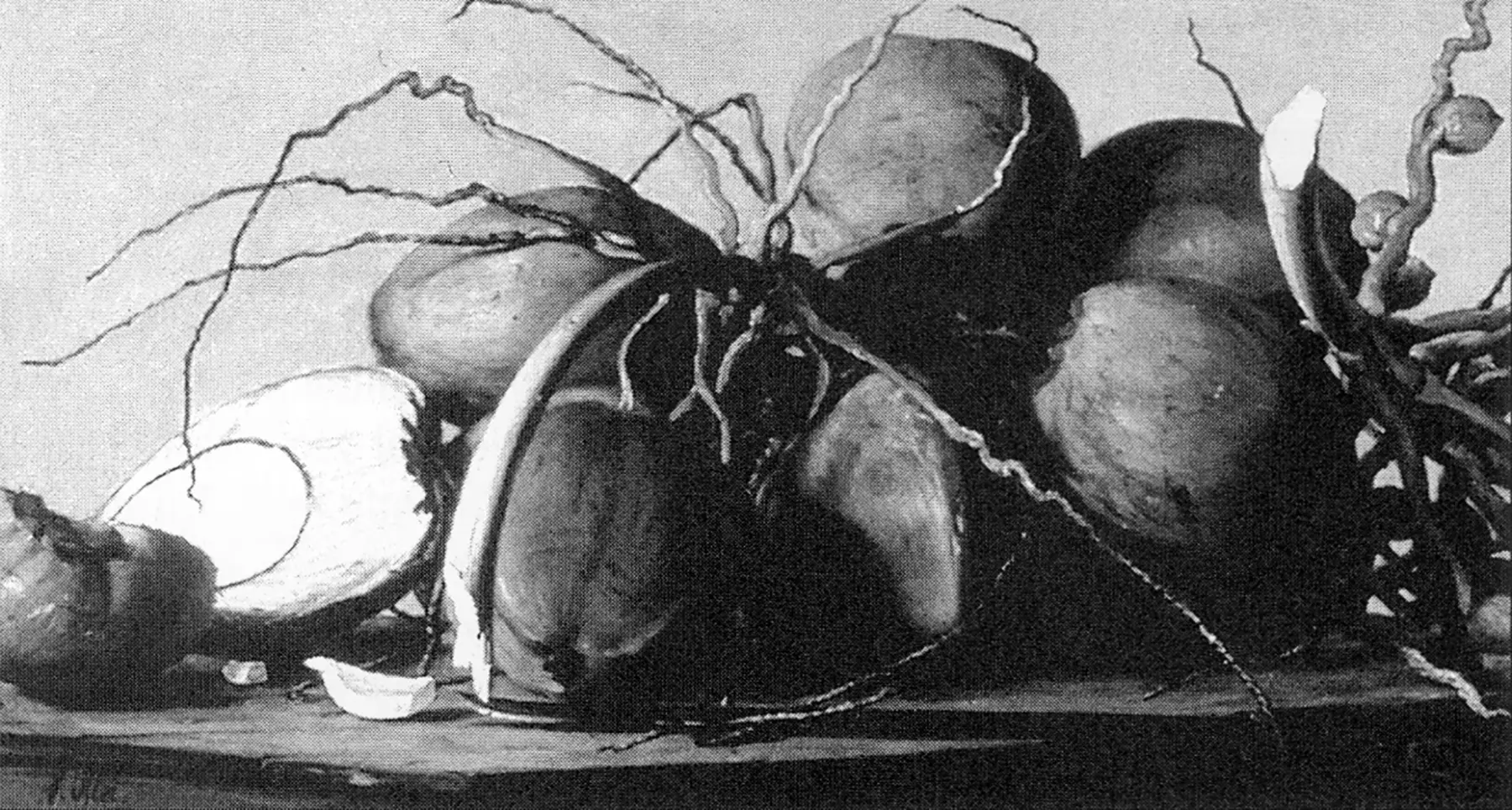
Porto Rico is represented in the exhibition with one of its idols, Francisco Oiler, the oldest of the artists included, with his premonitory vision of traditions and unusual treatment of vegetable roots (magnificently reworked by Mirna Báez, his distinguished and absent compatriot). Fall from Grace (1993) by Anna Ido Roche Rabell, is a characteristic and vigorous encaustic oilwork. Ernesto Pujol, a disturbing Cuban artist, is represented by a small installation and a photographic diptych—works that distance themselves from any trivial concept of still-life to include everyday and social elements. As to the masters, an inevitable reference is Joaquín Torres-García, whose work casts its shadow over the exhibition. Others include Augusto Torres, Francisco Matto, José Gurvich, and Julio Alpuy, representing Uruguay. From Peru, there is Humberto Aquino, and from Venezuela Alexander Apóstol, with Heads of Fish (1999) and Goat-fish (1992), while Armando Morales represents Nicaragua. From Frida Kablo to Tina Modotti, Amalia Mesa-Bains, Milagros de Ia Torre, and Soledad Salamé, women artists in the show confirm their power of expression, passion, and versatility. Some of them had to resist tradition and the imposition of familiar canons in order to paint. The exhibition is accompanied by a catalog with good texts and illustrations, which was made possible thanks to support from The Rockefeller Foundation, Philip Morris, the National Endowment for the Arts, the Westchester Arts Council, the patronage of M. Katonab as well as that of various other institutions and corporations.
GRACIELA KARTOFEL