
The eleven years worth of mixed media images presented in this show by Guatemalan photographer Luis González Palma, demonstrate a gradual change in his work. His unsettling portrayals of individuals of Mayan ancestry have evolved from manifold, tactile pieces wrought from layers of overlapping acetate, handmade paper, and text, to the recent, clean harmonies that balance the photograph with squares of colored ground and a smartly placed object. Absent from González Palma’s late work is the haunting pain and mystery evoked in his early nineties portraits of proud, impassive faces.
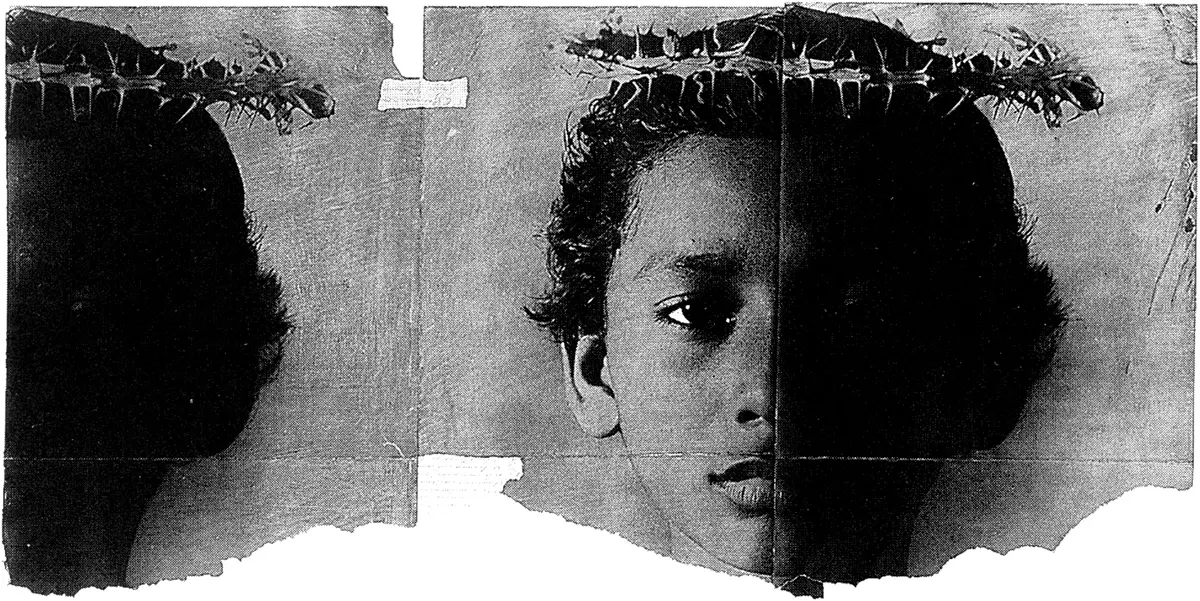
In his early piece, Portrait of a Boy 1990, the head of a young boy wearing a crown of thorns gazes steadfastly into our eyes from a ground pieced together, its edges torn and folded, its surface burnished by brushstrokes of oils and bitumen. Attached to the top of the creased photograph is a bit of paper covered with writing, lending the impression that this work was culled from someone’s attic trunk. The youngster’s face and the second image showing half of his head that appears at left, project an uncanny familiarity as if he is someone we have seen in our travels. Or else, we recognize him from his crown of thorns and quiet strength, as a Christian leader and a Guatemalan one as well, a Mayan figure who has suffered repression with resolve and dignity.
González Palma repeatedly places evocative Latin American cultural and religious symbols with his models, lending an often enigmatic symbolism to his mixed media portrayals. Occasionally his inference is clear, as in INRI, 1994, in which a young boy stands in sepia shadow, holding before his bare body a carved sculpture of Christ nailed upon a cross that reaches up to the boy’s nose. His hands hold the crucifix before him, and his luminous eyes stare resolutely into ours, daring us to question the sanctity of this vision. Overall, this triptych conveys the impression of a 19th-century daguerreotype, with its solemn theme, the rough edges of the three prints, and the warm sepia and chestnut tones that differ slightly in each impression, bathing the portrait in mysticism.
By contrast, González Palma’s recent work lacks the visual complexity of his seemingly aged and distressed earlier images. In Hero, 1998, for example, a young boy sits shrouded in a cloak bearing an enormous encircled star upon his chest, with two small round, photographs of trophies sewn in perfect alignment in the corners above. This classic González Palma portrait is so cleanly and carefully conveyed and the subject’s face and pose are now so familiar, that the photograph fails to resonate. Similarly, América, 1999, balances visual elements in a harmonious and almost predictable composition. Its precise format, a large 100 x 99.5cm square divided into four smaller squares, together create a striking but unremarkable impression, particularly given the numerous similar works he has conceived. The bottom two squares are covered in shimmering silver leaf, and the top left quadrant, presents the head and shoulders of a handsome adolescent boy staring at the viewer, a heart tattoo with stars, stripes, and a banner stating “América” superimposed upon his brow. The square at right is painted red and sports a tin crown, the type worn by deities or saints. Although González Palma's images continue to draw one’s eye, his recent photographs disappoint by appearing more formulaic than his richly evocative works of years past.
MARY SCHNEIDER ENRÍQUEZ