Memory is a disposition, capacity, or faculty to preserve special moments. Therefore the will intervenes to ensure that these memories are fixed and not lost in the past. In this sense, the title of this exhibition by Marcos Kurtycz at the Carillo Gil Museum (November 17, 1999 - February 13, 2000) suggested a number of different meanings. It referred to both the artist’s fascination with memory and one of his works at the MoMA, but also to the memory enclosed in documents, which in this case reminds us of Kurtycz’s production in this first posthumous retrospective of his work.
Towards the mid-1950s, art in Europe was focused on its dematerialization. That is to say, artists began to create non-objectual works with a marked conceptual content which in some cases led to what we now call ephemeral art. The ephemeral suggests the idea of a passing temporality, a brevity that by definition soon disappears. Ephemeral art evokes this state from its conception, as an internal condition of the work. This is also the case with performance art, where the documentation becomes the memory of the action.
By means of videos and photographs of the performances, this show offered us a conceptual discourse of the paths taken by the artist. The Wheel is a city walk in a large circle that simulates Newton’s color spectrum. Exprocession is a walk by 40 persons towards a gallery, with musical steps and the exhibition of 40 canvases in the streets of Guadalajara. Labyrinth recalls the temporality of the body through an unknown space where different emotional states arise, within the spatial traps laid by the artist. There is a sense of playfulness in this work which begins at the entrance to the labyrinth and requires the spectator to make changes in their sense of dimensions with regard to reality. The air, sequence, time, and space are determined by the position, size, volume, and path established by the work, thus modifying our material perception of things.
Another kind of performance is that which uses the body as the main character in the discourse. On the one hand, the body is the matter that is common to us all, without any a priori meaning; on the other hand, it is a field where violence, communication (or lack of communication), sexuality, as well as ethnic and religious factors express themselves in all their aggression. In Persona, a dummy replaces the desired creature in the desolation of a volcanic crater. The person becomes an object, thus creating confusion between what is seen and what is said.
The Passion and Death of a Printer was one of the artist’s various expressions in which the body undergoes changes before the confused eyes of the spectator. Life becomes a fiction and the events taking place after the action become a source of anguish in the presence of death and resurrection.
There is also an obsession with color, as can be seen in Morning Stars, in which a series of Christmas lights acquire muted tones under a sheet of white acrylic, accompanied by music by Philip Glass. Paper Games is an experiment with different forms and colors that suggest flowers, snakes, or stars made of paper. In some of Kurtycz’s land art projects, we can see the same attraction towards volumes, two-dimensional forms, mirrors, lights, and colors, which were to be used for some interventions in the Hidalgo desert that were never carried out.
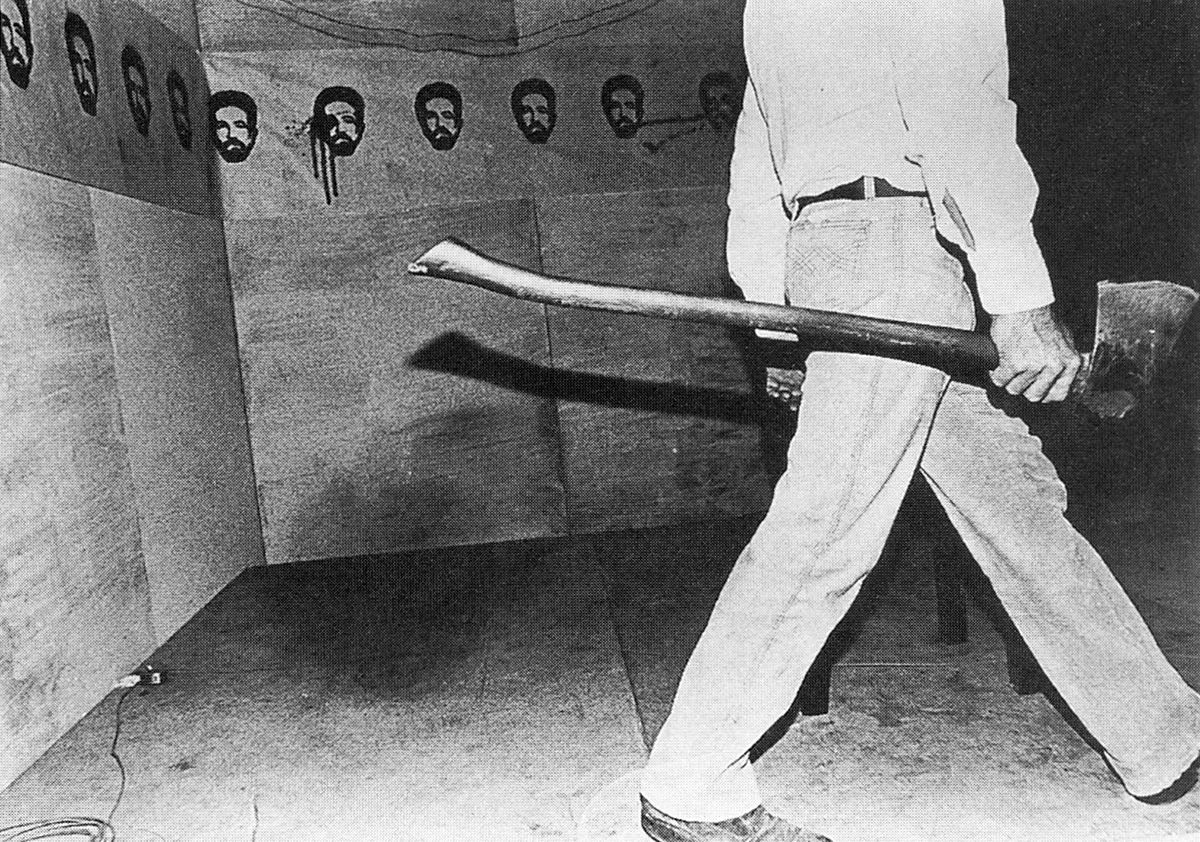
For Kurtycz, artist editions provided spatial support and acted as a container of ideas. When he arrived in Mexico, he began to work as a graphic designer, discovering a vein of expression that he exploited throughout his life. In 1984, he wrote a book per day and included four actions in various parts of the city. Twin Books are two books in which the Pecannins twin gallery owners pass the pages between their legs, in an act of sexual replacement by an object.
His Bombas were a means of intervention with which Kurtycz used to make “threats” against a gallery in Poland, to express his anger with some magazine, and to show his friendship with Felipe Ehrenberg, by means of letters.
In 1991 Kurtycz created a work entitled Change of Face, in which he showed half of his face paralyzed as a result of surgery for a disease of the facial nerve. In this way, Kurtycz’s performance was the result of an introspective experience revealed through an action. In both his work with fire in Puerto Vallarta, Labyrinth in Pennsylvania, Burning Water, Snake Maquiladora, and Change of Face, and in all his performances, the action was transformed into a ritual. The everyday world becomes a central motif and theme in his actions, where the performance emerges as the internal language of his expressions, with the documents remaining in our memory after his death.
JIMENA MARTÍN