
Ball of yarn without end stitches without thread. Shunning stone, metal, and wood, Marina de Caro weaves sews, and embroiders incredible flexible sculptures with multi-colored fabric. Easy to keep, and cheap to make, most of the pieces included in the exhibition Ball of Yarn Without End—with which the Gara Gallery ended the century and welcomed in the new millennium—look like fantastic and multiform creatures, without names or recognizable features.
Marina de Caro is currently engaged in work that has no single line but instead revolves around “organic structures that open up to the body and other objects.” Depending on the support or the freedom with which they are treated, the fabrics acquire multiple and unorthodox forms. Are the resulting figures hallucinating or tranquil appearances? Are they on the point of dissolving or do they point to the future? Are they mere expressions of fashion or do they challenge our clichés of the feminine?
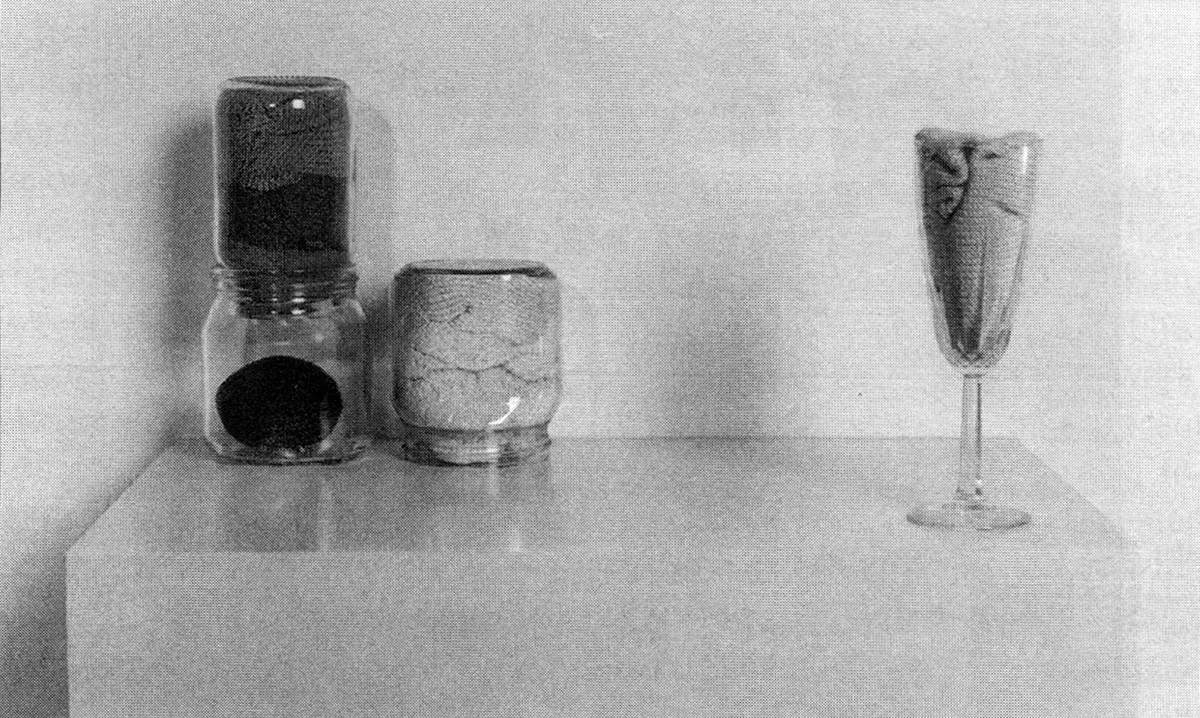
The exhibition, which was organized like an installation—with around 30 objects measuring an average of 20cm each, and three large figures up to 3m high—, generated more questions than answers. This was because, at first sight, these multiform, colored, and minimal figures seemed to offer a sample book of textiles, a catalog of rather unconventional toys, or a collection of clothes for children. These unusual works seemed to be talking to us about dress and fashion.
But a visit to the large sculptures and a closer look at the tiny elements revealed some interesting things. A concern with structure was also present in the soft forms on firm supports, as in the twisted fabrics and those inserted into flasks and transparent wine glasses. Was there some game here about inside and outside?
The artist, a graduate in art history who for many years taught design at the Faculty of Architecture, Design, and Urbanism at the University of Buenos Aires, constructs her works without following any pre-established plan. She creates a theme for her works only after making them. Traditional iron structures offer one possibility, but one that is that provided by chance. The number of meters woven is another element that sometimes inspires or distorts the line of whatever design is imagined by the artist. Rather than using the digital processes so much in vogue at present at, de Caro prefers to exercise her intellectual freedom in a craft as ancient as weaving. Why is this task identified with women? Because it contrasts with technology?
All classifications prove to be futile when speaking of the work of de Caro, who began to exhibit her drawings in 1981 and who was awarded the Third Klein in Foundation Painting Prize in 1999, with a work entitled 2002 - 2 x 1. The title of the work refers to the figure 2002, which is the number of lines of the thread mounted on a canvas of an abstract green and black landscape. 2 x 1 indicate that there are two works in one: under the visible fabric there is a canvas painted with exactly the same design as in the fabric, “because otherwise it would be visible. ”Appearance veiled, or appearance revealed? The artist, who is on a Kuitca scholarship in Buenos Aires, continues to draw and explore her textile adventure because, as she herself says, every idea associated with this technique “is marvelous”. She began her career designing woven and rubber clothing with Lady Tricot, with accessories. A task that translated into concepts rather than industrial products. The result was a series of performances with articles of clothing on the point of disappearing. Similar to, but different from, her mutating figures which suggest and express a very contemporary sensibility.
Her small works, in particular, bring into play the senses of the viewer: the sense of touch, and the sense of form, broadening the spectrum of interest. “These organic projects recuperate the sensitive memory of the spectator,” the artist says, invoking viewer participation over passive contemplation. If one thread is pulled, the work disintegrates. Ephemerality for its own sake?
Far from presenting any kind of narrative—“I detest narratives”—De Caro’s work is shot through with ambivalence. She maintains that her work is no mere entertainment. “Even though there is a ludic element in my research, my artistic work is a commitment. ” While for some viewers her work might seem rather superficial and decorative, her humble objects and large sculptures are for others, the reflection of the times and therefore faithful emblems of a moment in our history. Art for art’s sake?
In this sense, the work of de Caro, like that of other contemporary Argentinean artists, is part of a tendency to not see the past or one’s surroundings as a source of polemics or inspiration. Her work seems full of private symbols, away from any social situation and the necessary cultural debate. Ball of yarn without end, stitches without thread?
VICTORIA VERLICHAK