The 33rd National Salon of Artists presented in 1990 brought national attention to the work of Pablo Van Wong (1957), an artist from the Valle del Cauca, who at that time had just finished his studies of Plastic Arts at the Departmental Institute of Fine Arts in the city of Cali. Since then, his work has undergone two fundamental shifts. On one hand, we have a stage in which he realizes three-dimensional works with important variants, objects elaborated with diverse metals. In the second instance, the embroidered fabrics that make up his most recent production emerge. In both phases his work is marked by a delicate and careful style linked to violence—sometimes hidden, other times explicit-and an incisive pain—inherent conditions for his own philosophy as well as the forms and materials used.
The double nature of his objects may be related to his cultural adolescence. Pablo Van Wong is the son of Chinese parents. He grew up in the port of Buenaventura, and he has been living and working in the city of Cali for several years. The influences of Asian culture that filtered through his home where his parents speak in their native language are reflected in a contemplative, silent, and ritualistic attitude that links him to a worldview that is explained through the coexistence of opposing elements. These are precisely the principles taught in the I Ching which allude to the existence of two forces, two contrary energies, the yin and the yang, one representing movement and the other repose, one weakness and the other strength, one darkness and the other light. It is in this harmonic coexistence of opposing forces that the order of the world is founded. Moreover, Van Wong’s link to the Western world is manifested in many ways throughout distinct stages of his work, as we shall examine later. But it is the quotidian contact with crude violence that characterizes the Colombian environment, that makes the theme of violence unfold under the form of a continuous reflection and like a sort of motivation that guides the elaboration of each of the pieces.
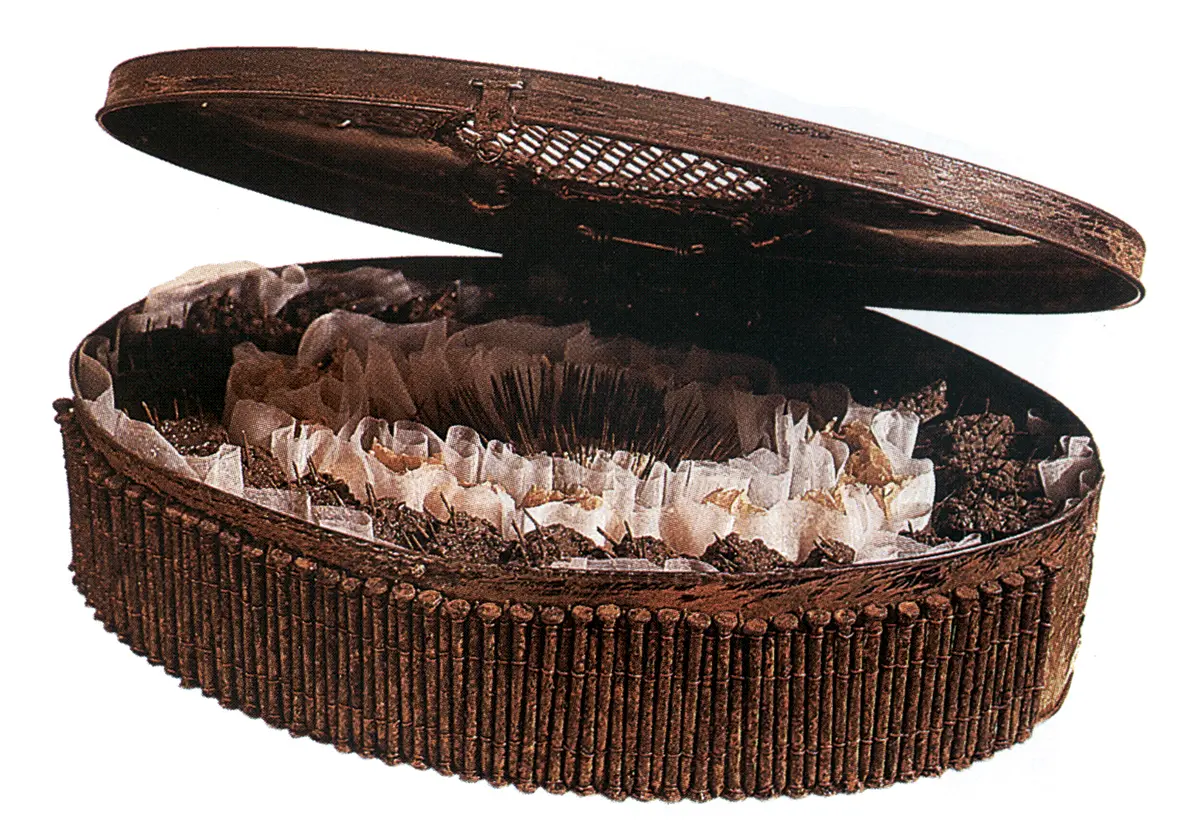
In 1990, in the aforementioned National Salon, Van Wong received an honorable mention for his exhibited works, that make up part of the series Containers. These are small metallic cookie boxes, some round, others long, whose fragility and delicateness stand out among a show replete with an infinite number of grandiloquent works. Van Wong’s refined objects, on the other hand, elaborated with a mystical silence and profound keenness, capture the viewer’s attention through the sense of sight, taste, and touch. Exhibited as half-open boxes placed on a fine, discrete metallic support, the pieces attract the curious look of those who wish to explore their interior. Upon closer inspection, the rusty material and the infinite barbs that cover its surface cut the gaze. Added to the mystery housed within is a sensation that pricks and wounds the skin. However, the curiosity persists, for within the boxes, delicate sheaths made of fine, semi-transparent cotton seem to preserve candies; at other times, he uses uchuva peels. In both cases, they are organic materials that make us feel that we are in the presence of something sweet, delicate, and sophisticated. But upon taking a detailed look inside, our taste is altered by the presence of carefully arranged small bullets and fine pins. Due to their material and nature, these items abruptly contradict what could have been at one moment a fine pleasure for the palate. Thus, through the act of perception, our senses, guided by sight, oscillate like the yin and yang between pain and pleasure, attraction and repulsion. And it is in the experience of these dualities, and in the delicateness with which the artist wields the materials, that we remain trapped before these apparently inoffensive and seductive cookie boxes.
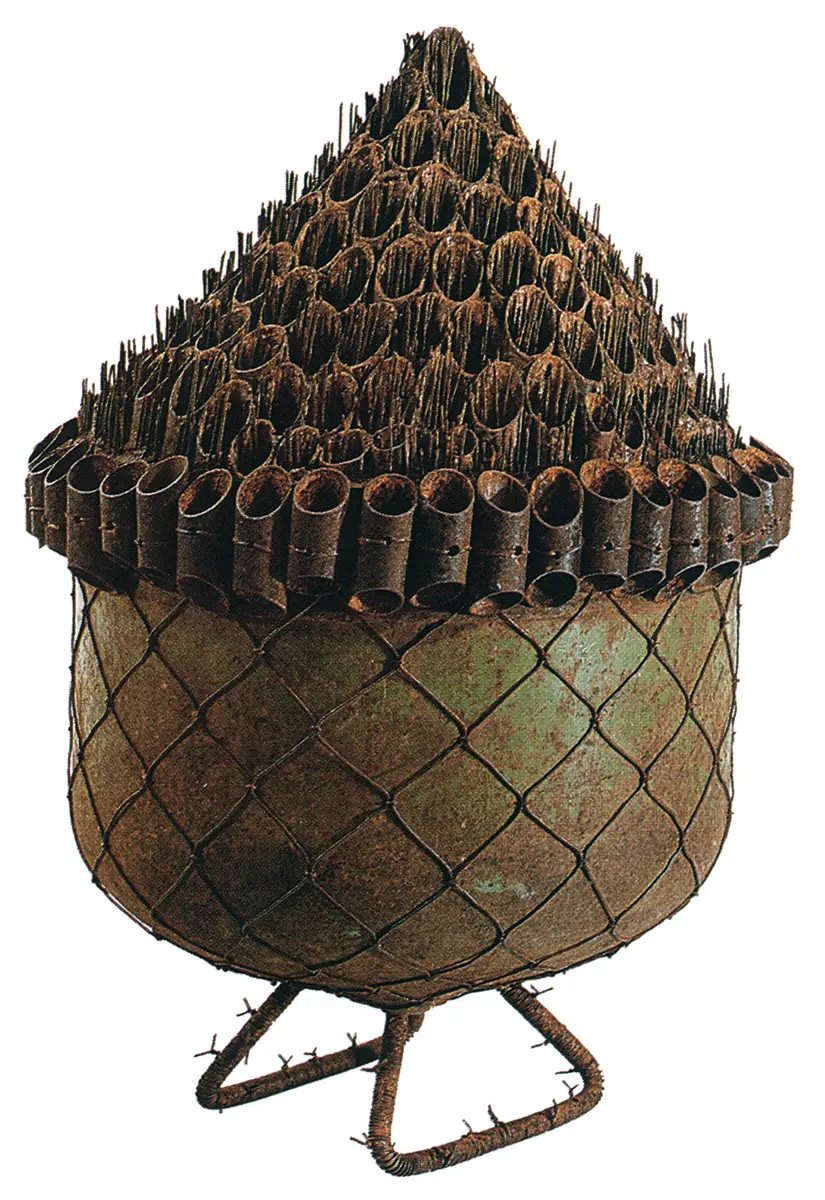
Also in this initial stage, Van Wong realizes a series of objects marked with a decidedly ritualistic character that is made manifest in pieces like Quiebran la Fortaleza aun de bronces y aceros (They break the fortress even of bronzes and steels) and Oculta su resplandor y permance lúcido sin embargo (It conceals its splendor and nonetheless remains lucid). These works, on account of the careful arrangement of the elements that constitute them, can both recall a floral offering and sound like a prayer, as José Hernán Aguilar observes, "Van Wong’s delicate but compact (and impactive) sculptures executed with metallic materials of debris convey the idea of ceremony to its deepest place, toward a center that wishes to remain hidden. His works demand to be seen as renovations and not as simple assemblages of random material, and they may therefore be considered as prayers said silently with considerable concentration."1 These pieces are elaborated using gas cylinders cut in half. The top part becomes solid support upon which cylindrical elements are organized in a circle, cartridge belts in the first case, and tubes in the second. They are secured among themselves by welding and by the action of a fine wire that wraps them.
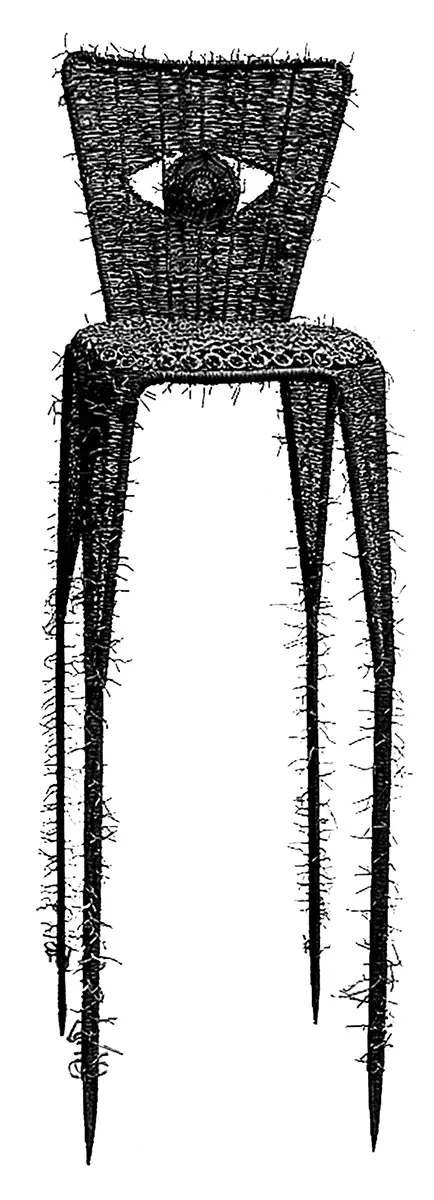
Another significant piece from this period is Ascenso lento hacia el sur (Slow ascent southward), a mysterious sculpture elaborated with metal and natural seeds that, like the impressive and threatening appearance of El rey se acerca a su trono (The king approaches his throne), which won honorable mention at the 2nd Bogotá Biennial in that city’s Museum of Modern Art, it evokes deities inspired in animal figures whose beauty and mystery we associate with millenarian civilizations closer to the East than to the West. Miguel González has accurately illustrated the rich meaning of these objects in his comment that: "Pablo Van Wong’s work is full of diverse types of suggestions. Literary, in the minute standstill that generates poetic and extensive titles for his works that affirm their mystery. Religious, in a ritualistic and magical sense, with elements of both silicon and veneration of imaginary tribal deities. Erotic, in its sadistic intonation and its contrary correspondence, with disturbing and provocative instruments in its expressivity. Humorous, in its severe hilarity refers to a humor both lascivious and black."2
After this series, Van Wong forges a unique plastic language that turns him into one of the most significant artists of his generation. It is a language in which the tense duality of opposing principles gives rise to a most refined beauty that draws strength from the use of highly fragile, delicate materials that are plastically assimilable to the linear and to the transparency that contrasts with solid and heavy metals. But on the other hand, the delicate structures of his objects that are enriched and transformed with the presence of light, as well as with the passing of time, allude to the sharp-edged, to the stabbing, to the wound, to pain. The repeated use of rusty metal has reinforced both the beauty of his objects and has accentuated the allusion to the wound, to abandonment, and to oblivion.
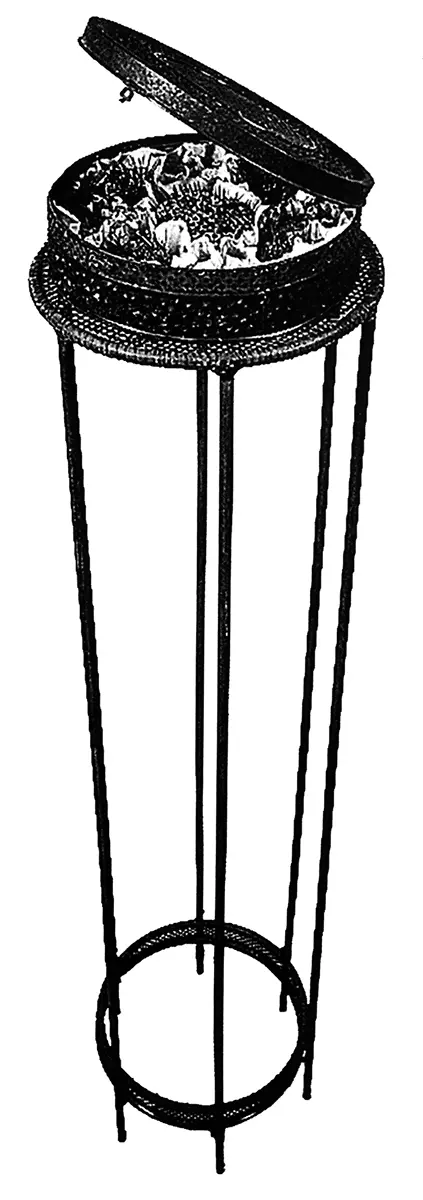
Valor e identidad (Value and identity), Van Wong’s second solo show at the Valenzuela y Klener Gallery in 1995, gathers a series of works executed in the mid-'90s in which a new facet of his production is revealed. In the first place, the theme of violence abandons an intimate sphere, somewhat enigmatic and hermetic, in order to make direct reference now to the external environment, to the violent events that take place in Colombia, but always maintaining the coexistence of dual forces. On the other hand, the plurality of cultural aspects of the environment in which Van Wong lives, the Valle del Cauca, are filtered in his new objects in such a way that these objects bear echoes of Catholic colonization as a distinctive feature that links him to Western culture. Therefore, the coexistence of opposing forces, now more than ever, seems to center itself between the polarity of life and death, without ever falling into obvious postures or into pamphleteering works. This encounter with violence, as the artist himself mentions, is given life by the custom of accumulating newspapers over months or weeks and, suddenly one night, reading them in their entirety. The experience of receiving in one instant that avalanche of violent news that the itinerary of national life writes day by day influences in an unconscious but decisive way the direction his work takes.
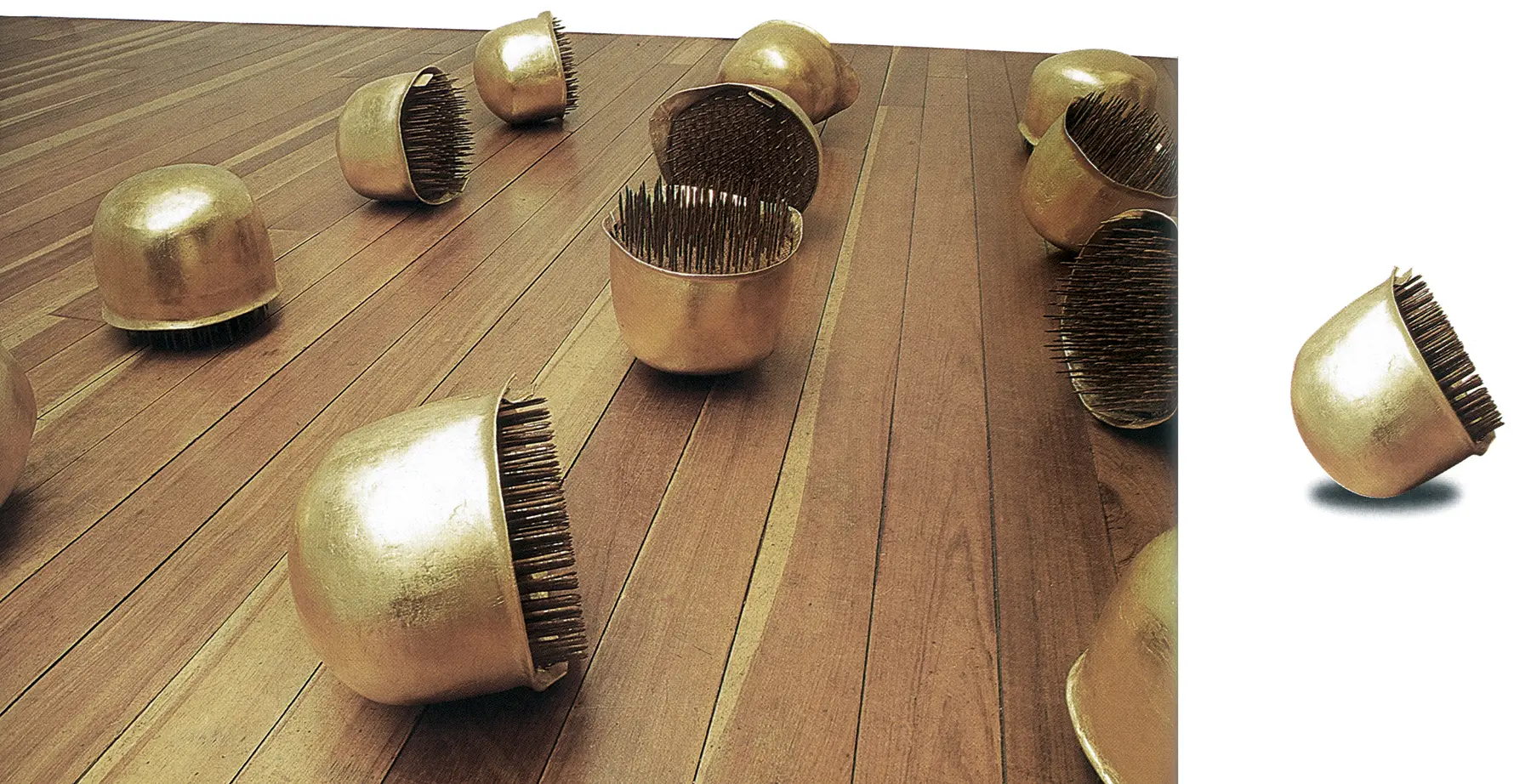
But, beyond the daily acts of barbarity, violence also seems to be a feature that defines the attitude of Colombians in the face of their cultural components: "We Colombians are violent and that is one of the points of contact that we share. We ask ourselves where we come from, but we hate our past. Colombians reject their Black and Indigenous heritage. But it just so happens that identity is constructed along the opposing path. We must look for it in the past and then look at the present context in order to join the two elements."3 His work turns out to be contrary to that attitude because, as Carolina Ponce notes, what becomes clear in this new production is the presence of distinct cultures that coexist in the Valle del Cauca, a region in which indigenous and African traditions live together with Catholicism, whose vestige of power is found in the colonial churches and, more specifically, in their altars covered with gold leaf.4 The symbolism of gold begins to be used by Van Wong in such a way that its value and splendor, that so aroused greed during the conquest, come to coexist once more with the face of violence and death, as occurs in his installation Volverá a despertar y todo no habrá sido más que un fugaz momento de exaltación (He will awaken once again and everything will have been nothing more than a fleeting moment of exaltation, 1995), in which soldiers’ helmets are bathed in gold while their interior is filled with metal nails. The helmets are lined up directly above the floor, some allow their interior—wounding and spiky because of the rows of nails—to be seen, and others display their shiny and radiant surface.
Also at this time (from 1994 to 1996), Van Wong arrived at new procedures for joining metal with other materials like glass, powder, velvet, plastic toys, and photographic images of different people who died in violent circumstances that he cut from the newspapers. The majority of these pieces are small-scale. In their appearance, they recall monstrances, relics, and medallions. Some are constructed with tuna cans that, like drums, shelter in their interior small children’s toys, crystal balls, and little plastic dolls. In this way, they become receptacles of sharp, rusty metal in which the image of childhood and the sound of war resound.
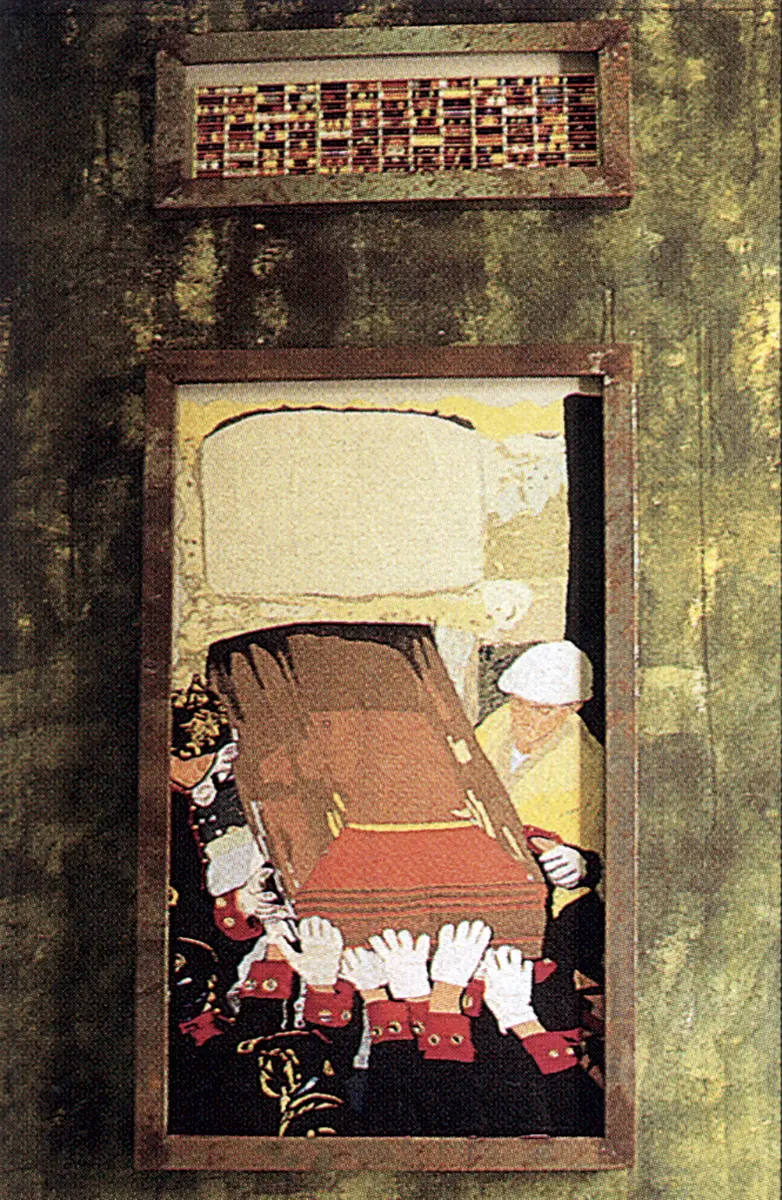
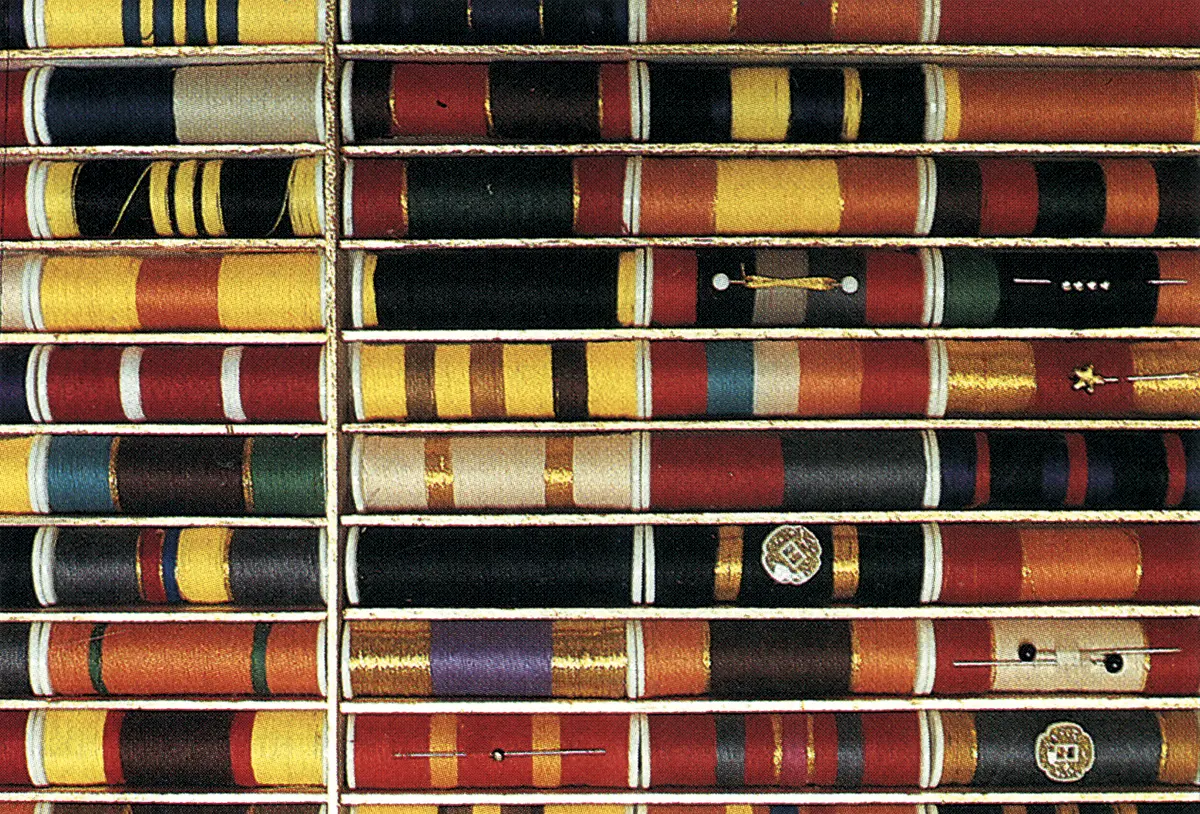
In 1997, Pablo Van Wong was invited to participate in the 6th Havana Biennial and he showed his work titled Obrepción con decoración (Obreption with decoration). This is a series of ten fabrics, richly embroidered by hand or machine by different women who are experts in this traditional labor. Each of the fabrics is framed in thick metallic frames that turn them into boxes that may be placed upon walls of variable dimensions. They are always given an allusive color, generally olive green or “military green.” These works are made up of two pieces. On the top part of each fabric, also within a metallic frame, the artist places a series of threads with all the colors used in the embroidery. Buttons, needles, and all kinds of sewing implements are superimposed over these tubinos elaborated by Van Wong.
The process of these works is initiated with the choice of newspaper images in which the death of some person is recorded. Sometimes the person is anonymous; other times the reference is to the death of a distinguished politician, as in the case of the photo that displays an aspect of the burial of Álvaro Gómez Hurtado. Once he chooses the images on which he seeks to base a particular history, a specific case, in order to allude to a more generalized problem that affects the different sectors of the population, they are blown up to an adequate size and transferred onto the canvas (the pieces are of variable dimensions whose height generally exceeds one meter). In the representation of the event, special attention is placed on the person’s clothing, which somehow refers to the social condition of the victim of this indiscriminate violence that extends throughout the country.
In order to accede to Van Wong’s intentions in this series of works, it is important to keep in mind the narrative path implicit in these images. A violent act occurs in the death of one or several persons at the hands of one of the many fronts in conflict. This act is recorded by the photographer and the journalist who are present and give their version of what happened. This version is received by the readers of the newspaper, among them Pablo Van Wong, who finds out about the event through the version given by the news. He was not a witness who could be physically affected by this violent act. His relationship is indirect, depending on the version of others. The event affects him in his intimacy; his affection occurs at a distance and in his home. He, in turn, selects the image and takes it to the women who embroider, so that they take possession of the event through a third version, and in the act of embroidering they, in turn, give their own interpretation.
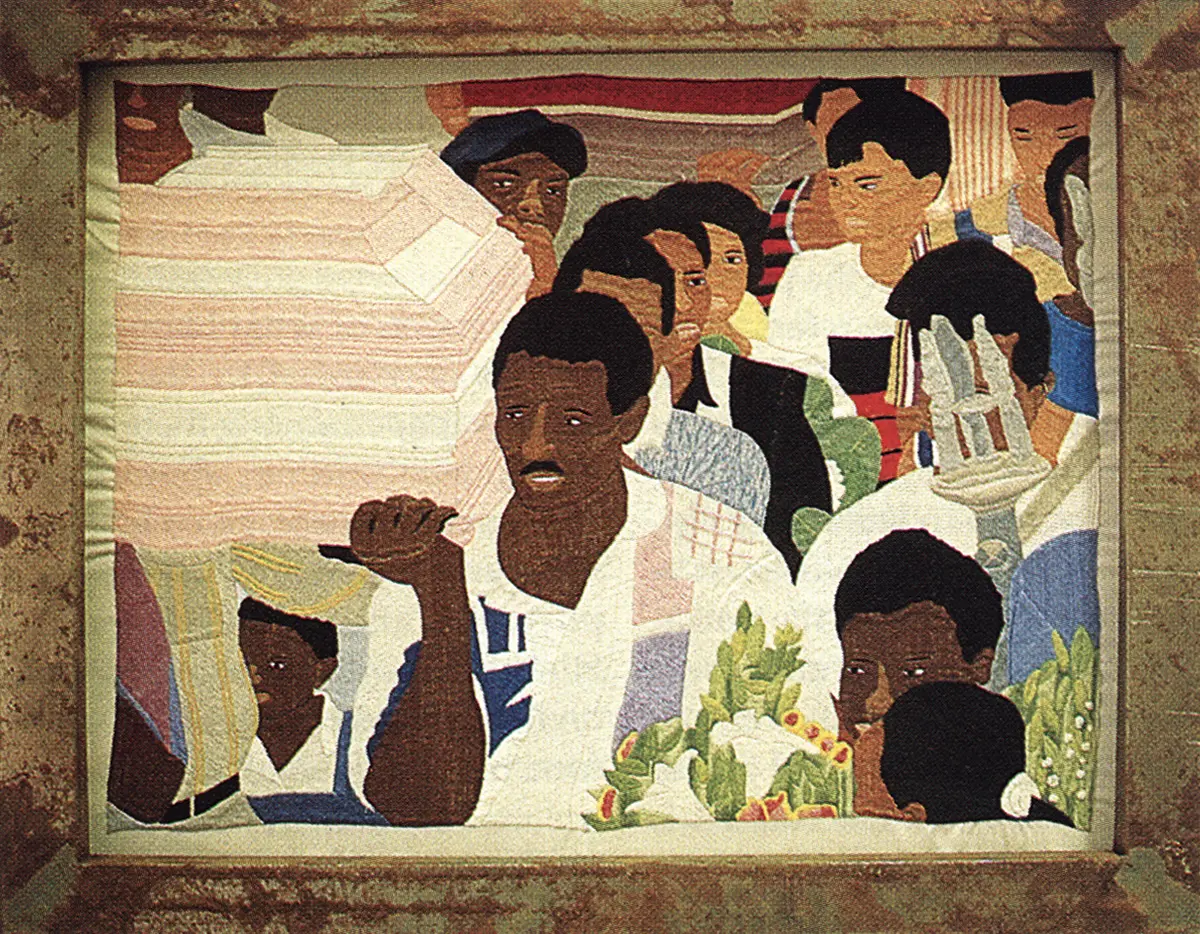
This superimposition of narrations leads us to the word “obreption,” the title of the series. According to the dictionary, “obreption” is a false narration that a subordinate presents to his superior with the aim of obtaining a promotion or recognition, but in the narration, any detail that could attempt an offense against his aspirations is concealed. Thus, when we see these richly embroidered images with profuse colors and such painstaking care in their elaboration, we find ourselves with a decorated narration that has passed from hand to hand. What we have before our eyes, therefore, is a new image that gives a new version of the event.
As always happens with Van Wong’s work, in the act of perception we are impelled to go from one psychic state to another. What we perceive at a distance is a profusion of colors and rich brocaded textures that trap and seduce the gaze. The upper box with threads looks like the epaulets or shields used by generals, but when we draw closer through the rich coloring, we begin to discover that, inside the metal box, a man lies with hands and feet tied. Or we see the faces of men and women crying as they bear a coffin. Or we find ourselves with the gloved hands of some cadets who are holding a funerary box. Once again, we have the experience of oscillating between opposing forces: the living color immediately leads us to see the gelid face of the dead; the pins over the threads prick us again; and just as happens with the yin and yang, we go from pleasure to pain. And in this continuous circuit, the bloody history of an entire nation is written, embroidered slowly, delicately, and keenly
NOTES
1. José Hernán Aguilar “Rituales internos,” El Tiempo, Nov. 6, 1991: 2A.
2. Miguel González, “Pablo Van Wong,” in the catalog Pulsiones (Call: Museo LaTertulia, 1993).
3. Pablo Van wong, “Una violenta identidad,” El Tiempo, Jul. 4, 1995: 12C.
4. Carolina Ponce, “Bio as in ‘biography,’ ‘biology,’ ‘biogenesis,”’ Colombian Center New York, October 17, through December 31, 1996.
MARTA RODRÍGUEZ
Professor at the Arts Faculty of the Universidad Nacional de Colombia, Bogotá.