Contemporary art is making silent progress in Santo Domingo, overcoming the resistance of a public that used to confuse creation, imitation, and decoration. The Larrama Gallery, which is now taking major risks by presenting pioneering exhibitions, is successfully meeting this challenge and will be remembered in the country’s artistic history for having played a decisive role in changing the attitudes of collectors and the public in general.
This show of recent works by Quisqueya Henríquez was the greatest commitment yet undertaken by this young and brave gallery in this respect. The symbiosis of space, balance, and harmony resulting from this set of works and from each individual piece, was naturally seductive, once any “prejudices” about non-traditional art were overcome.
Quisqueya Henríquez, who is Cuban and Dominican by origin, and who acquired an excellent training at school and through her readings and experiences, is extremely meticulous in both her investigation and execution. She is better known at the demanding international level than in the Dominican Republic. A graduate of the Higher Institute of Art of Havana, she has successfully presented her work with Consuelo Castañeda and lived in the United States where she continues to have a solid following. She now resides in Santo Domingo.
Her artistic vocabulary is unique in the Dominican context. Her sense of intellectual reflection evident in her capacity of visual transfer produces a work that combines both conceptual and minimalist art. This was her first one-woman show in the Dominican Republic—a choice that matured slowly since ethics and aesthetics are inseparable values for this young artist.
Her work therefore can be placed within two particularly difficult contemporary currents, unquestionable in their plastic form but linked to a post-abstract discourse and a rejection of representation. Frequently, these approaches can lead to an excessive coldness or a hermeticism that calls artistic practice into question. Fortunately, Quisqueya Henríquez avoids these reductive solutions, even though her work can be situated within this artistic lineage.
Henríquez thinks, constructs, and produces emotion. She takes pulchritude to its final consequences, as though she was seeking something absolute through the refining of her textures, lines, and details. The chromatic range is austere but limpid and radiant, with a predominance of white, light, and a paroxysm of all colors.
By means of a formal and expressive duality, the works oscillate between being solid and fragile, evident and latent, visible and invisible. In short, the apparent simplicity of her graphic and plastic formulations masks their conceptual complexity.
Indeed, without the poetics and the intellectual support, the nine works included in this show—exquisitely mounted— would lose much of their attraction: hence the importance of the second gaze in discovering the profound meaning of their creation.
Henríquez does not produce “texts”—to use literary terms that fit her work—or drawings, sculptures objects, or installations, but all these at the same time. No genre-based division is possible here. Memory, time, language, gesture, reason and the lack of reason all motivate and inspire her writing of signs in space.
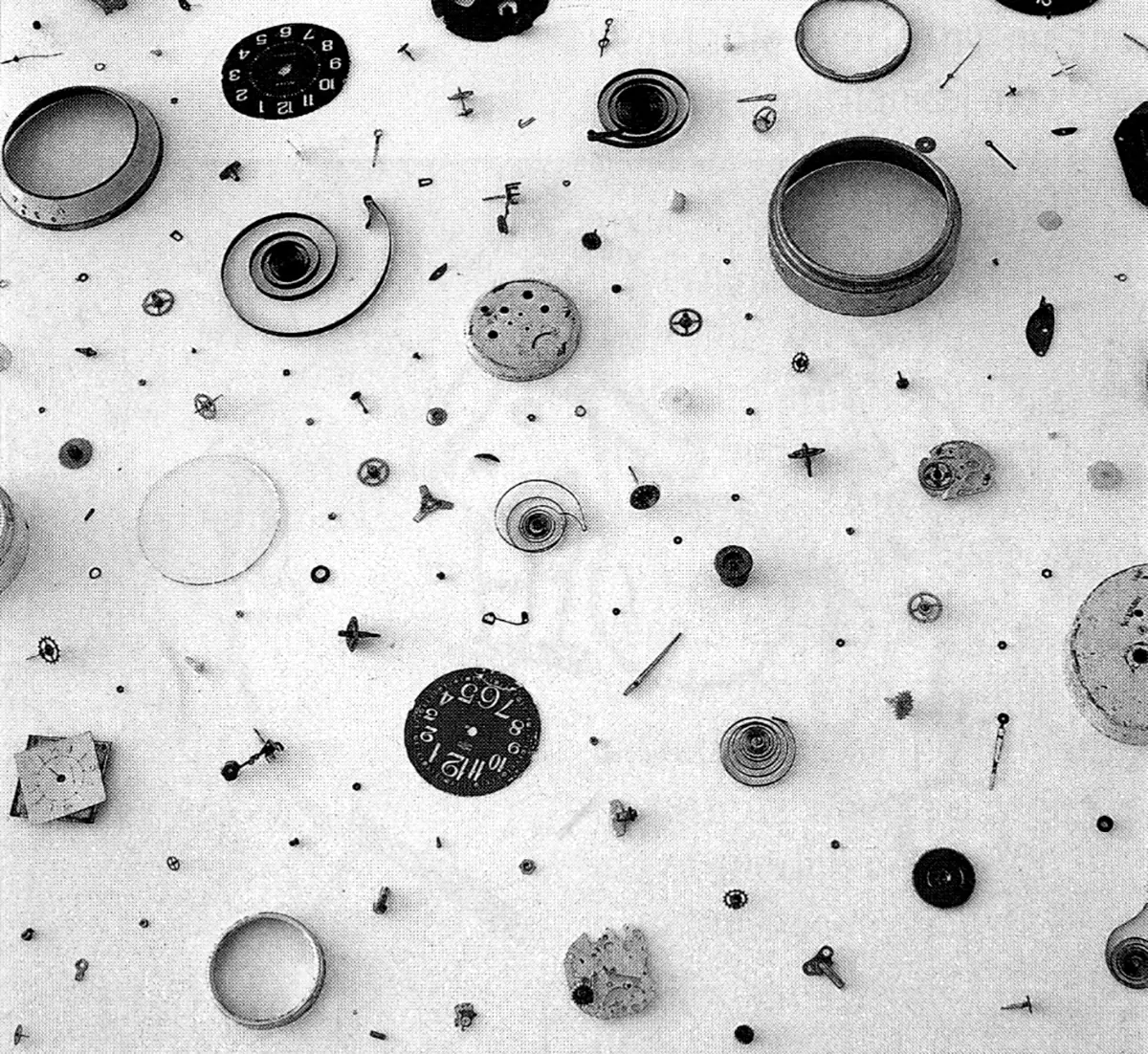
Almost at the entrance to the gallery was a work entitled The Ideas of Fragmentation, consisting of 100 dismantled clocks, an uncountable number of pieces meticulously distributed over a white rectangle, inviting the spectator to a slow, repeated horizontal contemplation. A very beautiful work is its first quality made up of and based on decomposition and deconstruction, it required three years of work. If anything were moved—a spring, a little wheel, a screw, a fragment, however, tiny—the whole fragile, and perfect balance of the work would disappear.
Henríquez has symbolically broken time, fighting the machines that measure it, indefinably destroying them, but in a discretionary act unrelated to any pre-established duration, she creates a “new time” that she has physically incorporated into space. Reflection engages in an exchange of arguments with art, which in turn encourages reflection on the part of the spectator.
Nearby, another work entitled Memory as a Vehicle of Amnesia consisted of 20 rolls of metal and paper, geometrically laid out and fixed to the wall- twenty orthographic variations on the word, beginning with amemori, or negation of memory. With this polyptych, the artist gives form and consciousness to a mental process that we experience every day. We look for a name, a number of phonetically similar words appear, and we almost find the right word... and then suddenly, the miracle of memory triumphs over amnesia. This work was pure, impressive, and sensitive.
Always memory and more memory. And then transfigurations, through ready-made and combined metal ellipses, according to the compositional principle of the previously mentioned work, move towards the “measure of the infinite.” This was the most ludic piece in the show, combining graphic elements and choreography. The transformations succeed one another: mystery, gesture, arabesque, flight, dance, all evocative of even the famous image of Nijinsky dancing. Prelude to the Afternoon of a Faun an open work that invites a creative reading.
Polysemy is another quality of her work, encouraging spectator participation and personal interpretation. The end of the work echoes like a kind of coda, through a sign of the infinite. The message passes, and we continue to think.
The materials used paper, pencil, metal, and glass as well as the serial elements they incorporate and the execution of the works (we have only spoken of three out of nine, and they all deserve comment) might seem to suggest anonymity and universality. But the contrary is the case.
With her skill, determination, and internalization, as well as her enormous sensitivity that shapes and creates emotions in an unusual way, Henríquez’s work transcends the physical immediacy of the visual. In this show, the artist gave intense life to conceptual experiences.
MARIANNE DE TOLENTINO