Raúl Recio is the most precocious professional painter of Santo Domingo. Before the age of 20, he had already produced solid and audacious work that was so brilliant and witty that it generated astonishment and bursts of laughter. The imagery was unusual, combining very personal phrases and graffiti, reflecting the artist’s interest in creative writing. Fifteen years later, the magic continues. Of course, artistic autonomy and emotion have matured, but features remain that we must accept as part of his personality. And why not?
As a result of this humor, freedom, and spirit, Recio has been called an enfant terrible. The “child” has now become a young adult, the work is more profound, and the “naughtiness” has become more directed. Raúl Recio is a very serious artist with impeccable conduct and a sense of ethics, his apparently unbridled sense of fantasy notwithstanding. This contradiction was evident when he recently presented his work at the Lyle O’Reitzel Arte Contemporáneo Gallery, which specializes in cutting-edge Caribbean art. Formal homogeneity and conceptual coherence are combined here to produce a singular kind of iconography. Recio belongs to the neo-expressionist current; his mythologies are both collective and personal and he possesses a strong critical sense. At the same time, his interest in popular culture, his mocking of kitsch, and his urban context place him within a Creole kind of tranvanguardism with links to the “Italian elders” (of which he is here the original representative). Although performance art is part of his everyday life and he also works with installations, it is the two-dimensional works that are his forte. These works, with their attractive, sensual, and immediate features, correspond to well-defined genres and are “classical” in their approach: painting, drawing, and printmaking.
In Italy, the term “folgoralzione figurativa” has been used for the disciples of Achille Bonito Oliva. These paintings by Recio are in that vein: resplendently figurative, overflowing with signs of their humanism. This is the repeated effect of these pictures. The (very relative) approximation to abstraction, with the use of maps and austere color, can be seen as merely a simple and debatable experiment. The real delight is in The Pleasure Pools, which fortunately made up most of this show.
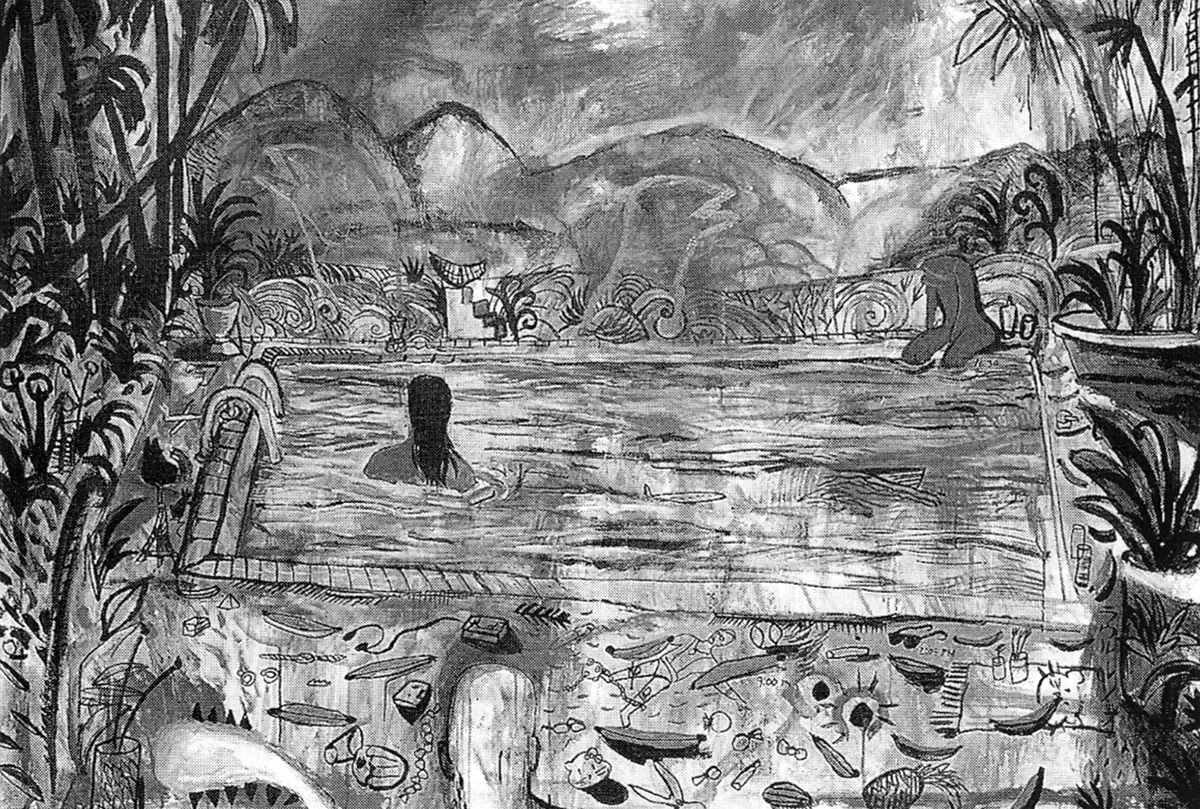
The reading of these tropical paradises featuring girls endowed with sharp pointed chests, flashy guys dripping in gold, and baby bananas everywhere, all set against a backdrop of palm trees and cordillera, goes well beyond any postmodern print.
One work, which in fact marks a break with the composition and atmosphere of the other pictures, provides a conceptual key. Three faceless figures, like some chilling and diabolical Trinity, armed with guns, drink and cigarettes, appear with consignments of drugs lined up in front of them. What might have been an inoffensive group portrait and an almost domestic memory has become a disturbing image, heavy with connotation. Like some kind of edifying altarpiece, it does not require further allusions for it to evoke danger and death. Pictures within the picture “signify” two essential references: a group of skyscrapers and a naked goddess-queen are both erotic emblems. These icons of the city and the woman are a constant in Recio’s work.
Drugs are usually linked to sexual exploitation. The artist, writing his own introduction in the catalog, refers to "sordid stories mingled in the pleasure pools and the violent reality in which we live, surprising us in the warm waters of these swimming pools. Although in most of the pictures the drug dealer poses" (for posterity?) in the middle of the canvas, the constellation of naked bathers suggests a harem more than a brothel.
Once again the conceptual element arises. The alluring girls are not always in this situation because of any vice or venality, at least “those who don’t think.” They have simply lost their heads, and Recio decapitates them literally. The humorist is thus reflected in the figures and signs of a work that is one of the most unusual and successful in the show. The silly woman has lost her head. The firm upright breasts form a mouth and the woman becomes a kind of fish. The metamorphosis is also a visual metaphor.
The archetypal fruits of the Caribbean are not absent. Baby bananas cover the ground in an obsessive manner, like leaves. Bananas are emblematic of life in the Antilles, a sign and symbol of the entire region, its economic crises included. This fruit, in graphic and compositional terms, does not play any organized role, except to provide another source of rhythm. The bananas are basically ludic elements, apart from their interpretation associations.
The pictures of Raúl Recio —I am referring to the more elaborate works, not the sketches or maps— propose an aesthetics, which we need to decipher beyond our first impressions. The artist has wanted to be an anti-intellectual painter, intuitive, close to popular art, and these facets are reflected in his pictorial repertoire.
But it would be a mistake to see Recio simply as a superficial artist in a hurry. Despite his emotive temperament, he knows how to observe, investigate, and deepen his language. He is a very conscious creator, even when he produces primary and unfinished images. This relaxed easiness is an expression of freedom, one of his essential characteristics.
Recio’s Pleasure Pools invites us to jump into the naughty waters and join the nymph-like creatures in this hot and vibrant tropical climate.
MARIANNE DE TOLENTINO