This exhibition entitled Un-Natural Sciences was presented at Ex Teresa Arte Actual in Mexico City between November 3, 1999, and January 30, 2000. The curator, Hugo Cervantes, explained that the selection of the artists and works was mainly determined by the possibility of the work being carried out in a specific place, knowledge of the space in which the final installation would be undertaken, and an awareness of the importance of the changes brought about by the place in the development of the work of art and on the spectator.
From time immemorial, mankind has endeavored to define the concepts of time and space. In different ideological and historical periods, various definitions have been proposed to help men and women develop in their environment. It was in the 1960s that a controversy arose concerning the terms to be debated: time became separated from the sense of space and the coordinates of both concepts were no longer intimately inter-related. They were now distributed independently in the postmodern environment. The information highway, the mass communication media, and the predominance of the image over the real event are some of the main causes for the split in the space/time dichotomy.
In the field of plastic arts, two expressions reflect the conspicuous separation of time and space: video art and installation art. The transformations which have occurred in the different spheres of our perception are due to the repercussions these factors have had at the present time, when we are guided by time and forget distances: the Internet is just one example of this. The Venezuelan theorist Celeste Olalquiaja has said that the present is characterized by considerable confusion and a great sense of fear because we cannot make a clear distinction between time and space as temporal continuity is transformed into a territorial extension, with the dimension of space being replaced by a continuous duplication.
In this exhibition, Cervantes began with two principles that would determine the overall direction of his curatorial vision: the desire to revise the support for the dissemination of history (of art, science, and the evolution of mankind) within museums; and secondly, the ways in which artists can modify static scenographies (which are precisely those that characterize museums) by intervening in these spaces. To give dynamism to the show, Cervantes worked together with the museographical and production team at the Ex Teresa to ensure that the works were presented in a darkened environment, with the pieces lit individually. Comfortable armchairs were provided to allow the spectators to look at the exhibits carefully, in particular the videos. Cervantes explained that the access to the museum (formerly a church) enabled the spectator to experience a kind of ritual since the chaos of the traffic outside and the enormous number of people moving through the historic center of the federal district contrasted dramatically with the silence and soft lighting of the enclosure. For the curator, antis a kind of unnatural science, and this exhibition was an attempt to show how new proposals can offer new interpretations of life.
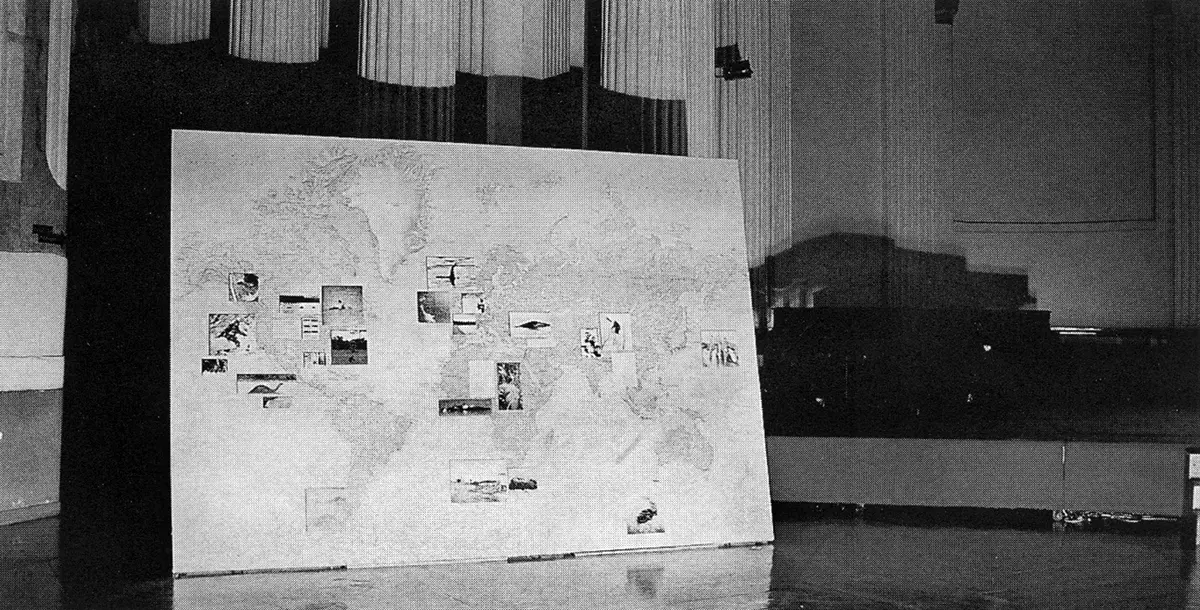
Ismael Merla (Monterrey, 1 976) presented a video recorded near Monterrey that dealt with a monster wrapped in clothes made of garbage and recalled the sculptures of plastic waste material by the artist presented in different urban settings. Along the same lines, José Dávila (Guadalajara, 1974) produced a map showing legendary monsters, where the imagery and information were based on electronic means, which on the one hand diminished their feasibility but on the other enhanced their credibility. These monsters are the product of myth and oral tradition, but at present their existence can be constructed by means of retouched images, photomontages, or the construction of characters by digital processes. Laureana Toledo (Mexico City, 1970) investigated the behavior of a bird with a serrated beak known as the constructor of scenarios. In an attempt to attract and mate with the female, the bird collects together objects of the same color and puts them in the same place. Depending on the bird’s location, it collects organic, plastic, or industrial objects. In this way, the artist made a collection of red objects from around the museum. The Chapel of Souls was used as a setting, but she allowed the production staff to give the final touches to the position of the objects so that the intervention would also have a collaborative element.
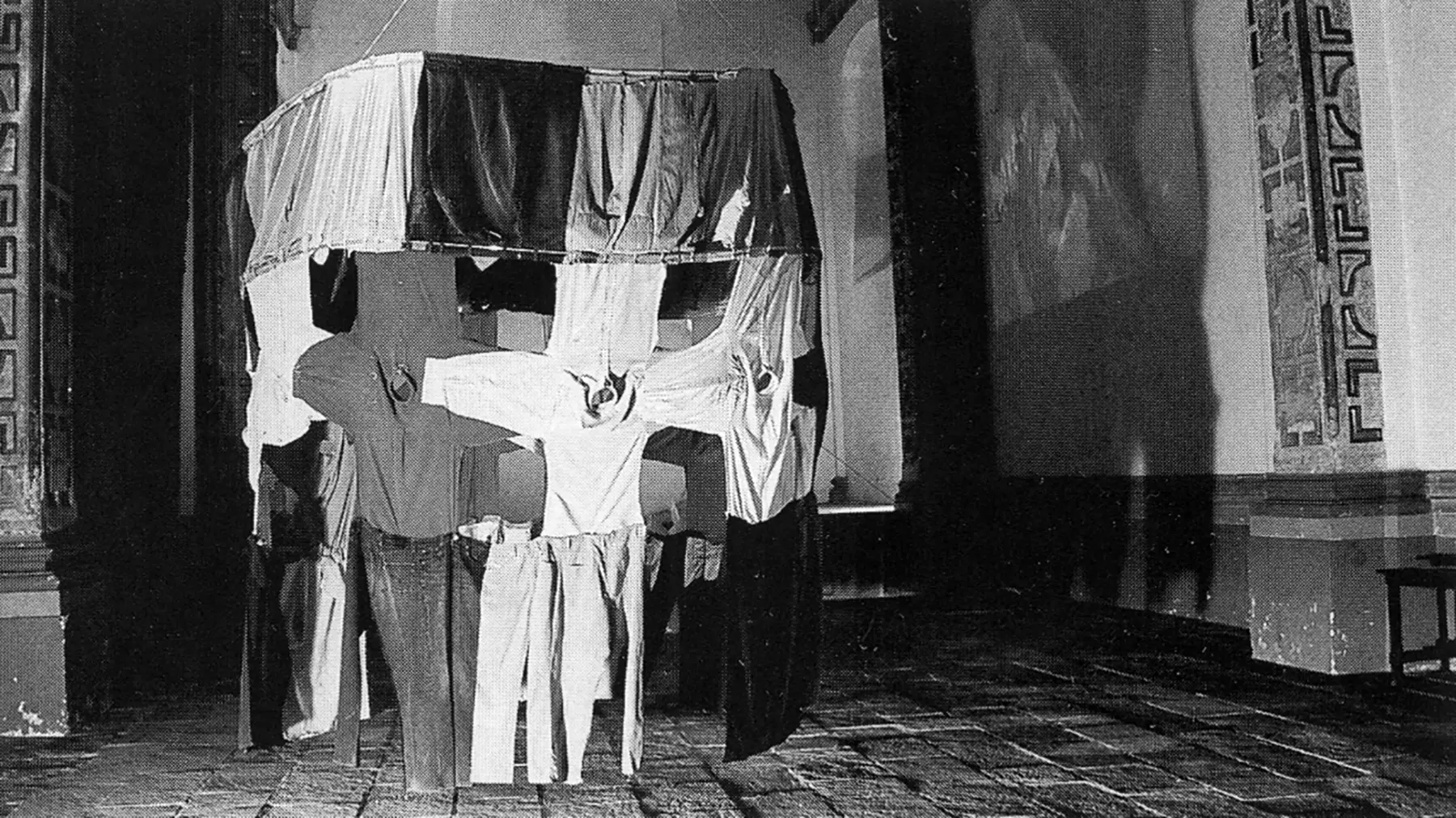
In another installation, Javier Dueñas (Guadalajara, 1974) constructed a space made up of the clothing of various persons close to him. The artist sees clothing as a kind of second skin and architecture as a third. Thus, the spectator penetrated into the space filled with clothes sewn together, all of which tell different stories and have a specific emotional content. In another piece, the artist presented girls’ shoes cut in half and joined together with stitching, creating something to be worn by a mutant and mounted on a pedestal.
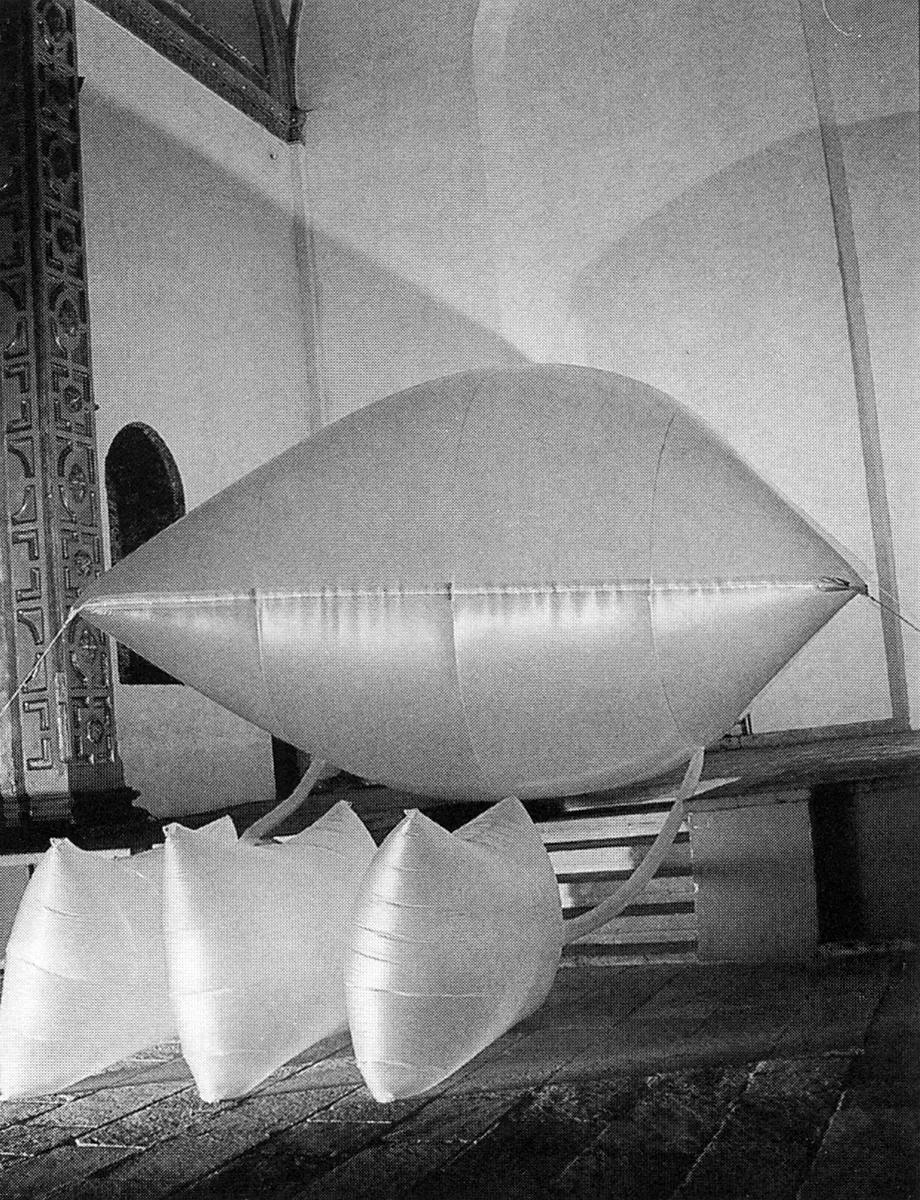
Mirna Manrique (Mexico City, 1972) created an urban /ung consisting of an enormous transparent plastic bag, which was filled with air by means of a ventilator and the help of three smaller “lungs.” After a few days, the color of the lung had changed from white to grey, revealing the presence of impurities in the air and the transformation process visible over a relatively short period of time.
Juan Manuel Romero (Mexico City, 1960) presented a video relating the linear story of a journey he took in the Amazon and the archeological site of Machu Picchu. It is the story of a journey made on foot or in a raft through natural scenery and reveals the events of everyday life encountered on the way. The video was shown on two monitors: one in color with a superimposed transference reading ON, while the black and white screen showed the word OFF. Next to the two screens, an aquarium with piranhas displayed the words “The lightning flash which floors you the lightning flash which lifts you up” on the glass surface. This was in reference to a personal experience of the artist after chewing some coca leaves, when he entered a deep process of self-reflection filled with insights and flashbacks. Rubén Gutiérrez also used video to project scenes of his everyday life combined with digital photos of the display cases of the Chapultepec Museum of Natural History.
Finally, Luis Napoleón C. Habeica constructed a cube with photographs hanging inside of different exhibition spaces, in this case from the Museum of Contemporary Art of Monterrey, creating a floating space in which the spectator had the sensation of being in a place within another, and which in turn is inside another.
LUZ MARÍA SEPÚLVEDA