
The work of Vik Muniz was recently presented for the first time in Paris in three exhibitions, including a mini-retrospective at the National Photography Center. In this way, the Brazilian artist confirmed his growing success in Europe, which began in the FIAC, where his work was shown at various specialized galleries. In addition to the unanimous praise lavished by the French press, a bilingual catalog (French/English) was published to mark his triple Parisian showing. The opportunity which the artist had to present simultaneously different facets of his art in various parts of the French capital, allowed visitors to discover the playful, poetic, and aesthetic ways in which this Brazilian photographer works. Born in São Paulo in 1961, Vik Muniz is from a generation of Latin American artists (including José Bedia, Julio Galán, and Guillermo Kuitca) whose precocious careers found fertile ground in the United States before they became known in Europe. It is clear that Paris no longer plays the catalyzing role for Latin American artists that it did up until the 1970s. The few very good artists from the new generation who live in Paris have great difficulty making themselves known outside France or their countries of origin.
Muniz’s three Parisian exhibitions (Xippas Gallery, November 29, 1999 - January 15, 2000, the Deposit Bank (November 19, 1999 - December 23, 1999, and the National Photography Center (November 17, 1999 - January 10, 2000) probably suggest, mutatis mutandis, a change in the situation with regard to France, but they also confirm that consecration still requires passage through New York.
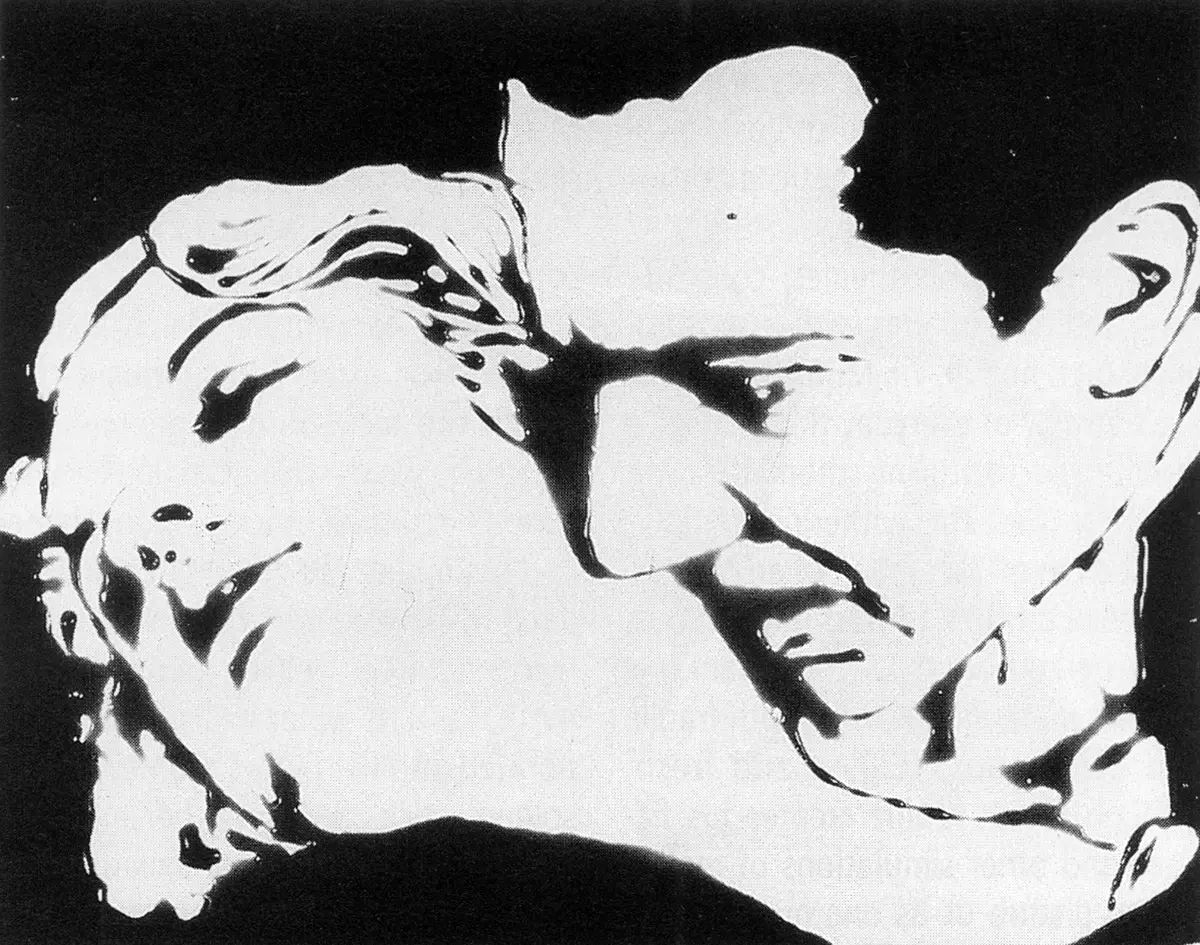
It was at the National Photography Center that Muniz’s work was shown in its greatest variety, with photographs dating from 1993 to 1999. The show occupied four rooms and ran concurrently with an exhibition by the Australian photographer and filmmaker Tracey Moffatt. The Xippas Gallery selected the “gustatory” works by Muniz (works done with culinary ingredients), while the Deposit Bank presented a series of photographs on the theme of artificial flowers, entitled Flora industrialis. The gentle and humorous manner in which the artist questions both everyday elements and time gives his work a dimension that contrasts the real with the imaginary, the true with the false, what is palpable with what is fleeting, and what is destructible with what is immutable. The artist manages to cast doubt on our own certainties and to destroy the limits of our rationality. Muniz the sculptor, painter, and finally, the photographer, works on the images of our memory and proceeds like an artisan, giving preference to the preliminary gesture to fix, in total jubilation, that which is transient. He constructs a universe, that is nurtured, both conceptually and aesthetically, by advertising, magazines, film, and television. By using images that are emblematic or symbolic of our collective memory, his work as an artist is inseparable from his visual discourse. The images are sometimes taken from films (Marilyn Monroe or Marion Brandon), politics (Mao Tse Tung), music (Elvis Presley), or the media (Jackie Kennedy). They may also come from the history of art (Caravaggio’s La medusa marinara, Delacroix’s Raft of the Medusa or Caspar David Friedrich’s A Walk on the Sea of Ashes), or very well-known portraits like those of Jackson Pollock and Yves Klein. The gesture establishes and inscribes the image. On the frontier of the “eat-art” of the 1 960s and the new French realism of the same period, and flirting with Andy Warhol’s style, Muniz’s specialty is to convert photography into the means for another medium, one which is edible and perishable, subject to decomposition. His “pictures” can be eaten and after being photographed thrown away- although they are far from the extreme proposals (photographs of urine or sperm) so often served up recently by Gilbert and George or Andrés Serrano. The material is always perishable: chocolate (Raft of the Medusa, 1999); marmalade (Mona Lisa, 1999), ketchup (Jackie al ketchup); and various kinds of peppers and spices (Marilyn); nails, earth, waste materials, wire, thread, fabric, and paper for the photographed flowers. Brazilian anthropophagy reworked and corrected by Muniz is domesticated into a process of gustatory alchemy that is above all a game of mirrors and mirages.
In this artisanal work in which time is a decisive factor and where the act of destruction remains secret and intimate, Muniz tries to capture a pictorial quality while at the same to fixing, in a two-fold manner, the ephemeral. The artist’s interest in the matter is essential, whether reflected in images of taste (Xippas Gallery), nostalgia (the flowers on paper or fabric in the Deposit Bank), or the series with nails or threads (National Photography Center). Reworked to allow its absorption, destruction, or transgression, the matter is always the basis (the essential support) of his preliminary work and the vehicle for the physical dimension of the object image. In the National Photography Center, the cushions “drawn” with nails in the series Durer’s Pillows (1999) and Pictures of Wire (1993-1997) are first and foremost objects of his affection”. They are like signs of the everyday world, fleeting and changing, modifiable and exchangeable. Muniz reworks universal themes (Vanity) or themes related to the earth and life (snakes, an hourglass). For the series Pictures of Thread (1995), he always selected emblematic landscapes or scenes that could be identified with historical paintings (Monet, Corot, Ruisdaël), which he reworked into a kind of negative vision based on a schematized image, of which he retains only the essential elements. The thread is taut, tangled and mixed, separated and woven into knots. The photographs of children from the slums (Aftermath, 1998) and those making up Sugar Children (1996) cast a tender gaze at Brazil he left when he settled in New York, which nevertheless is still very present for him. The evocation of childhood involves a kind of beatification of the image depicted as an apparition, set within an unreal reality. This very “matter-based” series (photographs with backgrounds of waste material and detritus) reveals a true affection for his themes, and very real attitudes the interest of which lies simultaneously in their aesthetic qualities and their symbolic force.
By endowing his themes, constructions, and final images with a sense of poetry and humor, Vik Muniz is a sensitive narrator of everyday things, with a finesse for capturing them through small touches. The withering of flowers, seen as a “facsimile” of an old herbarium of artificial flowers (magnificent silver gelatin prints, Deposit Bank), is another metaphor of time, both fragile and voluptuous, refined and fresh, through which Muniz creates his fiction and other simulations of reality. Not to disturb us-as one might think but to let us marvel.
CHRISTINE FRÉROT