
The retrospective exhibition presented hy the Museum of Modern Art of Bogota (MAM) in the final days of last year, entitled Salas: Active Painting, offered a close view of the development of work which has been strongly characterized by its reflection on painting itself. As was pointed out by Carmen María Jaramillo, the curator of Through the Mirror (MAM, March-May 1998), an exhibition that proposed one of the most perceptive readings of Colombian painting at the end of the last century, the work of Carlos Salas (1957), along with that of Danilo Dueñas (1956), María Elvira Escallón, Jaime Iregui (1956), Víctor Laignelet (1955), Luis Luna (1958), Rafael Ortiz (1960), Nadín Ospina (1960), Luis Fernando Roldán (1955) and María Fernanda Zuluaga (1969), provides a place in which painting looks at itself.
According to Álvaro Medina, the curator of this show, Salas’ work, which from the beginning was linked to abstraction, abandoned the traditional canons of easel painting from 1993 onwards: ".... the painter finally achieved work which is materially fragmented, transformed into a profuse unfolding of rectangular shapes of various proportions and sizes, cut and taken out of the canvas, and with the canvas perforated to reveal the wall. Rectangles of the same size taken from earlier paintings are mounted on small stretchers and around what, by way of explanation, we might call the nuclear painting or the larger stretcher of the complex and fragmented whole." In this way, Salas’ painting has been constantly re-exploring and re-making itself. Salas takes what he has already painted and transmutes it into a new work that redefines the limit of the earlier piece and calls attention to its absence. His work therefore establishes a dialogue with many of the concerns of contemporary art.
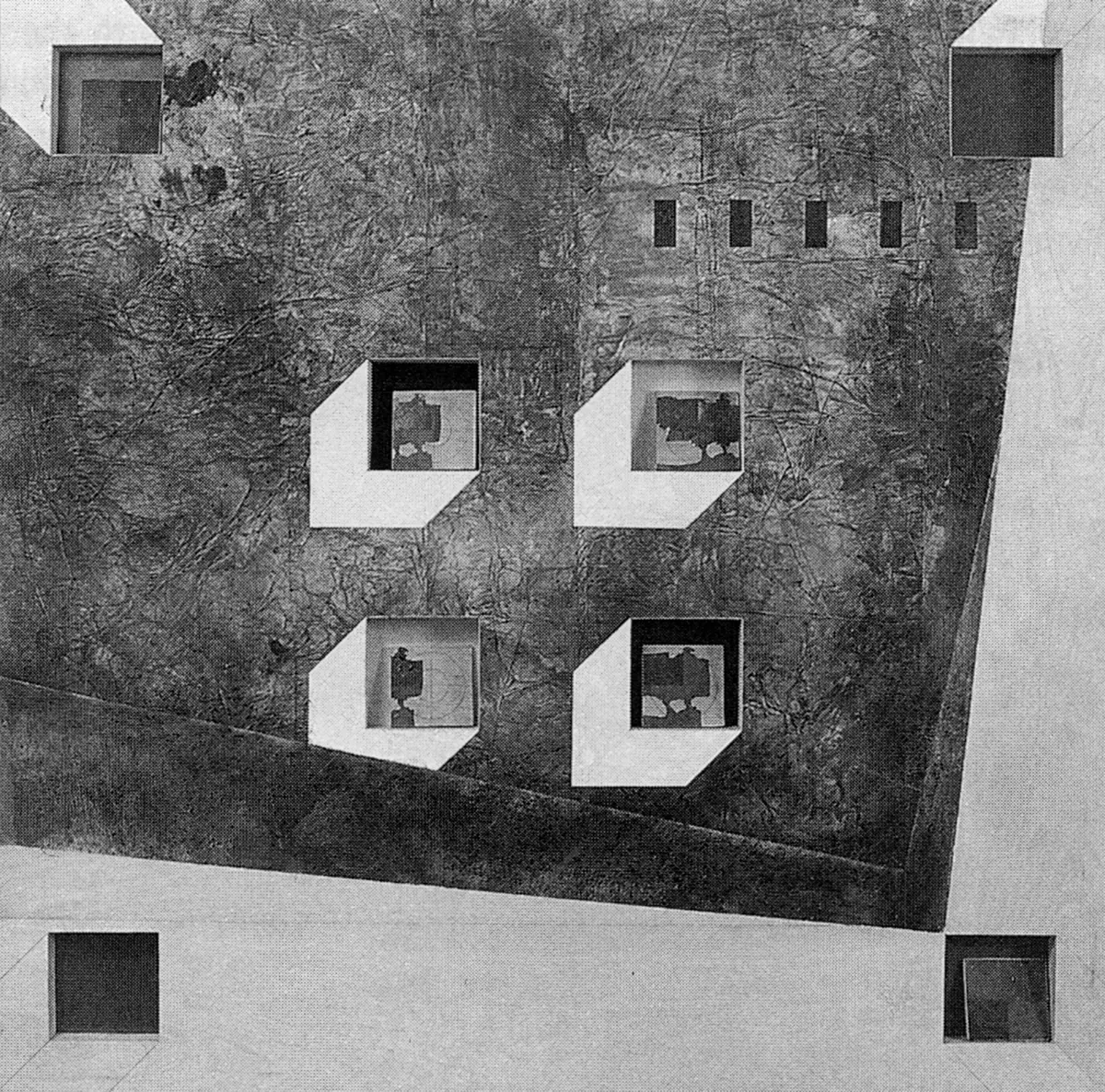
The creative process, the limit and instability of the work of art, and the fragment, amongst other things, are problematic matters, which shape the direction of his work.
Painting as a source of an unstable thought which man produces through his imagination, is one of the ideas, which Salas has been developing. Indeed, he himself has said: “The modes of thought engendered by painting are at the same time reading and an object for reading. Thus they are the least likely to be imposed." These modes of thought allow man, through his feelings, to create exclusively human worlds. Rejecting the idea that his work may be defined in terms of a recycling process, Medina argues that Salas transmutes his images by painting, cutting, and re-cutting them, in a process devoid of any premeditation.
The instability of painting has been another concern in his poetics. In this respect, Salas has said: "The strength of what is unstable is accumulated through the saturation of the painting. If it were only objective, the painting would have become exhausted and would have already achieved its plenum. Despite this saturation, we can breathe in it. It saturates life and becomes invisible. It occupies a place at the interstices of reason, intermingling with the objective world without losing its own capacity." His work, as has been pointed out, does not shun the destruction of a picture if this will lead to the creation of a new image.
The fragment is the raw material of Salas’ work. When he cuts the original image, the Colombian painter not only breaks the whole but fragments the visual perception of the painting, calling attention to the detail and introducing time and space where the perception of the work occurs.
By playing with itself Salas’ painting reflects on the conditions of its own possibility. Moving very close to what Umberto Eco has called an “open work”, and undermining the very role of “author”, Salas opens up his work to participation by the spectator, who is offered a pictorial structure that can be co-created. Beyond the rigidly limited canvas, Salas’ painting invites the spectator to enjoy the creative act.
WILLIAM LÓPEZ