
Ilse Gradwohl (Gleisdorf, Austria, 1943) is an artist whose personal and intimate work is very distant from the noisy currents of recent Mexican art. Her pictures are not representational and are above all directed toward the sensation and relevance of painting as a process whose results are defined by two elements: the determination of the artist and the reading and re-elaboration by the spectator.
For this exhibition entitled The House of Time, Gradwohl presented fifteen works at the Continuous Education Center which made up a kind of traveler’s journal: a reaffirmation that otherness and difference humanize and transform us despite the fact that the turn of the century period in which we are living is characterized by frequent bursts of intolerance and the aggressive re-assertion of individual identity. With these photographs and paintings inspired by a visit to Ethiopia, the artist places her bets on a journey as something which is often ontological, an experience that places us at the limits of our vision of the world and a journey into the next: a different vision that both surprises and questions us.
Travel has been reduced in the modern world of mass societies, globalization, and homogenization to a source of induced and trivial entertainment. The hordes of tourists who dirty the beaches, destroying or trivializing temples and places considered sacred in times gone by, are perhaps expressions of the “desertification” of the world that Heidegger once lamented. In this sense, it would seem that one of the artist’s intentions is to restore the idea of travel as an encounter with others and through them, with oneself. It is the journey, the adventure that allows us to know ourselves and to reach our inner selves. Literature, more than painting, is rich in examples of this kind of journey. A voyage of initiation as an experience that suddenly changes our view of the world and things, which sometimes does not involve an actual displacement but can occur within a closed space. There is perhaps no difference in the end between the world and our room.
As in the case of many artists who like to travel and without denying the importance of the experience and sense of epiphany that this trip had for her there is in this work a fascination with the exotic, a feature that continues to be shared by many contemporary artists and which has been a part of the Western mentality since the Romantic period. It can be defined as a kind of escape from Western rationality, either as a means of criticizing through comparison with a culture that has not been contaminated by reason and progress, a wild culture in the sense that Rousseau used the term, or as a nostalgic lament for the lost childhood of mankind. Ilse’s journey to Ethiopia and her contact with the hybrid and complex cultural characteristics of all cultures in the final analysis became an experience of initiation or spiritual reaffirmation that was already present in her last exhibition, Mnesis at the Museum of Modern Art in 1996. Since then, her paintings have been emphasizing the void and silence as limits of experience; the encounter with the ineffable, with something that transcends words because it cannot be expressed with words. Silence was used as an aesthetic resource, as poetry had already been done with white colors in jeu de dés, one of the foundational poems of cultural modernity which is not unrelated to the suprematist experience and in general a good deal of abstract art.
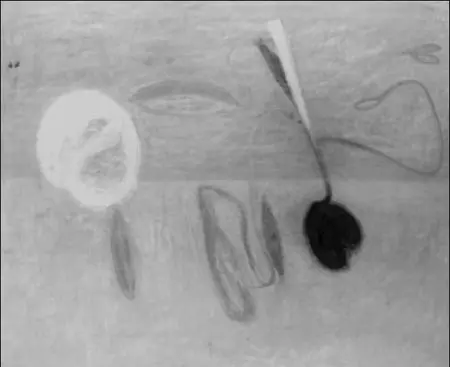
A taste for neutral tones, glazes, a minimal amount of compositional elements, and the succession of days of work with their variations and ups and downs all help generate surfaces which are rich in atmospheres where there is an interplay of lightness and heaviness. The artist’s work seems to have reached a difficult conclusion, the product of a patient and laborious process involving the placing of new layers of paint until the exact point has been reached, a precise sensation achieved, which indicates that the work has reached its end and that it is time to begin the intricate process of another task.
The paintings have hidden and nebulous strokes which lose themselves in the multiple brown tones. Without any shadows or contrasts, lines appear which are diffused over a successive of planes. These monochrome works astonish us because they encourage contemplation: spaces of light that conjure up the idea of a new journey, perhaps as revealing as that experienced by the artist herself.
ERNESTO SOSA