
The political events now taking place in Venezuela in one way or another lead us to reflect on the political history of the country. This is, in the final analysis, the history of our democracy and institutions, including the various perspectives from which they have been looked at.
The recent work of Juan José Olavarría at the Sala Mendoza is based on specific events from our history that have either played a transcendental role in subsequent events or given rise to certain doubts that call into question the integrity of many of our governors from the constitutional era.
Olavarría takes as his starting point the democratic period ushered in by Rómulo Betancourt, following the fall of the dictatorship of Marcos Pérez Jiménez in 1958. Despite his electoral victory, and between uprisings and violence, Betancourt tried to give legitimacy to a new democratic system through the drafting of a new constitution (which was recently scrapped) and the consolidation of the Punto Fijo Pact, in which the three main legal parties active at the time, the AD, COPE I and the URD, reached an agreement to share the task of government. Between 1961 and 1999 all government activities were carried out within this legal framework.
But this did not imply any permanent stability. The early years of democracy were marred by violence and uprisings. Subsequently, when the country was pacified under the alternating mandate of the AD and COPEI, rampant corruption left a deep mark on the country and gradually led to the serious political, economic, social, and institutional crises that resulted in the political changes now underway.
In the face of this historical past, the work of the contemporary artist Juan José Olavarría acquires a significant and referential dimension. He does not propose the easy, official history, but explores its sensitive, ironic, and lacerating side, revealing between the lines that history is made according to the views and interests of those who tell it. He does not reconstruct the process of the events, but reinterprets key icons generally taken from press photographs of the time-specific “historical tensions” which, as Carmen Hernández points out in the excellent catalog of the show, reflect the “visible signs of a collective identity trying to reconstruct itself.”
Thus there is the leitmotif of the wounded soldier, clinging to the priest’s cassock, a photograph, which was shown around the world and won the Pulitzer Prize. The event occurred during the bitter clash known as the “Porteñazo” in Puerto Cabello, in the state of Carabobo. During this uprising in 1962, civilians and the military waged battle against the government forces, in a battle which left 400 dead and more than 700 wounded. Olavarría reproduces the image eleven times in three-dimensional format, in varying sizes and different artistic interpretations. This set of work, collectively entitled The Drain, also refers to the name of a butcher’s shop in the center of the city, where the government attack began. The artist uses details from this setting in various two-dimensional works, including The Water Bottle and The Drain.
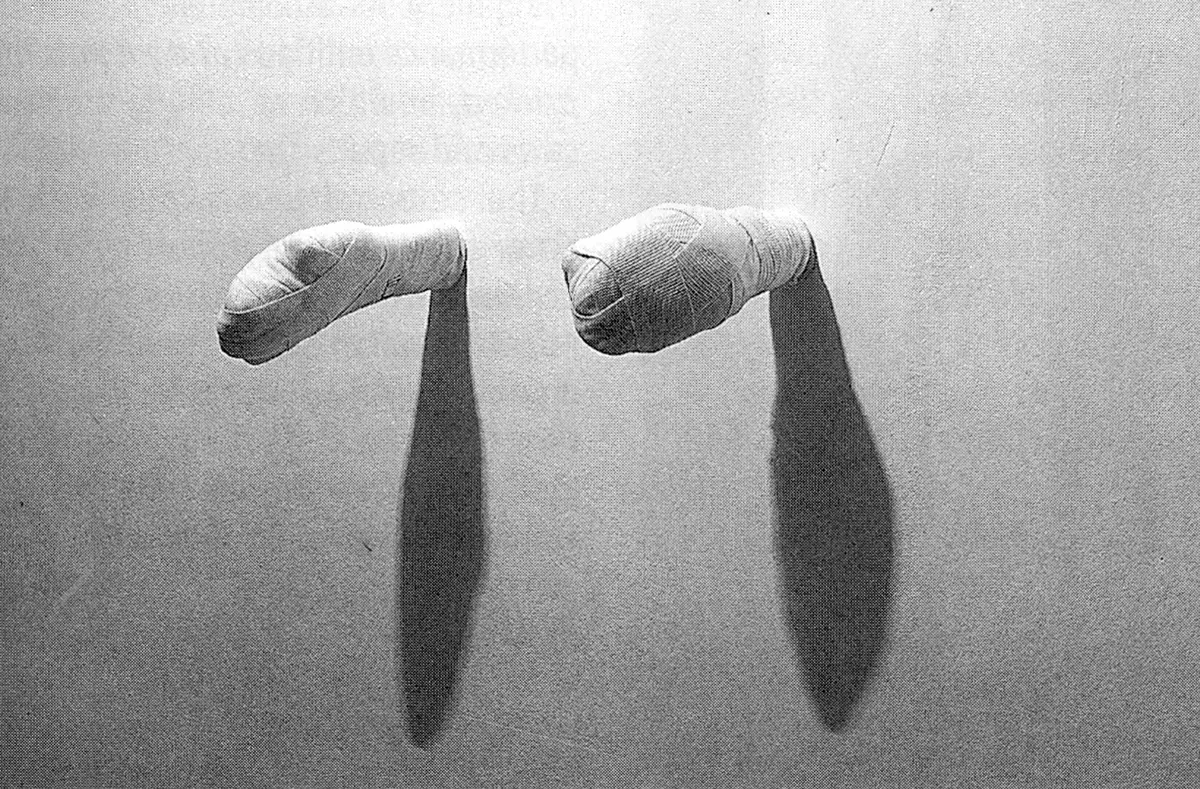
The figure of Rómulo Betancourt ended up by being an emblem of the 1960s. His bandaged hands (as a result of an attack suffered in Los Proceres) turned fact into a historical irony, since only days before the President mentioned the burning of his hands if ever he should succumb to corruption. This image formed the axis of the show, beginning with the title Let My Hands Be Burned, and the presentation of a symbolic installation with plaster and greased bandages placed against a white wall in the gallery. As a complement was a performance entitled Let My Hands Be Pricked, in which an elderly woman sews and repairs flags.
The selected events reveal, as Hernández points out, the authoritarianism of the State under the cover of political alliances. There remains the mystery surrounding the assassination of Professor Alberto Lovera in 1965 (The Bitter Draught; the performance entitled Notes on political sacrifice) and the uncertain destiny of El Helicoide, a construction initiated during the Pérez Jiménez period, which posed a challenge to contemporary world architecture. Without being finished, and abandoned to its own fate, the building became the pretext for more than 20 projects never carried out and the source of a major corruption scam in the 1980s when attempts were made to make it into a cultural center (The Tower of Babel).
In these discolored pieces of canvas, some subtly treated with earth, coffee, myrrh, and French bean ink, others merely raw canvas, embroidered or unraveling we can recognize images that in one way or another characterize us as a nation: the flag and the rain-tree (Samán de Güere). The flag series retains the same structure, with its three edges and seven stars. The absence of color and the drawing of the unraveling fabric refer to the patriotic emblem, now deteriorated or acting as a shroud. The Samán de Güere, on the other hand, a tree of enormous size, was a sacred tree under whose shadows the Venezuelan indigenous peoples celebrated their rituals. Today it is an emblematic image of the state of Aragua. Works such as El Samán de Güere and The Tower of Babel illustrate the quality of Olavarría’s drawing skills, with clean, well-defined strokes that reflect a deep understanding of the depiction of space. Without using conventional pictorial means, the artist employs techniques, such as embroidery and unstinting, which transcend the mere concern of painting as a theme in itself. However, the historical and social awareness of this work does not displace its artistic richness: the virtue of his proposal lies precisely in the equilibrium achieved through the freedom and variety of resources characteristic of contemporary art.
Juan José Olavarría is a member of the Provisional group of alternative artists who have used their actions to question the logic of the Venezuelan cultural system. Within this line, Olivarria confronts the effectiveness of communication codes through images and calls into question the veracity of historical events, to reveal that truth and lies are, at the end of the day, only relative realities.
SUSANA BENKO