In October and November 1999, the House of Art in the city of Malakoff presented the work of the Argentinean artist Marcela Gómez. This institution devoted to the promotion of contemporary art reflects the policy of decentralizing cultural institutions in France. Established in a former neo-classical palace constructed in 1834, the House of Art has a large exhibition area, both in the building and in its garden. Marcela Gómez’s work filled the entire space, with the artist creating through her installations a world of matter, sound, and light.
Gómez’s conceptual search has led her towards exploring the duality between the formalism of geometry of structures that she herself makes with various materials, such as iron, rubber, and resin, and the fragility of the balance of nature, reflected in such elements as trees, leaves, humus, grass, earth, insects, water or feathers incorporated into her pieces. Gómez places, solders, sticks, and sews her elements together, in a process of experimentation in which she learns by doing, with the serenity provided by her knowledge of universal proportions evident in her graphic work. She identifies with some of her predecessors, with her work recalling that of Richard Deacon, Tony Cragg, and Arte Povera, as well as her Latin American precursors, such as the Venezuelan sculptor Asdrubal Colmenarez, with whom she worked at the University of Paris VIII, and kinetic art.
Her installations provide an opportunity for reflection, and exploring a material, concrete, and formal world in poetic terms. Her work is based on the dynamic of opposites: technique/nature, permanence/fragility, rational/sensitive. Gómez sees the relationship between space and matter not as a struggle, but as a dialectical harmony, and she accepts the need to constantly think through these contrasts and balance the impossible. Her sculpture suggests forms in response to the new aesthetic criteria at the end of the century. The co-existence of organic and inert elements reflects her observance of a world undergoing change in which, in praising the creations of man and the materials forged by his talents, she utters a cry in defense of the life instinct and the spiritual element in nature. In the piece entitled Projection, an iron parallelepiped on the ceiling projects its lines through taught rubber cords which descend and terminate in its double, thus giving life to a three-dimensional space which is turn prolonged towards the floor to create, along with similar repeated structures, a geometrical forest inviting the spectator to enter.
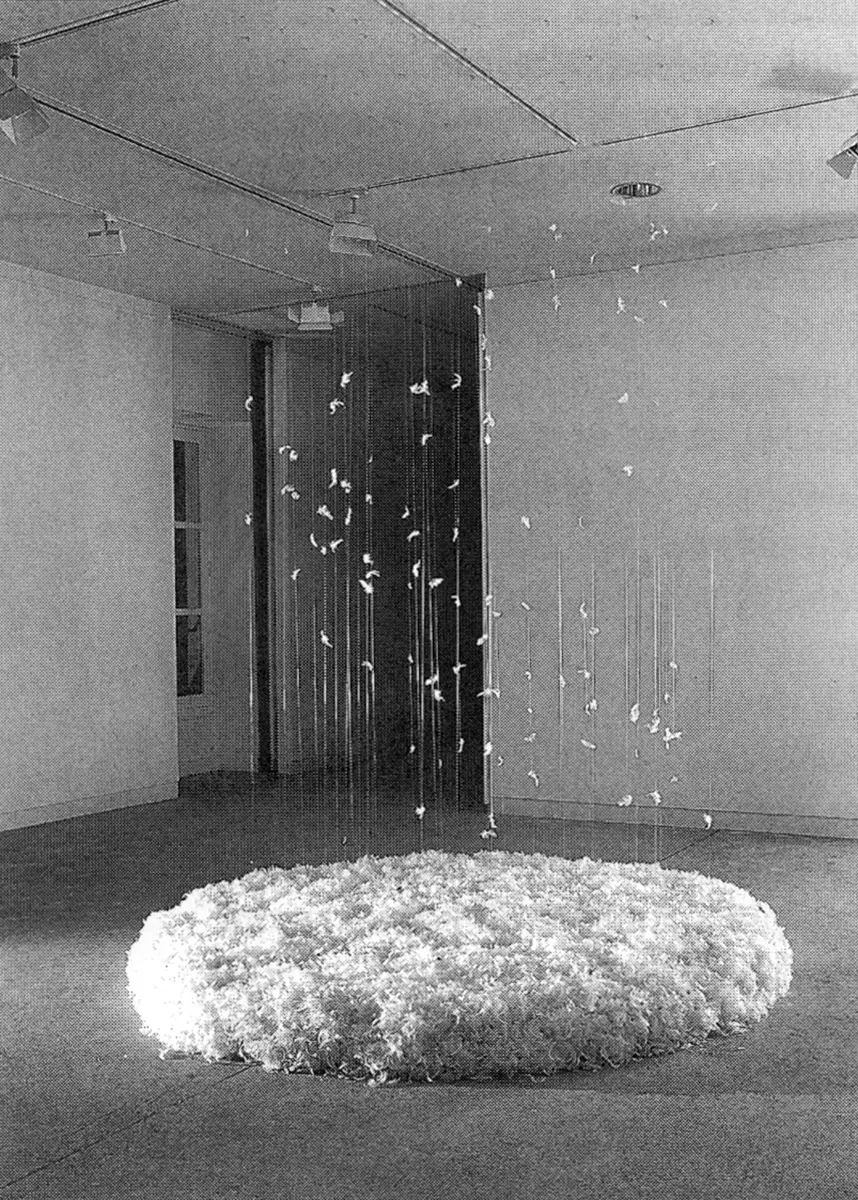
The same sensation of ubiquity is present in Corpus, a concretion of goose feathers forming an enormous and soft pastille lying on the floor, supported by nylon threads that join it to the ceiling as if it has just been taken down. As the spectator approaches, the sound of the wind alternates with the beating of a heart. The eternal dream of sleeping on a cloud becomes a visual reality.
Marcela Gómez explores the mystery of the nature of the materials she uses. In the totems made of superimposed resin cubes, enclosing branches of trees placed upside down, she breaks the visual rigidity with the translucent resin, thus creating a need to make guesses about the playful and familiar structure of the tree inside, but presented upside down.
TATIANA VILLEGAS ZAMORA