In a darkened, not very large square room, Maria Magdalena Campos-Pons laid out her installation entitled Meanwhile the girls were playing. Born in Cuba and exiled in the United States since 1990, the artist created three different lit areas in this show: two volumes with a circular perimeter, looking like islands and for that reason placed on the floor, and a frontal, flat large format piece: a screen for the projection of the video which repeatedly shows girls playing and birds flying. On the floor, the two pieces express the contemporary rituality characteristic of this artist, here physically resolved with fabrics, light, visual and sound projection, and pieces of molded glass, with oeil-de-boeuf in páte de verre. The fabrics are used like covers, skirts, and aprons. The repetition of situations in both small altars, with their colored glass recalling flowers and evoking localized characteristics of Central America, refers in various ways to the interweaving and fragmentation of contradictory autobiographical experiences, thereby accentuating the overall dynamism of the show with its repeated and linking videos. Repeated too were the expressions of everyday experiences and matriarchal life: for example, the presence of cotton cloth and embroidery refers to women and their necessary everyday work which is undervalued or not valued at all.
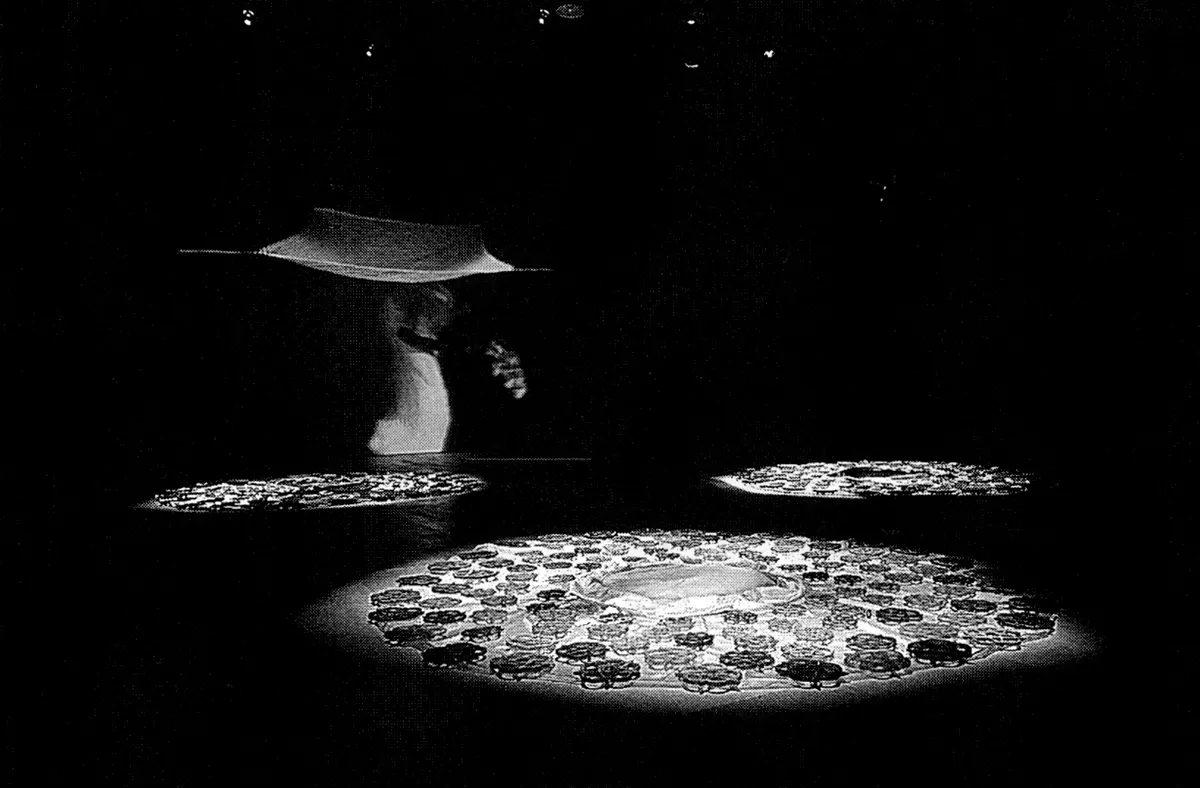
In this exhibition of great softness and visual beauty, Cam pos-Pons does not attack but rather floods the senses with an imperceptibly rising tide of emotions. The installation in no way refers exclusively to water, but water is present in the musicality of the lullabies (such as those accompanying the artist in her cradle at birth), in the white foam of the rags and lights, in the sensation conjured up of some nocturnal sea on a dark night (the darkened room and the white edges of the waves). It also evokes the air, flight, and the movement and fragility of human beings in the contemporary world. Through the lyricism of certain images, it might also seem to recall Death in Venice. In the same way, climate and temperature were undeniable agents in this exhibition. The private temperature of the autobiography and the geographical climate of the island dwellers contrast with the coldness of the glass of the two video screens which we imagine on the floor and with the colored invented amulets in processed glass.
The artist manages to keep the spectator moving around. The composition of the installation invites us to draw closer to the two islands, to go around them without losing contact with the large screen on which the video is projected, and the modules of which reiterate the connection between pairs of contrasting segments of life. In the video, the formal fragments deal with memory and forgetting, the fading of memory, physical and psychical closeness and distance, innocence and its loss, the lightness and strength of femininity, the kind of life that the artist remembers she had in Cuba and the life she now has in Boston-irrespective of the difference in age- and, at the formal content level, the persistent interaction of liquid and solid elements. This “Maria Magdalena” is not the penitent figure of the religious imagery of the history of European art. Instead of carrying a glass flask to fill with her tears of individual repentance, this “Mary Magdalene” has designed fanciful forms in glass that act as a visual metaphor, depicting mothers, wives, daughters, sisters, and lovers weeping for those who have been tortured and deprived of their individual freedoms. The artist’s ancestors were taken from Nigeria to Cuba as slaves in the nineteenth century, to work on a plantation where she was subsequently born and raised. The installation is clearly and delicately Latin American. By way of conclusion, it is worth recalling the remarks of Darcy Riberio, in her book Los Brasileños (Mexico, Siglo XXI Editores, p.65). There are various kinds of Latin American peoples: testimonial peoples (made up of the modern representatives of ancient civilizations); new peoples (a mixture of very different indigenous stock with Europeans), and transplanted peoples (moved in large numbers to other geographical regions and a large percentage of whom have maintained their original culture). By means of metaphor, poetic reason encompasses a nucleus of essential activity that provides man with the possibility of knowing and describing himself.
GRACIELA KARTOFEL