
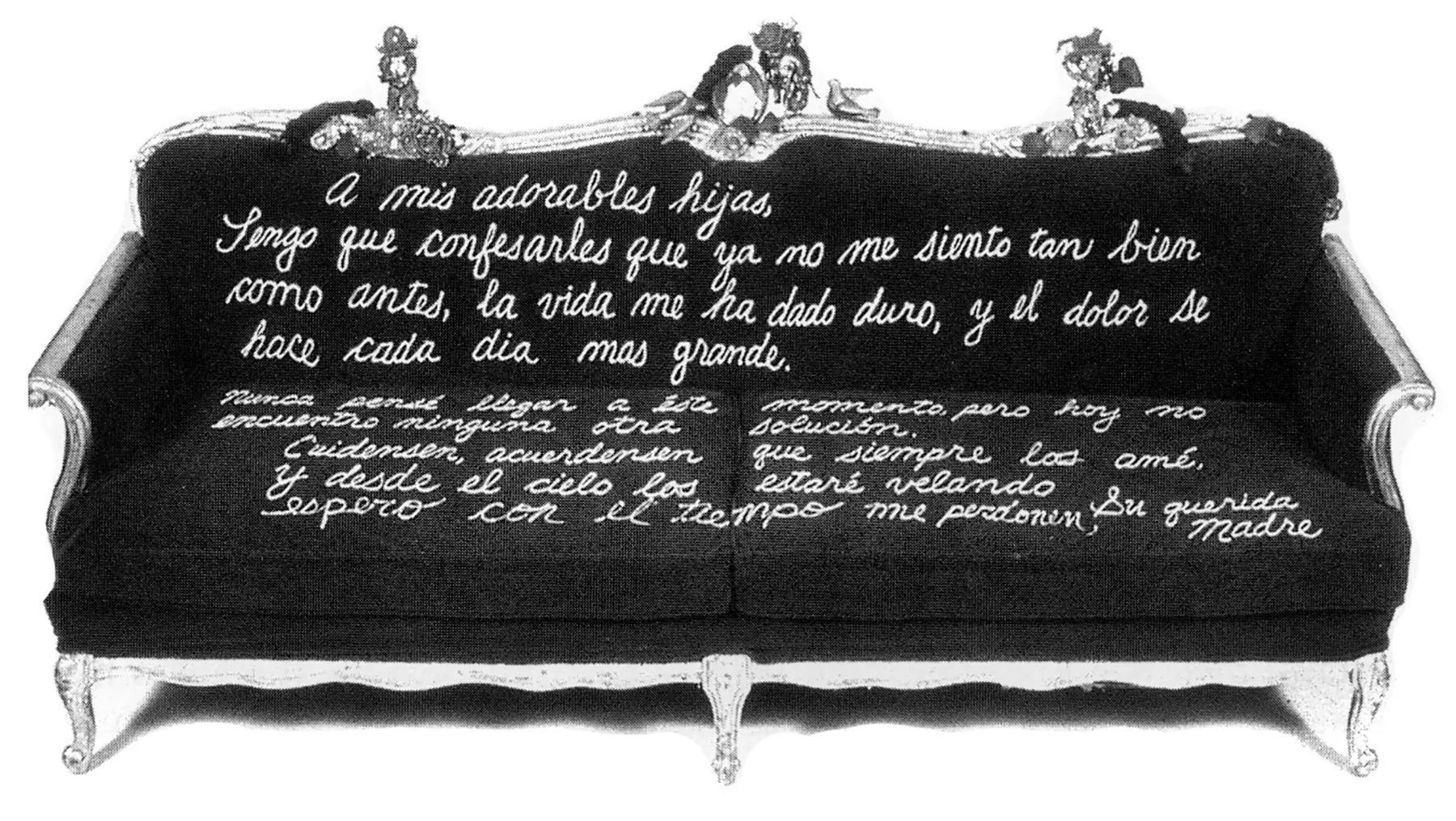
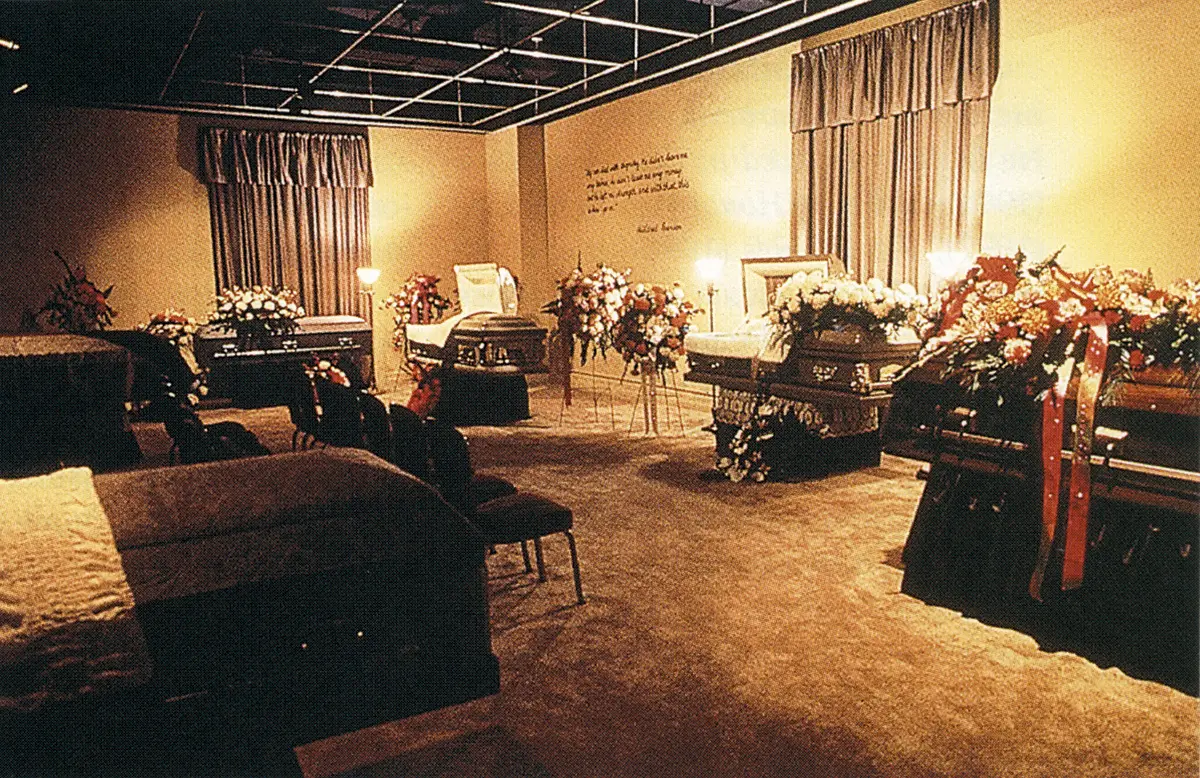
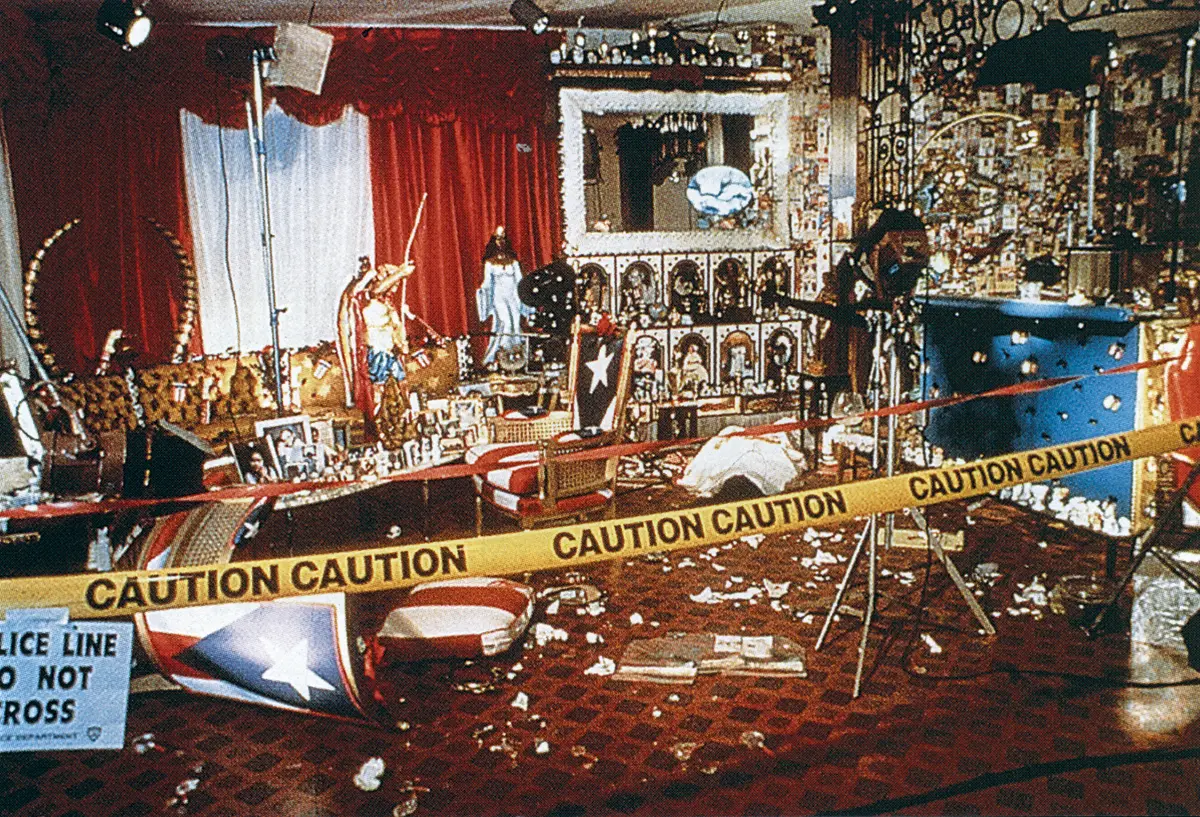
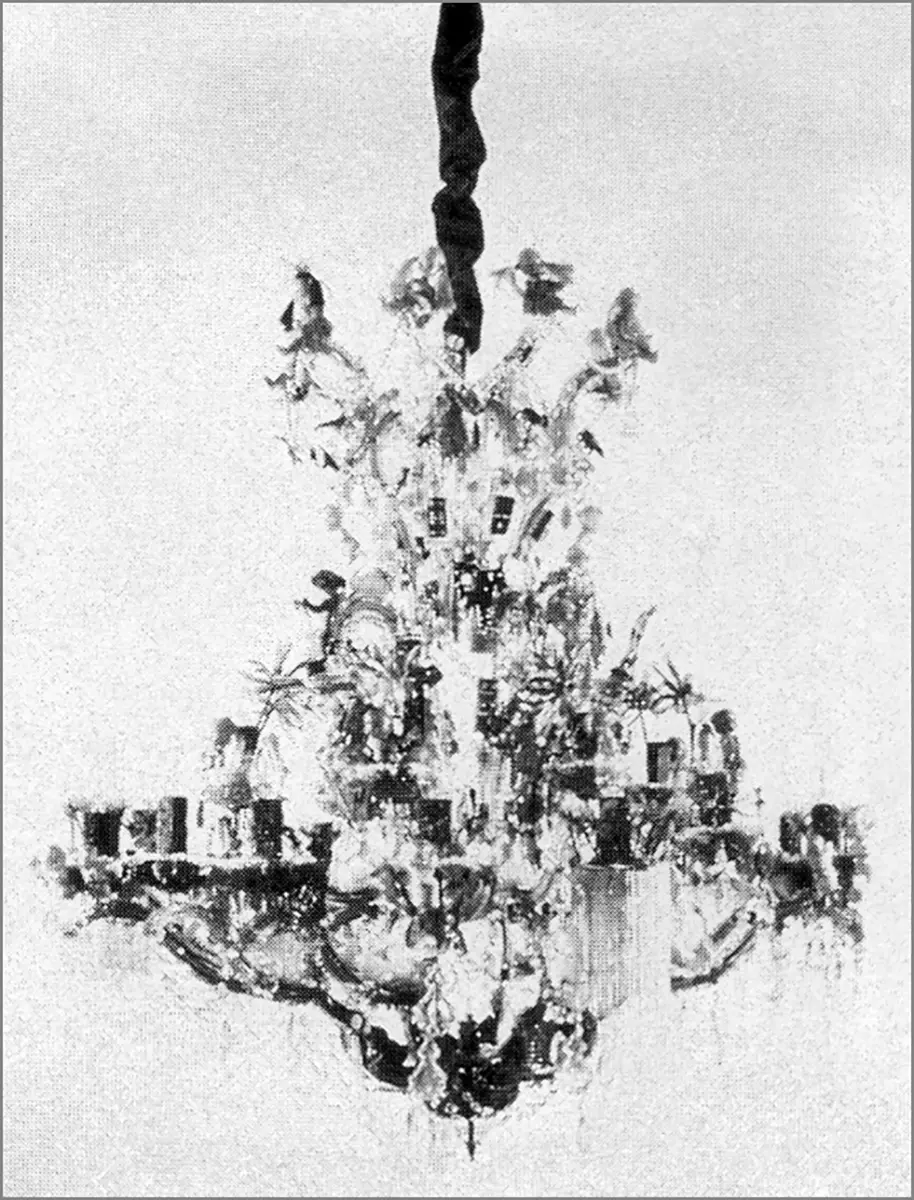
Pepón Osorio is a contemporary installation artist who works in the territories that lie between theater, performance, sculpture, dance, and video. Born and raised in Puerto Rico, found his métier in New York during the experimental decade of the 1980s, when he created elaborately ornate sculptural objects, such as El Chandelier (1988), and transformed found objects, such as A mis adorables hijas (To My Darling Daughters, 1990).1 The artist then became interested in the challenges inherent in site-specific installation art. Two signature works from the early 1990s, The Wake (1991) and Scene of the Crime (Whose Crime?) (1993), set into motion the formal and conceptual directions that continue to engage the artist. Each work struck a cord within the Puerto Rican community in New York. El Velorio / The Wake revealed the ways in which AIDS victims and/or their families suppressed the news of the disease among themselves as well as from the outside world. In creating the simulacrum of a funeral parlor, Osorio recaptured the solemnity of an actual wake. Rows of coffins punctuated the dramatic space and handwritten texts on the walls, carpets, and body bags expressed the loss felt by the loved ones of the deceased. Scene of the Crime (Whose Crime?) exposed racist views of Latinos as perpetrators of crime by the media. In the process of recreating a Latino working-class living and dining room, Osorio visited many families in the Bronx, borrowed their personal photographs, and purchased dozens of store-bought objects to reinvent the decorative arrangements people used in their homes. In recreating a crime scene, the artist worked with two police detectives who investigated homicides.
Osorio’s subjects hold a mirror to diverse social issues experienced as a Puerto Rican who moved to the United States. Working like a cultural anthropologist, with aesthetic goals uppermost in mind, the artist explores ideas by talking with people in his community, listening to their stories, and finally weaving the numerous strands of their conversations into visual form, giving shape to the everyday person’s voice, aspirations, fears, disillusionment, frustrations, and humor. The many layers of meaning imbedded in his work address a range of social issues central to many in his Caribbean—based community who have migrated from the island to the mainland.
Osorio presents his installations first in community spaces —vacant storefronts, taxicabs, a former barbershop, a public library, and a department store— and then exhibits them in museums.2 To accomplish this complex arrangement, the artist collaborates with both non-art community organizations and arts institutions. Most community residents who view the artwork in a neighborhood space are peripheral to art world discourse and programming, and therefore would probably not see it in the museum. During the time the installation is in the neighborhood, residents have opportunities to explore the issues raised and discuss the work as an art form. They can talk to the artist attend workshops on site, and participate in informal dialogues held in people’s homes. Osorio believes that neighborhood audiences, who in many instances are the protagonists of the work, will benefit from the discussions.
Osorio’s projects continue to challenge the traditional role of museums as self-contained institutions involved principally in exhibiting and interpreting objects. In organizing the artist’s dialogues in private and public places and in securing neighborhood venues for the artwork, museums, community organizations, and the artists collaborate with one another. This kind of three-way conversation is becoming institutionalized in the programming of many museums. As a result, Osorio is now cautiously optimistic that museums will continue to develop models in which the arts and practicing artists will help transform education into more active, collaborative, and imaginative programming with constituent communities.
Osorio’s installations since 1994 include En la Barbería no se Llora / No Crying Allowed in the Barbershop (1994); Badge of Honor (1995); El Cab (1997), Las Twines (1998), and most recently Transboricua, 1999. In these he joins together beauty, humor, and bittersweet social consciousness as he constructs and deconstructs images of popular Caribbean culture, exploring masculinity, family relationships, cultural, ethnic, and racial identities, internal racism, and consumerism. The issues also speak to empowerment and disenfranchisement, belonging and displacement, exile, and transculturation.
The experimental nature of Osorio’s community-based work has received broad critical attention in this country and abroad from community organizations, museums, and biennials.3 Over the years many foundations have also supported Osorio’s innovative work through grants and fellowships.4 Most recently the artist received a John D. and Catherine T. MacArthur Foundation Fellowship in the arts. The grant is given to experts who are particularly gifted in their fields.
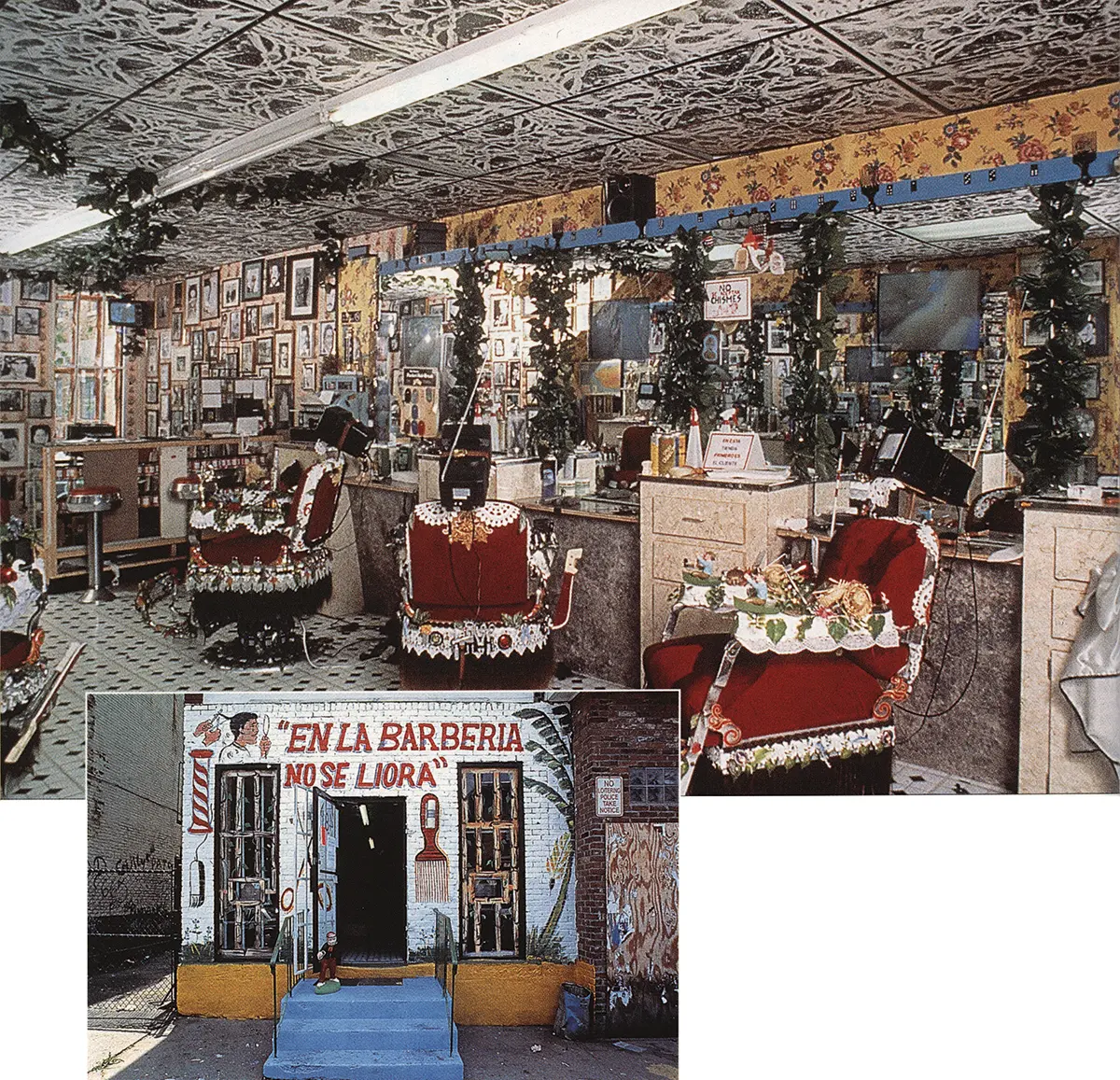
Rooted in Caribbean popular culture, Osorio’s work —both collaborative and individual— shows him working in the boundaries between art and life. En la Barbería no se llora / No Crying Allowed in the Barbershop is a signature piece in which a theatricalized space, excessive detail, and imaginative accumulations of ordinary objects are assembled in an extraordinary fashion. Intended as a critique of Latino machismo, the piece is also filled with many humorous references.
Osorio’s barbershop was commissioned by Real Art Ways5 (RAW) in Hartford, Connecticut, as part of the institution’s public art program.6 In holding meetings with the director of RAW and Latino community leaders, the artist learned about a Puerto Rican neighborhood in the city where gang violence was a central issue. He decided to do site-specific work in the center of that community, which is made up of about one-third of Hartford’s population. He converted an empty, boarded-up barbershop on a busy street in the community of Fog Hollow into a new barbershop where he addressed the subject of machismo in Latino culture. Both the artist and Real Art Ways felt that the art project would create an opportunity for an audience to engage in dialogue over hidden, personal issues relating to the construction of male identity.
It took a month to transform the inside and outside of the old barbershop to resemble the former place. People from the immediate area stopped in to help with the work. When the installation opened, barbers gave free haircuts on the sidewalk. The interior space was full of male iconography. Walls were covered with photographs of Latino men, politicians, athletes, and entertainers who formed a kind of Latino Hall of Fame —one that distinguished itself from the more common representations of Latino men as criminals or lovers. Many images were taken from barbershops in the United States, Puerto Rico, and the Bronx, where Osorio conducted research for the project. The ceiling was covered in a screen-printed, design pattern of blown-up photographs of giant sperm; barber chairs reupholstered in red velvet had screen-printed images of male torsos on them; TV screens, attached to the headrests of the barber chairs, showed men weeping; other screens presented older men telling stories of their past; mirrors in each barber stall displayed photographs of men showing off their muscles and tattoos; mats decorated the tiled floor; a red velour car seat was placed in the corner of the shop, a statue of St. Lazarus on crutches, protector of the ill, in another corner; hundreds of small figures and objects referring to maleness adorned the re-imagined space that also contained small Puerto Rican flags. Male pride was on display.
Osorio’s theatrical space holds memories of his own first haircut at age five. When the young Osorio sat in the barber chair, tears filled his eyes, prompting his father to say, “Men don’t cry.” In the installation, Osorio provided an alternative to that role model through the video images of men weeping silently. Whereas in real life men have traditionally had the dominant voice in social relations, Osorio silenced them. In editing their voices, the artist portrayed the hidden side of their emotional makeup. Images of men crying in the barbershop became powerful reminders of human vulnerability. Those touching scenes of manhood communicated through body gestures subverted the stereotypical notion that men don’t cry. In September the installation moved to Real Art Ways where an art public had the opportunity to come to terms with issues of masculinity.
Within a year of Osorio’s Hartford project, the artist opened Badge of Honor in Newark, New Jersey, a work that examined the effects of imprisonment, crime, and separation between Latino sons and fathers.7 With the utmost sensitivity, Osorio communicated an intimate view of a father and son’s feelings that few ever glimpse.
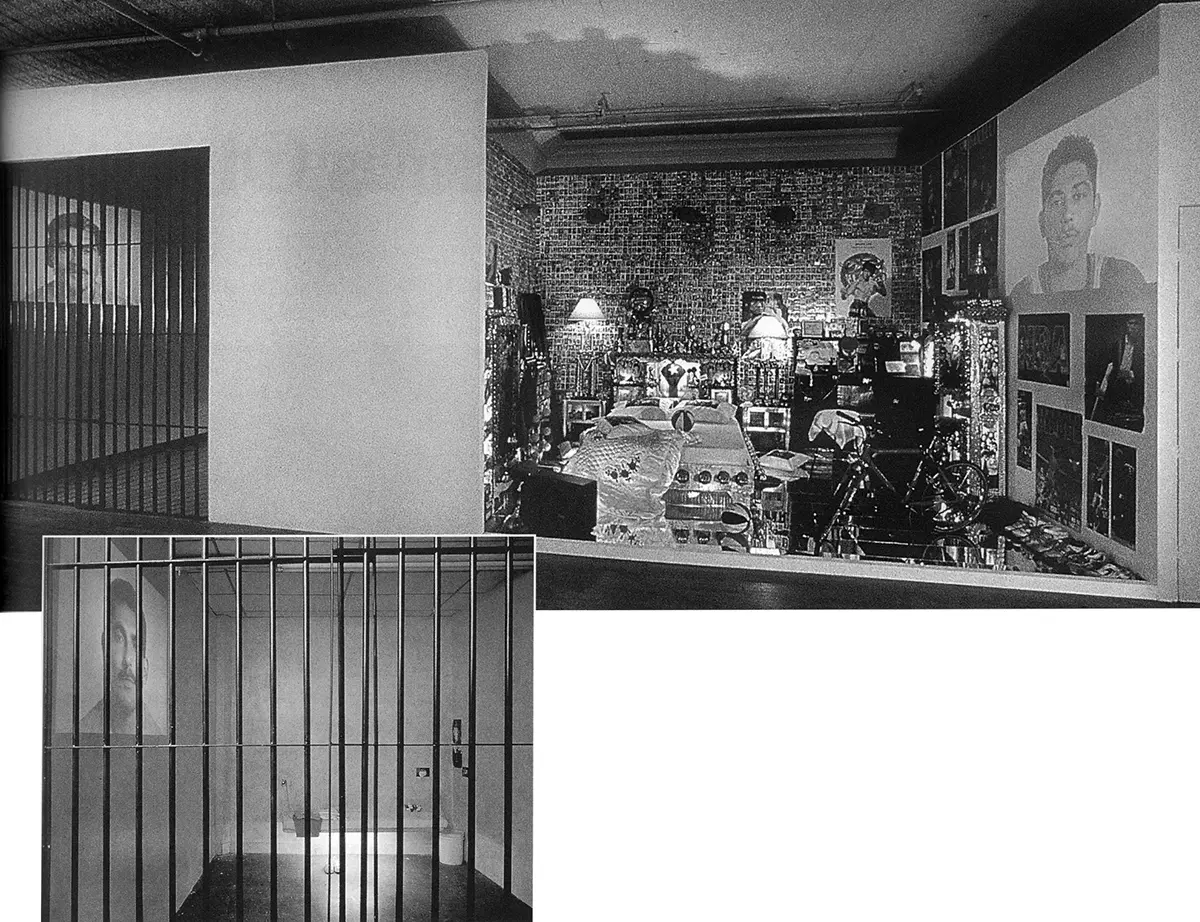
Sponsored by the Newark Museum in collaboration with Aljira, A Center for Contemporary Art, the installation opened in a storefront in a working-class, predominately Hispanic, and African American neighborhood in Newark, New Jersey in the summer of 1995. In the fall the work was exhibited at the Newark Museum prior to its viewing at Ronald Feldman Fine Arts in 1996, and subsequently at the 2nd Johannesburg Biennale in 1997. Osorio developed the piece as an aesthetic inquiry and social probing in consultation with representatives of several social service organizations and community groups to identify important issues for members of the neighborhood regarding appropriate subject material for the exhibition. The artist decided on an artwork that addressed the problem of fathers imprisoned for petty crimes.8 While the installation was in the storefront, the artist held workshops with boys whose fathers were or had been, in prison.
Osorio created two rooms, side by side: one a stark, minimally equipped jail cell, the other a boy’s bedroom crammed with every object a teenager might dream of possessing in a consumer—driven world— kung fu and basketball posters, baseball cards lining the walls, expensive sneakers, balls, a bicycle, a boom box, photos lionizing father figures. The two spaces epitomized the physical and psychological separation between the father and his son. Through a social services agency, Osorio found a father and son who were suffering because of the father’s incarceration. With the approval of each, Osorio interviewed Nelson, Sr. in prison and Nelson, Jr. in his home over an extended period of time. During the process, Osorio played back their responses to questions the artist posed. Each responded in an ongoing dialogue of exchanges that in real life had never taken place. When the final editing of the twenty-two-minute video was completed, two monitors were projected, one on the wall in the father’s cell and the other on the wall in the son’s bedroom. The viewer heard Nelson, Jr. express his profound sadness and resentment over the fact that his father had been jailed many times throughout his young life. In an equally poignant admission, Nelson, Sr. asked his son for forgiveness.
Osorio created El Cab, a moving public art piece that addresses myriad issues from the back seat of seven owner-operated radio-dispatched cars in the Bronx. The artist intended to make a memorial honoring a Dominican livery driver who was murdered and to remind the passengers who traveled in the cars of some of the dangers drivers face in the line of duty. For a month people could call Mega Radio Dispatcher, a private livery service, and ask for Pepón’s art project. The decorated cars became artworks, alternative spaces, and traveling exhibitions.9 The artist rode with the drivers many times to talk about the work and prepare them so they could explain the art and its message to their passengers.
Similar to previous work, Osorio assembled an elaborate array of store-bought decorations, including silk flowers, polyester lace, Dominican flags, ceramic curios, and other objects often found in real life in Latino livery cars. The artist arranged the tableaux on the dashboards and rear windows and integrated them with a video and text that make several points. The inscription on the rear window commemorating the slain driver, known in the company as “Twenty-Nine”, reads, “In memory of Twenty-Nine 1960-1996.” The video features a driver saying, “If I stay here another year, I doubt I’ll be alive.”
Osorio initially decided to do an art project in and related to taxicabs because of the increase in taxi driver deaths in New York. After researching the statistics, he learned that most homicides had been committed against private livery drivers, not yellow cab drivers. He therefore approached the owner of Mega Radio Dispatcher, a company down the street from his studio. There, Osorio learned that a group of the livery drivers was sending money to the family of the young Dominican driver who had been killed. Moved by the personal aspects of the story, Osorio decided to do the artwork in a group of livery cars in which seven drivers volunteered.
While riding with a driver whom the artist had come to know, the driver remarked that he didn’t like to stop for blacks and teenagers because they often refused to pay. The artist reminded the driver that he (Osorio) was black. Recalling the many instances in which taxi drivers refused to stop for him because he was a person of color, Osorio asked the driver if he agreed with those drivers’ actions. When the driver remained noncommittal, Osorio realized he was facing prejudices within his own Latino community, by a person of color who had internalized racism, probably without realizing it. At that moment, the artwork traveling in the real world revealed further issues than it had set out to. As a result, Osorio decided to explore the subject of racism in his next project, Las Twines.
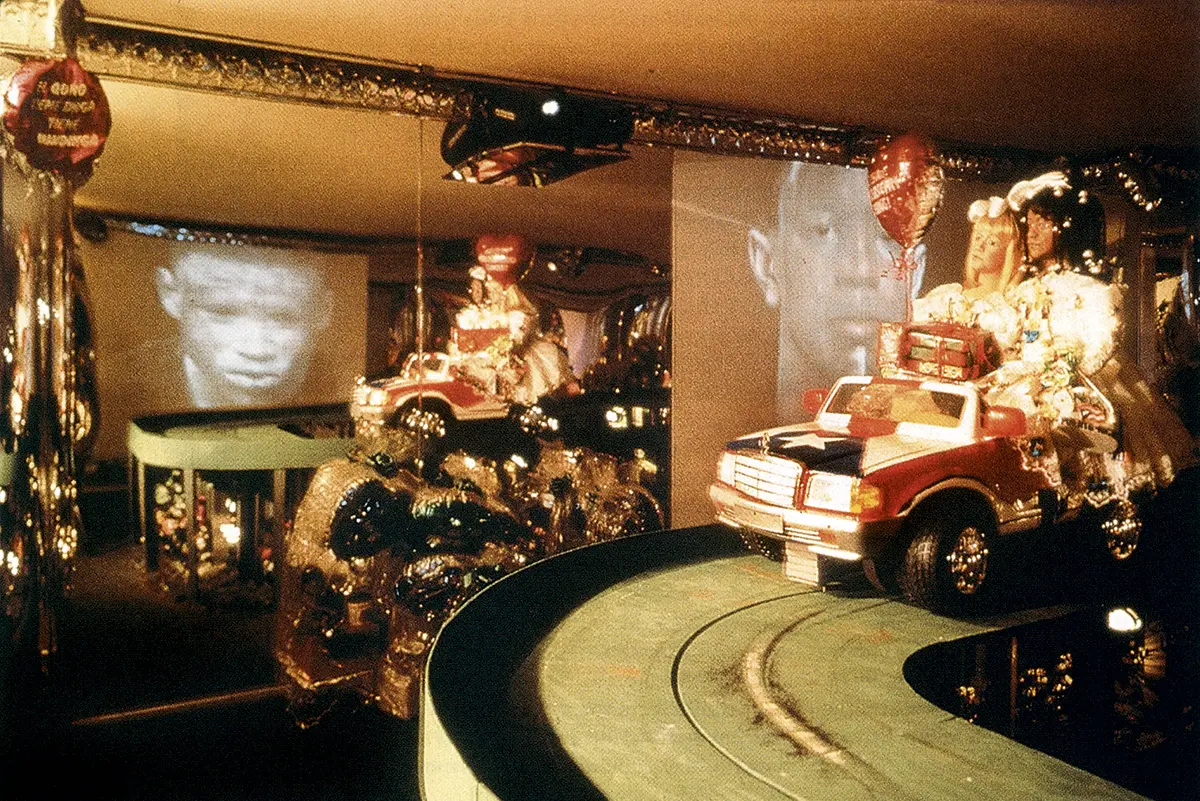
At first glance, Las Twines appears to be a children’s wonderland, filled with dozens of objects —Mylar balloons, toys wrapped in cellophane-that create a sensory overload. Once the eye moves beyond the cacophony of color and texture, it realizes that the visual seduction is carefully crafted to draw the viewer into a serious confrontation exploring sensitive issues of race in the Latino community. The artist’s text establishes the narrative:
"Once upon a time, not far away or long ago, there lived for many years, twin sisters. Adopted at birth after the death of their mother, they lived in fear that one day they would be separated forever. Because of this they vowed to each other always to remain together and to find their natural father. No one remembers their individual names. They were known as Las Twines. While they were identical in every way, one thing that distinguished them was their skin color. For over fifty years the sisters crossed the seven seas, traveled the seven continents, and spent all their days and nights in search of the truth. Everywhere they went they were showered with gifts, for people saw a bit of themselves in Las Twines’ story. Their father never dared to claim responsibility for their existence. People say that even today you can see them in the early morning hours walking through the streets and calling for Papa."
The installation featured twin girls, one white and the other black, riding in a toy car on a track, calling out, “Papa.” On three surrounding walls video projections present four young Puerto Rican men whose faces were painted either black or white. In a ritualistic manner, each man repeatedly washed the paint off his face and shook his head in a sign of disbelief, unable to imagine himself in another skin color and unwilling to accept the paternity of the twins. The multitude of objects in the corners of the room that provided a festive environment were layered with references to internal racism within the Latino world. The artwork took form after the artist had held extensive discussions, meetings, and workshops on the subject with youth and their families through a social organization in the Bronx.
Las Twines was first seen in a converted storefront in the Bronx, a few blocks from the artist’s studio in the summer of 1998. Many young people from the neighborhood who had participated in the workshops also participated in the videos as models for the twin girls and as docents for the installation.
Pepón Osorio’s most recent installation art, Transboricua, contributes to our understanding of the ways we, as multicultural people, perceive ourselves within our own narrowly defined communities as well as beyond them. The visually inventive and arresting artwork raises questions, from the artist’s perspective, about changes many people experience regarding their own cultural identities either as newly arrived residents or first or second-generation citizens. The idea came from Osorio’s perceptions of his identity shifts as a Puerto Rican from the island to a Nuyorican (a term often used for a Puerto Rican living in New York) to a Latino in the United States. Transboricua is an invented word that the artist defines as coming to terms with being a Puerto Rican from the island as well as coming to terms with seeing himself as a Latino in larger cultural contexts. In the process of transculturation, Osorio negotiates the many views of himself as he continues to accommodate, adapt, and expand his cultural position vis à vis the larger, diverse Latino community that is also redefined by ongoing changes in immigration patterns. Although Osorio’s negotiating process is specific to him, that process resonates across diverse cultural boundaries, engaging diverse audiences in compelling ways.
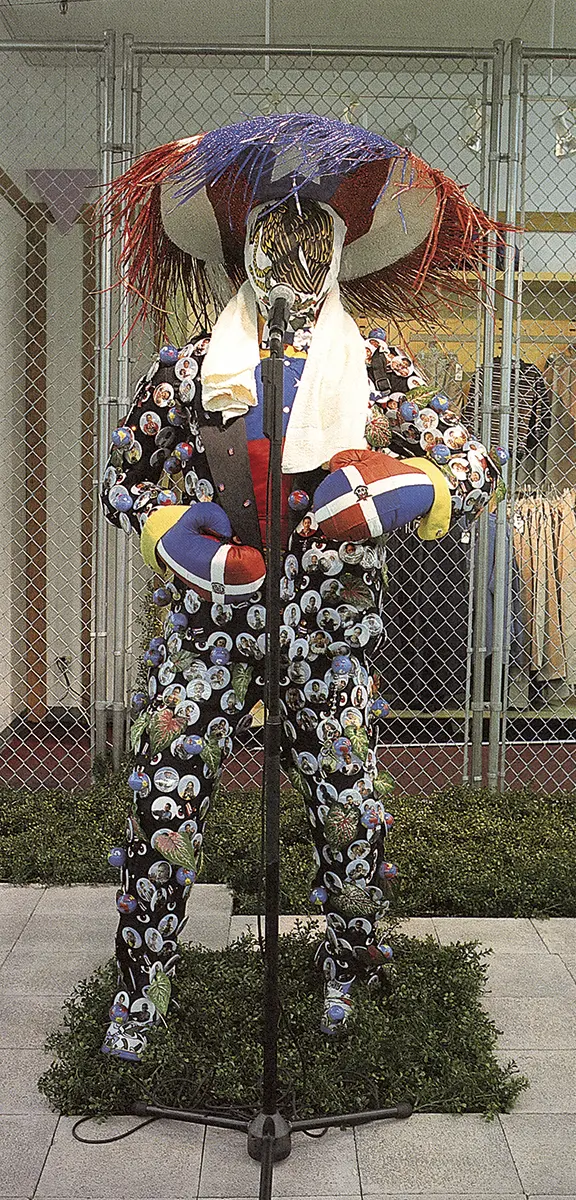
Transboricua combines sculpture, photography, video, and an elaborate array of found as well as handmade materials. The multimedia piece features a sculptural figure of a tall man standing in the center of a fenced-in area that is guarded by a stuffed peacock. The composite figure is partially identified as Puerto Rican by his hat, known as a pava in Puerto Rico, and the small Puerto Rican flags covering his suit. The figure’s body and clothing bear the names and images of many Latin American countries, references to a larger Latino identity.
To embody a metaphor for the future, Osorio covered the figure’s suit with large buttons or badges of headshots of youngsters with their eyes closed as if in a dreamlike state. The open and closed eye motif, explored in the video projection visible from within the figure’s backpack, shows a youngster alternately opening his eyes to reveal two rotating globes, and then closing them. The images of eyes on the appliqués, buttons, and video suggest the here and now when open and the future when closed and imply the question of what ethnic and cultural configurations will define the children’s world in the next millennium.
The artist raises an additional concern regarding people’s inclination to protect their territory —home, street, or neighborhood— by fencing it in. In Transboricua, the “mutant Puerto Rican” (as the artist refers to him) is enclosed by a chain-link fence. Questions arise: Who has access and who is denied it? Who is allowed in and who is not? Osorio raises the thorny question of ownership, and thus possession, by giving out keys to a selected group of people. Although the fence will remain locked throughout the exhibition, visitors can see the entire work by walking around the outside of the fence. Through its presentation, viewing audiences are invited to consider numerous issues raised by protective barriers.
Transboricua was commissioned by the Rhode Island School of Design Museum of Art and the Providence Public Library as a collaborative art project, Art ConText. Following the Providence venues, the Transboricua project traveled to El Museo del Barrio, an institution founded by Puerto Ricans in East Harlem thirty years ago. El Museo was an especially important venue for the artist’s work because the issues in Transboricua reflect those that continue to engage the institution in its ongoing examination of its role in the Puerto Rican community of East Harlem and beyond to the larger Caribbean, Latin American, and Latino communities in the United States.
In preparing for Transboricua’s installation at El Museo del Barrio, the artist collaborated with the head of Community Education and Outreach in planning a series of public forums and informal gatherings (tertulias) at the homes of residents in East Harlem’s El Barrio to discuss issues raised by the artwork. In keeping with the artist’s intentions, the informal discussions involved a cross-generation of people from diverse educational, professional, racial, and cultural backgrounds, including Puerto Ricans, Nuyoricans, other Latinos, and non-Latinos. The tertulias provided opportunities for the artist and neighborhood residents and friends to exchange their deeply held views on ethnic, national, or island identities as well as on gender and race as these factors formed their perceptions of self. At the conclusion of the tertulias, the work was installed in a department store in East Harlem, where customers had the opportunity to see the artwork in a retail setting. In that setting, shopping viewers might have been seduced to think about the economic aspects of their collective identity as Latinos in the United States in light of the fact that their purchasing power reaches $420 billion a year.
The different responses evoked by Osorio’s work depend largely on the contexts or locations in which his art is seen. In community spaces, residents and visitors can validate their cultural identities, reconsider perceptions of self, and see themselves as active participants (or actors) in everyday life. In the museum, where the work takes on different meanings, viewing audiences who take the time to consider the many meanings layered in the work will not only have an opportunity to learn about other people, but likewise, they will also an opportunity to learn more about themselves. For, in the final analysis, those are the directions in which Osorio’s brilliant creations lead us.
Osorio’s installations are located in the larger contemporary developments of installation art as it evolved in the 1980s and 1990s, drawing on disparate media, from painting and sculpture to performance and video. Installation art generally incorporates a physical site, makes a connection to real conditions —be they visual, historical, or social— and often bridges traditional art boundaries. Artists working with installations often work outside the museum walls in site-specific locations. Few, however, work as closely with specific communities in redefining the boundaries of installation art, as Osorio. Equally important, Pepón Osorio continues to hit an aesthetic high ground time and again, giving it all he’s got.
NOTES
1. The artist was born in 1955 in Santurce, Puerto Rico. In 1975 he came to New York to work and attend college. He lived in New York until recently when he and his family moved to Philadelphia.
2. In 1993 after completing Scene of the Crime (Whose Crime?), the artist decided to show his work in the Latino community before exhibiting it in a gallery or museum.
3. Since Osorio’s retrospective at El Museo del Barrio in NewYork in 1991, his work has been exhibited nationally and internationally, including The Whitney Museum of American Art Biennial 1993; the 2nd Johannesburg Biennale 1997; and the VI Bienal de Cuba, Havana 1997.
4. A partial list of prestigious grants includes the New York Dance and Performance Bessie Award, 1985; the National Endowment for the Arts Sculpture fellowship, 1988 and 1995; Pollock-Krasner Foundation Fellowship, 1988-1989; Theater Communications Group & National Endowment for the Arts Fellowship, 1990; Louis Tiffany Comfort Award and Lila Wallace Arts Partners International Artist Program, both in 1993; Joan Mitchell Foundation Artist's Fellowship and International Association of Art Critics, both in 1996; Cal Arts/Alpert Award for Visual Arts, 1999.
5. Real ArtWays is a presenter of new and innovative art with programs in visual arts, performance, music, film, and video. It facilitates the creation of new works of art connected with the region and receives funding from many foundations.
6. Several fine essays and articles were written on Badge of Honor. See Berta M. Sichei, "Pepón Osorio: The Theatricalization of Space," and Luis Aponte-Pares, “Art and Everyday Life in a Latino barrio," in Badge of Honor (Newark, NL. The Newark Museum New Installation," Journal of Contemporary African Art (Fall/Winter 1996): 10-11.
7. David Reisman's essay, “Badge of Honor," Texte zur Kunst 6 24 (November 1996): 171 begins with these sobering facts: "In the past two decades, the prison and jail population has increased from 480,000 to 1.3 million between 1980 and 1993. Most of the incarcerations are for nonviolent crimes, many of which were drug-related."
8. Amei Wallach, "Roving Taxis with a Message Told Through Art," The New York Times (Arts & Leisure), Sunday, February 16, 1997 (Section 2).
9. Ronald J. Onorato, “Blurring the Boundaries: Installation Art," in Blurring the Boundaries: Installation Art, 1969-1996 (San Diego: Museum of Contemporary Art, 1997), p. 13.
*All images are courtesy of Ron Feldman Fine Art, New York. 1996; Olu Oguibe, "Olu Oguibe on Pepón Osorio's ".
JULIA P. HERZBERG
As consulting curator at El Museo del Barrio, Dr. Herzberg organized the exhibition Pepón Osorio: Transboricua which was on view from September 1999 through January 2000. She has written about and curated many exhibitions of contemporary Latin American and Latino artists.