
These pastels by Ricardo Maffei (Santiago, 1953) immediately evoke a world of silent contemplation. His stylistic reference is classical realism, coupled with an impeccable technique. That a contemporary artist should select realism as his means of expression poses many risks: that of being seen merely as a good, skillful technician, or as someone whose art is reminiscent of the Academy or a historical posture which deliberately keeps its distance from anything avant-garde. The photorealism or hyper-realism of twenty years ago does not seem to inform the work of this Chilean artist, who escapes the usual definitions of this category. He has said that he is not interested in realism as such but uses it to encourage the spectator to see beyond appearances.
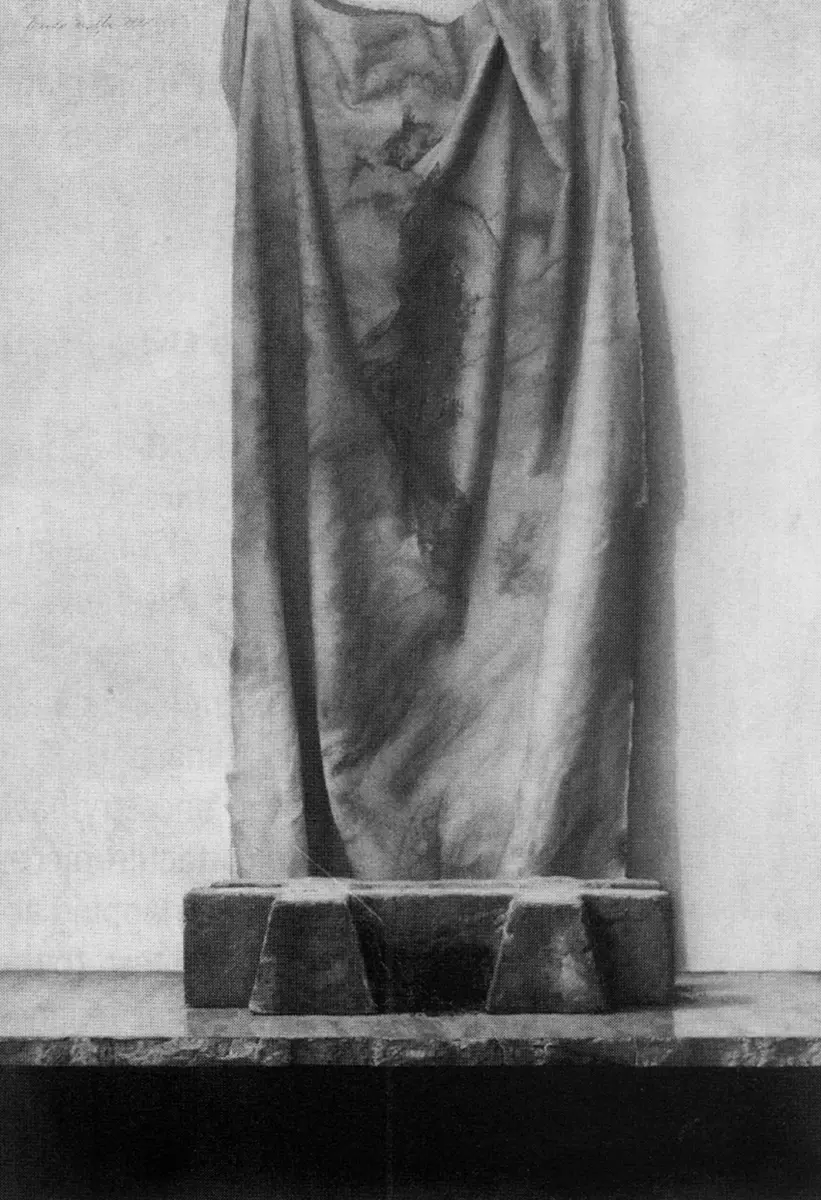
There are as many different kinds of realism as there are practitioners, writes Edward Sullivan in the exhibition catalog. And he is right. In the unusual case of Maffei, the first thing that we note is that the supposed reality to which his work refers is also a creation of the same artist. Maffei works with models that he assembles. His realism is not of the ordinary kind, but rather a sort of painting based on models invented by the artist himself. His invention of the models appears to overcome the simple arrangement or traditional classification in the sphere of still-life painting. Even his nudes with real models acquire unusual meanings, thanks to the spatial treatment to which he submits them: a slightly crumpled grey fabric covering a female body, or stagnant, still water in the lower plane of a fragmented male nude advancing in profile. Mattei’s pastels are not segments of what we normally understand as reality: they are plastic elaborations of a reality invented by the artist. So his realisms are in fact illusions, and in this sense, his work moves away from the various types of realism found in the twentieth century.
These paintings use their supports to create plastic worlds that transcend the simple objects that make up his compositions: a ceramic bowl, a broken paving stone, a piece of folded or hanging fabric, a rivulet of pigment, and a stone.
Almost all the compositions are constructed with a minimum of protagonists, with a well-established hierarchy that centralizes the main figure in the scene. In fact, we can read these pictures as scenarios: there is a plane that provides support, in most cases frontal, and another in the background, in the form of a wall, a board, a piece of cloth or fabric that fixes the space and depth within a visual distance that seems to be tangible. Within this angle, the chosen object or objects are presented. The spaces are intimate and secluded. Only very rarely do the pictures have any lateral limits. The space flows before our eyes in this dimension, towards the sides, emphasizing the centralized object it contains. Thus the stone or the box acquires an iconic and powerful force. And the narratives with which we usually associate them no longer apply. This ability to generate unexpected narratives explains to a large extent the fascination that these pictures exert over the spectator.
Maffei handles color on the basis of tensions. He exalts it by transforming it into the matter of a specific object giving it nuances and making it resonate in both the support and background planes. The pastels are dense and saturated; they evoke concrete surfaces that bear no trace of the creative process. The artist is interested in the peculiar qualities of each surface, the thousand and one complexities generated by light falling on a specific body, but without this aspect becoming a protagonist in his work. Here are his painted objects, and the quality of their presence, which seem to evoke a secret reality, a substance that endows them with a life of their own. In this way, they become disturbing, without being suggestive in any way of a surrealist approach. Like magical words that contain meanings we barely discern, or the essence of what is real and which most of the time we do not see.
MARÍA ELVIRA IRIARTE