
Desmothernismo brings together works from the period 1990-1998 when Rubén Ortiz Torres (Mexico City, 1964) arrived with a Fullbright scholarship to study at the California Institute of the Arts (CalArts) in Valencia, California The works are done in a variety of very different media such as painting, collage, video, photography, small format sculpture, installation art, found and manipulated objects.
Desmothernismo is a word that does not exist in Spanish: it is a neologism, based on an English “translation” of the word desmadre, a key concept in the Mexican vocabulary, and retranslated into Spanish in an intelligent wordplay that implies a throwing back or dismantling of modernity (del modernity). The title summarizes the essence and main thread of the work. The spectator enters a place in which Mexican and North American cultural symbols from the past and the present are completely fused, without either culture dominating. The list of works is varied and comprehensive, as will be seen in the following paragraphs.
The first pieces in the show were large placards or canvases done with an airbrush, in a direct allusion to Chicano murals that are used to mark out the territory of the different gangs that exist in the frontier cities. The works were commissioned by the artist and produced by Ricardo Torres. The large format canvases, like collages, show figures from the imaginary of both worlds, in an interplay of recognition between heroes and traitors, who are sometimes so difficult to differentiate.
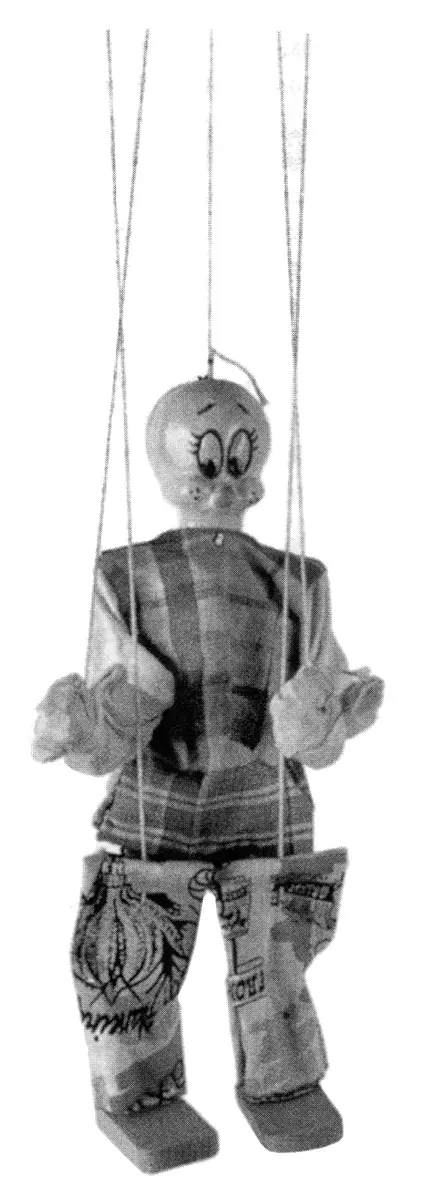
The paintings were from the CalArts Portraits series of 1993 and consisted of the portrait of John Baldessari by Rogelio Peralta, and other figures, commissioned by the artist to produce portraits of workers of Latino origin. Espécimenes de Ia raza cósmica/Aliens of exceptional ability, from 1998, consists of artisanal puppets made on the Mexican frontier, of figures from Anglo-Saxon mass culture, such as Piolin, Darth Vader, the Ninja turtles, and the Power Rangers. The figures are dressed in clothes that in no way correspond to the characters they represent. The found objects collected by Ortiz Torres were presented along with the respective portraits painted in oil on canvas. The pieces entitled Bart Sánchez and Pachuco Mouse, both from 1991, show Bart Simpson and Mickey Mouse with outfits taken from Mexican stereotypes painted in a cubist style.
The installation entitled Breaking the Mayan Code, Guatemala, 1995, was made up of a closed-circuit TV, a model of the Tikal pyramid, a monitor, and a projection. The small monitor, placed outside the room, transmitted the image taken by the closer circuit camera of the model of the pyramid, which was inside, with a fixed view of the real pyramid projected above on the wall, including the tourists climbing up it to look at the landscape.
Alien Toy, 1997, consisted of a small plastic “E.T.” sitting on the ground and looking at a monitor with the image of a puppet of an extra-terrestrial dancing against a changing background, combined with images of a vehicle, directly influenced by the Low Riders, and constructed in collaboration with Chava Muñoz. To the rhythm of the music, the component parts of the vehicle unfold in a kind of dance.
The small format sculptures from 1998, entitled Che/Chevy, Convertible Spaceride, and Mothership with Daytons, are models of imaginary vehicles with retro spacecraft features. Inside the intervened objects, there is a collection of baseball caps with modified texts or emblems that radically alter their meaning and purpose. For example, in one of the caps with an ‘X’ and colors representing Africa, symbolizing Malcolm X, the ‘X’ was transformed into the ‘X’ of MeXico.
Fronterilandia/Frontierland, a film produced in collaboration with Jesse Lerner in 1995, offers a tour of frontier culture in a profound reflection on how culture is alive, created, and transformed every day. Throughout the 56 minutes of the video version, various stories are told. One of them concerns the Californian architectural style and the way it was introduced by the conquistadors, adopted by the rich and famous of Hollywood, and then copied in the 1940s in the new and elegant districts of Mexico City, such as Polanco and the Lomas de Chapultepec. Another thread in the film concerns Chicanos who claim East L.A. as the location of Aztlán (the place from which the Aztecs went towards central Mexico) and a sort of promised land. As the stories unfold, the spectator begins to wonder if it is the Mexicans who are learning to eat hamburgers or the Americans who eat tacos.
Nineteen brilliantly colored photographs, probably Torres’ most well-known works, show scenes of Central America, Mexico, and the United States, all chosen to illustrate this cultural fusion. Examples include the Statue of Liberty shown on a human scale on the patio of a primary school in Guatemala, the four members of the Morsa group imitating the Beatles in Mexico City, and SombreroTowers in Dillon, South Carolina, amongst others.
By incorporating into his artistic practice works done in collaboration with other artists and producers, Ortiz Torres distances himself a little from the idea of the artist as a hero or total creator, and by not taking full credit for the pieces. This attitude is repeated in his re-utilization of elements such as baseball caps which, merely through the addition of some design element, cease to be inoffensive and become the communicators of ideologies.
The shifting meaning of the symbols resulting from the decontextualization is a key feature of these works. By presenting Bart Simpson as Bart Sanchez, disguised as a Mexican revolutionary with a cartridge belt and painted in the cubist style, Ortiz Torres is not playing with or casting doubt on the cultural value of these symbols, but combining them as a result of a contemporary culture permeated by influences from both the past and the present, as well as by both locations. Ortiz Torres identifies and focuses on certain examples from a society that is inventing its own identity, without wanting to separate itself too much from its sources or to feel alienated. The constant interplay of representation and the translation of one plastic language into another, with the result varying according to the support, is one of the most frequent and recurrent techniques in the works making up Desmothernismo.
Rubén Ortiz Torres shows in this body of work that he is an artist who has assimilated the history of twentieth-century art and has been able to put it to work for his own benefit. We might trace the various influences or models, from Duchamp, with his found or intervened objects, along with the inevitable Picasso and the cubist style, the appropriation techniques so characteristic of the 1980s in the work of artists like David Salle and Sherry Levine, the use of popular icons characteristic of pop art, as well as the “commissioning” of works from others, as in the case of Jeff Koons. Desmothernismo is, therefore, an exhibition of work by a multifaceted artist who uses various means to express his ideas but whose research never loses its focus.
FRANCISCA RIVERO-LAKE