The situation of the country as seen through the work of contemporary Colombian artists was the central focus of this exhibition. The artists were well-chosen: in addition to their knowledge of imagery and handling of materials, their works have always reflected their concern with the country, and the extent to which this has been one of the goals of their art. These artists who live in Colombia as an “act of faith”, not without its irony, know that their sensibility is inextricably linked, for better or worse, to the fact of living amid contradictions.
The temporary premises of the Valenzuela and Klenner Gallery, where contemporary Colombian art has been presented for six years, are located in a one-story house. They are lit with natural light filtering through windows covered with material that looks like rice paper. Temporary premises that are six years old are characteristic of the country, where most galleries have closed. Those that remain are promoting a more complacent kind of art, with very few inquiring into what is happening with the arts and the artistic context at the dawn of the much-touted new millennium.
On the walls of one of the rooms, the work of Miguel Ángel Rojas entitled At the other side demonstrated, from the outset, that the status quo remains unchanged. A country is depicted like a huge hacienda devoted to a single crop, with its overseers wearing sombreros and looking into the horizon (though in this case speaking English and saying “Go on!” like in any Western). A landscape constructed with dried coca leaves, cut into small identical circles and stuck on the wall. A perfect atmospheric perspective was created by the subtle change in the color of the leaves.

Beatriz González has for some time been using a technique characteristic of the great masters of painting like Vermeer and Gauguin and the most experienced writers: this is the small bodily gesture that reveals emotion with one glance of the eye and little else. In one of her earlier works, a woman covers her face with her hands and this gesture, accompanied by an almost imperceptible languishing of the head, depicts sadness itself. In the work included in this show, all the elements of the image contribute to expressing the presence of pain. It was a work on untreated canvas, with edges of black fabric, installed almost at floor level, with an essentialist charcoal drawing of women’s bodies dragging themselves along, repeated in a kind of frieze, denouncing events that are being forgotten. The work was entitled All the Women Died Carbonized.
The work of José Alejandro Restrepo reflects his interest in the use culture gives to images. In this piece entitled Iconofllia and Iconoclastia, the artist expresses concerns about two basic questions that have always been secret in our society. These are the questions of sex and power, which when reflected in images, are not treated as secret, but are subjected to violent censure. In the video, the artist decided to bring out from this world of secrecy “sweet images”, as the text says, of Cicciolina who, it will be recalled, proposed vis-á-vis politics to bring the female body out of the darkness and secrecy in which it had been kept for years by culture. Restrepo also highlighted, in images that immediately followed the “sweet and beautiful” pictures of Cicciolina”s body the massacres and censorship that power imposes on the images of violence in the country.
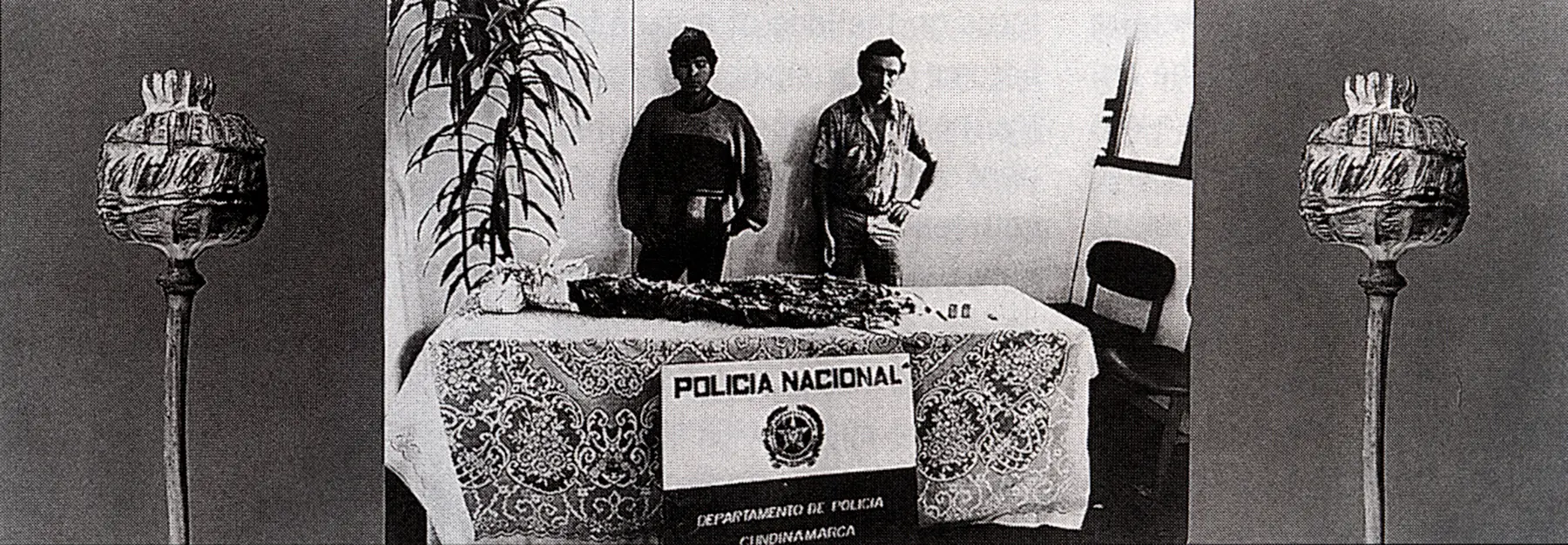
If the goal is to examine the state of a situation, as was the case with this show, an index, which is a visual catalog of the contents of something, becomes indispensable. Juan Fernando Herrán uses this device in a seemingly objective manner, but the relationship between the images in itself gives it a symbolic dimension. His work, Judicial Triptych consists of an archive photograph illustrating an instance of delinquency, accompanied on either side by photographs of the calyx of the poppy flower. Its ingenuous and beautiful form is like some art nouveau sculpture. Once again, we are confronted with a status quo that has in this respect not changed for centuries, and which concerns a condemned flower and all the judicial procedures arrayed against it, also for the purposes of condemnation. Of whom? The question is without an answer. Once again the flower becomes a centuries-old metaphor of condemnation, the condemnation of those who are the least deserving of blame.
In a similar vein was the work by Adriana Arenas, entitled Football 1979. This consisted of a mural photograph of the Pereira football team, in which she appeared as a mascot when she was a child. It must be remembered that at this time in the country, football was hot news because of its supposed links to large amounts of underground capital that financed it. The image of this little girl, no more than ten years old, dressed as a football player alongside her idols, questions the way the public redefines the private, and how the global context redefines what is local.
Wilson Díaz, in explicit small format paintings of ordinary figures in ordinary places in cities like Cali, and in conversations with the same kinds of persons recorded on a video, explored how people who live an anodyne reality, with repetitive work, seek refuge in simpler but the same time unrealizable dreams. The people interviewed compared everyday life with their expectations, and in this index of the life of ordinary Colombians, we can hear, for example, “I gave up my career as a woman writer, but I write to win a competition.” or “After working all day, I want to investigate something which I never knew anything about.” The conversations revealed that ordinary life is so rigid that it is better to think that reality is elsewhere. This focus on the idea of escape has become characteristic of the country. The work was called An accident can happen to anybody, and with tenderness rather than with irony the artist leaves the reading of the work open as if hope springs eternal and is, as people say in this country, the last thing we lose.
NATALIA GUTIÉRREZ